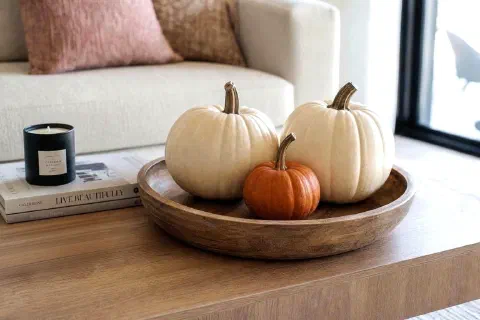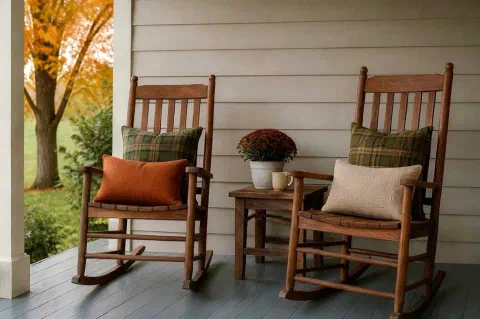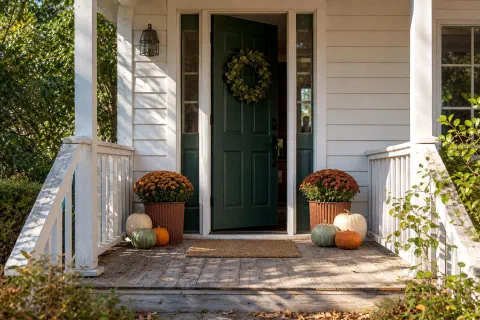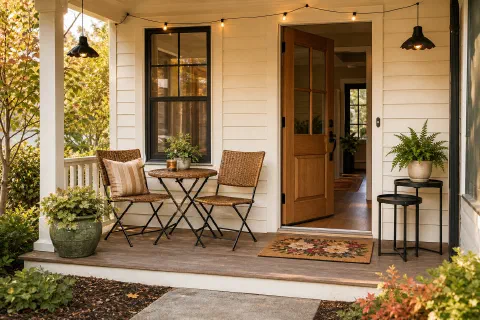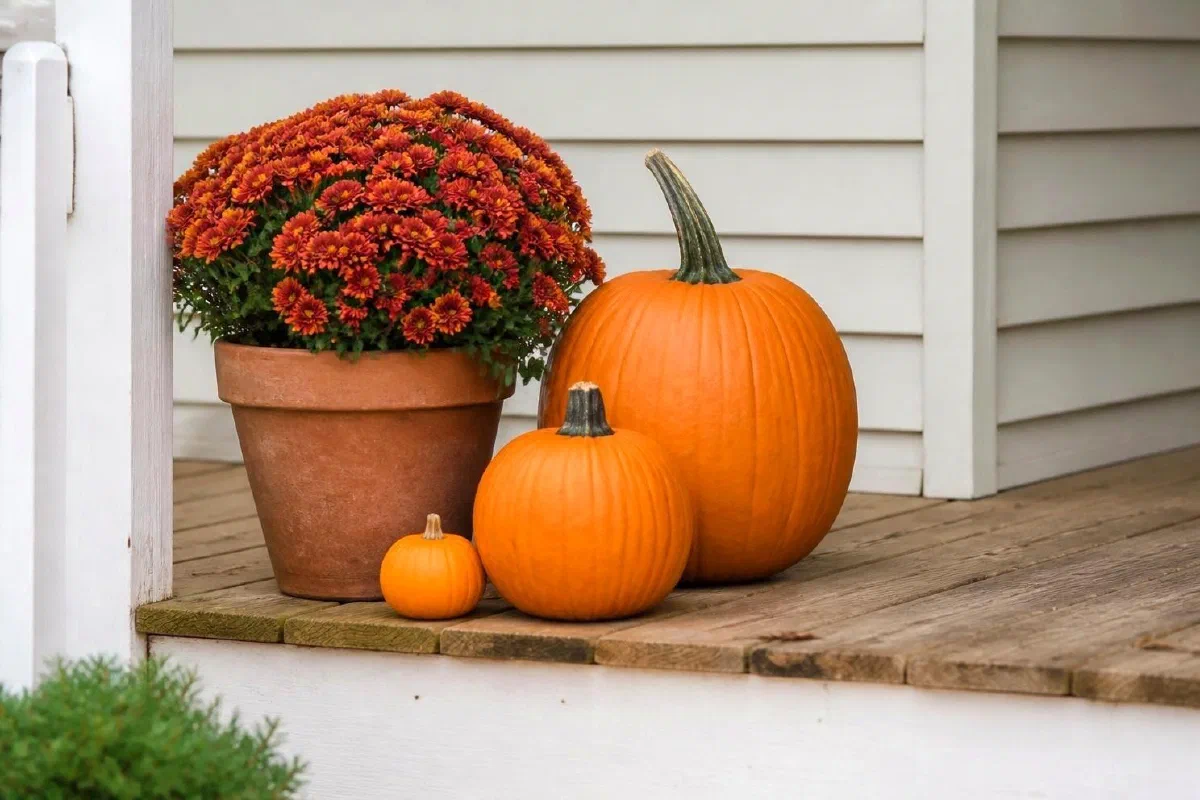
The pumpkin bin at the front of the grocery store is almost entirely one size. Arkansas Extension calls it the medium jack-o’-lantern class, 10 to 20 pounds, and it is what the word pumpkin means to most people. Buy three of them, line them up on the steps, and you have three pumpkins sitting on some steps.
That is the failure behind most front porch pumpkin ideas, and it is not budget. Every pumpkin is the same size, so the eye reads a row of repeated objects instead of one arrangement.
Fix the sizes and the count first. Start with the doormat and the mums instead, and the row is still a row.
How Many Pumpkins a Porch Needs, and Which Sizes to Buy
Three pumpkins in three clearly different sizes is the answer for one step, five to seven for a small covered porch, and odd numbers always, because an even group invites the eye to pair it off and hunt for a center that is not there. Sizes come first, though, because that is the decision you make in the parking lot and cannot undo at home. Pumpkins are sold by weight class, and the classes are more distinct than they look in a bin. Here they are, from the University of Arkansas Cooperative Extension Service , with the porch job added:
| Size class | Weight | Cultivars on the sign | What it does on a porch |
|---|---|---|---|
| Miniature | 1 pound or less | Jack Be Little, Baby Boo, Wee B Little | Rail tops, ledges, filling the gap at the base of a group |
| Small and pie | 3 to 6 pounds | Baby Pam, Orange Smoothie, Hijinks | The workhorse. Sits on a step without taking the step |
| Medium jack-o’-lantern | 10 to 20 pounds | Spirit, Autumn Gold, Magic Lantern | The anchor on a small porch. One is usually enough |
| Large jack-o’-lantern | 20 to 40 pounds | Howden, Connecticut Field, Gold Rush | The anchor for a full staircase. Two hands to move |
| Specialty | Varies | Casper, Lumina, Jarrahdale, Long Island Cheese | Color and texture, covered below |
Buy three distinct sizes and make the jump obvious. A medium carving pumpkin runs roughly a foot across. The next one down wants to be noticeably smaller, so a small pie pumpkin at 6 or 7 inches, then a miniature at 3 or 4. Sizes two inches apart do not read as variety. They read as one size where one got dented.
Odd numbers, and count the group rather than the porch. Three in a cluster, five in a cluster, seven across two clusters. An even number sitting together invites the eye to pair them off and hunt for a center that is not there.
| Porch | Total pumpkins | Shape of the display |
|---|---|---|
| One step and a railing, 2 to 3 feet usable | 3 | One cluster, hinge side of the door |
| Small covered porch, one or two steps | 5 to 7 | A cluster of 3 by the door, a pair on the bottom step |
| Three to five steps | 7 to 11 | Two or three clusters, staggered left and right |
| Full staircase, six steps or more | 11 to 15 or more | Clusters every second or third step, alternating sides |
On a staircase, group them. One pumpkin per step at even intervals turns a staircase into a fence. Put three on the second step at the left rail, skip a step, two on the fourth at the right rail, skip, then one at the top. The gaps do as much work as the pumpkins.
How a cluster is actually built. Largest at the back, tucked where the riser meets the rail. Medium in front and off to one side, roughly 45 degrees rather than dead center. Small in front, touching or nearly touching the medium. In a group of five, the extra two go behind and half hidden so the pile has depth instead of a front row. Pumpkins that touch look like a group. Pumpkins with three inches of air between them look like they were unloaded.
Leave the walking lane alone. Keep a path someone can carry a laundry basket through, and keep the door swing empty. A display that gets nudged aside daily gets nudged aside permanently.
How to Set Up a Small Porch or Apartment Stoop
Plenty of readers have one concrete step, a metal railing, and about two feet of usable width beside the door. That is a real porch, and it does not want a shrunken copy of the staircase version. It wants one vertical stack of interest instead of a spread.
- Pick the hinge side of the door, the side it opens away from. That is the only part of a small stoop where something can sit without being in the way.
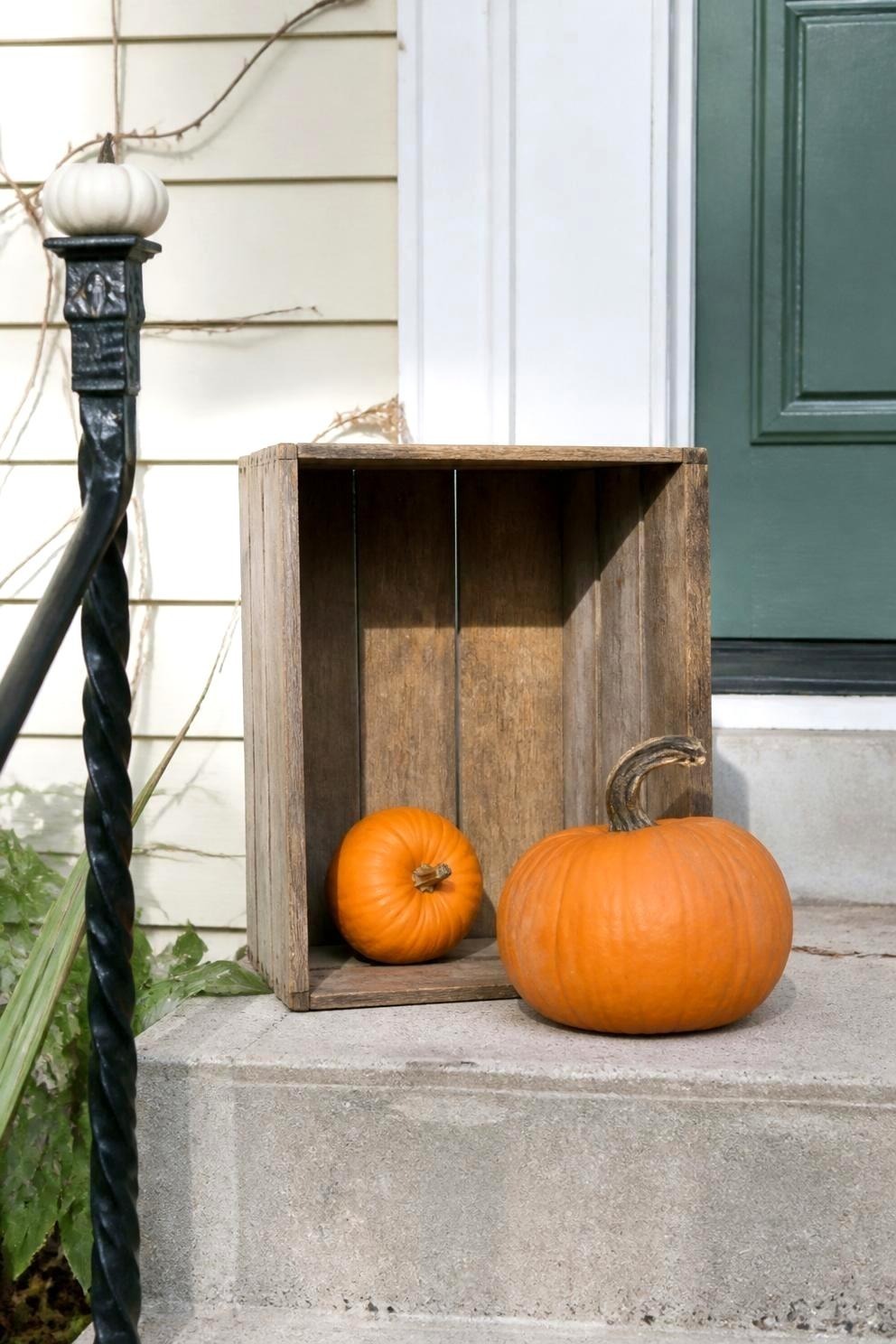
- Set one riser, 8 to 14 inches tall. An overturned wooden crate, a low stool, or two bricks with a board across them. This is the move that makes a small stoop work, because it buys height without buying floor.
- Put one small pie pumpkin on top of the riser. Not the medium. A heavy pumpkin on a crate looks precarious even when it is not.
- Set the medium pumpkin at the base of the riser, pushed against it so the two shapes overlap from the sidewalk.
- Add one miniature at the front corner, plus one on the railing cap if the post is wide enough.
Three pumpkins, or four with the rail, in about 18 inches of width. It reads from the street because the riser gave it two levels, and on a west-facing stoop it also keeps the pumpkin off hot concrete.
Rot is the real enemy, and it is mostly preventable
A display fails one of two ways. It looks wrong on day one, which is the sizing problem above, or it looks right for two weeks and then something is leaking onto the step. The second one is avoidable.
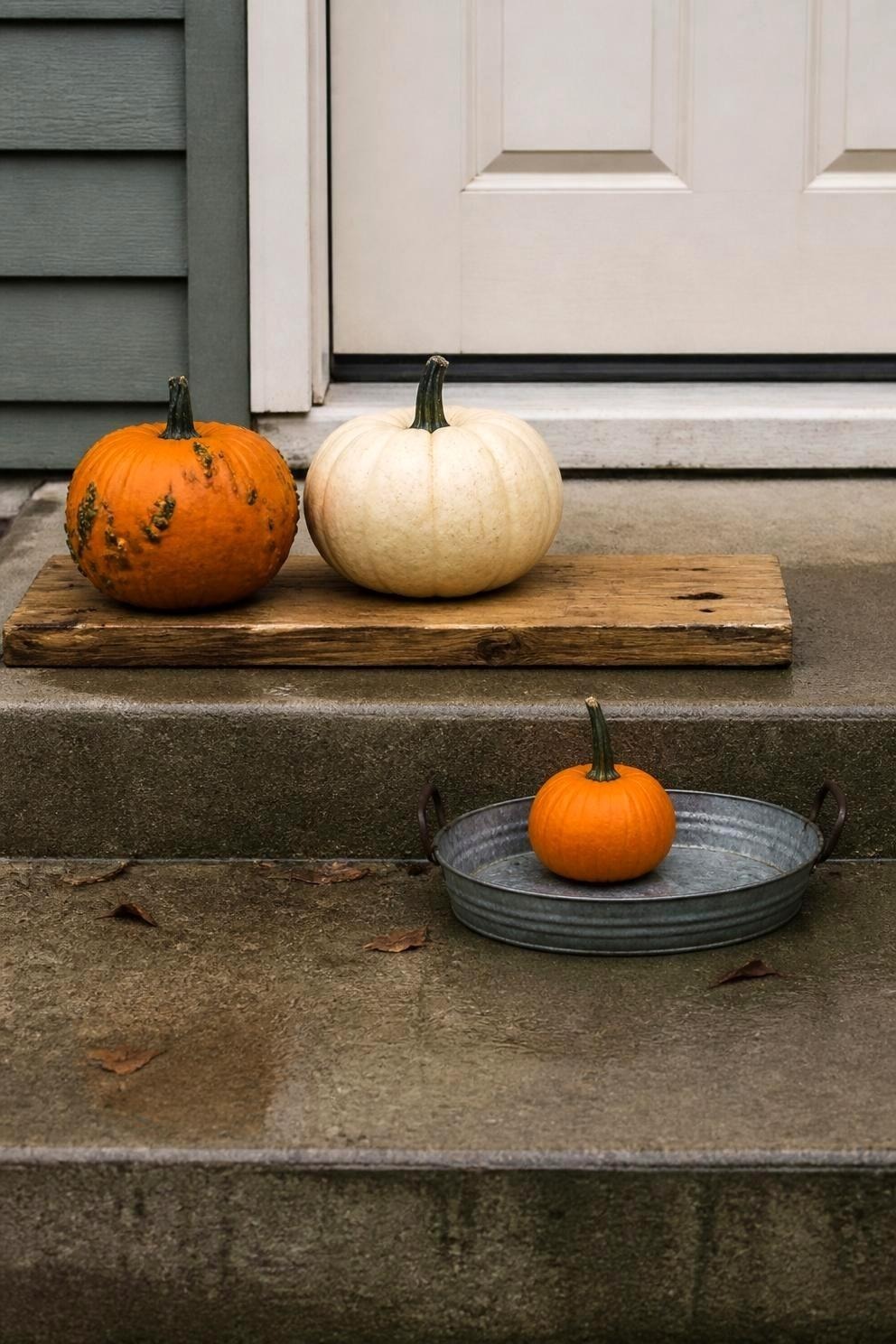
Never set a pumpkin directly on wet concrete, soil, or mulch. Concrete holds moisture and gives it back, mulch stays damp underneath, and the bottom of a pumpkin is the one spot with no air moving across it. Iowa State Extension’s storage guidance explains why pumpkins go in a single layer without touching: “good air circulation helps to prevent moisture from forming on the surfaces of the fruit and retards the growth of decay fungi and bacteria.” So lift them, onto a cedar board, a slate tile, a metal tray, a slice of log. Anything dry and hard, wide enough that the rind does not overhang.
Get them out of the sprinkler line. Water on a pumpkin every morning does more damage than a month of October weather.
Do not pile them. Iowa State again: “Placing the pumpkins in piles generates unwanted heat which may result in the rotting of some fruit.” A deliberate stack is fine, and there is a safe way to build one below. A heap is a compost pile.
The stem is a stopper, not a handle. Illinois Extension puts it well: “The stem acts like a cork in the bottle, keeping everything inside,” and pumpkins without one “tend to shrink and shrivel at the stem end and later begin to rot.” Clemson is blunter: “Carry your pumpkin in your arms, not by the stem.” Two hands underneath.
Buy one that is going to last. Three checks from Clemson’s Home and Garden Information Center :
- The fingernail test. “A mature pumpkin will resist scratching. If the surface is easily penetrated by gently pressing your fingernail into the rind, the pumpkin was picked too early and will rot.” Press near the base where it will not show.
- The stem color. Firm and bright green. A dry shriveled stem means long storage, and per Clemson it “will not remain fresh throughout the fall decorating season.”
- No cracks, splits, soft spots, or sunken areas. A sunken spot the size of a dime in September is a hole in October.
Wipe them down once, before they go out. Clemson recommends a 10 percent bleach solution, one part bleach to nine parts water, to reduce decay. Illinois notes white vinegar as a safe alternative, though it “will not be effective if the pumpkin is already showing signs of molding.”
The honest timeline
Extension storage numbers get quoted everywhere as though they describe a porch.
| Situation | How long | Source |
|---|---|---|
| Whole and cured, 50 to 55 degrees, 50 to 70 percent humidity | Two to six months by variety | Illinois Extension |
| Stored below 50 degrees | Deteriorates rapidly | Illinois Extension |
| Carved | Several days | Illinois Extension |
Read the first row as a ceiling, not a forecast. A cured pumpkin in a 52 degree basement can go months. The same pumpkin on a porch in a Zone 8 September, with afternoons in the mid 80s, will not. Nobody publishes a reliable porch figure because a porch is not a controlled space. The numbers give the direction instead: cool, dry, and off the ground is longer.
The carved row is the one to plan around. Cutting a pumpkin open drops the timeline from months to days. Illinois offers one way to stretch it, coating the exposed cut surfaces with petroleum jelly to hold moisture, which keeps a carved pumpkin looking good “for several days (and nights).” So carve late in October and let uncarved pumpkins carry the six weeks before that.
Real or faux, decided honestly
Faux pumpkins are not a cheat. Two questions settle it: how exposed is the porch, and how long does the display need to be up.
| Situation | Real | Faux |
|---|---|---|
| Covered porch, October only | Yes | Not needed |
| Uncovered steps, direct rain and sun | No | Yes |
| Up from early September through Thanksgiving | No | Yes |
| Squirrels or deer already visit the porch | No | Yes |
| Carving is part of the plan | Yes | No |
The calendar usually decides it. A display up from the first week of September through Thanksgiving is twelve weeks, longer than a real pumpkin holds on an exposed porch in most of the country. The alternative is replacing pumpkins partway through, which erases the savings.
Two notes on faux. A hollow foam pumpkin on an open step travels in a November wind, which the heavier carvable kind fixes, or a couple of handfuls of sand through the bottom hole. And cheap faux orange reads as plastic from twenty feet, while cheap faux white and pale green read as ceramic. If the budget covers only a few good ones, buy the pale ones and put real orange pumpkins around them. Faux for the anchors, real for the small pumpkins you swap out, is the usual split.
What goes with them so it stops reading as a pile
Pumpkins alone, at any count, still read as pumpkins on the ground. Three additions fix that, and the third is the hard one.
One taller element. Height plus a different silhouette: mums in a tall planter, dried grasses in a floor vase, corn stalks tied to the rail post, a lantern on the top step. Pick one. It turns a horizontal group into a composition, because the eye needs somewhere to go once it finishes reading the pumpkins.
If it is mums, buy them right. Clemson advises choosing plants “with tight buds that are just starting to show color” over plants already in full bloom, because the tight-bud plant displays much longer. The porch-ready-looking mum at the garden center is the one that will be brown in two weeks. For containers, the potted mum routine covers pot size and watering.
One texture layer. A woven basket, a wooden crate, a galvanized tub, a wool doormat. It varies the material so the porch is not all rind and paint, and it gives you a place to lift pumpkins off the ground. A crate on its side with two small pumpkins spilling out reads as one object rather than three, which is how you add pumpkins without adding clutter.
Restraint. Two or three colors across the whole porch, doormat included. When a porch looks busy, the cause is usually not the number of items but the number of unrelated ones.
The not-orange palette
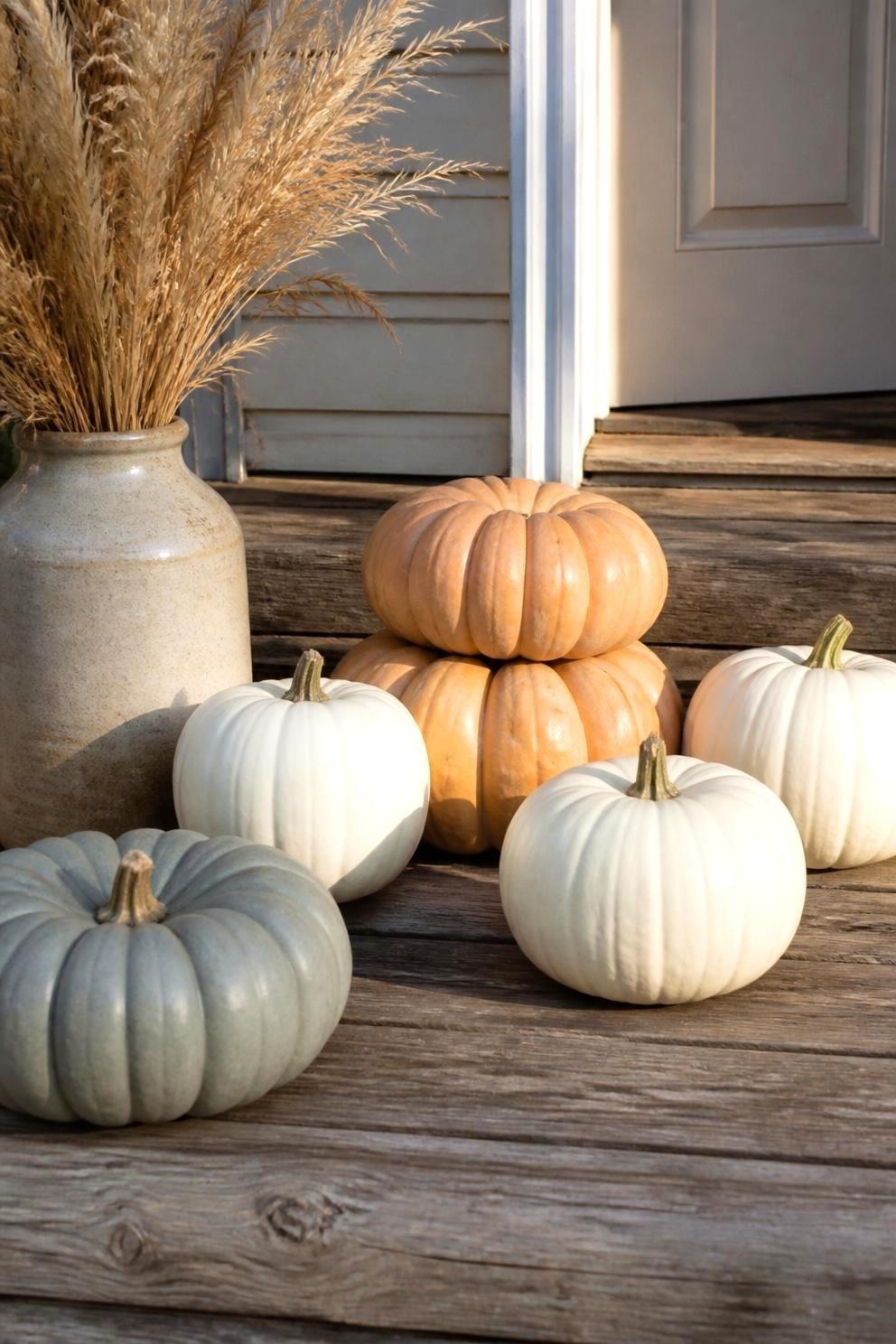
Orange is the default and it is fine. The specialty class is where a porch stops looking like a seasonal aisle, and the cultivars are worth knowing because farm stands label them. Arkansas Extension describes the range as red, white, tan, and blue.
- Casper, plus Lumina and Full Moon. Three true whites with different shapes and shoulders. Casper is the easiest to find at carving size, and using two named whites in one group gives variation without breaking the palette.
- Jarrahdale. Flattened and deeply ribbed with slate blue-gray skin, an Australian heirloom. The one people ask about.
- Goose Bumps II. Warted, heavy texture, peach and tan. One warty pumpkin among smooth ones does more than three more smooth ones.
- Long Island Cheese and Dickinson. Flattened, ribbed, tan to buff. The wheel-of-cheese shape is a genuinely different silhouette when everything else is round.
- Rouge Vif d’Etampes, sold as Cinderella. Deep red-orange, wide and flat, the carriage shape.
- Baby Boo. A miniature white, a pound or less. What finishes a group at the base or sits on a railing cap.
Pick one family and stay in it. All white with cream and one deep green, plus a single warty tan for texture. Or slate blue Jarrahdale with white minis and dried grasses, no orange at all. Orange dropped into a pale palette at random is the version that goes wrong, because orange is loud enough to become the subject no matter how little of it there is.
Wind and slope: keeping a stack from going over
Stacked pumpkins are a good look and a genuinely unstable one, because pumpkins have rounded bottoms and porch steps have a slope built in for drainage.
- The base pumpkin has to be a flat one. A shopping decision, not a fix. A Long Island Cheese or a Jarrahdale sits still. A tall round carving pumpkin does not.
- Kill the slope with a shim. A folded strip of cardboard under the front edge of the base board levels the stack and is invisible from the sidewalk.
- Museum putty between layers. A pea-sized dab at three points around the contact ring stops a slow slide. Better than dowels, which puncture the rind and invite rot.
- Two tall, not three. Get extra height from a riser underneath, not a third pumpkin on top.
What usually goes wrong
- Three pumpkins, all the same size. The only failure here you cannot fix at home.
- Even spacing on a staircase. Group them and leave gaps.
- Pumpkins straight onto wet concrete or mulch. Lift everything.
- Carrying them by the stem. Once the stem goes, decay follows.
What to Read Next
- Fall Front Porch Decor for a Small Porch: 7 Ideas widens the display past the pumpkins, which is what most small porches need next.
- Mums in Planters: How to Keep Them Alive Past Two Weeks is the companion piece when the taller element beside the pumpkins is a pot of mums.
- Fall Flowers for Pots That Get Better in the Cold covers the plants that keep going after the pumpkins are done.
- Front Porch Planter Ideas That Look Full Without Constant Replanting handles the pots on either side of the door, which is the rest of the entry.
- 5 Hurricane Lanterns for Fall Decor That Still Work After October gives you the one taller element that turns a group into a composition.