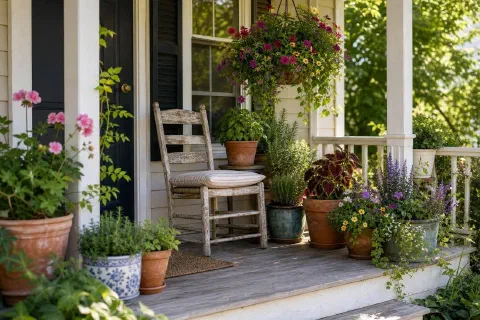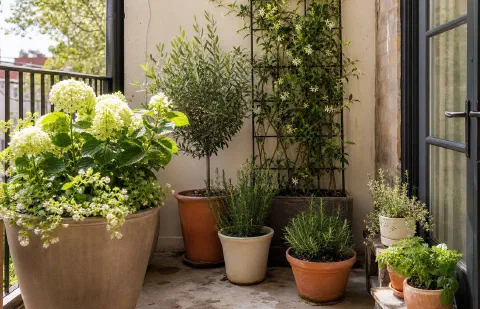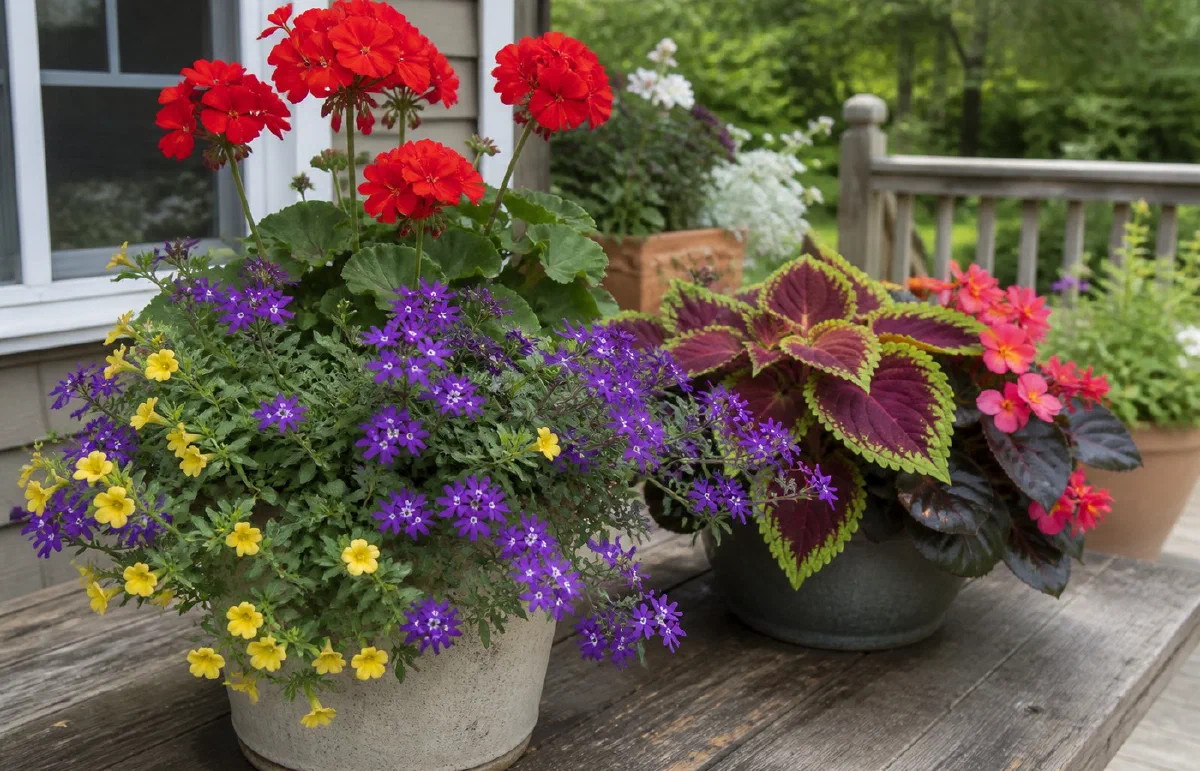
The prettiest container at the garden center isn’t always the one that lasts.
Some pots peak early and look tired by July. Some are stuffed so full that everything fights for water. Some use plants with completely different needs and then quietly collapse while you are away for a weekend.
A good flower container is less dramatic at the start. It has plants that want the same light, the same water rhythm, and enough space to grow into each other.
Here are the combinations I would trust for a porch, patio, or front step.
| Combination | Light it needs | Pot size | The plants |
|---|---|---|---|
| Full-sun porch pot | Sun, six hours or more | 14-16 inch | Geranium, calibrachoa, verbena |
| Shade pot | Shade to part shade | 14-16 inch | Coleus, begonia, fern, creeping Jenny |
| Cottage color | Sun | 14-16 inch | Salvia, zinnias, alyssum, trailing lobelia |
| Low-water patio | Sun, with sharp drainage | 14-16 inch | Lavender, sedum, thyme, dusty miller |
| Pollinator pot | Sun | 14-16 inch | Lantana, zinnias, trailing verbena |
| Clean front step | Sun to part shade | 12-14 inch | Boxwood, white bacopa, ivy |
Bulbs can go into the same pots for an earlier layer of color and scent. How to plant freesia bulbs in pots and beds covers depth, spacing, and when to get them in.
For Full Sun: Geranium, Calibrachoa, and Verbena
This is the reliable porch pot.
Use one upright geranium, two calibrachoa, and one trailing verbena in a 14- to 16-inch pot. Pick colors that are close neighbors instead of total strangers: coral and peach, red and pink, purple and lavender, or white and pale yellow.
Why it works: all three can handle sun, all three bloom for a long time, and the pot looks full without needing six different plants.
Water when the mix is dry an inch or two down, the depth Iowa State Extension uses as its container test . Pinch off tired blooms when you walk by. If the calibrachoa gets leggy in midsummer, trim it back by a third and let it regrow.
For Shade: Coleus, Begonia, Fern, and Creeping Jenny
Shade pots don’t need to look apologetic.
Use one bold coleus, one small fern, two wax begonias or tuberous begonias, and creeping Jenny at the edge. This gives you color from leaves, not just flowers.
Try lime coleus with pale pink begonias, or burgundy coleus with white begonias. The fern softens the middle and keeps the pot from looking too flat.
Shade containers still need water. Covered porches can be sneaky because rain never reaches the pots. Check them by hand.
For Cottage Color: Salvia, Alyssum, Zinnias, and Trailing Lobelia
This combination feels loose without becoming messy.
Use one salvia for height, two compact zinnias, a ring of alyssum, and trailing lobelia near the front. It looks especially good in a weathered terracotta pot or a simple galvanized tub with drainage holes.
The salvia gives vertical shape. Zinnias bring the color. Alyssum fills gaps and smells faintly sweet when the pot warms in the sun.
This is a sun pot. Don’t ask it to perform on a dark porch.
For Low-Water Patios: Lavender, Sedum, Thyme, and Dusty Miller
If you forget to water, don’t build a pot around thirsty annuals.
Use lavender as the upright plant, sedum around the middle, thyme near the edge, and dusty miller for soft silver color. The whole pot wants sun and drainage.
This combination is quieter than a basket of petunias, but it looks settled. It works near a seating area because the plants have texture and scent instead of loud color.
Use a pot with drainage. Skip the saucer if rain collects there.
For Pollinator-Friendly Color: Lantana, Verbena, and Compact Zinnias
This one is for sunny spots where you want movement.
Use one lantana, two compact zinnias, and trailing verbena. Keep the colors warm and simple: yellow, orange, coral, or pink. Too many colors in one pot can look busy from the street.
Butterflies and bees will visit, but the framing stays garden-pretty rather than heavy habitat messaging. That matters for Etheric Echoes. The goal is a porch or patio that feels alive, not a lecture.
For A Clean Front Step: Boxwood, White Bacopa, and Ivy
Sometimes a container needs to look calm, not colorful.
A small boxwood in the center, white bacopa around the edge, and a little ivy trailing over one side can carry a front step for months. It looks especially good beside brick, black doors, stone, or weathered wood.
This is also a good choice if your porch already has patterned cushions, flags, wreaths, or seasonal decor. The pot supports the entry instead of competing with it.
The Rule That Keeps Containers Looking Good
Match the plants by care before you match them by color. Iowa State Extension reduces the whole thing to one rule : everything sharing a pot has to want the same light and the same soil moisture, or one plant in the mix loses.
Sun plants with sun plants. Shade plants with shade plants. Dry-loving plants with dry-loving plants. Thirsty plants with thirsty plants.
That one habit prevents most container problems.
Then repeat something: one flower color, one pot material, one leaf color, or one trailing plant. Repetition is what makes a container garden look designed instead of accidental.
Plant a Pot in This Order
The order below is what keeps a container looking good into September instead of peaking in June.
- Check the light where the pot will actually sit, at midday, not where it would look best from the street.
- Pick the combination that matches that light before you pick colors.
- Choose a pot with a drainage hole, 14 to 16 inches across for most of these combinations.
- Fill with fresh potting mix and leave an inch of rim so water has somewhere to sit while it soaks in.
- Set the tallest plant in the middle or at the back, the fillers around it, and the trailers over the edge.
- Water until it runs out of the bottom, then water again when the mix is dry an inch or two down.
- Pinch off spent blooms every week or so, and trim anything that has gone leggy back by a third.
My Favorite Easy Combination
If I had to plant one container for someone who wanted color with very little fuss, I would use:
- one coral geranium
- two white calibrachoa
- one trailing verbena
- one small thyme tucked near the edge
It’s simple. It blooms. It smells good when you water it. And it doesn’t need a complicated diagram to make sense.
What to Read Next
- Container vegetable garden ideas for small spaces uses the same pot-size and sun checks for food instead of flowers.
- Container vegetable garden layouts for a small patio is the measured version, with plant counts and spacing for each pot.
- Container soil drying out too fast is the fix to read when a porch pot is dry again by mid-afternoon.
- Container garden ideas for a small patio covers what to group and what to skip when the pots share the space with seating.