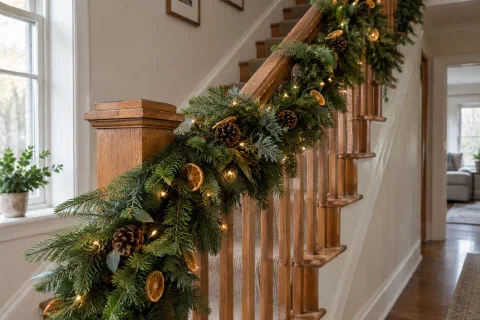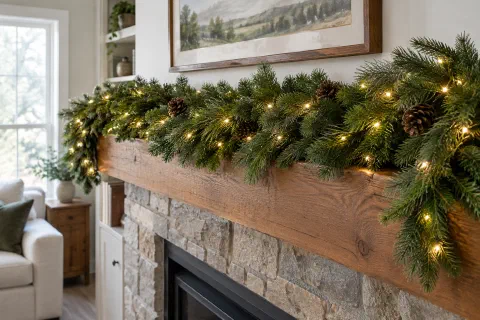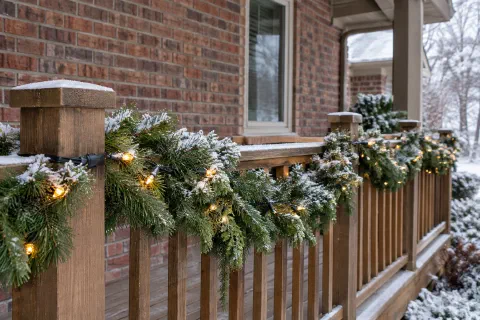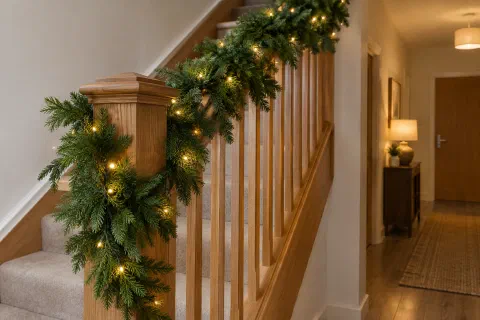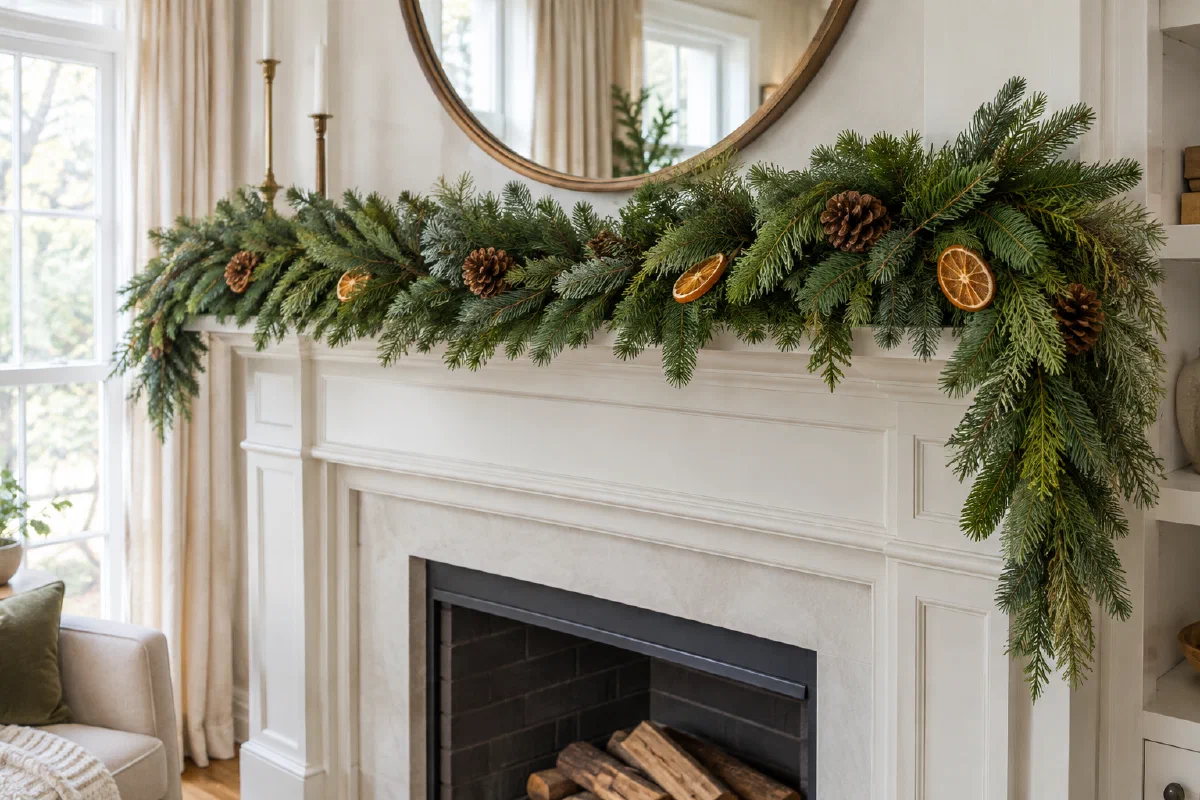
Faux garland has one thing to do: look like something you cut off a tree. Most of it fails for four reasons, and price is not one of them.
The strand comes out of the box compressed. The branches sit pressed against the wire spine, every sprig is cut to the same length, and the color is one flat green from end to end. Hung straight on two hooks, faux Christmas garland looks exactly like what it is.
All four problems have a fix, and the fix is mostly your hands.
Why Faux Garland Reads as Plastic
Real greenery shows you what the plastic is missing. At a tree lot, needle length changes with the species. Clemson Extension’s tree guide describes short, firm needles on a Fraser fir and long, soft, blue-green needles on an eastern white pine, and the NC State plant toolbox puts white pine needles at three to five inches. Faux garland averages all of that into one length.
Color works the same way. The NC State toolbox notes that Fraser fir needles are dark green on top with silvery white undersides, which is why a real branch shifts in the light. A flat color never shifts.
| The tell | What real greenery does | What to do about it |
|---|---|---|
| Every sprig is cut to the same length | Needle length runs from about an inch on a fir to three to five inches on a pine | Twist two strands with different needle lengths together |
| The wire spine shows through the middle | Side branches and stems break up the line | Fluff each branch outward, then offset a second strand |
| It hangs flat, like a pressed ribbon | Branches fan into several planes, so the shape has depth | Bend the spine into a curve instead of a straight line |
| One flat green from hook to hook | Two tones on one needle, darker on top and lighter underneath | Mix in a frosted, darker, or dried strand |
The hand test: run a palm along a branch at a tree lot. Clemson’s guide says fresh needles should feel flexible and stay on the stem. Aim for that same soft give when you squeeze a strand in the store.
The wire spine is the tell people forget. It is a thin, stiff line running the whole garland length, and once you see it you cannot unsee it. Fluffing, doubling, and shaping all exist to hide it.
Test Needle Length and the Wire Spine Before You Buy
Two strands at the same price can behave completely differently on the mantel. Squeeze both before you commit.
- Squeeze the strand. If the wire spine is the firmest thing in your hand and the greenery collapses under it, plan on extra fluffing time.
- Bend one branch back and let go. Good faux branches hold a soft curve. Plastic that snaps back flat fights every shape you try.
- Look for two tones. Hold a sprig near a window. One flat green reads as plastic from across the room.
- Check the wire wrap. Paper-wrapped wire bends and stays bent. A bare, stiff core turns a swag back into a straight line overnight.
- Count the branchlets. More small sprays per foot means less spine to hide.
Buy more garland length than you think you need. A six-foot doorway swag can eat nine feet of strand once you curve it. One and a half times your measurement is a safe starting point.
How to Fluff Faux Garland, Step by Step
Fluffing is most of the difference between a strand that looks store-bought and one that looks gathered. Budget ten minutes per strand, and start at one end.
- Shake it out. Hold the strand by one end and let the rest fall. Much of the compression loosens on its own.
- Work in two-foot sections, starting at an end rather than the middle. That way you never push fluffed branches back into a compressed pile.
- Begin with the outer tips. Take the outermost sprig between thumb and forefinger, pull it away from the spine, then roll it so the needles fan in different directions.
- Move inward one tier at a time. Separate the sprays stuck together, then spread each one like a small fan.
- Push the back row toward the wall and pull the front row toward you. That gives the strand depth instead of a flat face.
- Fluff the underside. It is what people see from the sofa, and it is the part everyone skips.
- Stand back after every two sections. A strand looks full at arm’s length long before it looks full across the room.
Do one strand during a movie. Finishing the whole box in one sitting is how people end up with a sore hand and half-fluffed garland.
Double Two Cheap Strands Instead of Buying One Fancy One
This is the highest-value trick here. Two inexpensive strands twisted together read fuller than one expensive strand, because fullness comes from overlap, not density inside one piece.
Lay both strands side by side with the branch bunches offset by about half a bunch. Hold the ends together and twist the pair gently, about one turn every foot. Where strand A has a thin spot, strand B has a bunch, and the two wire spines cross each other.
Add a Second Texture So It Reads as Greenery, Not Plastic
More length does not make garland look expensive. A second texture does. One material at one scale is why a very long strand still reads as plastic.
- Small pinecones wired in clusters of three, not scattered evenly.
- Dried orange slices, which add warm brown against all that green.
- Wide ribbon, two to three inches across, looped about once every two feet.
- A second evergreen with a different needle shape. Cedar sprays are flat and fir needles are round, so a mixed bundle reads as two plants.
- Real dried stems from the yard, like magnolia leaves or hydrangea heads.
Keep the extras in odd numbers and place them low on the strand. When ornaments sit on top, the eye reads them first and the greenery second.
Bend the Wire Into a Swag Instead of Hanging It Straight
The wire is the one part of faux garland you are allowed to bully. A straight strand reads as trim. A swag reads as decoration.
Find the spine and bend it in gentle arcs between your attachment points, so the middle dips four to eight inches below the ends. Alternate the high and low points along a long run. For a doorway, put the high points at the corners and let the center drop.
Hang it with clips made for cords or light-duty adhesive hooks rather than staples or nails. Then let a few branch tips fall below the wire line. That small overhang makes a swag look gathered instead of drawn.
Which Garland Is Worth More Money
Spend on the strand you will stand next to. Garland on a mantel, a doorway, or a stair rail sits at eye level, and that is where two-tone color, mixed needle length, and a bendable wire wrap show.
- Worth it: a strand with two-tone needles, mixed sprig lengths, and a paper-wrapped wire, especially for a mantel or entry.
- Worth it: a cheap strand you plan to double, since two of them do the work of one luxury piece.
- Skip it: anything headed for the top of a tall bookcase, where nobody looks.
- Skip it: paying extra for length alone. Buy width and texture first.
One more rule of thumb: if you decorate only one spot, one good strand beats three thin ones.
Five Mistakes That Make Faux Garland Look Fake
- Hanging it straight and tight, pulled flat against the mantel with no slack.
- Draping lights on top of the greenery instead of weaving them through the branches.
- Using one texture from end to end, so the eye has nothing to rest on.
- Leaving it in the box shape and calling the job done.
- Buying more length when the strand was never fluffed.
The lights deserve their own note. Push the string down into the strand and let it surface in a few places instead of laying it across the top like a necklace. Check the label on your set for an indoor or outdoor rating, and one electrical safety authority caps a run at three light strings connected together. Use clips, not staples, so you never nick a cord.
Keep Faux Greenery Clean and Store It Flat
Faux greenery collects dust, and dust is a quiet plastic giveaway. Once a strand looks dull, no amount of shaping helps.
- Dust it twice a season with a hair dryer on the cool setting, held a foot away, or with a soft paintbrush.
- Store each strand loosely coiled in a circle, not crushed flat in a box. The curves you bent in December will still be there next year.
- Keep bins out of a hot attic. Heat lets plastic take a set, and a crease is hard to fluff out.
- If a strand comes out crushed, hang it in a warm room overnight and fluff it again.
- Wipe the wire with a dry cloth if it feels tacky, and check cords for cracks before the season starts.
A strand that goes into the bin fluffed comes out next year needing half the work. That is the reason to store it in a loop instead of a wad.
What to Read Next
- Indoor Christmas Greenery That Lasts : which greens hold up in a warm, dry living room.
- Christmas Garland Ideas for a Small Home : where one strand does the most work in a small space.
- Fall Garland Ideas : the same fluff and double method on a non-holiday strand.