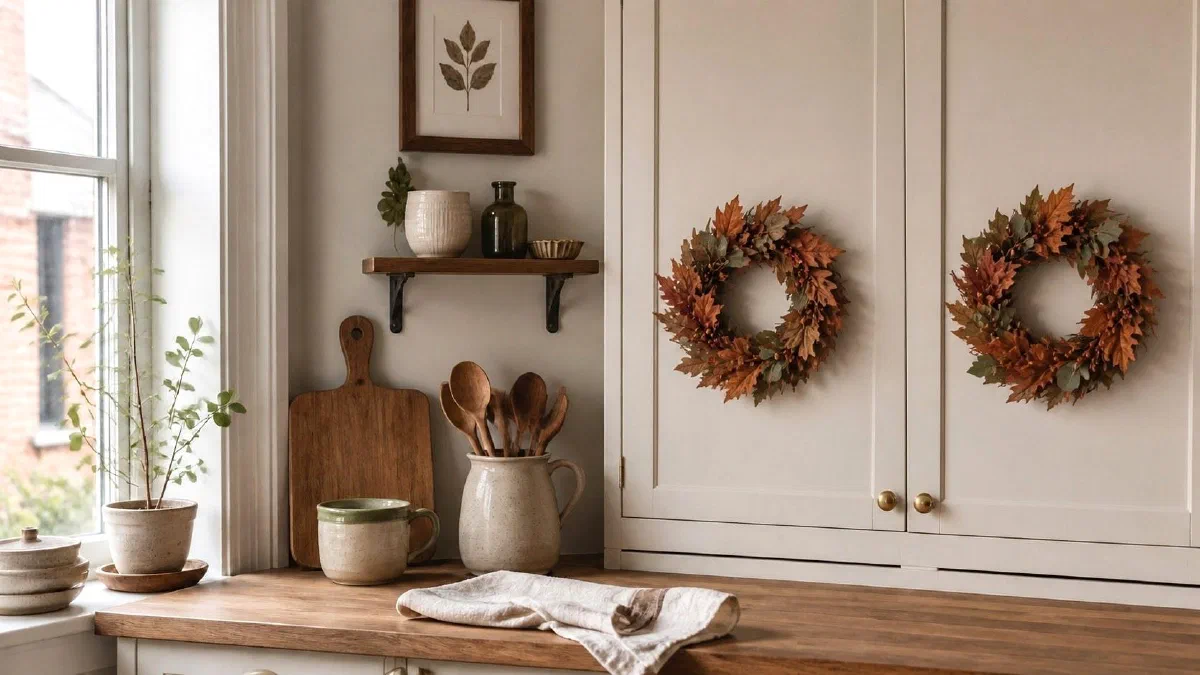
A full door wreath decorates one surface in your home, and it’s the surface you see least. You pass the outside of your own front door twice a day, usually carrying something, usually not looking up.
A 9-inch fall mini wreath fits the places a full door wreath overwhelms: cabinet doors, a bathroom mirror, the back of a bedroom door, a window sash, or the narrow strip of hallway wall where nothing else has worked.
The quick answer: measure the surface first and leave at least 2 inches of open space on each side of the wreath. On smooth, fully cured paint, a removable adhesive hook is the easy everyday choice. Use a suction cup hook on glass. If the finish is fresh, fragile, or unknown, move the wreath to glass or set it on a shelf instead.
The other thing that changes is where the decorating lands. One full-size wreath fills one large door. A few small wreaths can carry the same fall note into the kitchen, bathroom, bedroom, and hallway without taking over any one room.
Fall mini wreath ideas for cabinets, mirrors, windows, and doors
Run through the list before you decide the front door is the only option.
- Kitchen cabinet doors. The most common use, and what these are sold for. Two on the pair above the sink, or one on a glass-front door.
- A bathroom mirror. Glass is the one surface where a suction cup works properly, so it’s the easiest hang in the house.
- The back of a bedroom door. The side you see from bed. Nobody decorates it and it’s the wall you look at longest.
- A window sash. On the horizontal rail of a double-hung window, so it reads against the glass from inside and from the street.
- The side of a bookcase. A flat vertical panel that usually holds nothing.
- A narrow hallway. A run of wall too tight for art at any normal size.
- Around a flameless pillar candle. A mini wreath laid flat can work as a candle ring without putting dry or artificial leaves near a flame.
- A dining chair back. Tied on with ribbon for one dinner, then moved.
The pattern is small vertical surfaces you look at up close. That’s the opposite of the front door, a big surface viewed from the sidewalk.
If the front door is what you’re after, the full-size wreath guide covers base sizing, wiring instead of gluing, sun damage, and hanging without marking the paint. None of that math transfers down here. A 9-inch wreath is not a scaled-down door wreath. It is a different object with a different job.
Fall mini wreath size guide: when 9 inches fits
This is the one place where 9 inches either fits or looks wrong, so it’s worth a tape measure first.
Measure one cabinet door, not the whole cabinet. A pair of doors on a 30 inch cabinet gives you two doors of roughly 15 inches each. Subtract the wreath from the door and split the difference:
| Single door width | 9 in wreath leaves per side | How it reads |
|---|---|---|
| 12 in | 1.5 in | Crowded, the wreath touches the edges |
| 15 in | 3 in | The common case, and it looks right |
| 18 in | 4.5 in | Comfortable, slightly small but fine |
| 24 in (single wide door) | 7.5 in | Lost, use two wreaths or skip this door |
Two inches of clearance per side is the floor. Below that the wreath looks jammed in and the door looks smaller than it is.
Check the listed diameter, not the category name. An 11-inch wreath takes away an inch of clearance on each side compared with a 9-inch wreath. On a 12-inch cabinet door, that is the whole decision.
Center the wreath on the upper half of the door, not the middle. On a 30 inch tall wall cabinet door, that’s roughly 10 to 12 inches down from the top. Centered on the full height, it sits low and reads like it slipped.
The doors to skip. Anything you open more than a few times a day. The cabinet with the everyday glasses in it will bang a wreath against the frame a hundred times before Halloween. Use the pantry, the cabinet over the fridge, the doors that stay shut.
Best hangers for a small fall wreath
The right answer depends entirely on what the surface is made of.
| Method | Works on | Leaves behind | The catch |
|---|---|---|---|
| Adhesive hook | Smooth painted or finished surfaces | Depends on the paint, see below | Follow the package instructions exactly |
| Suction cup hook | Glass and mirror only | Nothing | Fails on anything textured or porous |
| Shelf or picture ledge | Fragile, fresh, or unknown finishes | Nothing | The wreath leans instead of hanging |
| Over-cabinet hook | Cabinet doors with a free top edge | Nothing | Adds thickness, the door may not close flush |
A removable adhesive hook is the practical default. It keeps the wreath centered, disappears behind the ring, and comes off later without a ribbon crossing the door. Use one only on a smooth finish the package names, wait until paint is fully cured, stay below the printed weight limit, and remove it with the exact slow pull shown in the instructions.
Suction cups belong on smooth glass. A mirror, a window pane, or a glass cabinet insert gives the cup a non-porous surface to seal against. Check the seal after a temperature change, and do not hang one where a fall could break dishes or damage a sink.
A nearby shelf is the safest fallback. When the paint is fresh, chipped, very old, or impossible to identify, lean the wreath against the wall on a picture ledge or open shelf. It avoids both adhesive risk and a strip of ribbon crossing the door gap.

How to hang a fall mini wreath in a rental without damage
This is the part that decides whether the deposit comes back.
Paint age matters more than the wreath does. Fresh paint may feel dry before an adhesive-hook maker considers it ready. Follow the waiting period for the exact product. The 3M instructions linked above say 7 days; if you do not know when the unit was painted, use glass or a freestanding placement instead.
Old paint is a different problem. The EPA notes that homes built before 1978 are more likely to have lead-based paint , usually buried under newer layers, and it specifically names doors and door frames as high-wear surfaces where that paint becomes a hazard once it’s damaged. In a pre-1978 building, an adhesive hook that lifts a chip off a door frame is not just a deposit conversation. Use a suction cup on glass or a freestanding placement, and leave the painted trim alone.
Test somewhere that doesn’t show. Inside the cabinet, behind the door, low on the frame. Leave it a day, pull it the way the package says, and look at what came off with it.
Cabinet finishes are not all paint. Thermofoil and laminate doors have a thin surface layer that can peel at an edge, and once it lifts it doesn’t go back. If you’re not sure which you have, test a hidden area or choose a nearby glass surface instead.
Weight is only half the check. A small artificial wreath is usually light, but the hook still needs to be rated for its weight and approved for the surface. A strong hook cannot protect a finish that peels away beneath it.
How to hang a mini wreath with a removable adhesive hook
Start to finish on a smooth, fully cured cabinet door. Manufacturers publish the surfaces, weights, preparation, wait time, and removal method for each hook. For example, 3M says to wait 7 days after painting, clean the surface as directed, and use the printed removal method .
- Check the package against the surface. Smooth cured paint is different from wallpaper, raw wood, textured paint, or peeling thermofoil.
- Clean and dry the spot exactly as directed. Household sprays can leave a film that weakens the bond.
- Place the hook on the upper half of the door, usually 10 to 12 inches down on a 30-inch cabinet door.
- Press and wait for the time on the package. Hanging immediately can pull down a strip that would have held after the adhesive set.
- Hang the wreath from its back frame, not a leaf or bow, then step across the room to check the height.
- When fall is over, remove the strip by its tab. Pull slowly in the printed direction instead of peeling the hook away from the paint.
For a bedroom door, measure the actual door rather than relying on a standard width. A 9-inch wreath tucked against the top can look marooned, so place the hook near eye level and step back before pressing the strip in its final spot. If the paint is fresh or questionable, skip that door and use glass or a freestanding placement.

Small fall wreath buying checklist
The listing photo is not enough. Use this short check before you order:
- Finished diameter: 9 inches works on many cabinet doors; 11 inches needs 2 more inches of surface width.
- Piece count: decide which exact doors, mirror, or window you will decorate before a four-pack turns into four wreaths crowded into one room.
- Back frame: a visible wire or vine frame gives the hook a secure place to hold.
- Depth: thick pumpkins and stiff bows can catch on a cabinet frame even when the diameter fits.
- Indoor or outdoor rating: keep an indoor-only artificial wreath away from rain and strong direct sun.
- Return terms: hold one wreath against the actual surface as soon as the box arrives, before removing tags or reshaping every piece.
The safest choice for a rental is a lightweight wreath with a clear back frame and a diameter that leaves visible space around it. Color comes after fit.
Cleaning and storing them so next fall costs nothing
Artificial wreaths last years. What ruins them is the box.
- Dust them before they go away, not when they come out. A hairdryer on cool, held a foot back, clears a season of kitchen dust without touching the leaves.
- Kitchen grease is the real enemy. A wreath that lived above a stove picks up a film that dust sticks to. A cloth barely damp with dish soap, patted rather than rubbed, handles it. Dry it fully before storing.
- Store them flat and stacked, not squashed in a bag. Four fit in one flat box with tissue between them. A crushed wired bow is what makes a wreath look tired next year.
- Keep the ribbon with the wreath, and steam a flattened bow back into shape when it comes out.

The honest limits
A few things a mini wreath won’t do.
- It won’t decorate a front door. Nine inches on a 36 inch door reads as a mistake, not a choice.
- It won’t survive weather. Artificial leaves left in sun and rain go chalky and pale in one season.
- It won’t fix a cluttered surface. A small pretty thing on a crowded counter just makes the counter busier.
- Four of them in one room is too many. Spread them out. That’s the point of buying small ones.
The reason to do this instead of one big wreath isn’t thrift. It’s that a small apartment has almost no surfaces that will take a large decorative object, and dozens that will take a small one. Working with what you’ve got gets you a home that feels like fall faster than fighting for one grand gesture at a door you barely look at.
Fall mini wreath questions, answered
What size mini wreath works on kitchen cabinets?
A 9-inch wreath works on many 15-inch cabinet doors because it leaves about 3 inches of door showing on each side. Measure one door before ordering. Keep at least 2 inches of open space on each side so the wreath does not look wedged into the panel.
Can I make a homemade mini fall wreath?
Yes. Start with a 6- to 9-inch grapevine or wire ring and attach two or three short faux stems with floral wire. Keep the back frame clear so it can sit flat against a cabinet or mirror. If you want a larger front-door version, the DIY fall wreath guide covers wiring, sizing, and weather exposure in more detail.
When should I hang a fall wreath?
There is no required date. Hang it when you want the room to feel like fall, then take it down before the hanger or wreath materials have spent months collecting kitchen grease, direct sun, or damp weather.
What to Read Next
- DIY fall wreath you can finish in one evening is the full-size front door version, with base sizing, wire, and hanging without marking paint.
- Apartment fall decor with no mantel needed covers the rest of a rental when there’s no fireplace to build a display on.
- Fall kitchen decor ideas is where the cabinet door wreaths fit into a whole kitchen instead of standing alone.
- Cozy fall bedroom ideas for a small room picks up the back of the bedroom door and the rest of a room that has no floor space left.