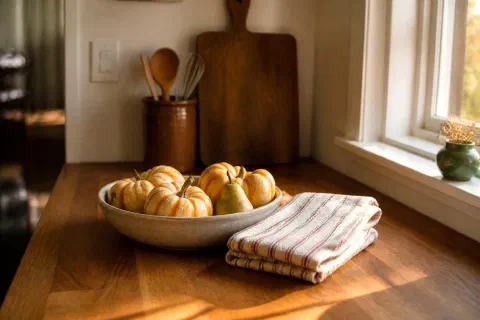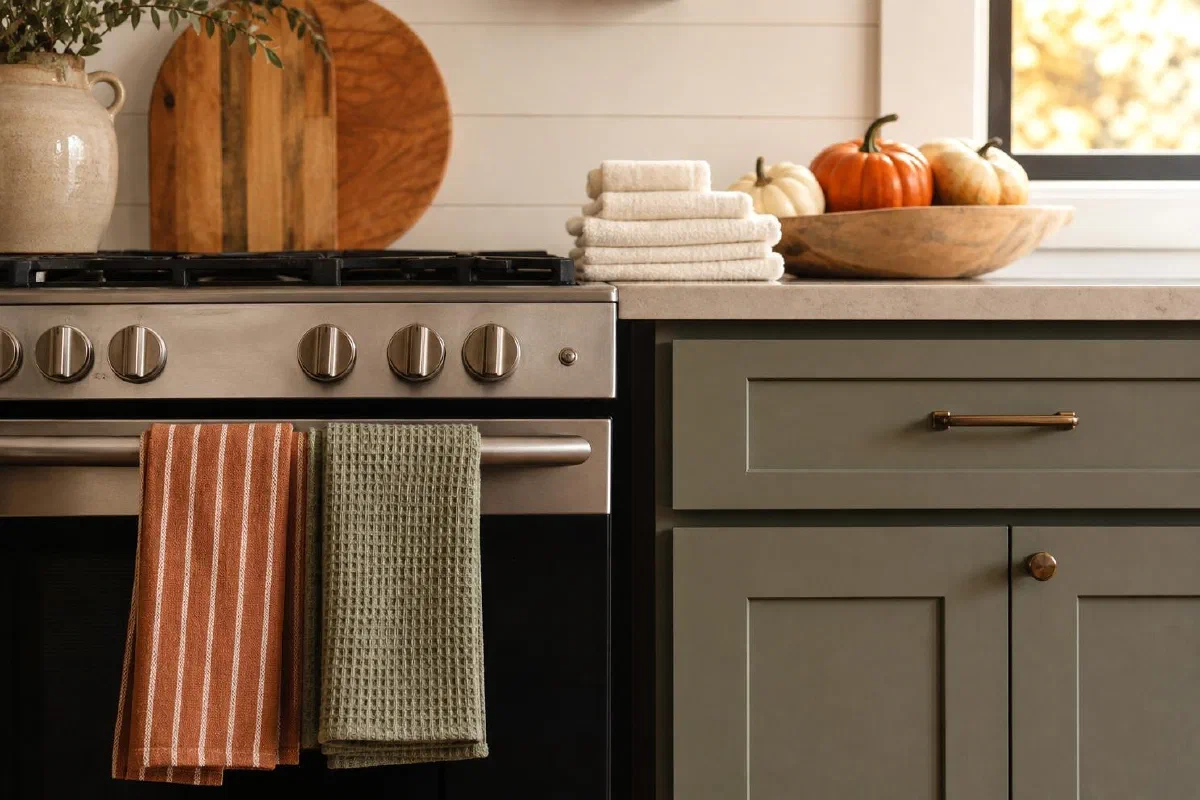
The prettiest towel in the kitchen is usually the worst one at drying a dish. That is not a defect. It is a job description, and the whole trouble with fall kitchen towels is that most of us buy one towel and then quietly resent it for failing at two different jobs.
Swapping the towels is the cheapest seasonal change in a kitchen, and in a small one it is often the only change that fits. Nothing takes up counter space. Nothing needs a drill. Nothing has to be stored in November except a folded square of cotton. It is one piece of a bigger picture covered in fall kitchen decor ideas for a small kitchen; this page is only about the towels, in detail.
But the seasonal aisle sells decoration, not equipment. A heavy screen print blocks water. Plenty of seasonal towels are polyester underneath, sold quick dry with a hanging loop, which is a different material doing a different thing. So you hang the pumpkin towel, reach for it with a wet glass, push the water around the outside of the glass, and put it back annoyed.
The fix is to stop asking one towel to do both jobs. Everything below follows from that.
Buy one towel for looking at and one for working
A kitchen needs two kinds of towel, and they are not interchangeable.
The display towel hangs on the oven door or the dishwasher handle. It is the thing you see from the doorway, and its whole job is to be the right color in September. It dries clean hands and nothing else. It stays square. You own one or two, and you swap them with the season.
The working towel lives folded by the sink, on a hook, or in a drawer within reach. It dries dishes, mops a spill, lifts a hot lid, and goes in the wash constantly. It is plain, it is cheap, and you own a stack so you never have to wonder whether there is a clean one.
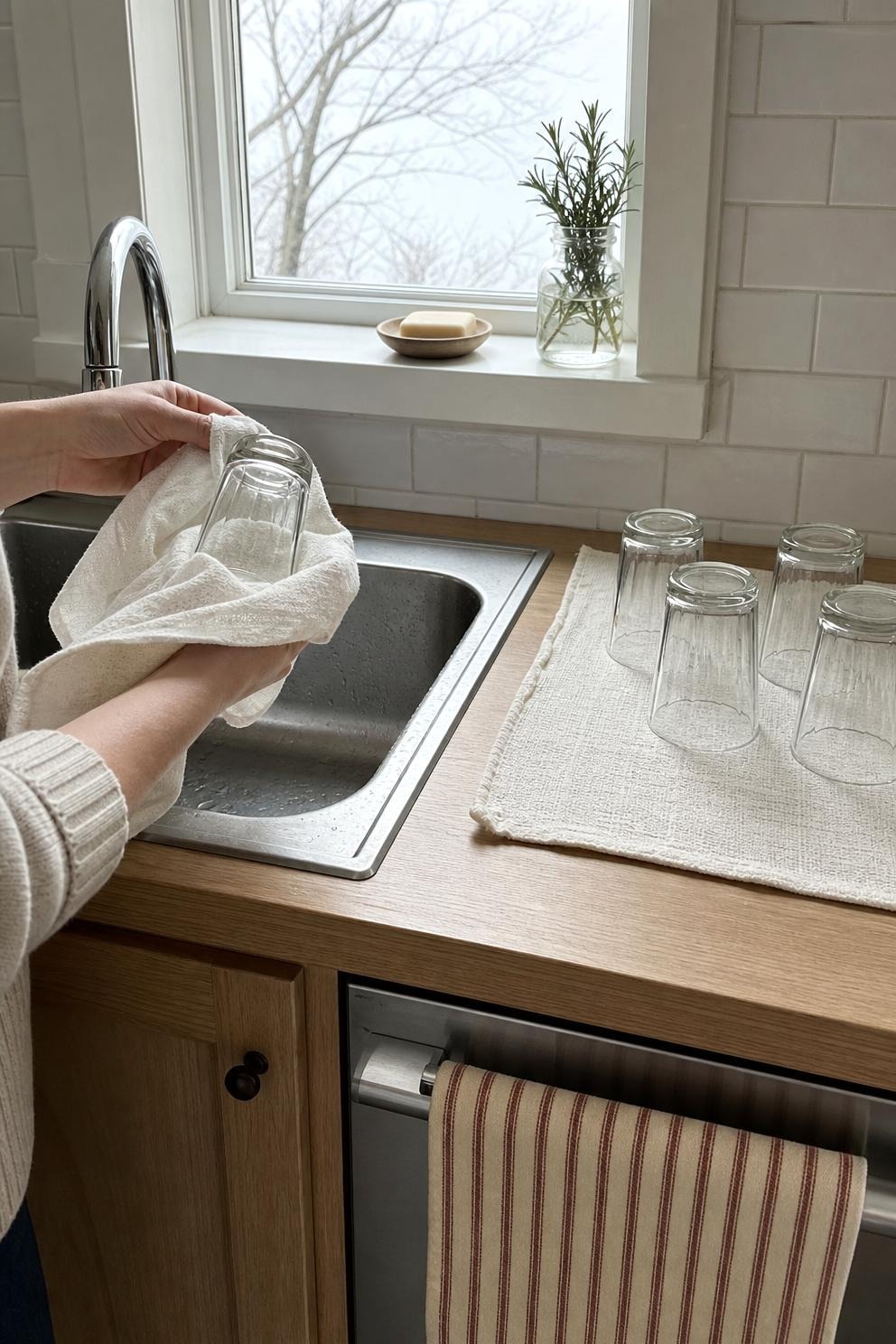
That is the entire system. Once the seasonal towel is off dish duty it stays looking new through October instead of going grey and limp by the second week. And once the working stack is plain cotton you stop caring what happens to it, which is the only sane relationship to have with a kitchen towel.
It quietly solves the storage problem too. If every towel you own is seasonal, you are storing four sets a year. If only two are seasonal, you are storing two towels.
Quick picks
Four towels, four different jobs. The useful question is not which one is prettiest. It is which job you need it to do.
| Pick | Best for | Weave | Size |
|---|---|---|---|
| Aunt Martha’s Flour Sack Towels (opens Amazon in a new tab)As an Amazon Associate, we earn from qualifying purchases. Full disclosure. | Glassware and wringing produce | Flour sack cotton | 28 x 28 in |
| Homaxy Check Plaid Waffle Towels (opens Amazon in a new tab)As an Amazon Associate, we earn from qualifying purchases. Full disclosure. | Fast drying and a restrained pattern | Cotton waffle | 13 x 28 in |
| Homaxy 380 GSM Cotton Towels (opens Amazon in a new tab)As an Amazon Associate, we earn from qualifying purchases. Full disclosure. | A substantial working stack | Flat weave and terry | 18 x 28 in |
| Artoid Mode Fall Towels (opens Amazon in a new tab)As an Amazon Associate, we earn from qualifying purchases. Full disclosure. | A clearly seasonal display pair | Printed fabric | 18 x 26 in |
Best for glassware: Aunt Martha’s flour sack towels
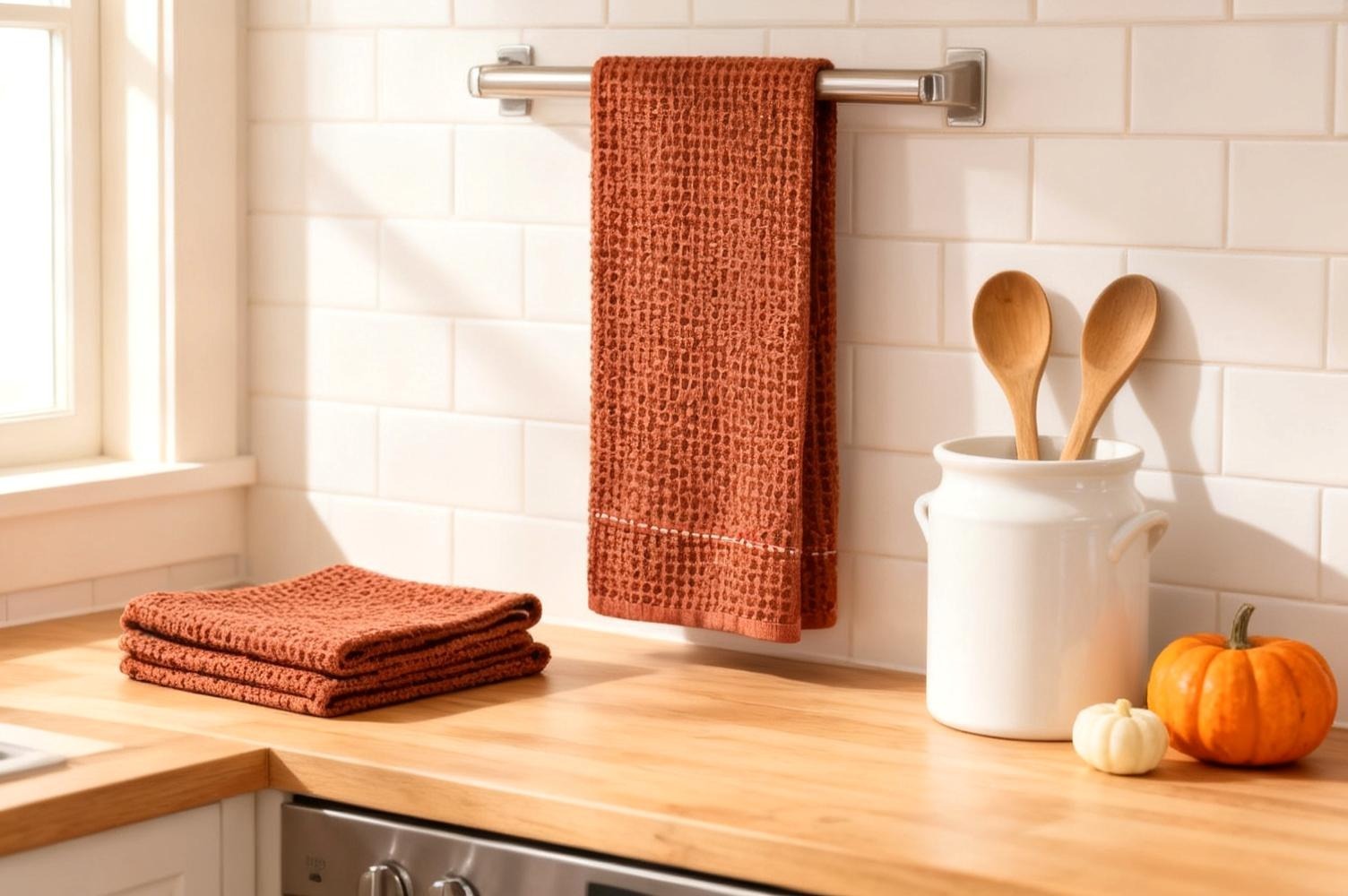
Flour sack cloth is thin, broad, and low-lint. That makes it the useful choice for glasses, covering dough, draining shredded vegetables, and the jobs where a thick terry towel gets in the way.
The 28-inch square also gives you more working area than a narrow decorative towel. It folds down small, but it can handle a full rack of glasses without running out of dry cloth.
Pick it if: lint on glassware bothers you or you want one towel that can cover, strain, and dry.
Skip it if: you want a plush hand towel. Flour sack cloth feels thin because thinness is part of the job.
The honest drawback: plain white does not add much seasonal color. Pair it with one display towel rather than asking it to decorate the room.
Best quick-drying weave: Homaxy check plaid waffle towels
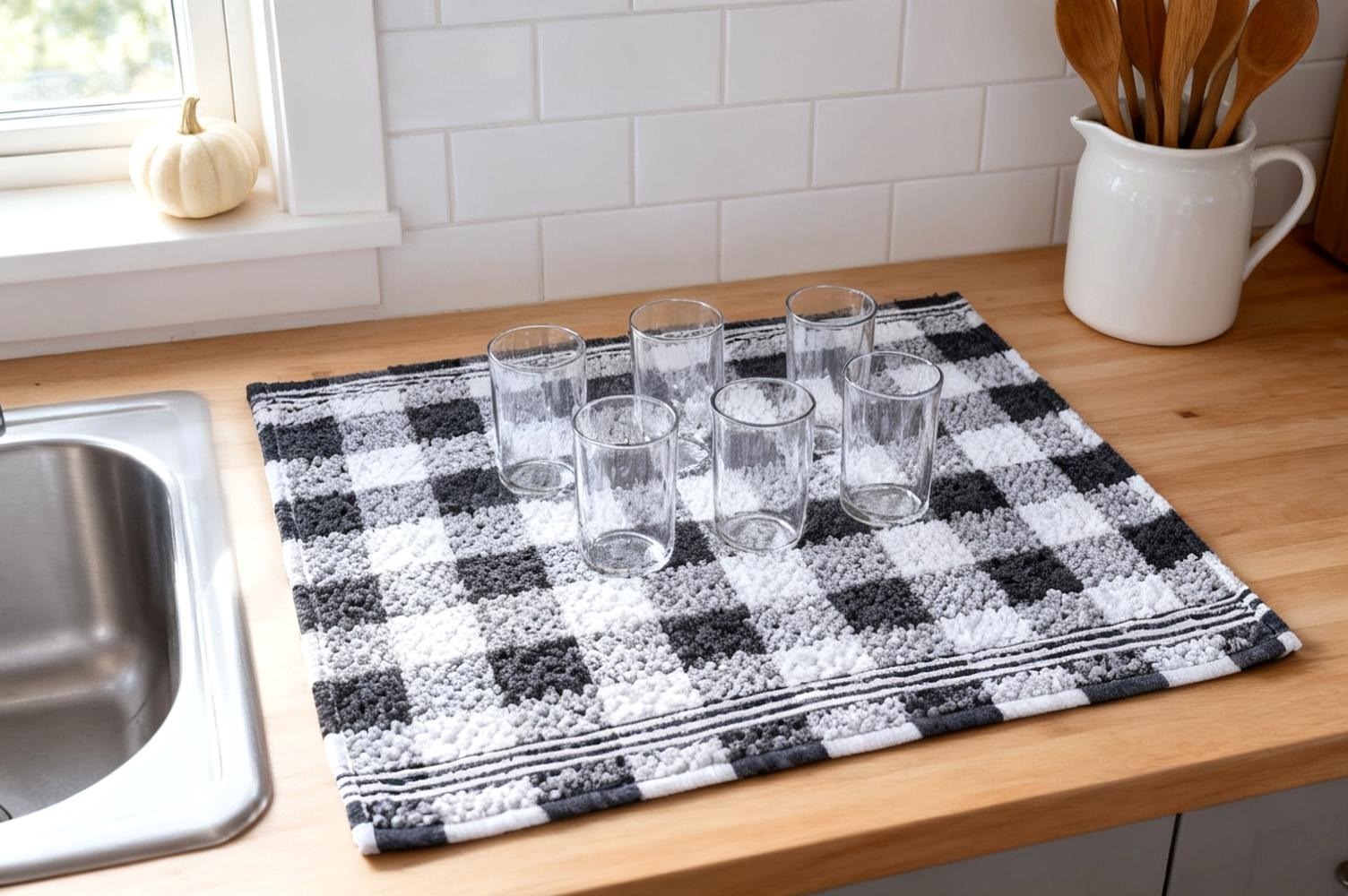
The waffle structure gives damp fabric more exposed surface and airflow than a flat, tightly packed cloth. The black-and-white check works beyond October, which matters if you do not want a cupboard full of six-week designs.
At 13 by 28 inches these are narrower than a flour sack towel, but the four-pack gives you enough rotation to put a used towel in the laundry instead of leaving it damp on the oven handle.
Pick it if: you want a light working towel that dries quickly between small jobs.
Skip it if: you need one large cloth for a full dish rack.
The honest drawback: the smaller size means you may use two during a large cleanup.
Best obvious fall print: Artoid Mode pumpkin towels
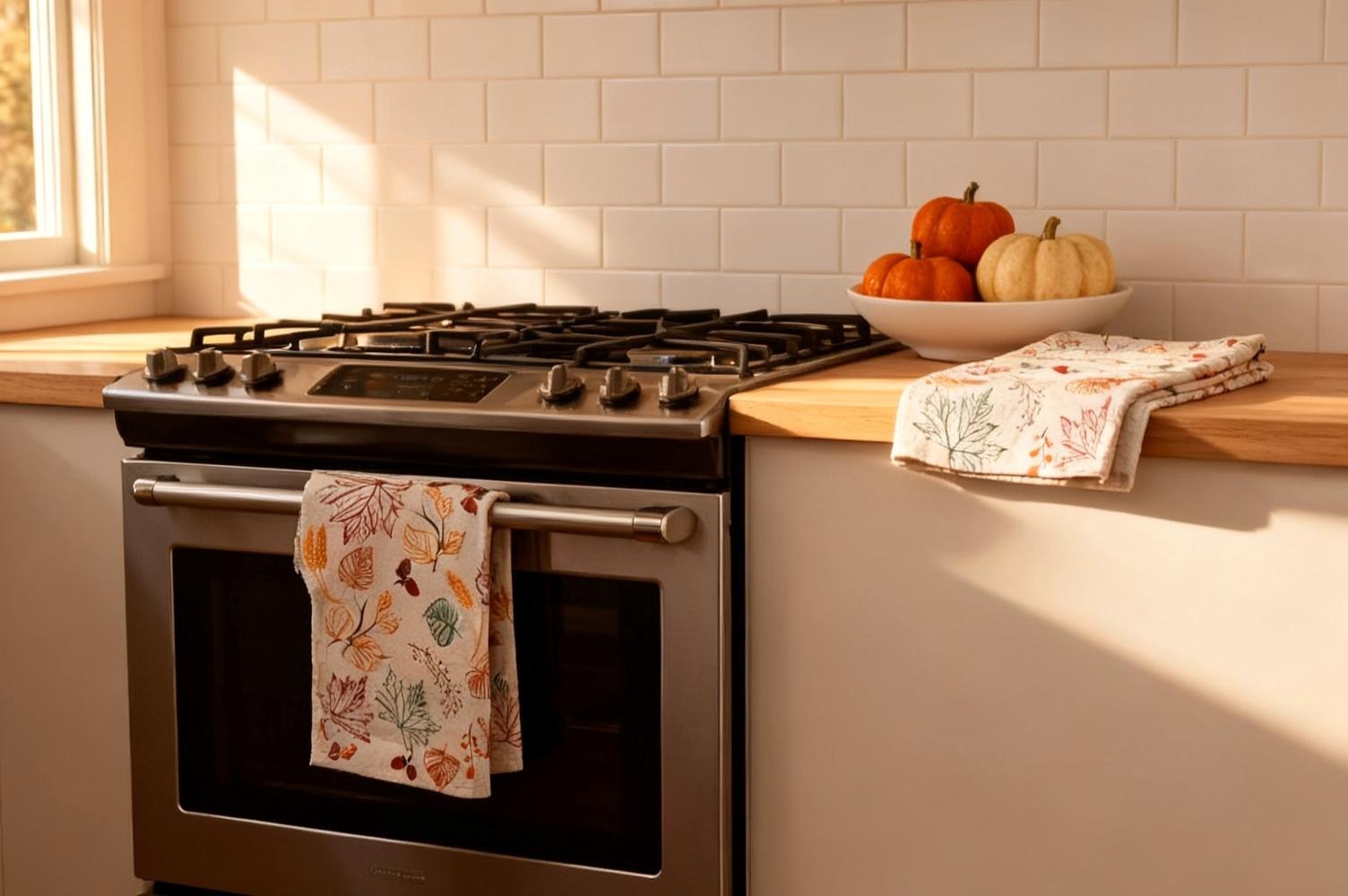
This is the display pair. The pumpkin-and-plaid print reads as fall from the doorway, which is useful if the rest of the kitchen stays neutral.
Treat the printed face as decoration first. Keep a plain cotton working towel within reach so a thick print does not have to dry every pan and glass.
Pick it if: you want one inexpensive, unmistakably seasonal change.
Skip it if: you want a towel that stays out through winter. The print has a short window by design.
The honest drawback: inspect the fabric and print quality while the return window is open.
Why a brand new towel pushes water around instead of soaking it up
Almost everyone has had this. A new towel comes out of the packet feeling wonderful and cannot dry a plate.
Nothing is wrong with it. Towels are finished at the factory to feel soft on the shelf, and those finishes sit on the outside of the cotton. A silicone based softening treatment is the usual explanation given in the towel trade, along with leftover dye and loose fiber. Whatever the exact chemistry, the effect is the same: a coating between the water and the cotton. It washes off over the first few cycles, which is why a towel you have owned for a month works better than the one you bought yesterday.
Fabric softener does the same thing on purpose, and permanently. It works by leaving a thin layer of oils or silicone on the fibers so they feel slippery, and slippery is the opposite of absorbent. Dryer sheets do it too. Detergent buildup and hard water minerals add to the same film over time.
So, for any towel that has to work:
- Wash it before you use it. One cycle starts the process, and full absorbency usually arrives after about three.
- Go easy on fabric softener. It coats fibers, so follow the product and towel care labels and avoid overusing it on the stack that has to absorb quickly.
- Use less detergent than feels right. Overdosing leaves residue, and residue is the thing you are trying to avoid.
- Dry it all the way. Folding a towel that is even slightly damp is what makes a clean stack smell sour a week later.
What each weave is actually good at
Buy the weave for the job rather than for the picture on the packaging.
| Weave | What it does best | The catch |
|---|---|---|
| Terry | Holds the most water, and gives the best padding when you grab a hot handle | Slowest to dry, and it leaves lint on glass |
| Waffle | Absorbs well and dries fast, because the honeycomb moves air | Thinner than terry, so less protection against heat |
| Flour sack | Glassware and anything you want lint free, and it dries fastest of all | Thin, so almost no heat protection |
| Linen | Lint free, resists pilling, and softens rather than wearing out | Absorbed noticeably less than cotton in testing, and it starts out stiff |
| Microfiber | Streak free on hard surfaces | Can melt against a hot pan, and it hazes glassware with static |
That microfiber line is worth sitting with. America’s Test Kitchen left microfiber out of its dish towel testing altogether on the grounds that it can melt when it meets high heat. In a small kitchen the towel hanging on the oven bar is also the thing you grab to move a hot dish, so a towel that cannot handle a hot pan is a genuine hazard rather than a preference.
New linen is stiff because of the natural starches still in the fiber. It takes a couple of washes to soften, so do not judge a linen towel on day one.
The size most fall towels get wrong
Seasonal towels are frequently sold around 18 by 26 inches, and plenty run smaller. A classic flour sack towel is 28 by 28. That difference decides whether you can dry a stack of plates without the towel being soaked halfway through.
Towels also shrink meaningfully in the first wash. In America’s Test Kitchen’s measurements the preferred size was roughly 30 by 20 inches before washing, coming out around 27 by 19 after. If you are buying for real work rather than for the oven handle, buy bigger than you think and let the first wash take it down.
For a display towel the size barely matters. For the working stack it matters more than the color does.
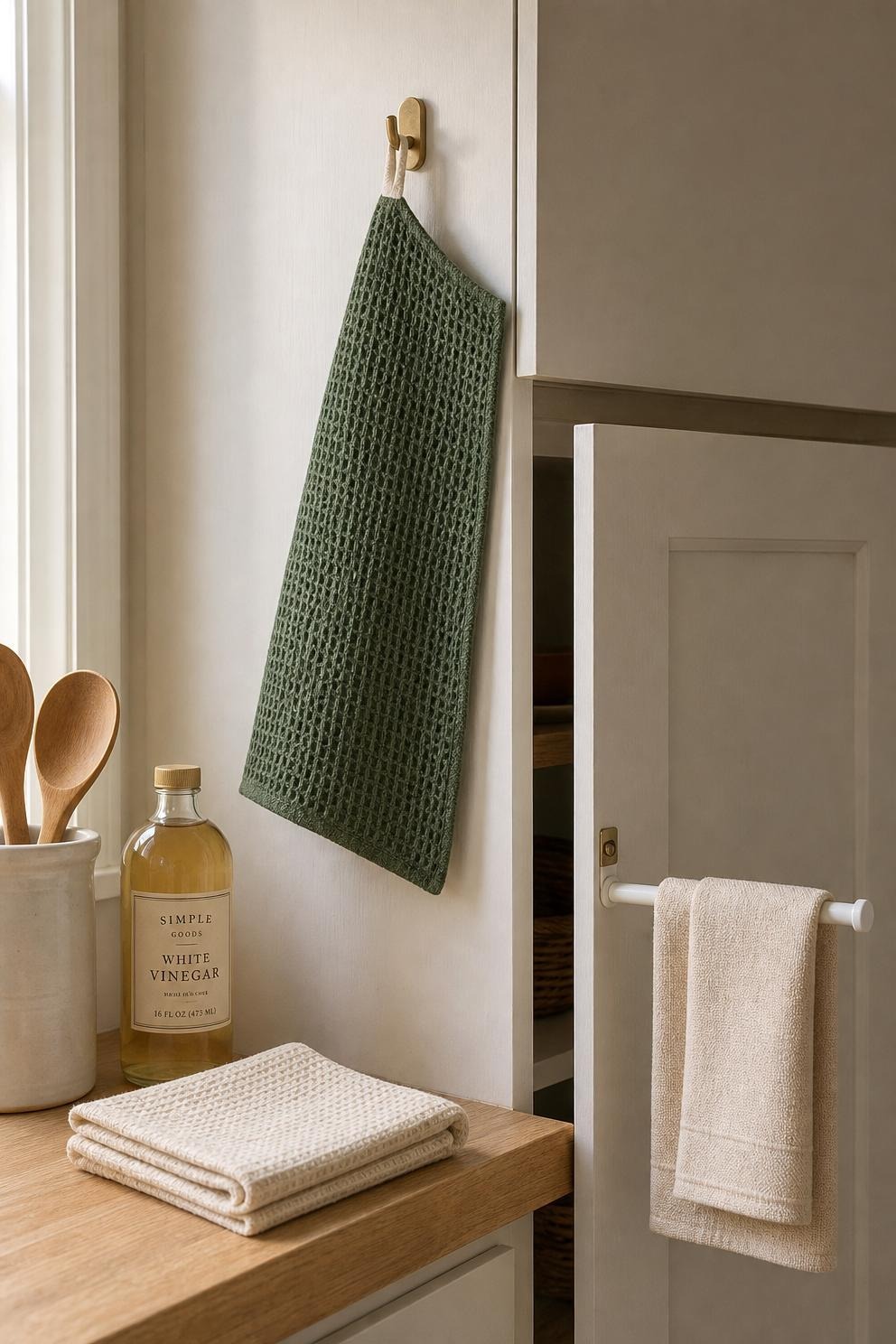
How to Hang a Towel So It Stops Sliding Off
The oven handle is the default, and it has one flaw: a folded towel slides off it about four times a day.
The fix is a knot, and it takes three seconds. Fold the towel in half. Drape it over the bar so the folded center hangs down behind. Reach under, pull that fold toward you, pass the two loose ends through it, and snug it up. It will not slip, and one pull takes it off again.
If you would rather not knot anything, buy towels with a stitched hanging loop and use a hook.
For a rented kitchen with nowhere to screw into:
- Over the cabinet door hooks. Nothing to install, and they put the working towel inside the cabinet door under the sink, out of sight.
- A magnetic hook or bar on the side of the fridge. The most overlooked surface in a small kitchen.
- A tension rod inside a cabinet door. Wedged between the stiles, it holds two folded towels flat.
- Adhesive hooks or a small adhesive bar on the end panel of a cabinet run.
How many you actually need
Two display towels and six to eight working towels covers a household that cooks.
Two display towels because one is always in the wash. Six to eight working ones because the point of a stack is never having to reuse a damp towel, and dampness is the single variable that keeps turning up in the research on kitchen hygiene.
Then keep them separate by job. One for hands, one for dishes, one for wiping down surfaces. A single towel doing all three is how a kitchen moves things around it should not.
Washing and care, including the one contradiction nobody resolves
Here is the thing that trips people up on a new printed fall towel, and almost nothing written about fall kitchen towels covers both halves of it.
Food-safety guidance and first-wash textile care solve different problems, so handle them separately.
For the first wash of a new printed towel, follow its care label and wash it separately. The American Cleaning Institute recommends washing new dark or brightly colored items separately for the first few cycles because excess dye can transfer. Cooler water may reduce fading when the care label allows it; household vinegar is not a substitute for the label.
For towels used during food preparation, wash them frequently and dry them completely. University of Nebraska-Lincoln Extension, citing USDA guidance, notes a common recommendation to change them daily depending on use and to wash them on the washer’s hot cycle. The towel’s care label still controls the hottest safe setting.
One rule is not negotiable. If a towel touches raw meat, poultry, or seafood juices, it goes straight in the laundry and you take a clean one. Not at the end of the meal. Then.
The reason for the fuss is dampness more than use. In one study of a hundred multiuse kitchen towels left unwashed for a month, roughly half showed bacterial growth, and the risk rose with damp towels, larger households, and towels asked to do several jobs at once. That is a study of month old unwashed towels rather than of a stack you launder, but the direction it points is clear enough. The enemy is a towel that never fully dries.
Resetting a stack that has stopped absorbing
If your towels have stopped absorbing, start with the care label instead of a homemade stripping recipe.
- Rewash them with the correct amount of detergent for the machine and load.
- Skip extra laundry additives for that cycle.
- Use the hottest water and dryer setting the towel’s care label permits.
- Repeat once before deciding the fibers are worn out.
The American Cleaning Institute’s laundry guide recommends correcting detergent amount, sorting, and water temperature according to the fabric. That is a safer baseline than combining acids, alkalis, or bleach without a product label directing you to do so.
Putting the fall towels out is a good moment to do this, because you are handling the whole drawer anyway.
What to skip
- Anything whose fiber you cannot identify. Flip the tag. If it says polyester and you meant to dry dishes with it, put it back.
- Heavy applique and thick screen prints on a towel you plan to use. The print is a waterproof panel.
- Heavy fabric-softener use on the towels you rely on for quick absorption.
- A seasonal set for every holiday. Two seasonal towels and a plain stack does more, with far less to store.
- Novelty prints you will not want to look at twice. The gnome towel is funny in the aisle and tiring by October.
- Matching everything. A rust towel, a plain cream stack, and one print is a kitchen. Five coordinated pumpkin items is a seasonal aisle.
What I’d Actually Buy
Product details can change; check the listing before you buy.
- Aunt Martha’s Flour Sack Towels, 28 x 28, set of 7 (opens Amazon in a new tab)As an Amazon Associate, we earn from qualifying purchases. Full disclosure.. The glassware towel, and the one to reach for when a recipe wants cheesecloth or you need to wring the water out of shredded zucchini.
- Homaxy check plaid waffle weave towels, 4-pack (opens Amazon in a new tab)As an Amazon Associate, we earn from qualifying purchases. Full disclosure.. The faster-drying working option and the easiest pattern here to keep out after fall.
- Homaxy 380 GSM Cotton Kitchen Towels, 6-Pack, 18 x 28, with hanging loops (opens Amazon in a new tab)As an Amazon Associate, we earn from qualifying purchases. Full disclosure.. Flat on one side, terry on the other, and the stitched loop is the answer if you would rather hang from a hook than tie a knot.
- Artoid Mode Pumpkin and Buffalo Plaid Fall Kitchen Towels, set of 2 (opens Amazon in a new tab)As an Amazon Associate, we earn from qualifying purchases. Full disclosure.. If you specifically want the pumpkin, this is the one, with the thinnest track record on this list by a wide margin.
If you already own a plain cotton stack that works, buy one seasonal towel and nothing else. That is the whole change.
FAQ
What size should a fall kitchen towel be?
About 18 by 28 inches for general use, and 28 by 28 for a flour sack towel you want to dry a full rack with. Many seasonal towels run 18 by 26 or smaller. Towels also shrink in the first wash, so buy slightly larger than the size you want to end up with.
Why does my new kitchen towel not absorb water?
A new towel may carry finishing residue or loose lint. Wash it according to the care label, separately if it is dark or brightly colored, and test it again after a few cycles before giving up on it.
Can I put fall kitchen towels in the dryer?
Yes, if the care label allows it, and dry the towel completely before folding it. Use the heat setting on the label rather than assuming every cotton blend can take the same high temperature.
How often should kitchen towels be washed?
Frequently, and the right number depends on what the towel did. University of Nebraska-Lincoln Extension notes a common recommendation to change them daily depending on use. Any towel that touches raw meat, poultry, or seafood juices goes in the laundry immediately and gets replaced with a clean one.
Will my rust and orange fall towels bleed in the wash?
The first few washes carry the greatest transfer risk. Follow the care label and wash a new printed or deeply colored towel separately. After that, sort it by color and soil level, and choose the hottest setting the label permits when food-safety cleanup calls for it.
Are microfiber kitchen towels a good idea?
Not as your main kitchen towel. Microfiber can melt against high heat, which is a real problem for the towel hanging on the oven bar, and it tends to leave a static haze on glassware. Cotton is the safer default around a stove.
Sources
- University of Nebraska-Lincoln Extension: How Often Should You Change Your Kitchen Towels? covers changing, hot-cycle washing, complete drying, and raw-meat contamination.
- USDA Food Safety and Inspection Service: Washing Food and Kitchen Cross-Contamination recommends frequent hot-cycle washing when cloth towels are used for kitchen cleanup.
- American Cleaning Institute: Laundry Basics covers sorting new dark or bright textiles and following care labels.
What to Read Next
- Fall Kitchen Decor Ideas for a Small Kitchen adds seasonal color without taking over the counters.
- Apartment Fall Decor: 8 Ideas With No Mantel Needed carries the same small-space approach into the rest of a rental.
- Hygge Home Checklist: 12 Small Changes for a Cozier House builds a cozier room from practical changes rather than seasonal clutter.
- 3 Earthy Textures That Make an Apartment Feel Like Home helps pair cotton towels with wood, linen, and other natural materials.