Most fall kitchen decor advice assumes you have counter to spare. A tiered tray here, a garland there, a stack of decorative books next to the stove. In a galley kitchen or an apartment kitchen with four feet of usable counter, every one of those becomes something you pick up and put down again while you are trying to cook.
The version that works is different. In a small kitchen, the things that read as fall are the things already earning their space: what you dry your hands on, what sits in the fruit bowl, what the light does at five in the afternoon.
Nothing here is permanent, and nothing needs a drill.
Clear One Surface Before You Add Anything
The single biggest change is subtraction, and it costs nothing.
Pick the surface you see first when you walk in. Usually that is the run of counter beside the stove or the one under the window. Take everything off it. Then put back only what you use more than twice a week.
The blender you use on Sundays goes in a cupboard. The mail goes somewhere that is not the kitchen. What is left is a surface with room on it, and room is what makes a small kitchen feel seasonal instead of crowded.
This sounds like organizing rather than decorating. It is the step that makes every other idea below actually visible.
This article contains affiliate links. If you buy through them, Etheric Echoes may earn a commission at no extra cost to you. As an Amazon Associate I earn from qualifying purchases. Read the full disclosure.
Swap the Textiles First
Tea towels are the cheapest seasonal change in the house and the one people skip.
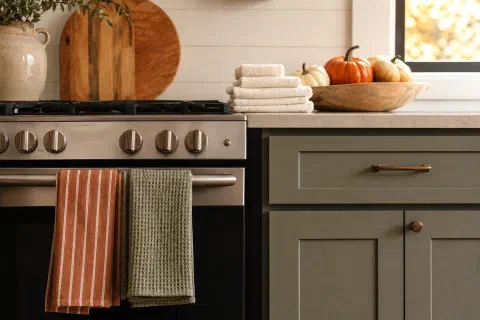
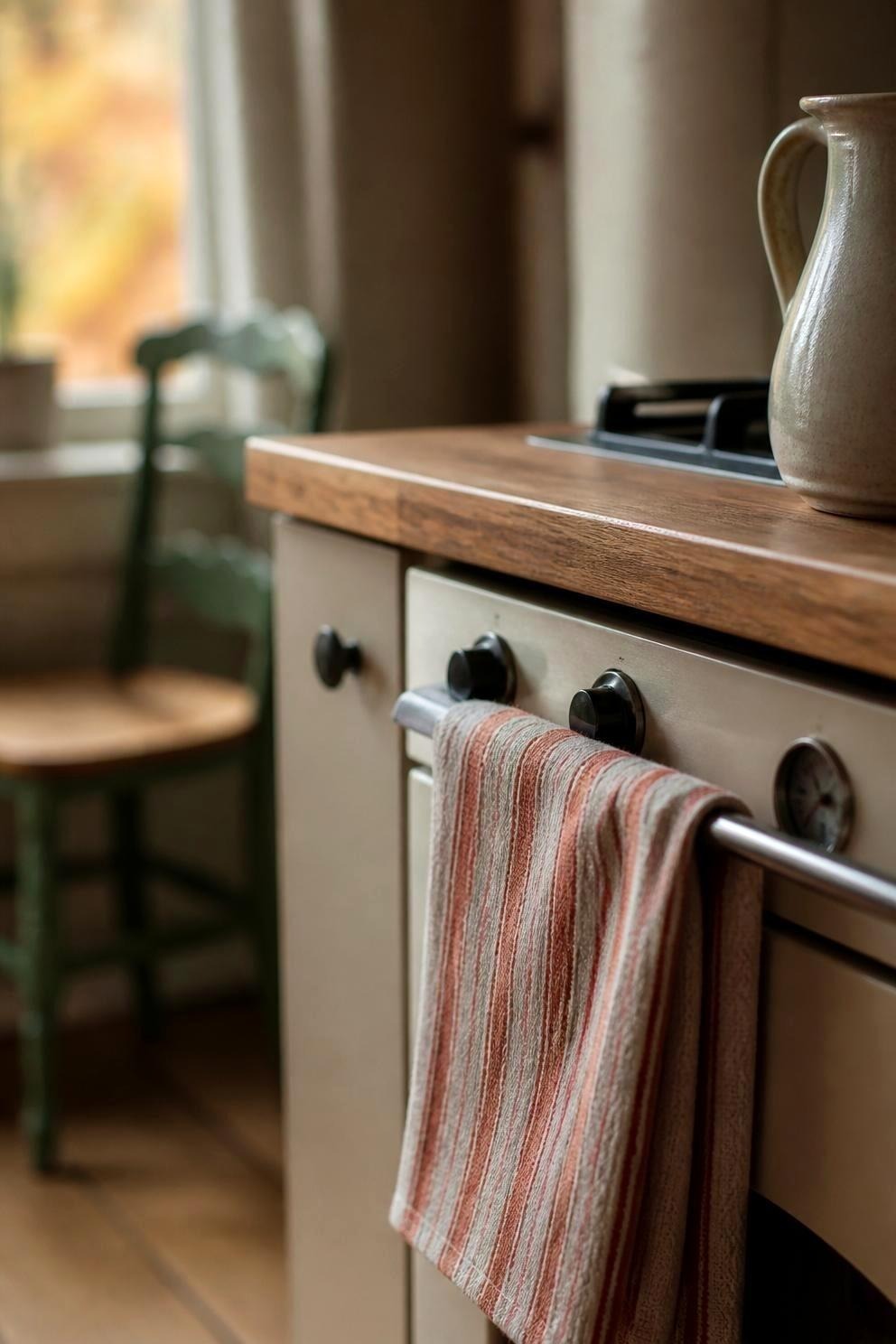
Move the bright summer stripes to the back of the drawer. Bring forward rust, oatmeal, deep green, mustard, or anything in a woven check. Two olive cotton tea towels (opens Amazon in a new tab) are enough: one over the oven handle, one folded by the sink.
If you have a bit of counter or a small table, a short runner in the same family pulls the whole room toward autumn without occupying usable space. Linen and cotton wash and go back out. That matters more in a kitchen than in any other room, because everything in here eventually gets something spilled on it.
Look for something you would still use in February. A towel printed with pumpkins has a six week life. A rust waffle-weave towel works from September through March.
If you want to go further on this one change, fall kitchen towels covers which weaves actually absorb, why a new towel repels water, and how to wash a printed one so the dye does not run.
Let the Produce Be the Decor
Fall is the one season where the food is the arrangement.
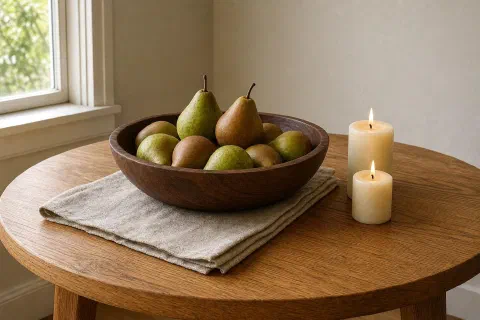
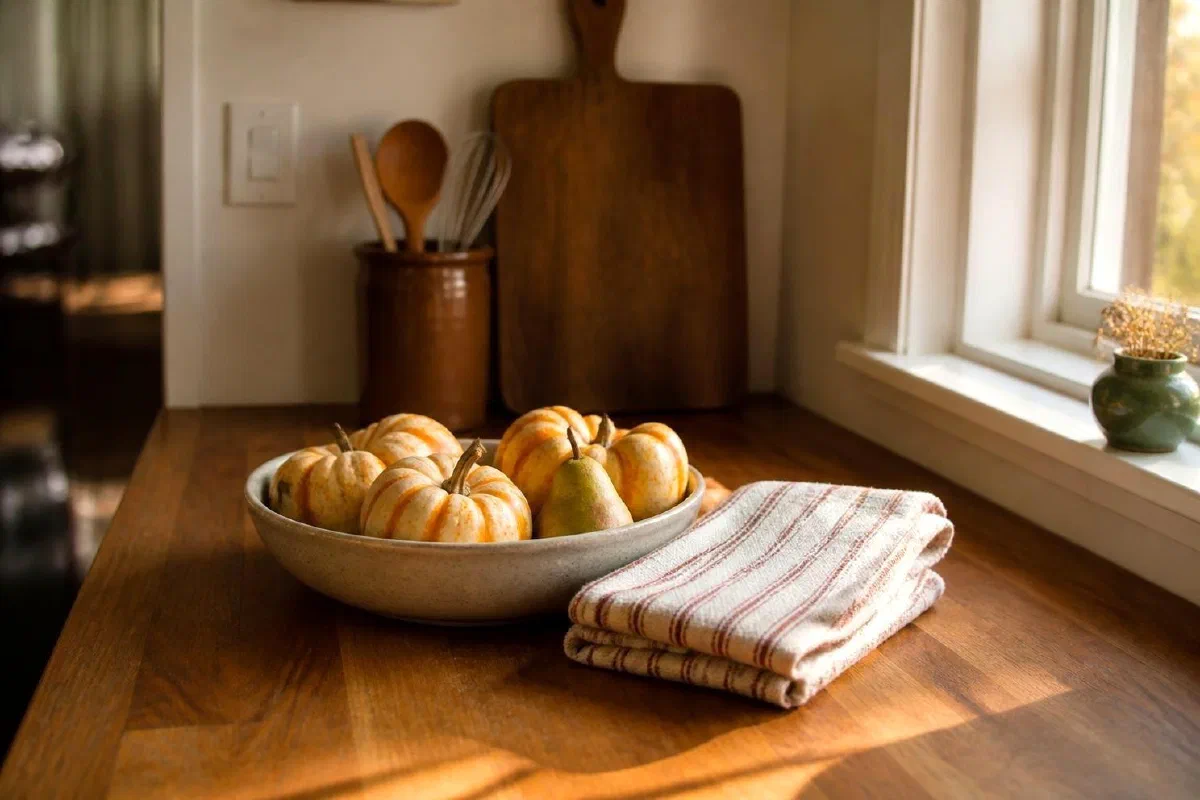
A shallow bowl of small squash on the counter reads as autumn from the doorway. Delicata, acorn, and small pie pumpkins hold for weeks at room temperature and then get roasted, which is the part most decor cannot claim. Pears and apples do the same job and turn over faster.
Keep it to one bowl and one type of thing at a time. A bowl of squash is a still life. A bowl of squash next to a bowl of gourds next to a bowl of apples is a produce section.
If you have a windowsill, that is the better spot. It gets the food off the working counter and puts it where the afternoon light hits it.
Drop the Light to 2700K
Kitchens are usually the coldest lit room in a house, because they are lit for tasks. Overhead fixtures at 4000K or higher throw a bluish light that reads as fluorescent, and no amount of textiles will fix a room lit like a break room.
The DOE’s bulb buying guidance splits color temperature the same way. It lists 2,700 K as warm, friendly light for homes, libraries, and restaurants, and 4,100 K as neat, clean, efficient light for offices, classrooms, and showrooms. If the fixture over your counter is in the second group, that is the whole problem.
Check the bulb box for the number. 2700K is often labeled soft white or warm white, and the reasoning behind the 2700K rule is the same one that governs the living room. Sylvania’s 8-pack A19 bulbs (opens Amazon in a new tab) are 2700K, 9 watts, and 750 lumens, which is the usual 60-watt-equivalent size for a kitchen fixture. Changing the bulbs over a small kitchen takes ten minutes and does more for the mood of the room than everything else on this list combined.
Then add a second, lower light source. A small plug-in lamp at the end of the counter, or a strip of stick-on under-cabinet lights aimed down at the work surface, means you can turn the overhead off entirely after dinner. A small kitchen with one warm pool of light at counter height stops looking like a workspace and starts looking like part of the house.
Put Out Only What You Cook With
Open shelves and countertop styling go wrong in small kitchens when the objects are chosen to be looked at.
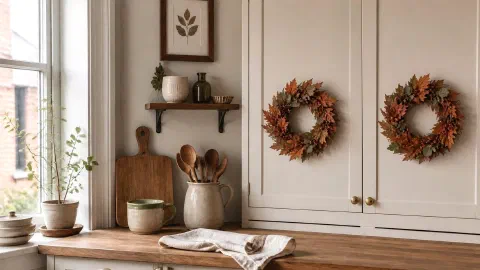
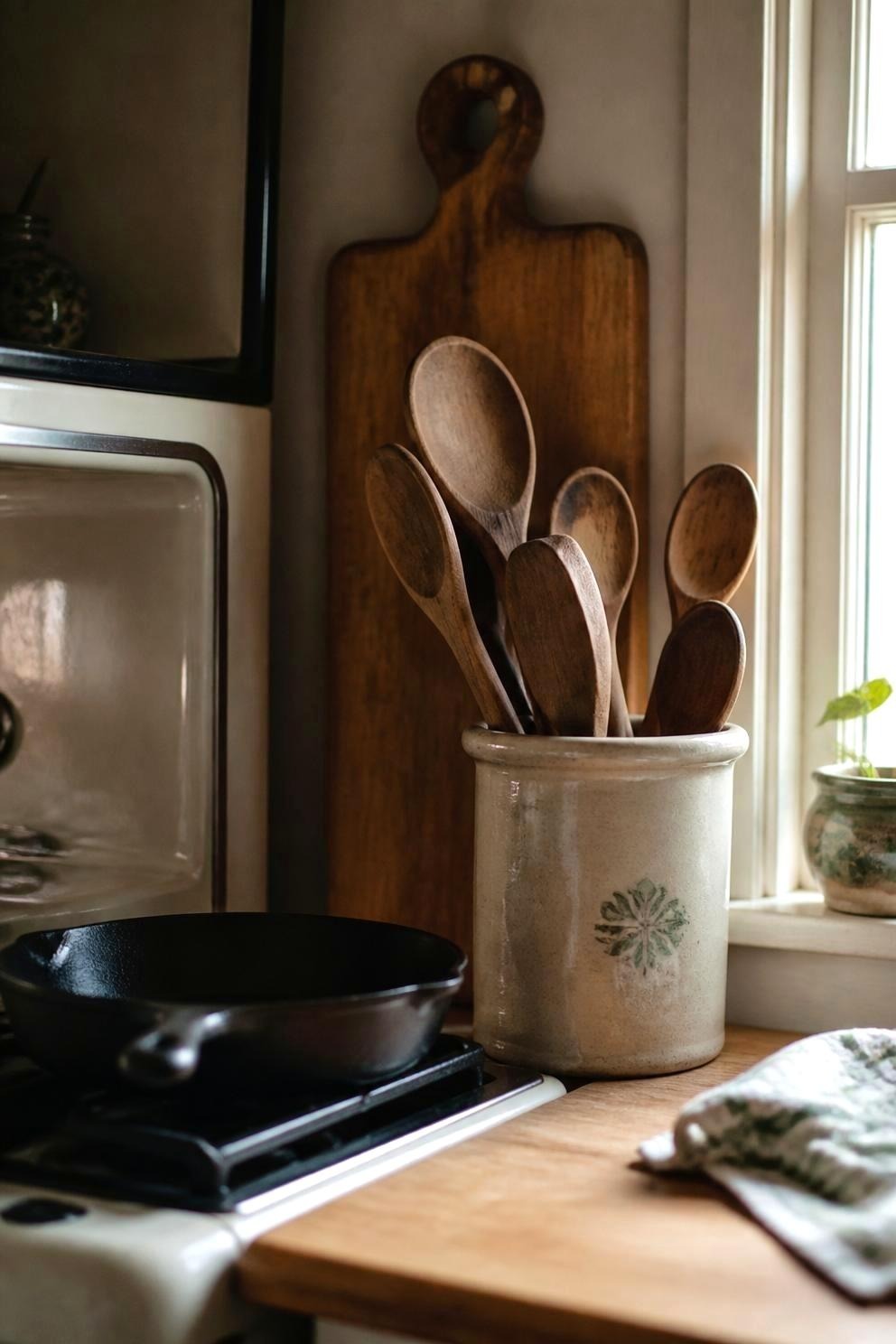
The things that work are the ones with wear on them. A wooden board leaning at the back of the counter. A stoneware crock holding the spoons you actually reach for. A cast iron pan that lives on the stove because you use it three times a week. Warm materials, and every one of them doing a job.
Two or three objects on a run of counter. Not seven. In a small kitchen the gaps between things are what keep it from reading as clutter, and gaps are the first thing people fill.
When you are deciding which appliance stays out, material is the tiebreaker.
| What it is | How it reads under a low warm bulb | Where it goes in a small kitchen |
|---|---|---|
| Wood, stoneware, unglazed clay | Warm and matte, and it shows wear | On the counter, in daily use |
| Linen or cotton in rust, oatmeal, or deep green | Warm, and it softens a hard edge | Towel rail, oven door, sink edge |
| Chrome, plastic, clear glass | Cold, and it bounces the overhead back at you | In the cupboard, unless you use it every day |
One Living Thing, Near the Window
A kitchen with something growing in it feels different from one without, and in fall that does not have to mean flowers.
Herbs are the practical choice, since you cook with them and they want the same window you already have. Rosemary, thyme, and sage are the tough ones here: all three want what Penn State Extension defines as full sun , six or more hours of direct light a day, so a sill that only catches a couple of hours will leave them thin and leggy. Basil is the one to give up on. It is a tender annual that quits at the first cold night, so stop replacing it in October.
If your window is dark or you travel, dried stems do the same work with none of the upkeep. Wheat, bunny tail grass, or a few branches of eucalyptus in a stoneware jug last the whole season and beyond.
When the sill is already full, hang something instead. A mini wreath sized for small spaces sits in the window frame or on a cabinet front and takes no counter at all.
One vessel, one kind of thing. This is the same rule as the produce bowl and it is the rule that keeps small kitchens calm.
Make the Room Smell Like Fall Without a Candle
An open candle on a small kitchen counter competes for the space you need and sits near things that catch.
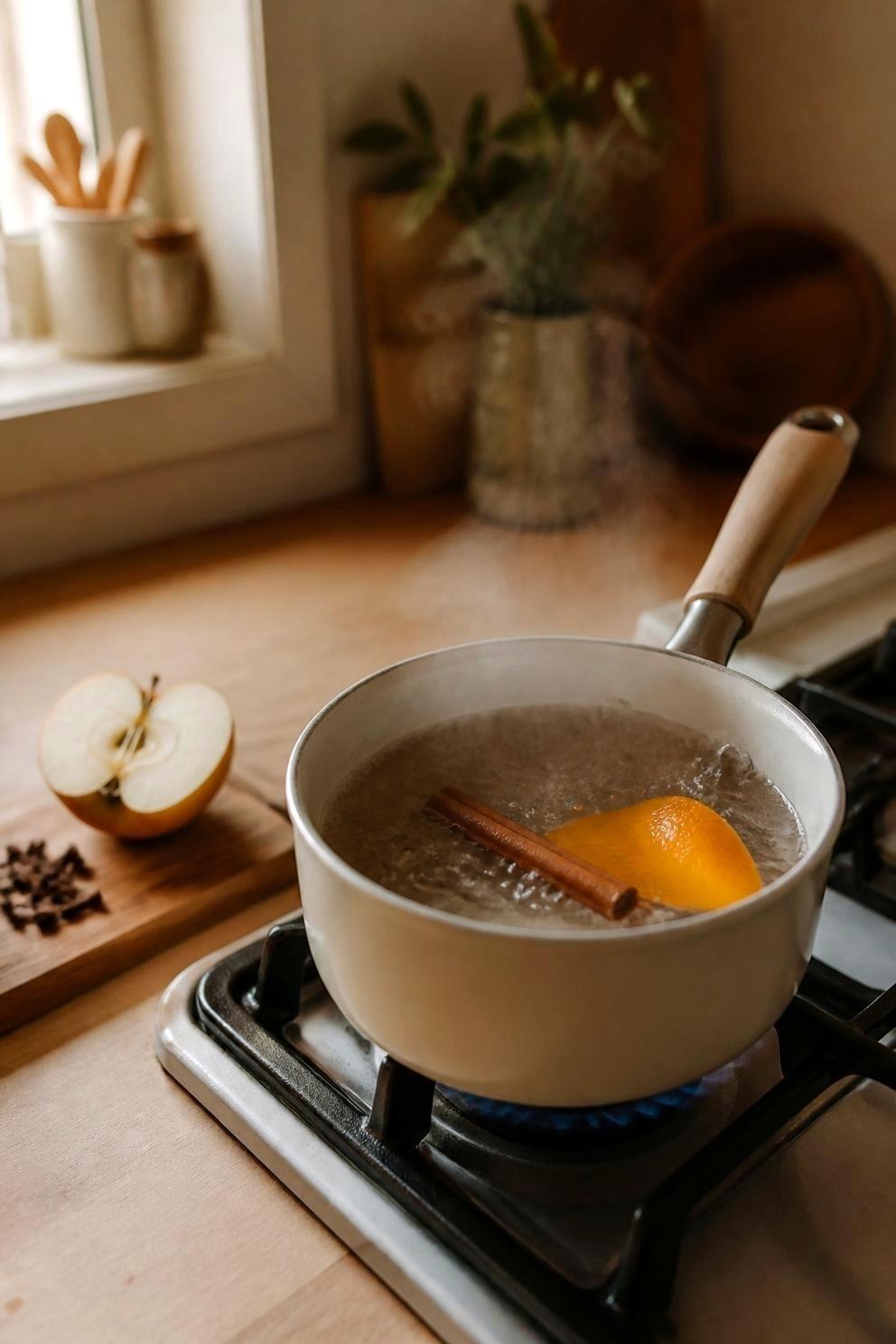
Put a small saucepan of water on the back burner instead. Add a strip of orange peel, a cinnamon stick, a few cloves, and a slice of apple if you have one going soft. Bring it to a bare simmer and leave it twenty minutes with the lid off. Top the water up if you leave it longer, and never let it run dry.
The scent carries further than a candle in an apartment, it costs whatever the peel would have cost in the compost, and it comes from ingredients you already have in October.
What to Skip
A few things consistently do not earn their space in a small kitchen.
Tiered trays take a square foot of counter to hold objects that do nothing. Garlands over a cooking surface collect grease and are a genuine fire consideration above a stove, so hang the garland somewhere with no burner under it instead. Decorative signs with a word on them read as filler, and they read that way faster in a room this small. Anything scented and artificial competes with the food.
The test for every piece is the same: if you had to move it to chop an onion, it is in the wrong place.
What I’d Actually Buy
Do the bulbs first. The towels second. Everything else in this article uses things you already cook with.
- Sylvania ECO A19 2700K, 8-pack (opens Amazon in a new tab) (4.7 stars, about 23,400 reviews). Soft white, non-dimmable, 750 lumens. Enough to change every fixture in a small kitchen in one order.
- LANE LINEN olive dish towels, 6-pack (opens Amazon in a new tab) (4.5 stars, about 10,600 reviews). Tightly woven cotton. Put two out and keep the rest in the drawer for spills.
Check the listing for the current color option. Olive is the one that reads as fall without a pumpkin print.
Start Here This Week
If you do nothing else this week, do these three in this order.
- Change the bulbs. One order covers every fixture in a small kitchen.
- Swap the towels. Two out on the rail, the rest back in the drawer.
- Clear the surface you see first. Put back only what you use more than twice a week.
That is an afternoon, and it carries most of the seasonal change on its own. The rest follows by itself, because in a small kitchen fall decor is mostly just cooking what is in season with the light turned down.
What to Read Next
Fall kitchen towels for which weaves actually absorb and how to wash a printed towel without the dye running.
Warm white light bulbs for a living room if the 2700K change worked in the kitchen and you want the same light through the rest of the house.
A mini wreath sized for small spaces when the windowsill is full but you still want one seasonal piece that takes no counter space.
Fall garland ideas for where a garland can actually hang in a small kitchen without ending up over a burner.