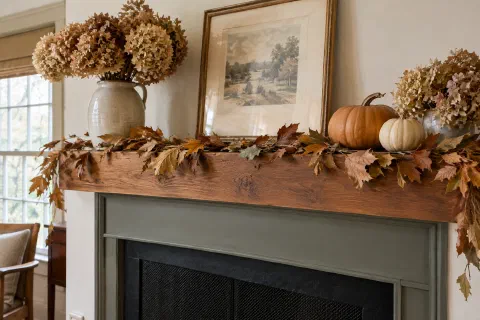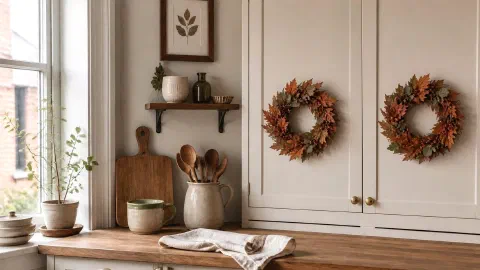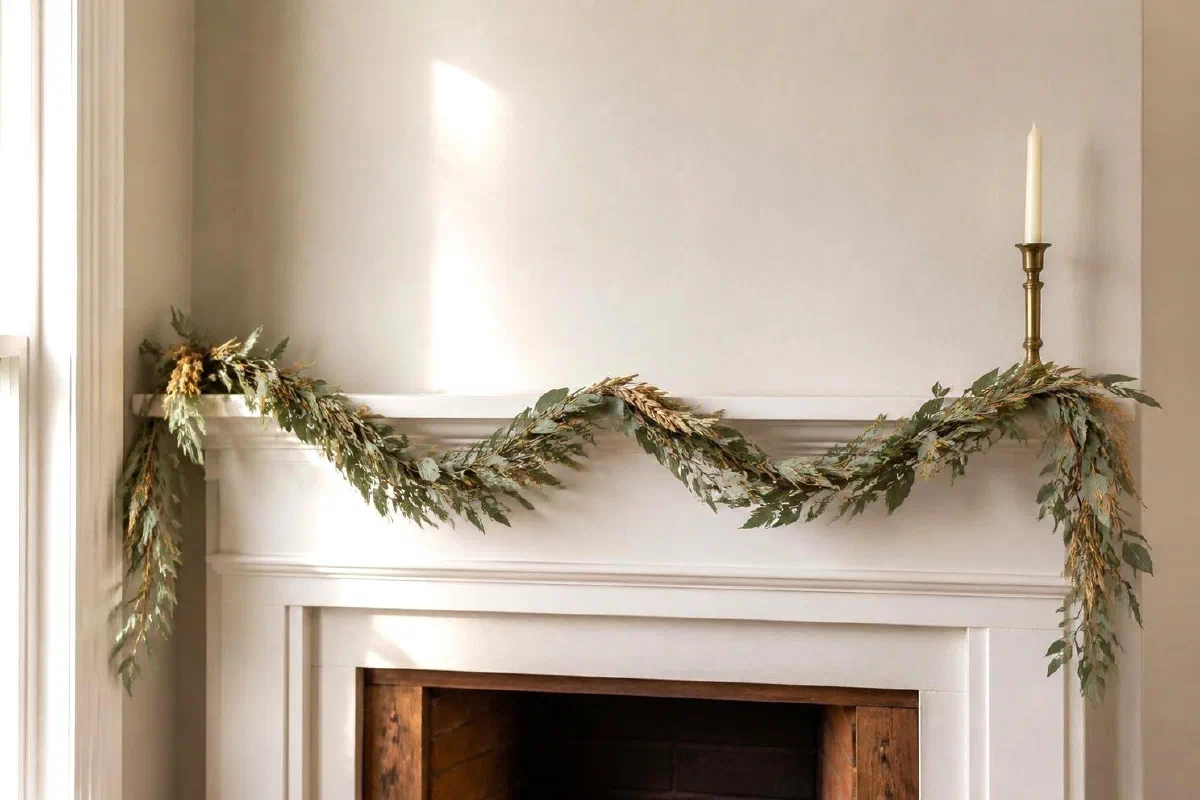
A fall garland sold as 13 feet is usually two separate pieces of 6.5 feet. The listing for one of the best-selling maple vines on Amazon says so in its own first bullet: two garlands, “each measuring 6.5 FT/78.7 INCH in length. If you want it to look plump, you will need to wrap it together.”
The manufacturer just told you what the photo does not. The garland in the picture is two strands wired into one. So if yours came out thin, sagging in the wrong place, and off the mantel by the second week, the garland is fine. What went wrong is length and attachment, and both are fixable in an afternoon without a drill.
The three places a fall garland genuinely works
Three, and they share three traits: a line at or above eye level, a structural edge you can grab from behind or underneath, and no traffic passing through.
A mantel shelf is the best spot in the house, because the shelf gives you a hidden underside to anchor to. A stair railing is the one place a garland gets to be long, which is what makes it read as intentional. A porch rail or exterior door frame has better light and room to move, which is why porch garland photographs well.
A few popular alternatives are worse than nothing.
| Spot people try | Why it fails |
|---|---|
| Over a television | Soft foliage against a black rectangle, and the rectangle wins. Also traps heat on the vents |
| An interior doorway you walk through | It hangs into an 80 inch opening, gets brushed, and comes loose weekly |
| Above a cooktop or range hood | Grease and heat on dry foliage |
| Dangling off a working fireplace | Fire risk, with a code number attached. See below |
How much fall garland to buy
This is the part no retailer page tells you, and it is the biggest reason a mantel comes out sparse.
Check whether the footage is per piece or per pack. “2 Pack, 6 Feet/pcs” means two usable six-foot runs. “2Pcs 13FT” means two pieces of six and a half. Read the bullets, not the title.
The drape costs almost nothing. The tails cost everything. A six-inch dip across a thirty-inch half span adds only about three inches of garland. What eats length is the tail hanging past each end of the shelf, and the tail is what makes a mantel garland look finished rather than pinned.
So the formula is the run plus two tails, then doubled if you want the catalogue version:
| Mantel width | One strand, 12 inch tails | Two strands layered |
|---|---|---|
| 4 feet | 6 feet | 12 feet |
| 5 feet | 7 feet | 14 feet |
| 6 feet | 8 feet | 16 feet |
A six-foot garland on a five-foot mantel leaves six inches of droop at each end. That is a wire with leaves on it.
Stair rails need far more than people expect. Measure along the rail, not across the floor. A standard flight to an eight-foot ceiling runs about fourteen risers at seven and a half inches with thirteen treads at ten inches, so each step’s diagonal is 12.5 inches and the sloped rail is roughly 13.5 feet.
The spiral then adds to that, and spacing decides how much. On a round handrail about two inches thick, wraps a foot apart make the garland travel about 13 percent farther than the rail, since each turn covers twelve inches forward plus roughly six around. Wraps six inches apart travel about 45 percent farther.
| Rail treatment | Garland for a 13.5 foot rail |
|---|---|
| Wraps a foot apart, single strand | about 16 feet |
| Wraps six inches apart, single strand | about 20 feet |
| Wraps a foot apart, doubled | about 32 feet |
Three or four of the common six-foot strands for a thin spiral, six or more for a full one. That is why stair garland looks better in magazines than in most houses. Not better technique, four times the material.
This article contains affiliate links. If you buy through them, Etheric Echoes may earn a commission at no extra cost to you. As an Amazon Associate I earn from qualifying purchases. Read the full disclosure.
Hanging it in a rental without nails
One mechanical idea makes all of this work: an adhesive hook is far stronger pulling straight down a wall than pulling out away from it. Hanging weight is shear, and peeling is what breaks the bond. Every method below arranges things so the garland pulls down a surface instead of off it.
The real weight ratings, from 3M’s own published product specs:
| Command product | Rated hold |
|---|---|
| Clear indoor mini light clips | 0.3 lb |
| Small wire hooks | 0.5 lb |
| Small utility hooks | 1 lb |
| Outdoor terrace hooks | 3 lb |
| Large utility hooks | 5 lb |
| XL heavyweight wall hook | 15 lb |
A bare faux maple vine weighs a few ounces, so a small wire hook (opens Amazon in a new tab) at half a pound is plenty. A six-foot lit garland with pine cones, a battery pack, and small pumpkins wired in can pass a pound, which is when you want a large utility hook (opens Amazon in a new tab) rated to five.
Distribute before you upsize. Three small hooks along a six-foot run beat one large hook. Failure is almost never adhesive tearing, it is one point peeling because all the load arrived there. Spreading it also puts hooks where the garland wants to touch, which produces an even drape instead of a triangle.
The temperature limit nobody reads. Indoor Command strips specify an application temperature between 50 and 105 degrees Fahrenheit. A porch rail in late October in Zone 6 is regularly below that, which is why indoor strips let go in November and get blamed on the product. The outdoor terrace hooks (opens Amazon in a new tab) use weather-resistant adhesive rated from minus 20 to 125 degrees. If the garland is going outside, buy the outdoor version.
What actually pulls paint off. Three things, all from the manufacturer’s own instructions. Paint needs seven days to cure before you stick anything to it. Wallpaper is a no. And removal means holding the top of the strip and pulling it straight down toward the floor, slowly, so it stretches. Yanking outward takes the paint with it. Prep with rubbing alcohol, not a household cleaner, because most cleaners leave a film the adhesive cannot bond through.
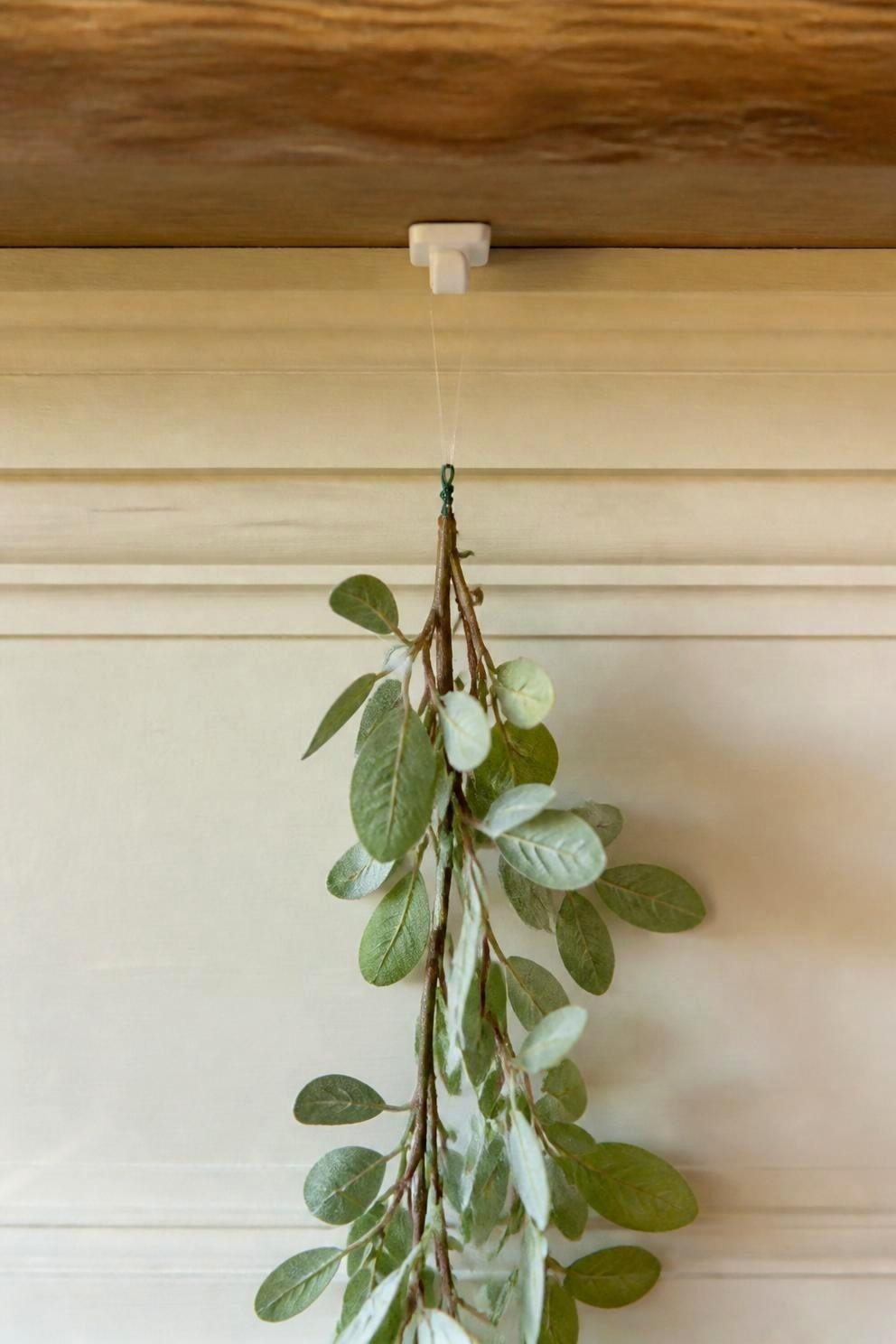
The underside of the mantel is the best trick here. Set your hooks on the underside of the shelf, an inch or two back from the front edge. From standing height they are invisible, the garland hides the rest, and the pull is straight down. On painted plaster above the shelf you would be fighting peel. On finished wood underneath, you are not.
Tension between two anchors. For a window frame, a doorway you only look at, or a long bare wall, put one hook at each end, run clear monofilament fishing line between them pulled taut, then wire the garland to the line at four or five points. The line carries the span, the hooks take only a downward pull, and 20-pound-test line disappears at arm’s length.
Floral wire for anything with a post or a spindle. On a stair rail, a porch rail, or a shepherd’s hook you need no adhesive at all. Green 22 gauge paddle wire (opens Amazon in a new tab) wraps around the rail and twists to itself, holds a heavy garland, and comes off with a snip.
Hanging a fall mantel garland, step by step
- Wipe the underside and front face of the shelf with rubbing alcohol. Let it dry.
- Overlap both strands on the floor along their whole length and wire them together every 12 inches. Bend the leaf stems out in different directions now, while you can reach all of it.
- Mark the center of the doubled garland with a loose twist of wire.
- Press one hook to the underside at the center, then one six inches in from each end. Three minimum, five for a six-foot mantel.
- Wait an hour. Adhesive needs time to bond, and this is the step everyone skips.
- Hang the center mark first, then work outward, letting the garland dip between hooks instead of pulling it tight.
- Let the ends hang past the mantel legs, one about 12 inches and one closer to 16.
- Weight both tails with a small gourd, a pine cone cluster, or a few extra stems so they hang straight instead of curling back toward the wall.
Steps 6 through 8 are the difference between draped and flat. Two anchor points give one long dip that reads as a clothesline, three give two shallow dips that read as fabric, and matched tails with matched dips look manufactured.
Stair railings, specifically
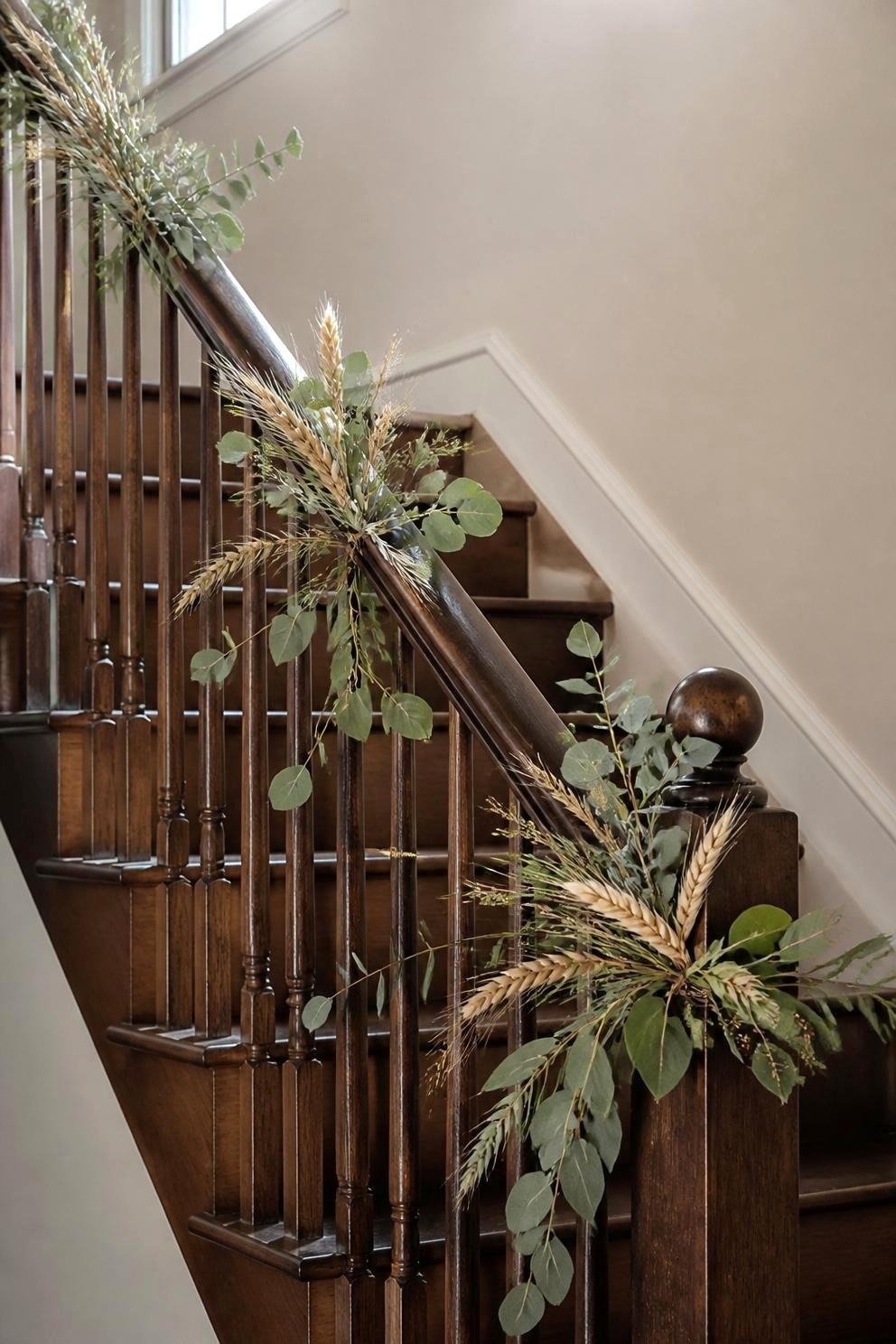
Gather the volume at the newel post. One strand spread evenly up thirteen feet of rail is thin everywhere. Put a full cluster at the bottom post, taper as you climb, finish the top cleanly. The bottom post is what people see from the entry.
Wrap from underneath, so each wire twist ends up out of sight and out of the way. Floral wire, not adhesive: a rail flexes, and a handrail is not a smooth flat surface.
Keep the grip clear. The IRC requires at least 1.5 inches of clearance between a wall and a handrail, and requires the rail to run continuously for the full flight. That clearance exists so a hand can close around the rail, which makes it exactly the space a fat garland wants to fill. Wrap the outside and top, not the wall side, and leave enough room to grip. On a stairway anyone navigates in the dark, this matters more than the garland does.
Faux, dried, or fresh, decided honestly
All three are right for different spots, and most advice picks a winner without asking where it is going.
The same decision comes round again in December with a different palette and a different fire risk, and christmas garland has its own measurement and greenery rules worth reading before you buy a second set of hooks.
| Holds up for | Smell | Best spot | |
|---|---|---|---|
| Fresh cedar, eucalyptus, magnolia | days to a few weeks with care | the real thing | one weekend, or a cool covered porch |
| Dried wheat, grasses, glycerin magnolia | one season to several years | faint | an interior mantel or shelf, out of sun |
| Faux | several seasons | none | a stair rail, a porch, anything handled |
Fresh wins on a short timeline in a cool spot. Clemson’s Home and Garden Information Center notes that pines, firs, and cedars may last several weeks indoors if properly treated, while broadleaf evergreens do better outdoors. Two conditioning steps are worth doing: crush the ends of woody stems so the cutting takes in more water, then immerse the greenery in water overnight before arranging.
Clemson is blunt about the hazard, which is why a garland on a working fireplace needs thought: dried evergreens become flammable in close contact with a heat source such as a candle flame or a fireplace. Keep fresh greenery away from space heaters, heater vents, and sunny windows, and pass on anything shedding or brown at the tips. IRC section R1001.11 keeps combustible mantels and trim out of the six inches immediately around a fireplace opening and limits anything within twelve inches to a projection of one eighth of an inch per inch of distance. A foot of dry maple vine dangling toward a firebox sits squarely in the zone that rule protects. If you light real fires, run faux on the fireplace and put the fresh cedar somewhere else.
Dried wins on an interior mantel, and costs least per season if you grow anything. For stems, MU Extension gives the method: group them into small bunches, tie with a rubber band, which pulls tighter as the stems shrink, then hang somewhere warm, dry, dark, and well ventilated out of direct sun. An attic or a closet, two to three weeks.
For leaves, glycerin is better. Clemson’s drying guide preserves magnolia and colored fall leaves in a warm mixture of one part glycerin to two parts water. Use mature leaves, mash the stem ends with a hammer, keep branches under 18 inches, and expect two to three weeks until the entire leaf turns golden brown. The payoff is worth planning around: the leaves stay flexible, and glycerized magnolia garland stays good for years. Eucalyptus takes glycerin the same way.
Faux wins anywhere the garland gets touched. A stair rail is handled by everyone in the house and a porch rail takes rain and wind. Neither suits something brittle. A UV-protected eucalyptus garland (opens Amazon in a new tab) at 4.3 stars across 8,000-plus ratings comes out of the box the same in year three.
The fall garland that is not orange
Search results here are almost entirely maple leaves in five shades of orange, and plenty of readers want fall without that. The neutral version is mostly different plant material.
- Eucalyptus, silver dollar or seeded, for grey green. The most useful garland to own, since it carries from September through the holidays.
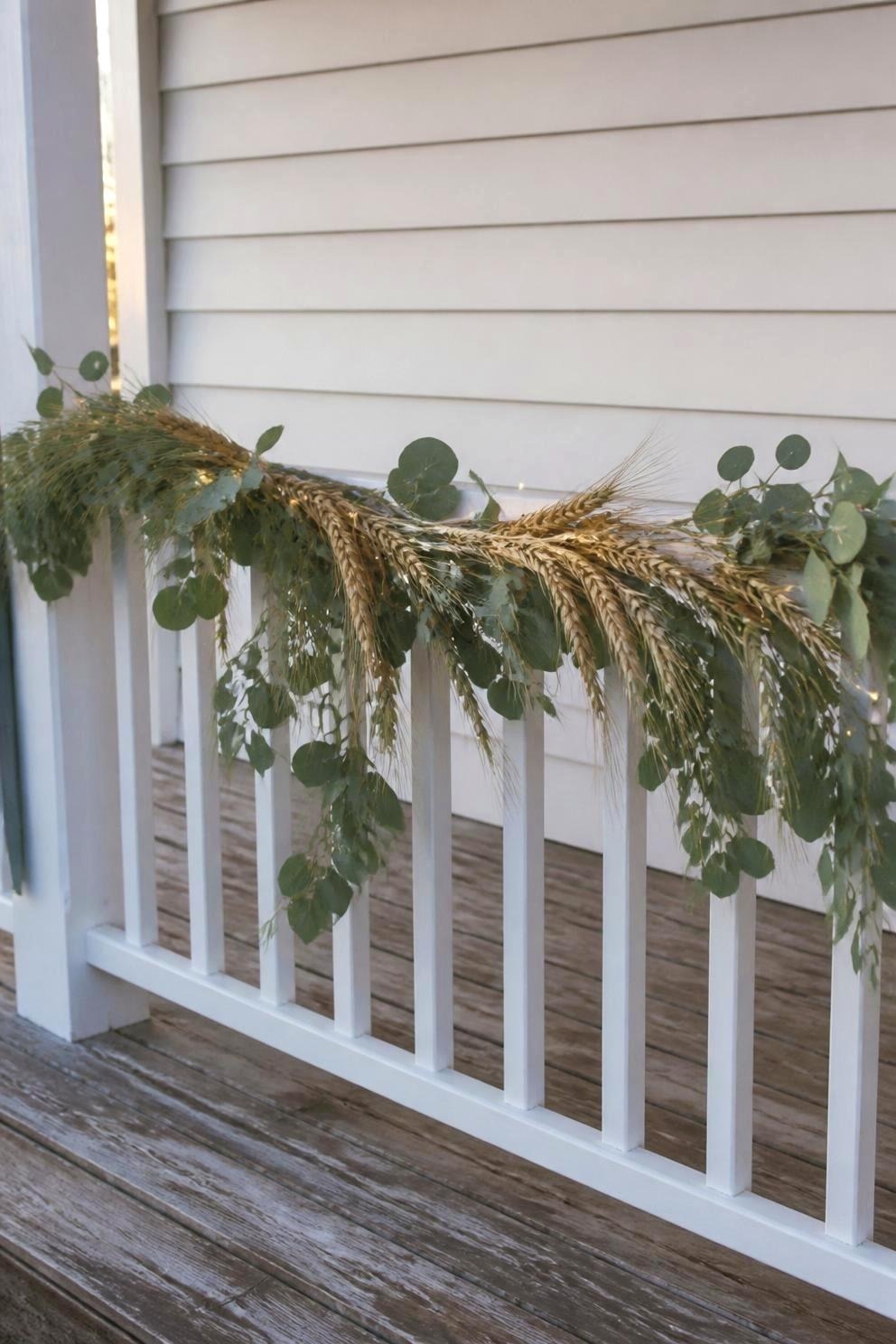
- Wheat and dried oats for pale gold. Wired into eucalyptus in small bunches, this is the whole fall signal you need.
- Glycerin-preserved magnolia for warm golden brown that keeps its shine.
- Lambs ear for soft grey, which photographs beautifully in window light.
- Faux maple in burgundy and cream for real fall leaves without the traffic-cone palette.
Two or three colors total, no more. Grey green, cream, and one warm brown is complete. Add rust and gold and orange and it stops being neutral, which was the point.
Battery operated fairy lights, without a visible pack
Spacing decides whether it glows or looks like dots. A 16-foot strand with 50 LEDs puts a light roughly every four inches, which reads as a glow through foliage. A 20-foot strand with 40 LEDs puts one every six inches, which reads as separate points. Shorter and denser wins inside a garland. Buy warm white with a timer: a 4-pack of 16-foot strands (opens Amazon in a new tab) running 6 hours on and 18 off is the difference between lights that are on when you come home and lights nobody switches on.
The battery pack has to live somewhere. It is a plastic box the size of a deck of cards with a switch on it, and nothing hides it in the wrong place. Three spots work: taped to the underside of the mantel shelf near one end with the tail covering the rest, behind a pumpkin or a stack of books at the end of the run, or in a small basket at the base of the newel post. Do not bury it inside a spiral wrap, because you will be unwinding two feet of garland every time it needs batteries. Check where the pack sits on the wire before ordering, since one six inches from the first bulb has nowhere to hide.
Mistakes that make a garland look wrong
- Buying the advertised footage without reading the bullets. Thirteen feet is often two pieces of six and a half.
- One strand where the photo used two. Fullness comes from doubling, not from a longer single vine.
- Tails cut short or skipped. The tail is what makes it look finished.
- Indoor adhesive strips on a porch. Rated to 50 degrees, and October is colder than that.
- Hanging weight the same hour you stick the hook. Give the adhesive an hour, and fresh paint seven days.
- Five colors in one garland. Two or three, then stop.
What I’d Actually Buy
Length is what to spend on, and hardware is what gets forgotten. Every pick came off an Amazon best-seller sort, sponsored rows excluded.
- Command small white wire hooks, 16 hooks and 24 strips (opens Amazon in a new tab) (4.6 stars, 41,000-plus ratings). Half a pound each, and sixteen is what lets you spread a garland across five points instead of two. The most useful item here.
- Command large utility hooks, 7 hooks and 12 strips (opens Amazon in a new tab) (4.6 stars, 38,987 ratings). Five pounds each, for a lit garland with pumpkins wired in.
- Command outdoor terrace hooks (opens Amazon in a new tab) (4.5 stars, 7,187 ratings). Rated minus 20 to 125 degrees, holds three pounds. The only correct choice outdoors.
- Command clear outdoor light clips (opens Amazon in a new tab) (4.4 stars, 27,000-plus ratings). 20 clips and 24 weather-resistant strips, to run the light strand independently of the garland.
- Green 22 gauge floral paddle wire, 3 pack (opens Amazon in a new tab) (4.8 stars, 1,100-plus ratings). Highest-rated and cheapest thing here.
- DearHouse faux eucalyptus garland, 2 pack, 6 feet each, UV protected (opens Amazon in a new tab) (4.3 stars, 8,000-plus ratings). The neutral base, footage stated per piece.
- AWARDSEN artificial fall leaves garland, 2 pieces of 6.5 feet (opens Amazon in a new tab) (4.3 stars, 926 ratings). The maple option, and the listing that tells you to wrap both strands together.
- Fairy lights, 4 pack of 16 foot warm white strands (opens Amazon in a new tab) (4.4 stars, 2,400-plus ratings). 6-on, 18-off timer, 50 LEDs per strand.
Check each product page for current lengths and options before ordering.
What to Read Next
- Apartment fall decor with no mantel needed , for a place with nothing to drape.
- Fall front porch decor for a small porch , where the porch rail garland fits in the layout.
- How to make a DIY fall wreath , for the build side. Same wire, same hooks.
- Fall table centerpiece ideas , for leftover garland lengths.
- Hurricane lantern fall decor ideas , the safer way to get candlelight near foliage.