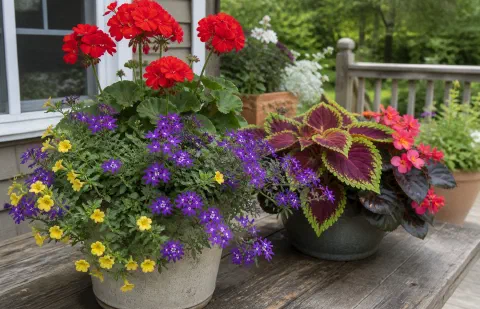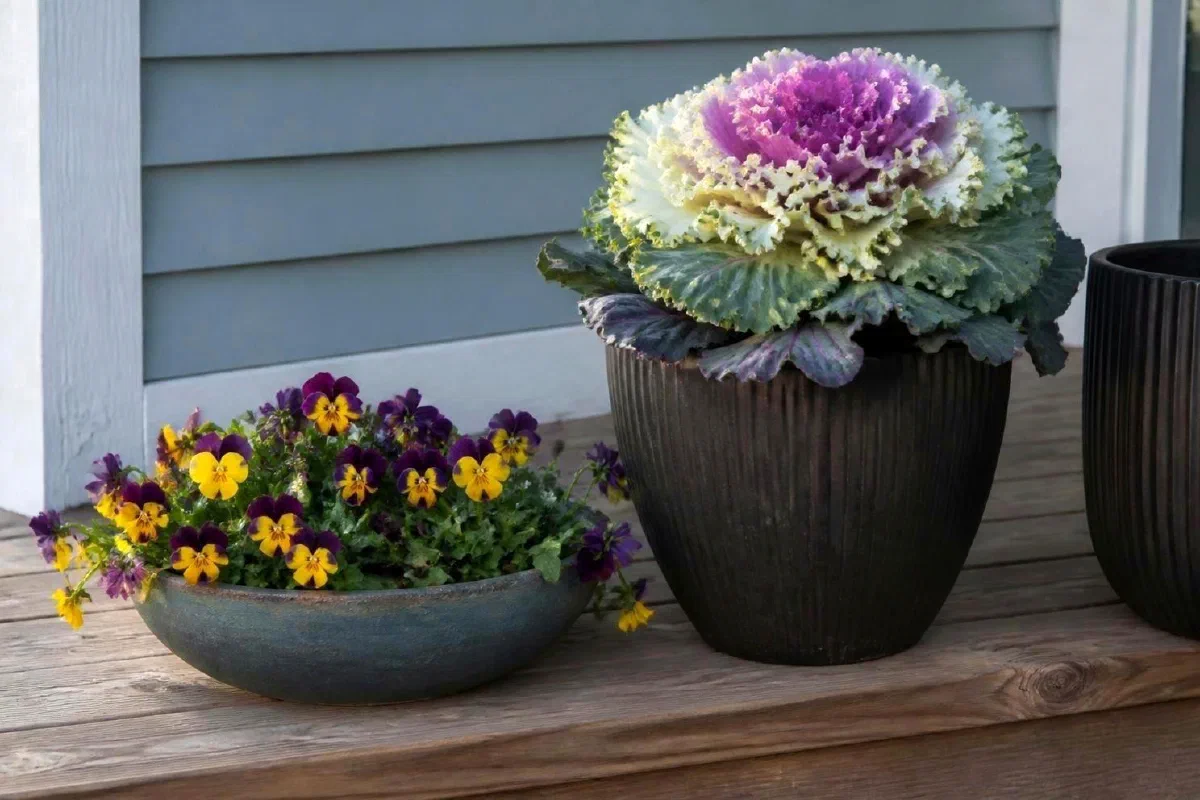
The ornamental kale you buy in late August looks like a cabbage somebody forgot about. Green, flat, faintly disappointing. Nothing is wrong with it. That pink and cream center it is sold for does not exist yet, because the plant will not make it until nights drop below 50 degrees.
That single fact explains most of what goes wrong with fall containers. The two best fall flowers for pots are both plants that get better as the weather turns, and both of them get bought and planted during the last hot stretch of the year, judged on how they look that afternoon, and written off by the third week of September.
Get the timing right and you have color from September through Thanksgiving in most of the country, and through winter in the South. Get it wrong by two weeks and you have leggy pansies and a green cabbage.
The two plants that do the actual work
Pansies and violas supply the flowers. Ornamental cabbage and kale supply the structure and the color that arrives later. Between them they cover the whole cool season, which is more than any single fall plant does.
Both are worth understanding as cool-season plants first and decorative plants second. That is not a technicality. It is the reason the timing rules below matter more than any design advice.
Pansies and violas: one temperature decides everything
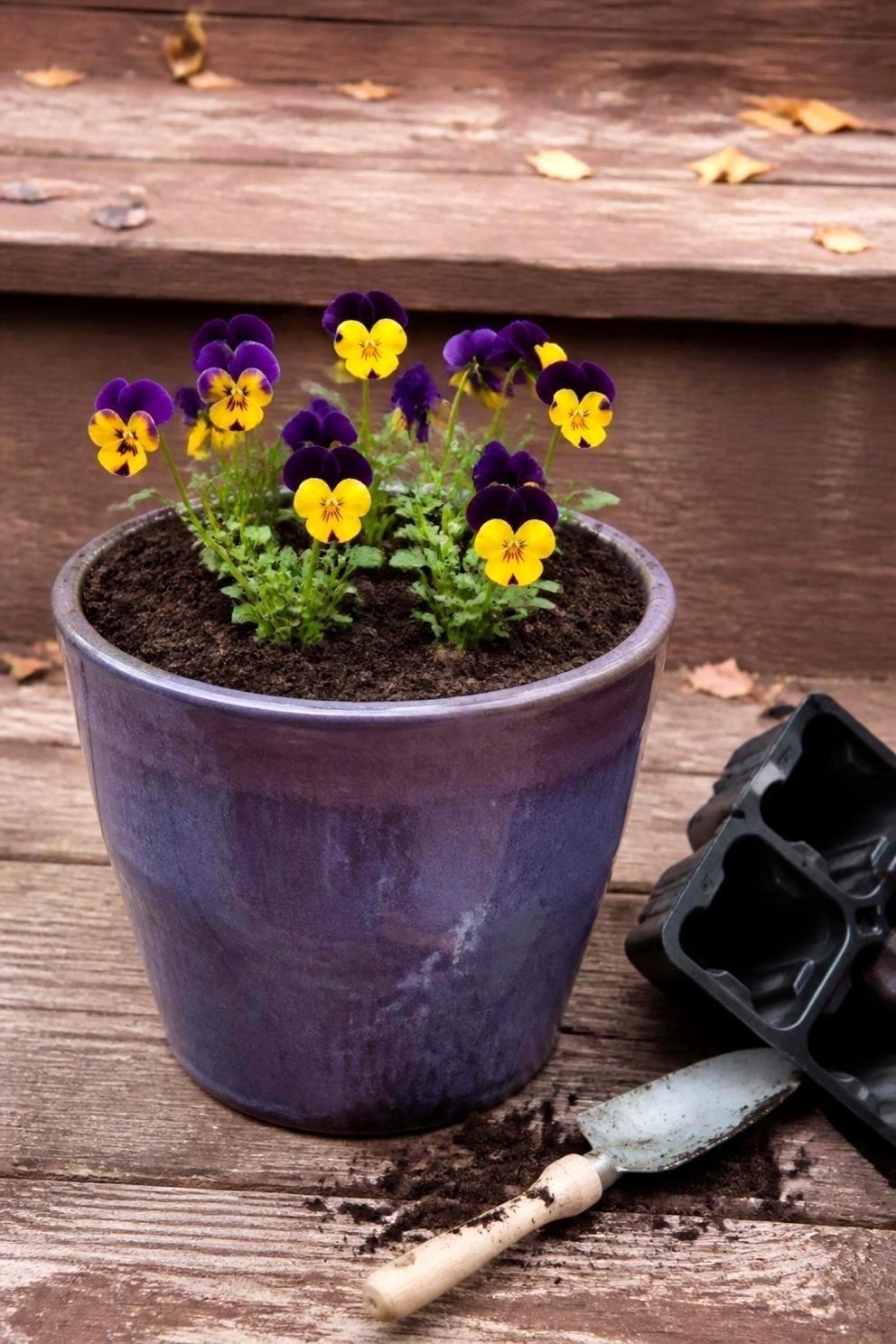
Pansies grow and flower best when temperatures stay below 75 degrees, according to Clemson’s Home and Garden Information Center . Utah State Extension puts the ideal range more precisely: about 40 degrees at night to 60 degrees during the day.
Read that range again, because it is the whole article. A pansy is not a plant that tolerates cold. It is a plant that prefers it.
Plant into heat and you get stretched stems, small flowers, and a plant that quits in six weeks. Plant into cooling weather and the same plant thickens up, sets more buds, and holds through frost.
Timing by zone. Utah State recommends transplanting by early September in the North, and later in September or early October where winters are mild. The general rule underneath both is to set plants out about six weeks before your first killing frost.
| Zone | Set pansies out | What you get |
|---|---|---|
| 3 to 5 | Late August to mid September | Fall color, then treat as spent |
| 6 to 7 | Early September to early October | Fall color, often a spring rebloom |
| 8 to 9 | Mid October to early November | Fall, winter, and spring bloom |
Pansies are listed as hardy in USDA zones 6a through 10b by NC State Extension, which blooms in fall, winter, and spring, and reaches 4 to 9 inches tall and 9 to 12 inches wide. In zones 6 and 7 a fall planting frequently comes back in March looking better than anything you could buy that month.
The planting detail people get wrong. Set the plant at the same soil level it was at in the nursery pot. Burying the crown, the point where stems meet roots, is a reliable way to rot a pansy. Space them 7 to 12 inches apart in a bed. In a pot you can crowd tighter than that, because you are buying a look for one season rather than growing them on. If you are filling a whole bed rather than a pot, fall flower beds with color after summer covers what to plant around them.
Water about an inch a week and deadhead the fading flowers. Removing spent blooms is not tidiness, it is what keeps a pansy setting new buds instead of making seed.
Pansies or violas. Pansies carry the large flowers with the blotched faces. Violas carry many more flowers at a smaller size, and they generally shrug off hard weather better and stay neater without deadheading. In a pot that will sit through a real winter, violas are the safer half of the pair. In a pot meant to be looked at from the sidewalk in October, pansies read from further away.
For containers specifically, Clemson notes pansies prefer a soil pH of 5.4 to 5.8, slightly more acidic than the 5.6 to 6.0 they want in the ground. A fresh container potting mix lands in that neighborhood. Garden soil does not, and it also compacts in a pot until the roots sit in water.
Ornamental cabbage and kale: buy the size you want to keep
Here is the buying rule almost nobody leads with. Wisconsin Extension says these plants reach about a foot wide and 15 inches tall, and “will generally not get much bigger after planting in the garden.”
So the small cheap one stays small. If you want a 12 inch rosette anchoring a porch pot, buy a 12 inch rosette. This is the opposite of how you buy almost every other plant, and it is why people come back in October wondering why the kale never filled in.
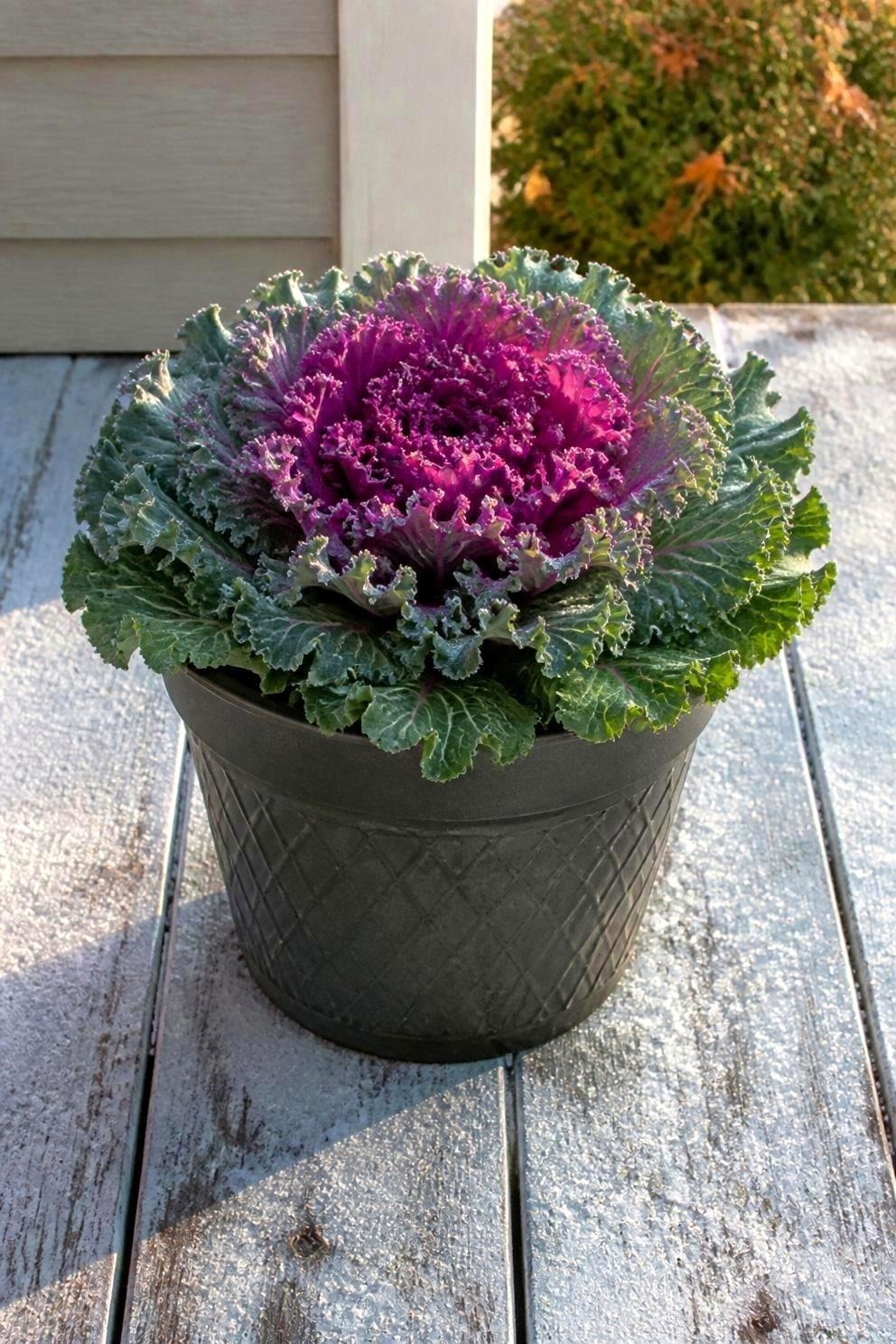
The color needs cold. Colors become vivid once weather turns and temperatures fall below about 50 degrees, and pigment develops with frost. Before that, the plant is green and doing exactly what it should. Nothing you add to the pot speeds this up. Cold is the trigger.
It lasts longer than you would guess. Once acclimated, ornamental cabbage and kale survive temperatures as low as 5 degrees, so they hold well into November and December. That outruns a mum by a wide margin and it is the single best reason to build the pot around the brassica rather than treat it as filler.
Never plant these in spring. Wisconsin is blunt about it: plants set out in spring will have bolted or declined by the time you want them. They are a fall purchase, full stop.
The named series, and what each looks like. Garden centers usually label by series, so these are worth recognizing:
- ‘Nagoya’. Round, heavily crinkled leaves with a tight rosette center in fuchsia pink, lavender, yellow green, or creamy white. The classic ruffled look.
- ‘Tokyo’. A nearly perfectly round cabbage type, smooth blue-green outer leaves, soft pink, red, or white center. The neatest and most formal of the group.
- ‘Osaka’. Fast growing and compact cabbage type, bluish-green semi-waved leaves, pink, red, or white center.
- ‘Peacock’. Compact hybrids with deeply serrated feathery red or white leaves. Reads as foliage rather than as a cabbage, which makes it the best mixer.
- ‘Chidori’. A mounded kale with purple foliage and extremely curly leaf margins, center in cream white or deep magenta.
- ‘Pigeon’. Flat heads with red or white centers.
- ‘Color Up’. Upright and columnar rather than flat, green leaves with a white, blush pink, or fuchsia center. The one to use when you need height.
Plant in sun, in moderately moist rich soil. If you are starting from ornamental kale or cabbage seed, sow 6 to 10 weeks before your first frost, and do not cover the seed, because it needs light to germinate. Buy seed from a supplier that lists the cultivar and a recent germination test rather than choosing by the packet photo.
Feed at planting, then stop. High nitrogen after the color develops pushes the plant back toward green growth and dilutes what you bought it for. If you use a slow-release granular food, follow its label at planting rather than adding repeated doses after the color develops.
The front porch pots
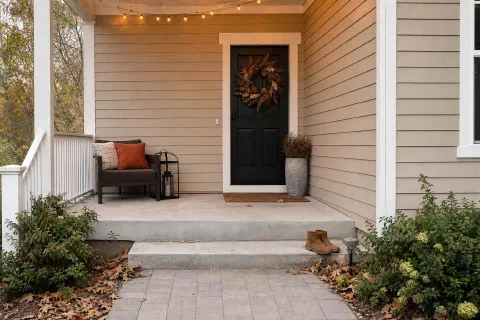
Two things decide whether a porch reads as styled or as pots left near a door: pot height against the door, and how few colors are in play.
A standard 36 inch entry door carries planters roughly 16 to 22 inches tall on either side. Below that they read as clutter around the base of the door instead of a frame for it. A pair of planters in that height range is the straightforward version, and the soil volume matters as much as the look, because a taller pot is not dry by lunch on a warm October afternoon.
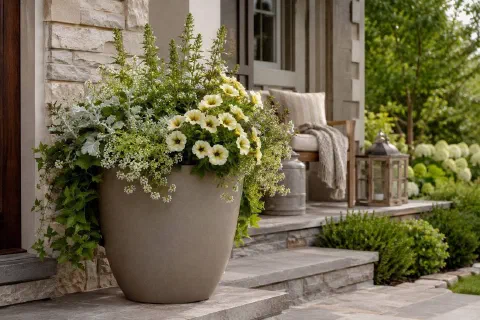
The pairing that works. One upright brassica in the center for structure, a ‘Color Up’ or a large ‘Nagoya’. Pansies or violas around the rim where they get looked down into. One trailing plant over the edge to break the pot line. That is three plants, and the third is optional.
Keep the palette to two or three colors across the whole porch. Purple kale, cream, and one muted green is enough. The brassicas bring a lot of saturation once they turn, and a pot with five colors in it looks busy the moment they do.
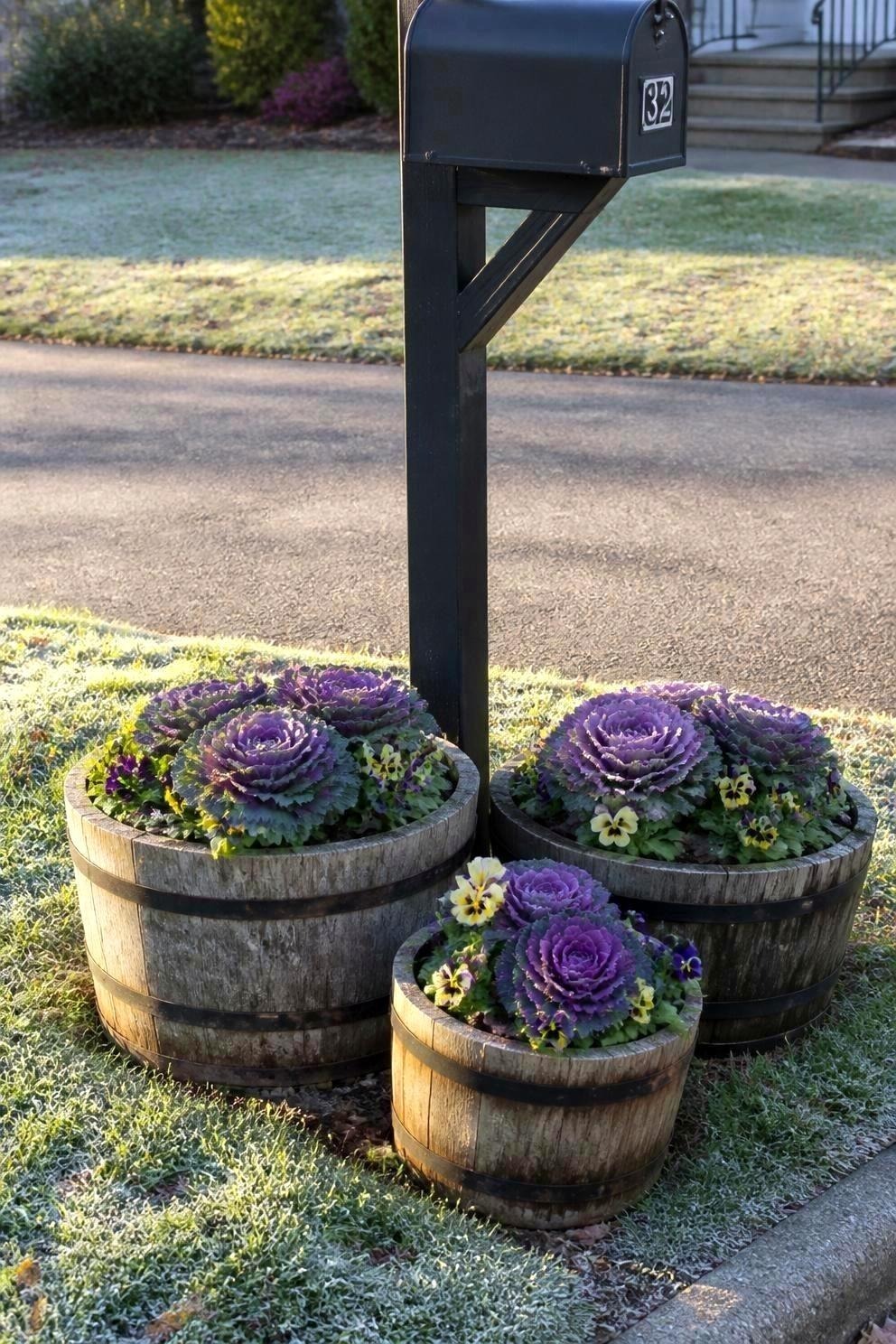
Pot size floor. Twelve to 14 inches in diameter with real drainage. On a step where a big pot would crowd the walkway, a group of 10-inch barrel planters in odd numbers does more than one medium pot, and each one holds a single plant well.
The mailbox: pots or a small bed
The mailbox is the most overlooked spot on the property and the easiest to improve, because almost nothing is there now. It also has constraints a porch does not.
Reflected road heat. Pavement radiates well into the evening, and pansies are the plant least happy about that. At a curbside mailbox, push your planting a week or two later than you would on a shaded porch, and lean on violas and brassicas over large-flowered pansies.
No hose nearby. Mailbox plantings often fail because they are a long walk from the spigot. Size up the pot. More soil volume means fewer trips, and it is the only lever you have.
Leave the carrier room. Keep pots clear of the door swing and out of the path of the flag. A planting that makes delivery awkward gets moved or run over, and in the US the box and its approach need to stay accessible.
Wind. Passing cars push air harder than you would think. Planting in the ground removes the tip-over problem. If you use a pot instead, keep it wide and low.
If the mailbox already sits in a small mulched bed, plant the same combination directly in the ground: three brassicas for structure, with pansies or violas spaced loosely around them. Keep the bed low enough that the carrier can still reach the box without brushing past wet foliage.
What usually goes wrong
- Planting pansies while highs are still above 75. The most common failure and the easiest to fix. Wait for the forecast to break rather than the calendar to hit September.
- Burying the crown. Set the plant at the depth it came out of the pot.
- Garden soil or straight compost in a pot. Both compact and hold water. Use a container mix.
- A saucer left full of water. Drainage holes do nothing if the pot is standing in a reservoir. Tip saucers after heavy rain.
- Feeding kale after it colors up. Pushes it back to green.
- Aphids down in the rosette. The tight center of a brassica is a good place to hide. Wisconsin also lists cabbage worms, cutworms, and slugs. Check the center when you water, because by the time you notice from a distance the colony is established.
- Never deadheading pansies. Bloom production drops off fast once seed sets.
- Buying a small brassica and waiting. It stays that size. Buy the finished size.
Can you eat ornamental kale and cabbage?
Yes. Wisconsin Extension states plainly that both are edible, “although they tend to be more bitter than the edible cultivars.” They are the same species as culinary kale and cabbage, Brassica oleracea, bred for leaf color instead of flavor and texture.
The practical answer is that you can eat them, and you will not enjoy it much. There is one caveat worth adding: plants sold as ornamentals are not grown as food crops, so treatments applied to them are not necessarily cleared for eating. If you want to eat the leaves, grow them yourself from seed and skip anything you would not put on a vegetable.
About mums
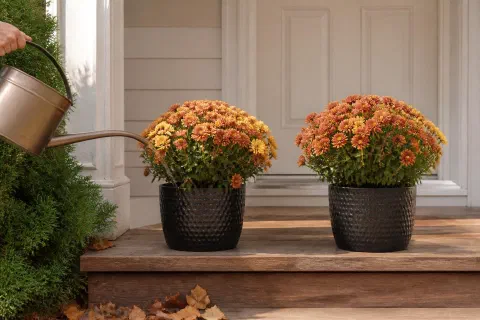
Mums are not the enemy and this is not an argument against them. They just do a different job. A mum gives you two to six weeks of heavy bloom depending on how far into flower it was when you bought it, and then it is finished. Pansies and brassicas run from September into December, and in the South straight through to spring.
Use a mum as the loud part of a pot in October if you want one, and let the brassica be the part still standing at Thanksgiving. If you are putting mums in planters this year, the care guide covers the pot size and watering habit that keeps them from dying in two weeks.
When to buy
Pansy and viola transplants show up in garden centers from late August. Brassicas arrive at about the same time and the best selection of large, well-grown rosettes goes early, which matters given they will not size up after you plant them.
Seed is a different calculation. Six to 10 weeks before frost is a workable window for brassicas in zones 7 and warmer if you start now, and in colder zones seed is a plan for next year rather than this one.
A garden-center checklist before you buy
Live plants are a local purchase. You want to see the rosette size, bud count, and root health in person, and shipping a tray of pansies makes little sense for a single porch. Take these notes with you:
- Measure the pot’s inside diameter and depth. The plant should fit without a buried crown or a root ball forced into a shallow container.
- Choose a container potting mix rather than garden soil, and confirm the pot has open drainage holes with no full saucer underneath it.
- Buy ornamental kale or cabbage at the rosette size you want to keep. Wisconsin Extension says these plants generally do not get much bigger after planting in the garden.
- Check the forecast and your porch exposure before buying a plant that needs repeated frost-cover duty.
Set the pots out in this order: drainage check, mix, tallest brassica, pansies or violas around the rim, then water until the excess drains. Leave enough room to walk past the display and tip a saucer after a heavy rain.
Use the same sequence when you refresh an existing pot:
- Empty standing water and clear every drainage hole.
- Set the plants at their nursery soil level, with the brassica behind the lower flowers.
- Water once, let the pot drain, and check the forecast before adding frost cover.
What to Read Next
- Fall Front Porch Decor for a Small Porch for fitting the finished pots beside one step and a narrow walkway.
- How to Keep Mums Alive in Planters if mums are still part of the display.
- First Frost Checklist for Pots, Window Boxes, and Small Gardens for the night the forecast finally drops.
- Fall Window Box Ideas That Still Work After the First Frost when the planting space is above the porch floor.