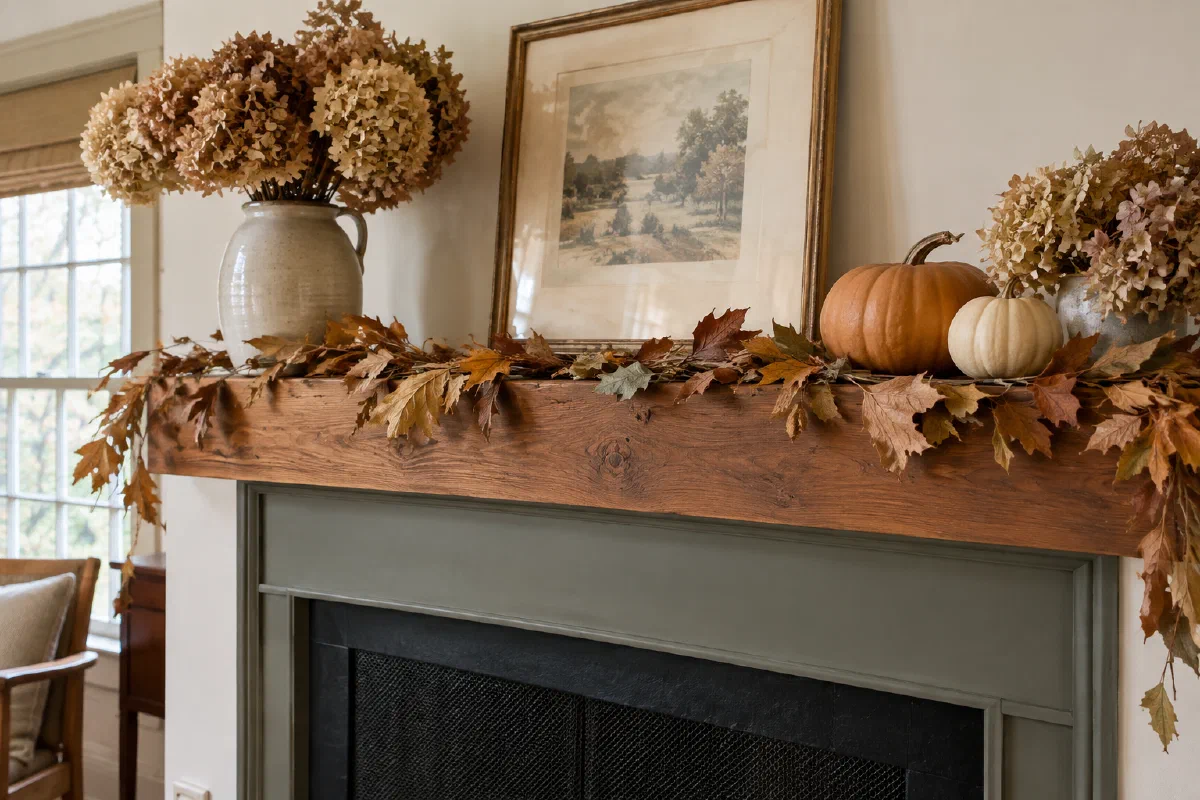
Every fall, the same four weeks go missing. The Halloween mantel comes down on November 1, the Christmas garland does not go up until after Thanksgiving, and in between there is a bare shelf in the room where you spend every evening.
That gap is worse when the fireplace below it has not had a fire in years. A cold firebox is a black rectangle wider than anything you own, and no number of small pumpkins fills a hole that size. So work in this order: find out what kind of dead fireplace you have, then decorate for what a cold shelf allows. Fall fireplace mantel decorations are easier than the December version, not harder.
Which Kind of Dead Fireplace Do You Have
No working fireplace is three situations, not one, and they need three different mantels. Guides that treat them as a single case are why so much of this advice falls flat.
| What is in your wall | How to tell | What the opening can hold |
|---|---|---|
| Sealed fireplace | A panel, a bricked-up face, glass doors screwed shut | Nothing. It is a dark frame, so work on the shelf |
| Open, with a damper that still moves | A handle or chain inside, and a view up the flue | A screen, a basket, a stack of logs. Nothing that burns |
| A gas or electric insert, switched off | A pilot, a remote, a key valve, or vents in the face | Nothing. Keep the vents clear and the glass bare |
The second row has a quieter problem. EPA’s Burn Wise guidance calls a wood-burning fireplace “a very inefficient way to heat your home” and says “fireplace drafts can pull the warm air up the chimney, causing other rooms to be cooler.” An open damper on a fireplace you never light is a hole in the wall, which is why the sofa end of the room runs cold in October. Close it, or have a chimney professional fit a top-sealing damper or a flue plug. Never plug a flue that serves a gas appliance, and never plug one you might light. EPA names the Chimney Safety Institute of America for finding someone qualified.
The third row is the one people decorate by mistake. An insert that is switched off is still a fuel-burning appliance, and the Consumer Product Safety Commission lists improper installation, poor maintenance, compromised venting and misuse as the four ways these cause carbon monoxide poisoning. It adds that flues and chimneys should be inspected before each heating season. If you cannot say for certain that the gas is off at the valve and the pilot is out, treat it as lit.
Measure the opening and the shelf on the same afternoon and write both numbers down. An opening three times the width of your widest vase will swallow it.
Dried Hydrangeas and Beeswax Tapers: What a Cold Shelf Gives Back
Dried hydrangeas, wheat, magnolia leaves, seed pods, a bowl of black walnuts. On a working fireplace almost none of that belongs on the shelf, because dry stems over a live fire are kindling. With no fire under it, all of it comes back.
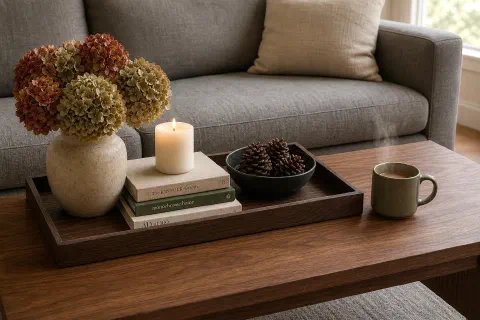
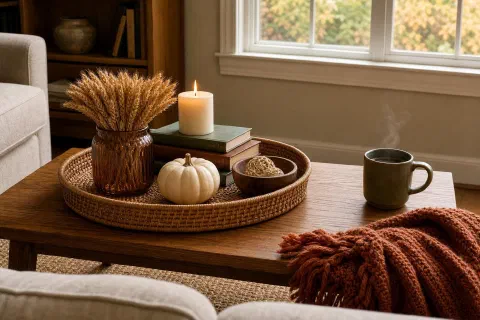
A cold fireplace does not make a lit taper safe beside dry stems, because the risk was never the firebox. The U.S. Fire Administration states the rule plainly: keep candles at least 12 inches away from anything that burns. It also reports an average of 20 home candle fires a day. So use beeswax tapers, and put them at the far end of the shelf or in a glass hurricane at the front edge with clear air around them. Keep the dried arrangement 12 inches clear. Where that leaves no room, flameless candles do the same job with none of the arithmetic.
Clemson’s Home and Garden Information Center has the drying methods. Air-drying works best in a warm, dark, dry place, and the darkness holds the color. Hydrangeas, yarrow and celosia dry well standing in an inch or two of water, and magnolia leaves take up one part glycerin to two parts water and come out flexible instead of brittle. If you would rather buy a strand than dry one, fall garland ideas covers the lengths that read as full once they are up.
How to Build the Fall Mantel in Four Steps
- Deal with the opening first. A screen, a folded panel, a basket of logs, or nothing. Decide it before you style the shelf, because everything up there is read against that rectangle.
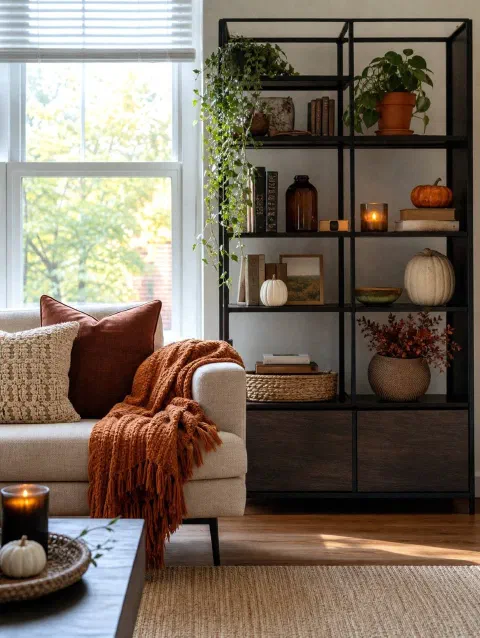
- Build a base that survives November. One vessel with real mass, in ceramic, brass or stoneware, plus one tall element 18 to 24 inches above the shelf. Fall objects are short and round, so a shelf styled only with them flattens into one band.
- Supply the glow from the shelf, since nothing glows below it. That is the one thing a working fireplace gives you free. A battery strand woven through the base, or two flameless tapers on a timer, replaces it.
- Add exactly two seasonal objects, then stop. Two changes the month. More turns the shelf into a collection, and the empty stretch at one end is what makes the rest look chosen.
The September to November Swap
The missing four weeks are easy once the base is up, because the base is not seasonal. Build it in September and change two objects a month.
| Layer | September | October | November |
|---|---|---|---|
| Base | branches, one brass vessel | unchanged | unchanged |
| First object | a pale gourd | one matte black piece | a dried hydrangea head |
| Second object | a cream candle | an amber candle | a bowl of walnuts |
| Comes off | nothing | the black piece | the last orange |
The base never moves. One matte black object and two amber lights read as Halloween without a single bat, and on November 1 that object comes off, leaving a Thanksgiving mantel. For the same schedule across the rest of the house, the fall to Thanksgiving transition sorts a room in about twenty minutes.
When the Mantel Is a Sideboard or a Ledge
Plenty of readers have no mantel at all, and a sideboard, windowsill or bookshelf doing the job is a different problem from a fake fireplace. A mantel is the only surface in a house whose single purpose is display. Every substitute has another job, so settle that argument first.
Two rules fix most of it: give the display an edge, and give it an exclusion.
- An edge is a tray, runner, board or shallow box the arrangement sits inside. That boundary does what corbels do on a real mantel: it marks where the display starts and stops, and lifts off in one motion when the surface is needed.
- An exclusion is one thing that never lives on top of it. No mail on the sideboard, no mugs on the ledge. The first week is the hard week.
Then respect what the surface is for. On a sideboard you serve from, keep the middle third clear and put the arrangement on the two outer thirds, because the middle is where a platter lands in November. A centered, symmetrical mantel arrangement does not transfer to furniture. A high picture ledge is the easy version, since nothing stands up there: garland and a light strand only. If you are building a shelf rather than using furniture you own, the Christmas no-fireplace guide has the height and the wall anchors.
Four Mistakes That Give a Cold Fireplace Away
- Decorating the opening instead of the shelf. A cluster of candles in a dead firebox reads as a shrine. One object with mass, or nothing.
- Assuming no fire means no fire risk. The 12 inch rule travels with the candle, not with the fireplace.
- Treating the shelf as storage between holidays. A mantel holding the remote, the mail and a charger is a shelf with a nice surround.
- Buying a full orange set in October. Three weeks later you pack it away.
Care for Dried Stems and Gourds Through November
- Direct sun fades dried material fastest, so the shelf opposite a bright window loses its color first.
- Skip the spray bottle. Water undoes drying. Dust with a soft brush instead.
- Real gourds rot from the underside, faster on a warm shelf above a radiator. Sit them on felt or a shallow dish, lift them once a week, and take them off at the first soft spot. A soft pumpkin on painted wood leaves a ring.
- Leave Oriental bittersweet in the woods. The USDA invasive species center calls it an introduced ornamental that “grows as a vine that smothers plants and uproots trees due to its weight.” Cut stems go in the trash bag, not the compost, and any other berry stem works as well.
- Wrap the preserved foliage. Glycerized magnolia holds its shape for years, so it is worth storing properly.
What to Read Next
- Fall decor that works through Thanksgiving puts the same keep, move and store system on the porch, the entry and the table.
- Fall garland ideas works out how much garland a shelf this width needs and how to hang it with no nails.
- Fall table centerpiece ideas carries the dried stems and the light layer onto the table you will actually serve from.
- Christmas mantel decor is the December handoff, with the garland quantities and the fixings for brick, painted wood and stone.
- Christmas mantel ideas with no fireplace covers building the shelf itself if the sideboard is not staying.