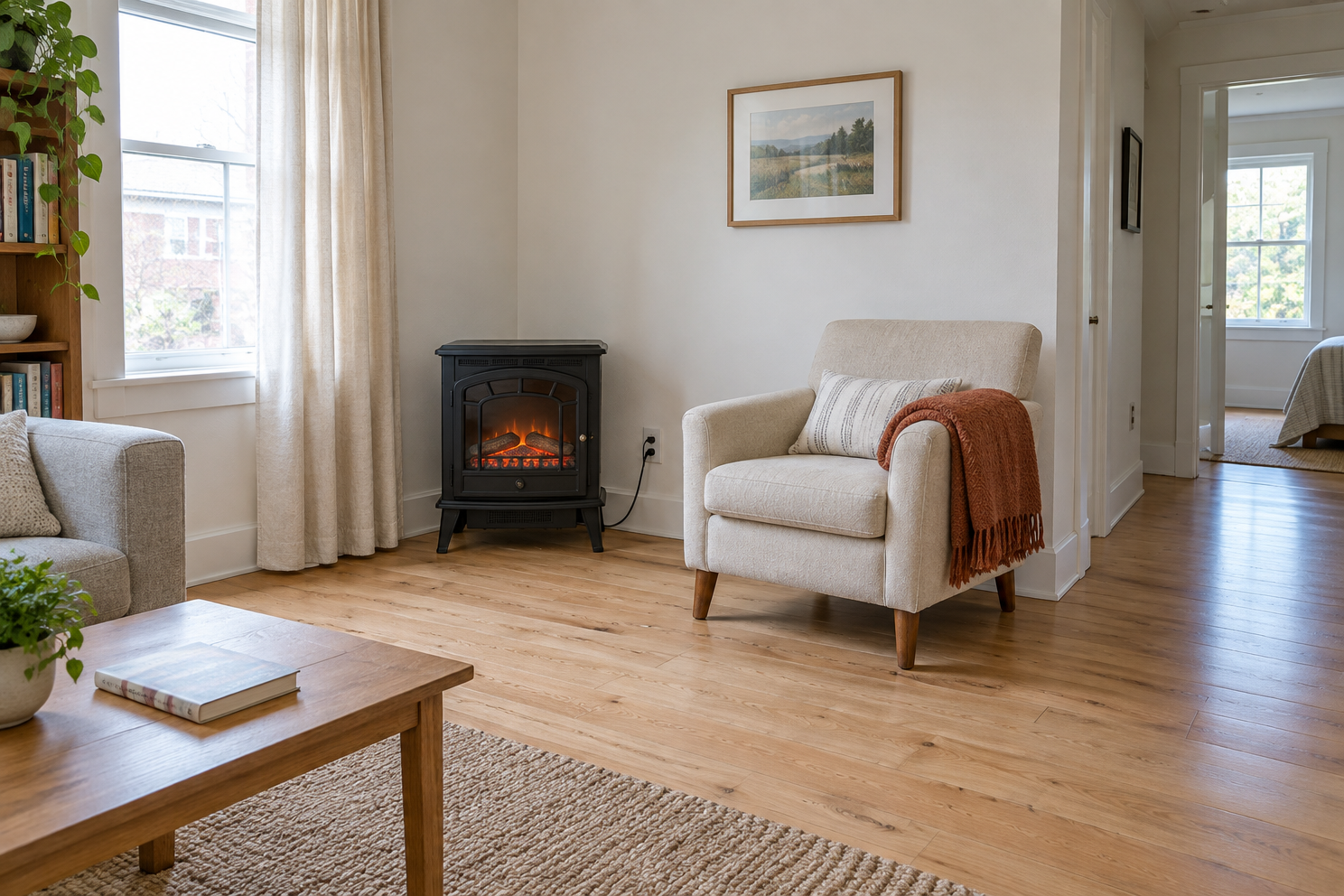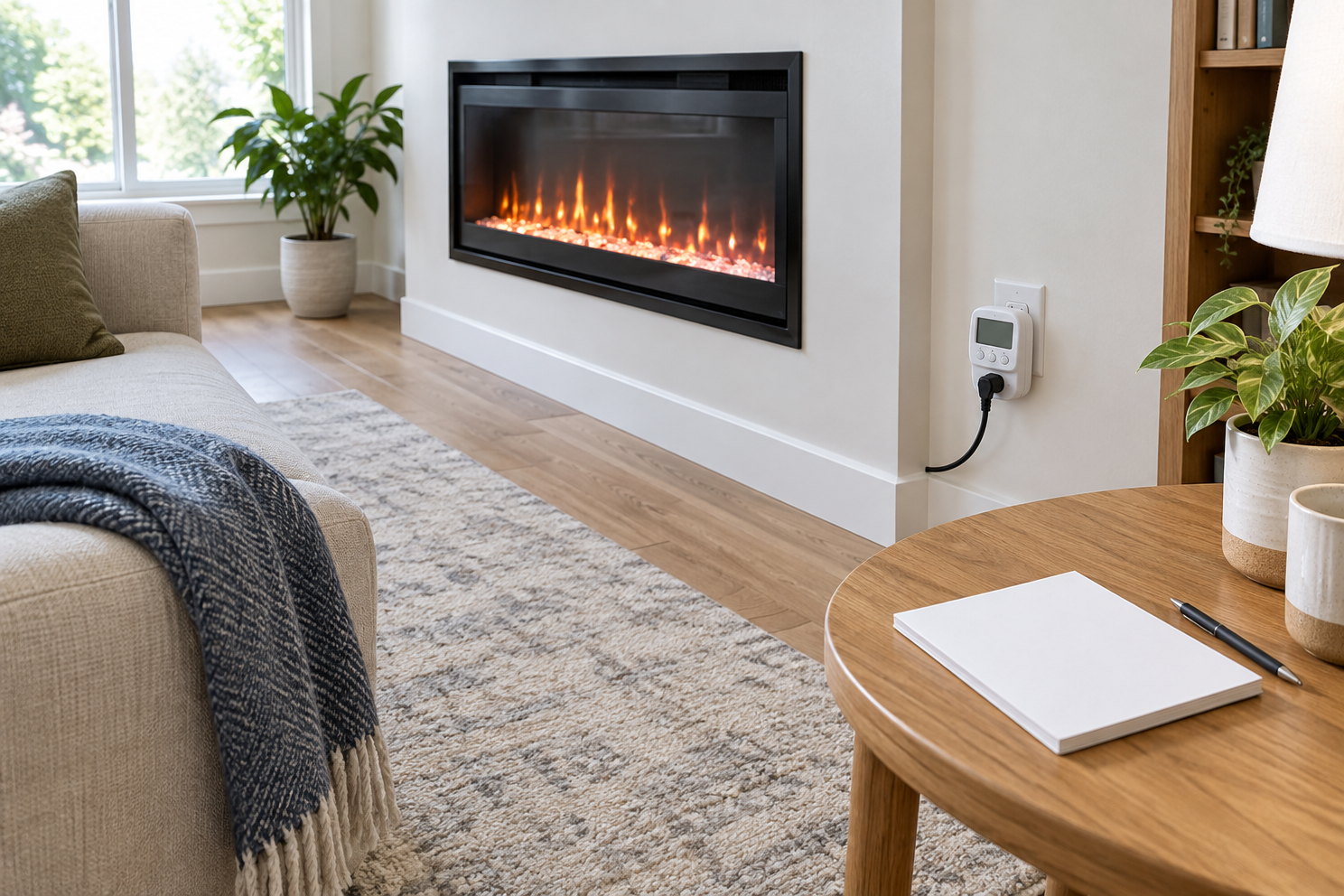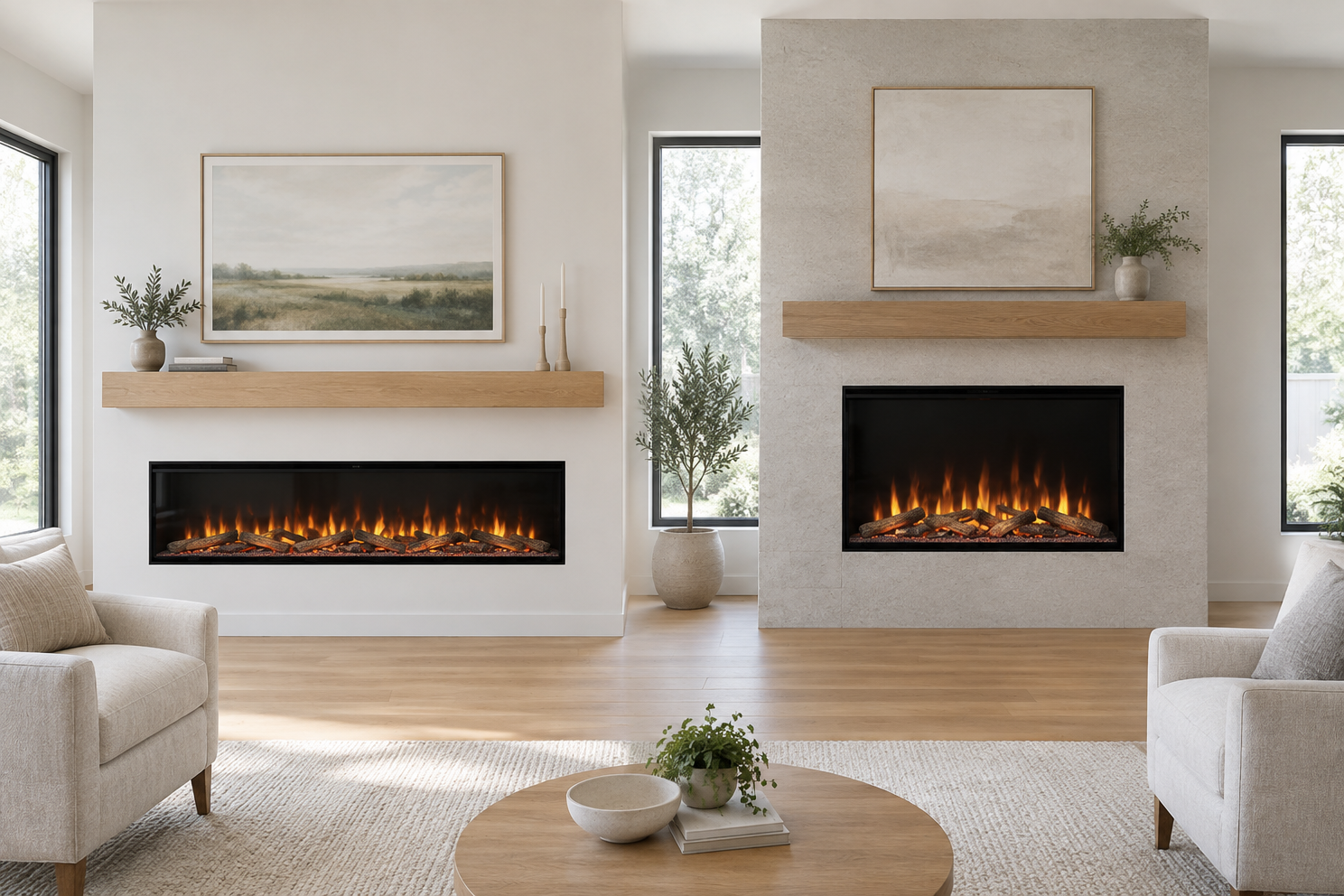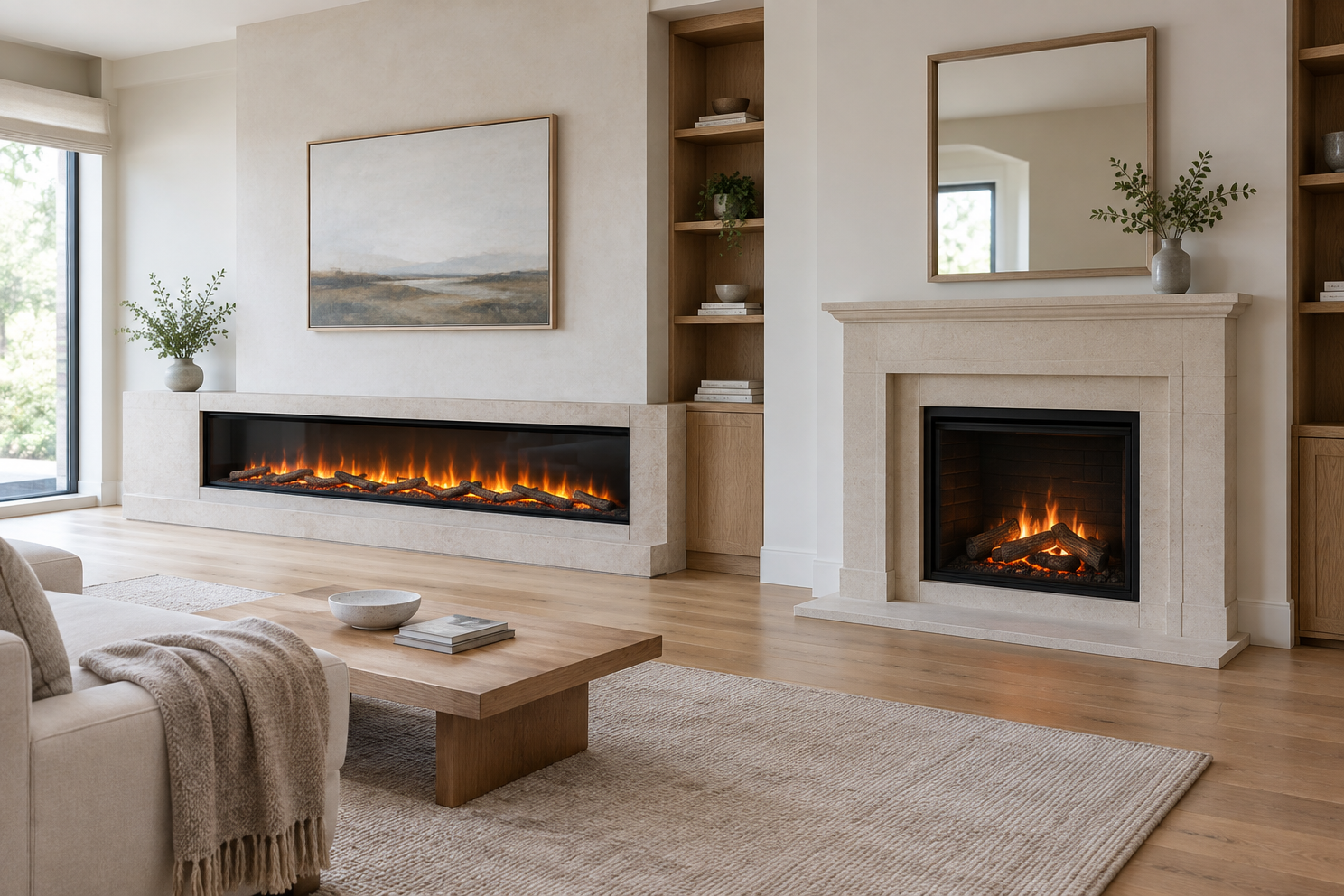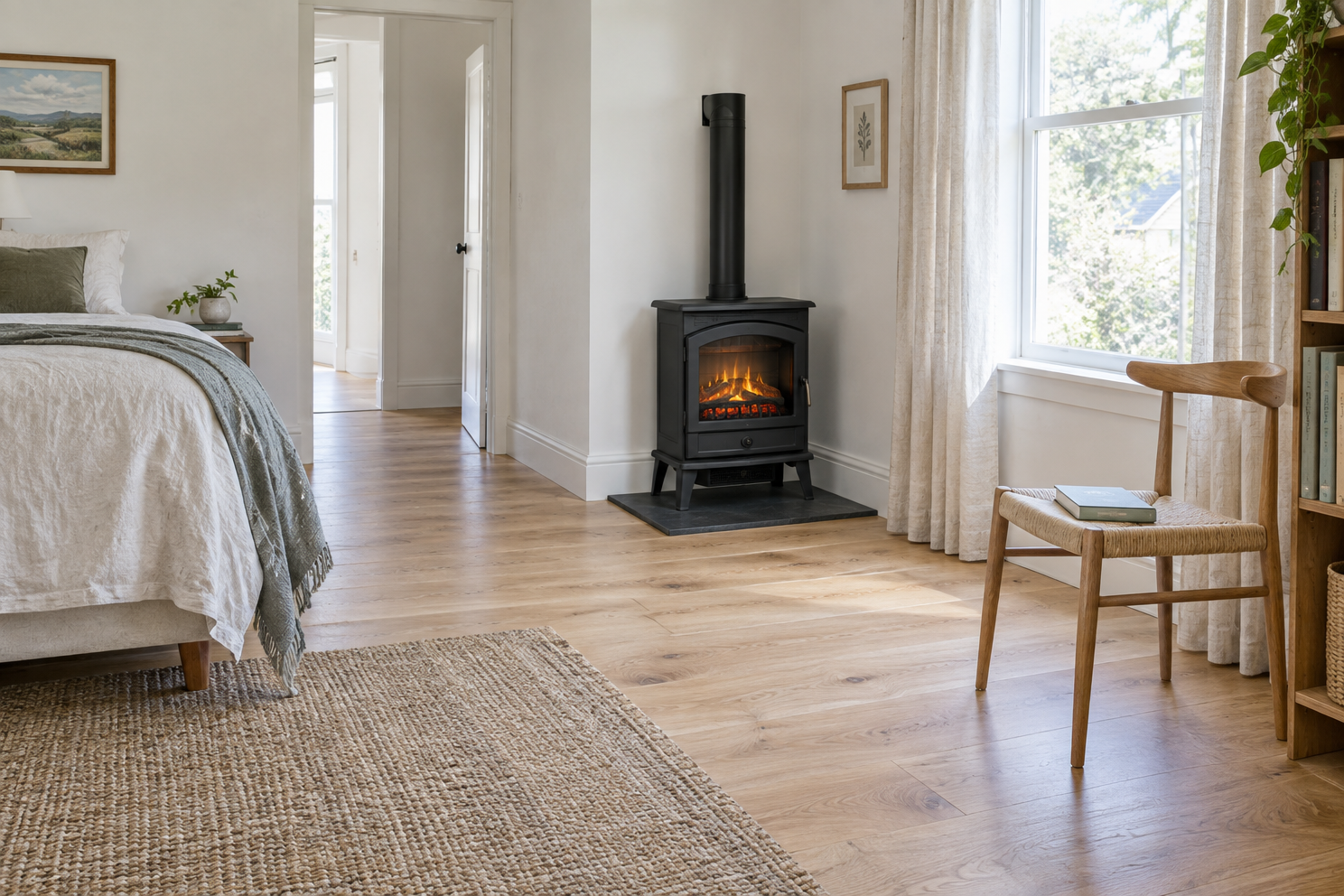
For a small room, choose the fireplace by physical scale and placement, not a large square-foot heating claim. A compact freestanding stove is best when the wall cannot be altered. A 20- to 24-inch electric log set works when an existing firebox is already the focal point. A long linear unit only makes sense when the wall is wide enough to leave quiet space around it.
Most plug-in heaters peak near 1,500 watts, whether the fireplace is 22 inches or 60 inches wide. A larger face does not automatically mean more useful heat.
Small-Room Decision Table
| Room constraint | Better format | Useful size check | Avoid |
|---|---|---|---|
| No wall work allowed | Compact freestanding stove | Mark full floor footprint plus 3-foot clearance | A deep stove in the main walkway |
| Existing masonry opening | Electric log set | Smallest opening width, height, and depth | Buying from nominal width alone |
| Wide blank wall, little floor space | Shallow wall-mounted unit | Leave visible wall on both sides | A 60-inch screen on a 70-inch wall |
| Bedroom or office | Quiet compact unit with thermostat | Listen to fan cycling and beeps | Choosing on flame video alone |
| Narrow room with TV wall already full | Neither | Keep the circulation path | Stacking fireplace, TV, console, and shelf too tightly |
Use the Wall-Width Rule
Tape the proposed fireplace width on the wall. As a practical visual check, try to leave at least 12 to 18 inches of open wall on each side of a linear unit. More is better when the room is narrow and the fireplace is near a doorway.
A 50-inch Touchstone Sideline needs roughly 74 to 86 inches of wall to avoid looking jammed. A 60-inch unit needs still more. If the only clear wall is 70 inches, the nominally “small” 50-inch choice may be too dominant.
This is not a manufacturer clearance. It is a room-scale check. The manual controls actual safety clearances.
Count the Depth You Lose
In a 10-foot-wide room, a 5.5-inch surface-mounted fireplace, 18-inch-deep sofa, and coffee table do not sound large separately. Together they narrow the path.
Mark the fireplace’s full projection on the floor with painter’s tape. Open nearby doors and drawers. Walk past it carrying a laundry basket. If your shoulder or the basket clips the taped zone, recessing may help, but only if the wall and lease support it. Otherwise, choose another wall or a slimmer format.
Option 1: Compact Freestanding Stove
A compact electric stove gives a bedroom, office, or reading corner a familiar fireplace shape without wall construction. The best placement is against a short unused wall where the door, curtains, and main walking path stay clear.
Choose one with:
- A stable base
- Thermostat and overheat protection
- Flame-only mode
- Front heat outlet
- Controls that remain reachable
- A factory cord that reaches the wall outlet directly
A 22-inch stove was visible in Amazon’s exact-match results when checked. Verify the current listing, manual, certification, dimensions, and clearances before ordering.
See the current compact electric stove listing (opens Amazon in a new tab)
Skip this shape if it steals the only nightstand position, sits close to bedding, or turns a clear path into a slalom.
Option 2: Dimplex Revillusion RLG20 in an Existing Opening
The RLG20 measures 23.75 inches wide, 19 inches high, and 12.5 inches deep. It uses the visual depth of an existing fireplace rather than taking new floor or wall space. For a small traditional room, that can look more settled than a wide linear screen.
It includes a 1,500-watt heater, remote, adjustable light, and flame-only operation. Choose it when the opening is deep enough and the brick or stone is worth showing. Skip it when you need a sealed front, have an active gas connection, or cannot provide a safe electrical supply.
Check the Dimplex Revillusion RLG20
Option 3: A Narrower Touchstone Sideline
The Touchstone collection includes widths below the 50-inch model, including 28-, 36-, 40-, and 45-inch versions when checked. A narrower linear unit can preserve the modern look without taking nearly the entire wall.
Don’t choose the width only by television size. Mark the fireplace on the wall at its intended height, then view it from the doorway and seat. A fireplace can be narrower than the TV and still feel balanced when a console, shelving, or negative space completes the composition.
Browse current Touchstone sizes at Modern Blaze
Heat: Do Not Size the Screen Like a Furnace
A common 1,500-watt electric fireplace produces roughly 5,000 BTU per hour. That can make the occupied area of a small enclosed room feel warmer, but actual results depend on insulation, drafts, ceiling height, outdoor temperature, and whether the door stays open.
Use thermostat control and start on low. The chair nearest the outlet can feel hot while the far side remains cool. A broad “heats 1,000 square feet” claim does not describe that experience.
At the June 2026 U.S. residential average electricity rate, 1,500 watts costs about 28 cents per hour. A half-power 750-watt setting is about 14 cents per hour. See the full electric fireplace cost calculation for monthly examples.
Bedroom Noise and Light
Small rooms magnify sound. A fan that disappears in a living room may be obvious three feet from a bed or desk.
Check, in this order:
- Flame-only motor or projection sound
- Low-heat fan tone
- High-heat fan tone
- Thermostat cycling
- Button beeps and display lights
- Whether the display can dim or turn off
If the listing lacks a noise specification, return terms matter. Do not assume a premium price guarantees a sound you like.
The Furniture-Displacement Test
Every small-room purchase replaces something. A freestanding stove may replace a side table. A media console may replace useful closed storage. A wall-mounted fireplace may take the only wall suitable for art or a desk.
Write down what leaves the room and where its job goes. If the answer is “the storage just disappears,” the fireplace may create a prettier but less livable room.
The buy-neither branch is appropriate when:
- The only placement blocks the walkway.
- Curtains or bedding cannot maintain safe clearance.
- The circuit already trips.
- The fan would sit beside a sleeper’s head.
- The wall is too short for breathing room around the unit.
- The room needs storage more than another focal point.
Safety in Tight Spaces
The National Fire Protection Association recommends keeping portable heaters at least three feet from anything that can burn and turning them off when leaving the room or going to bed. Plug directly into a wall outlet, following CPSC guidance .
In a small room, that three-foot zone can overlap curtains, a comforter, a laundry basket, and the doorway. Draw it on the floor before buying.
Frequently Asked Questions
What size electric fireplace is best for a small room?
There is no single width. Choose a unit that leaves the walkway open and visible wall around the fireplace. Many small rooms suit a 20- to 36-inch unit better than a 50- or 60-inch linear fireplace.
Is a 1,500-watt fireplace too powerful for a bedroom?
It can be more heat than a small well-insulated bedroom needs on high. Choose thermostat control and a lower heat setting, and follow the manual’s placement and supervision rules.
Can I run the flame without heat?
Many electric fireplaces offer flame-only mode, including the examples above. Confirm the exact model because controls and power use vary.
Where should a small-room fireplace go?
Use a wall or corner outside the main path, away from curtains and bedding, with a direct wall outlet and the required clearances. Avoid placing it where a door can strike it.
Is a wider fireplace warmer?
Not necessarily. Many wide and narrow 120-volt models share the same 1,500-watt maximum. Compare wattage and heat outlet, not screen width.
Bottom Line
In a small room, physical fit beats a dramatic product photo. Mark the width and depth, draw the safety zone, listen for fan cycling, and name the furniture the fireplace replaces. Choose a compact stove for flexibility, a log set for an existing opening, or a narrower linear unit for a clear wall. If the unit crowds the path or the room’s real work, a warm lamp and better textile layer may make the room feel cozier without asking it to hold another appliance.