Search for autumn centerpiece ideas and you will be handed a craft project.
Mod Podge and painted jars. An antique shutter you are supposed to already have in a garage you may not have either. A punchbowl. Every list is written for someone with a craft cupboard, a free Saturday, and a dining table that exists purely to be photographed.
That is not most people, and it is definitely not most weeknights. So this list has a hard rule: nothing here needs glue, paint, wire, floral foam, or a trip to a craft store. Every one of the eight is assembled from things already in the kitchen or bought in a single stop, and every one comes together in about five minutes.
There is one more constraint running underneath all of them, and it is the one that separates a centerpiece you keep from one you move: stay under about twelve inches tall. Above that, people cannot see each other across the table, and the arrangement quietly migrates to the counter by the second week. Where a candle flame is involved, twelve inches is also a sensible distance from a reaching sleeve.
If your table is genuinely small, the seating arithmetic in Thanksgiving table ideas for a small space is worth reading first, because on a table under 36 inches wide the middle disappears entirely.
| Best fit | Start with | Time to clear the table |
|---|---|---|
| Nothing new to buy | Pears in a shallow bowl | Under 1 minute |
| Longest-lasting arrangement | Dried wheat in short jars | Under 2 minutes |
| Smallest table | One tray with three objects | Under 1 minute |
| Dinner with guests | Low flowers or flameless candles | Under 2 minutes |
How to Set Up a No-Craft Centerpiece
- Measure the open width between the place settings.
- Choose one low vessel or one lift-off tray.
- Add one natural material and stop before it blocks the view across the table.
- Sit in two chairs and check the sightline.
- Move the whole arrangement once to make sure dinner setup will be easy.
Pears in a Shallow Bowl
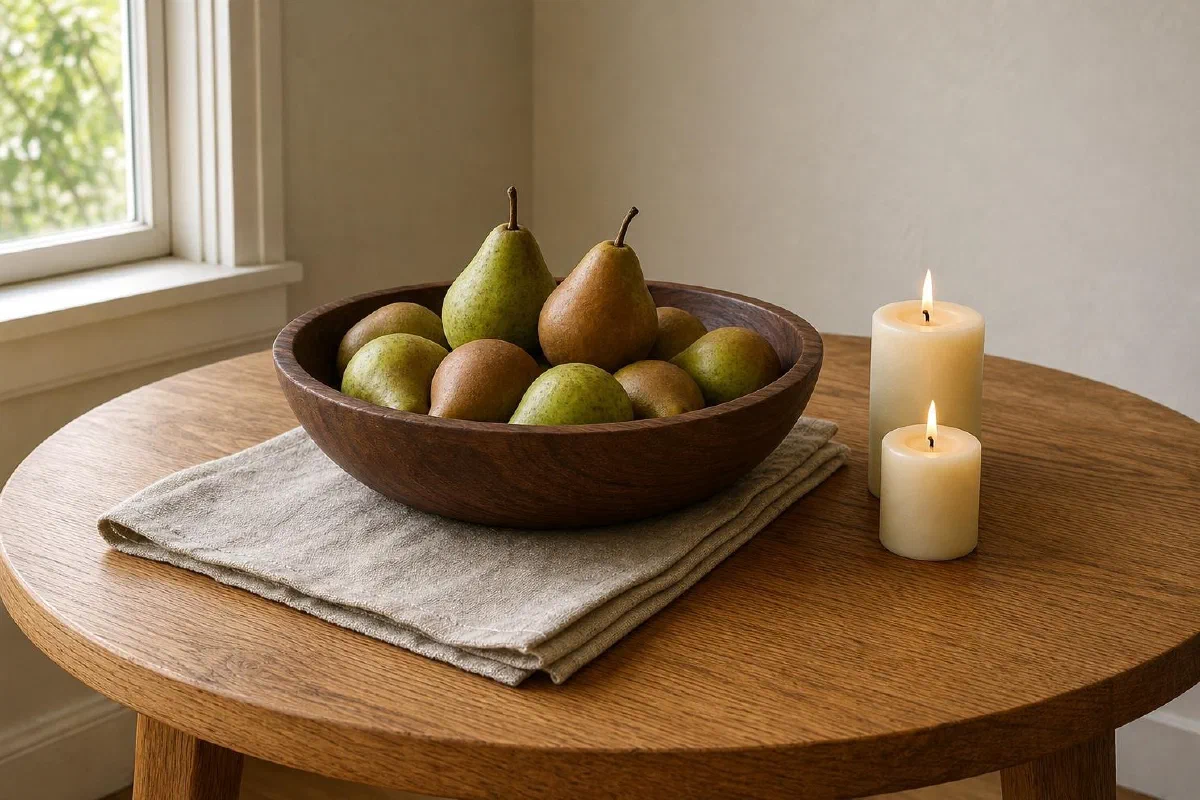
The one to start with, because it costs the price of fruit and looks like it was styled.
Take the widest, shallowest bowl in the house. Wood is ideal, but a ceramic pasta bowl or a serving dish works. Fill it with pears, stems up, in a single layer plus a few resting on top. Do not arrange them carefully. Tumbled looks right; placed looks fussy.
Green pears read as late summer easing into autumn, and brown-skinned varieties read as full fall. Both hold about a week on a table before they need eating, which is the point: the centerpiece is also the fruit bowl, so nothing is wasted.
Apples work identically. So do small pomegranates, which last considerably longer and look expensive for what they cost.
Dried Wheat, Trimmed Properly
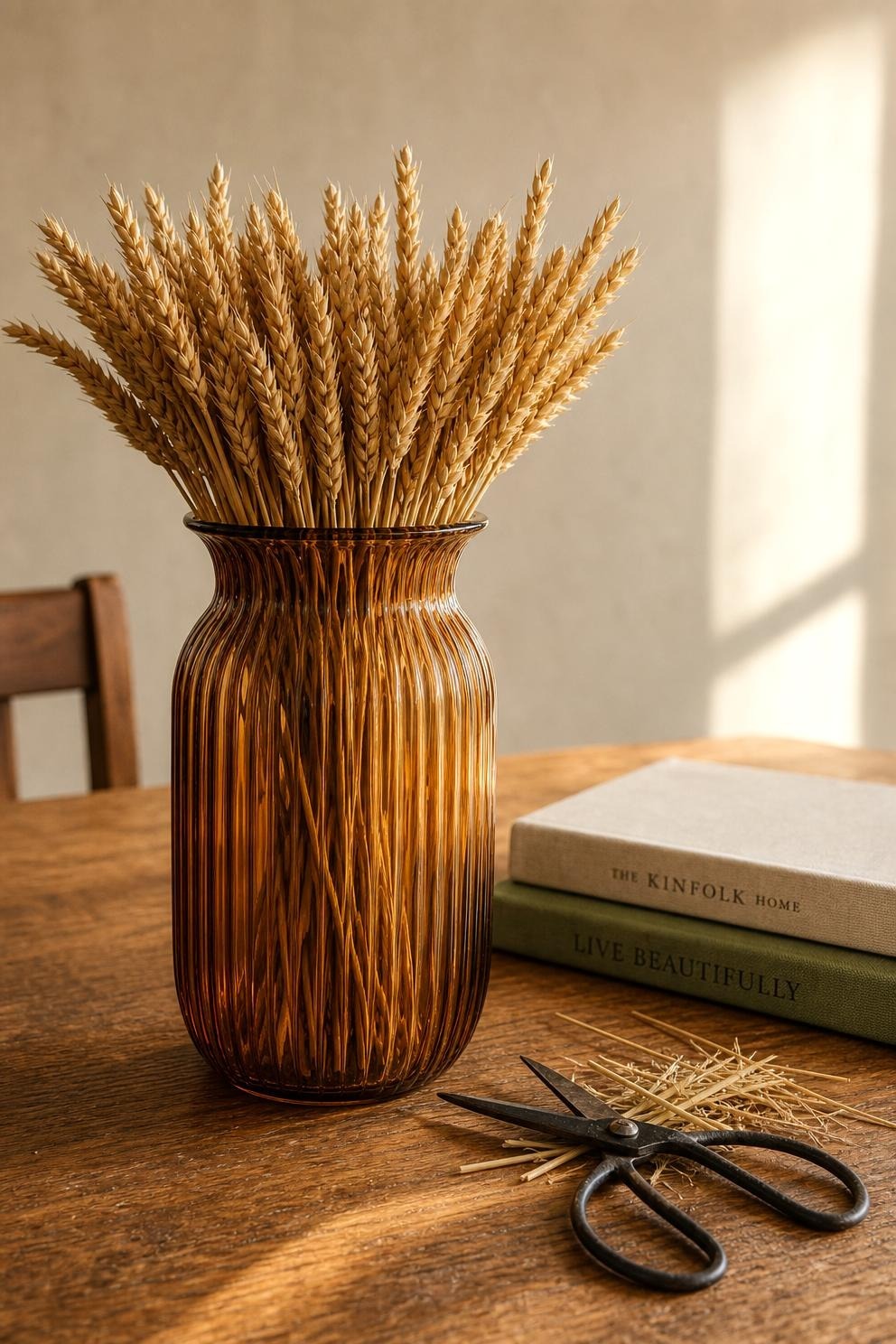
Dried wheat is the cheapest fall stem there is, it lasts for years, and almost everyone uses it wrong by leaving it full length.
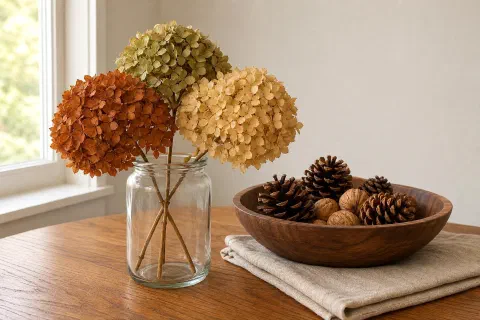
Buy a bundle, put it in a jar or a squat vase, then cut it down until the whole thing stands about ten to twelve inches from the table. That usually means removing a third to a half of the stalk length. It feels wrong while you are doing it and looks right the second you stop, because the heads are the interesting part and the stalks are only carrying them.
One bundle typically splits across two or three vessels, so you get a centerpiece and something for the hallway from the same purchase. Wheat does not shed the way pampas grass does, which matters on a table you eat at.
Three Jars, One Stem Type
Repetition does the work that arranging skill would otherwise have to.
Take three jars or small vases. They do not need to match, but they should share something, either the material or the colour. Put the same single stem type in all three, three or four stems each, then set them in a line down the middle of the table or clustered slightly off-centre.
Eucalyptus, dried hydrangea, wheat, bunny tails, or whatever is cheap at the grocery store that week. The reason this works is that repetition reads as intentional even when the individual arrangements are casual. It is also the easiest thing on this list to get wrong-proof: with one stem type there is no combination to balance.
Vary the heights slightly if you can, but only slightly. Wildly different heights turn the line into a chart.
A Runner of Gourds Down the Middle
No vessel at all. This one is just objects on the table, and it is the fastest of the eight.
Set five to seven small gourds and mini pumpkins in a loose line down the centre of the table, roughly a hand’s width apart, with a few turned on their sides. Nothing is arranged, nothing is glued, and the height never gets near the ceiling because gourds are short by nature.
Two things make the difference between this looking styled and looking like groceries. Keep the palette narrow: all white and pale green, or all warm orange and rust, but not both. And vary the sizes, because seven identical mini pumpkins read as a pattern rather than an arrangement.
Add a length of fabric underneath if you have one. A linen tea towel or a strip of muslin does the same job as a bought runner.
Candles at Two Heights
Light does more for an autumn table than any object, and this is the version that needs nothing else.
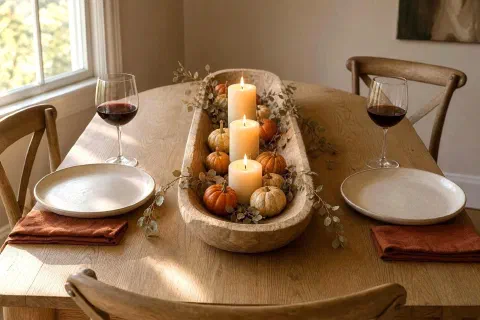
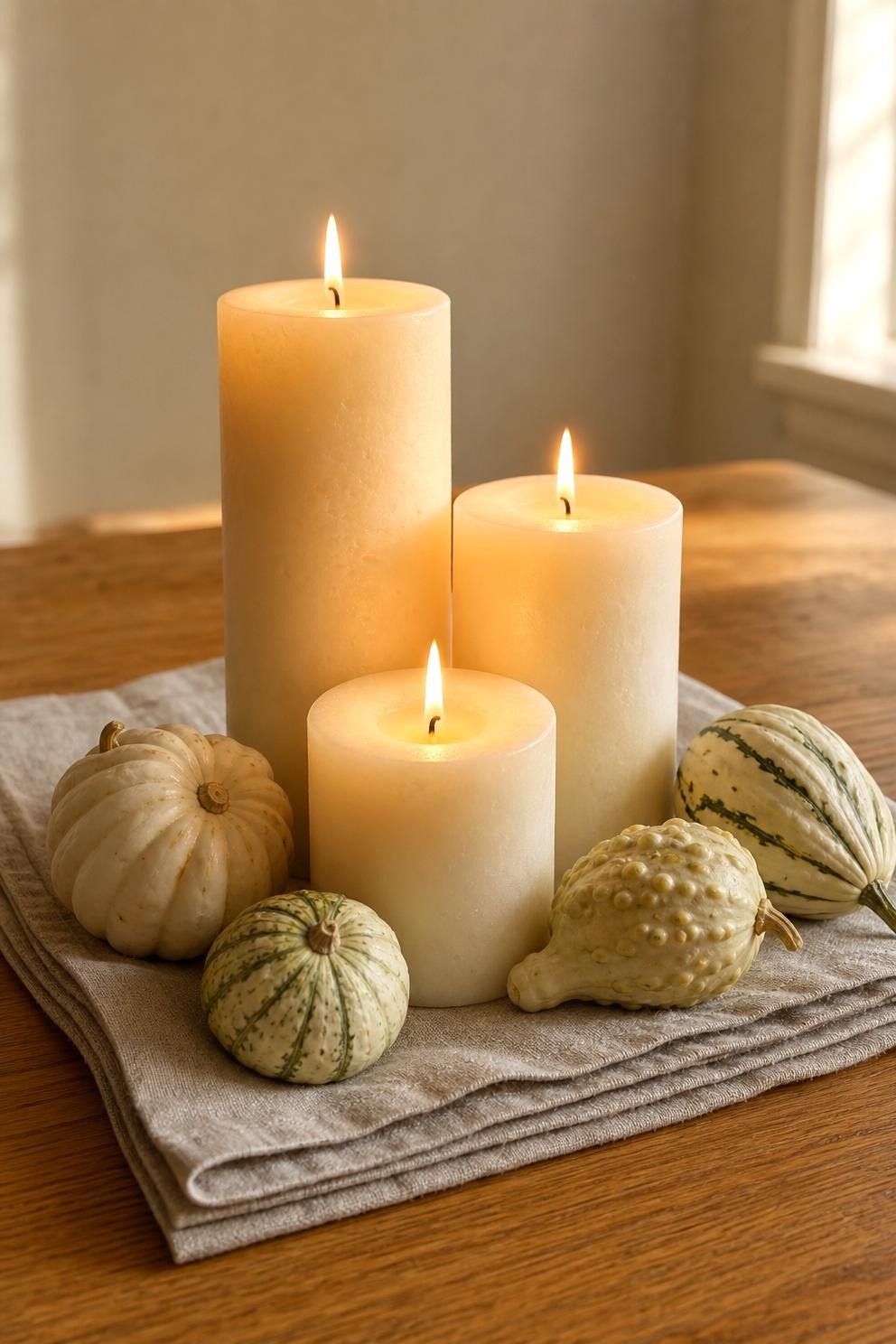
Use pillar candles at two clearly different heights, grouped in odd numbers. Three is plenty on a small table, five on a longer one. Set them close together rather than spaced out, because a tight cluster reads as deliberate and a spread reads as leftover.
If you light them, keep the flames in sight and away from dried stems, fabric, and anything else that can catch. The U.S. Consumer Product Safety Commission recommends flameless candles when possible, especially when a table will be busy with food, sleeves, children, or pets.
The two-height part is what makes it work. Three candles the same height are a row. Three at, say, six inches, four inches and two inches are a composition, and you can achieve the difference by burning one down or by setting one on a small plate.
Warm cream or unscented white beats a seasonal colour here, and unscented is genuinely better on a dining table, where a strong scent argues with the food.
One Big Branch in a Heavy Jug
The most dramatic thing on the list, and it is free if you have a tree.
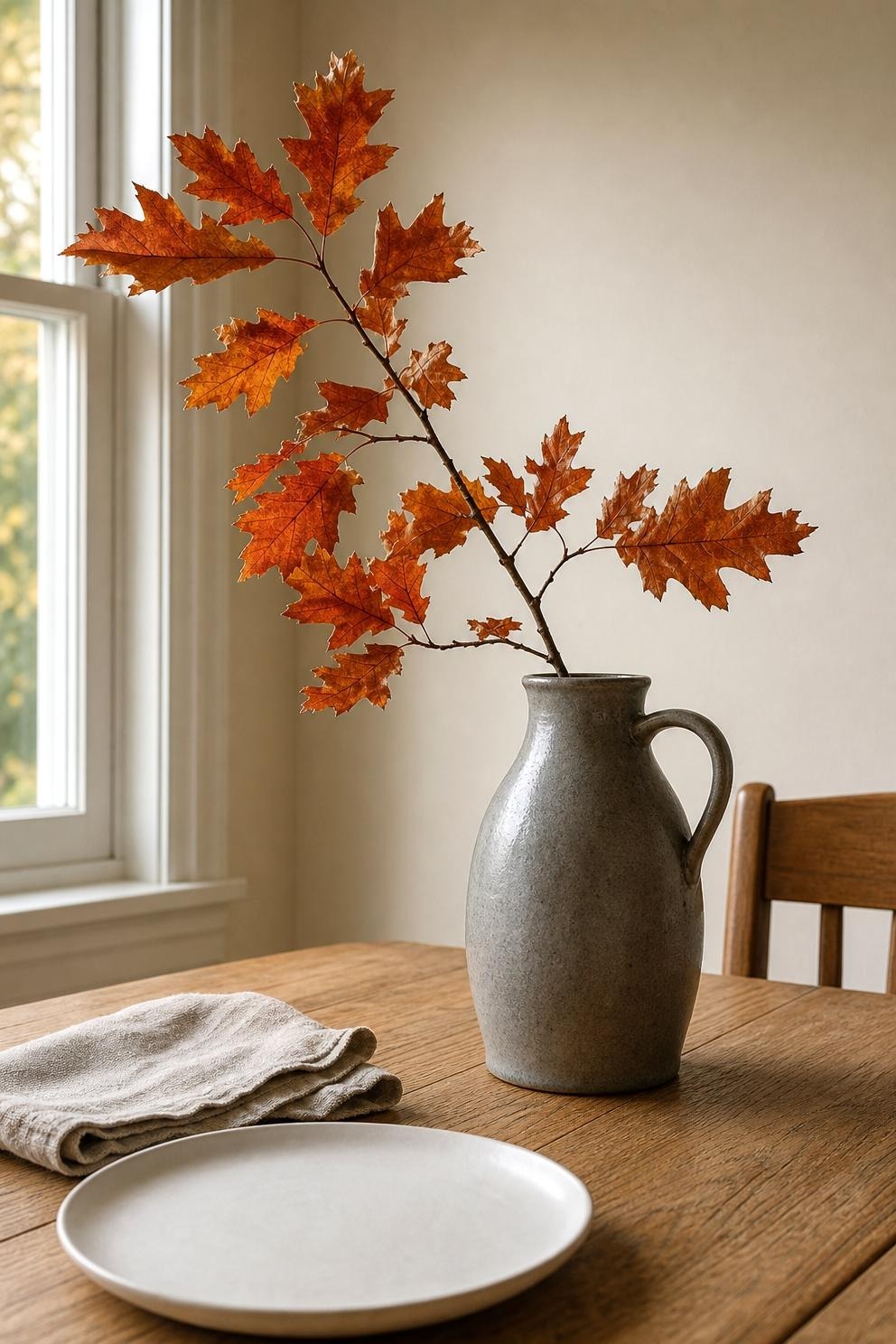
Cut one branch, not a bunch, with good leaf colour or interesting bare structure. Put it in a heavy jug or pitcher that will not tip. One branch, arranged so it leans rather than stands straight, gives you the sculptural look that expensive arrangements are chasing.
The height rule bends here, on one condition: the branch has to be open enough to see through. A sparse branch at eighteen inches is fine because sightlines pass through it. A dense one at eighteen inches is a wall and will get moved.
Oak, maple, beech and copper beech all hold their leaves for a week or two indoors. Bare branches with lichen last indefinitely and look better than they sound.
A Tray, a Candle, and Whatever Is Already Out
The lowest-effort entry, and the one that works on a coffee table as easily as a dining table.
Put a tray in the middle of the table. Onto it goes a candle, a small bowl of something textural, and one more object. That is it. The tray is doing all the work: it draws an edge around a group of unrelated things and turns them into an arrangement.
The textural bowl can hold anything with surface interest. Walnuts in shell, pinecones from a walk, twine balls, acorns, wine corks. None of it needs buying, and all of it reads as autumn.
This is the arrangement to use on a table that gets used constantly, because the whole thing lifts off in a single motion. The same logic applied to a living room is covered in how to style a coffee table for fall.
Grocery Store Flowers, Stripped Back
Supermarket bunches are usually a mixed arrangement that is trying too hard. Take it apart.
Buy one bunch, remove the filler greenery and the one loud flower that does not belong, and use only the two elements that suit the season. Then split what is left across two or three small vessels rather than crowding it into one. A ten-stem bunch becomes three small arrangements, all of which look more expensive than the original.
Sunflowers, chrysanthemums, dahlias and eucalyptus are the reliable autumn buys. Cut them short, five to eight inches above the vessel rim, because supermarket bunches come long and long is what makes them look like a supermarket bunch.
Fresh flowers give you about a week, which is the trade-off against everything dried on this list. Change the water on day three and it holds.
Which One to Pick
| If you have | Use |
|---|---|
| Five minutes and nothing bought | Pears in a bowl, or the tray |
| A table you eat at every night | The tray, or candles |
| Guests coming and no time | Candles at two heights |
| A tree in the garden | The branch |
| One trip to the grocery store | Stripped-back flowers, or gourds |
| A season to cover with no upkeep | Dried wheat, or three jars |
The dried options hold from early September through Thanksgiving without a single intervention. The fruit and flower options give you about a week and need to be part of the shopping rhythm. Neither is better; they are different amounts of attention, and it is worth being honest about which one you have to give.
Common Mistakes That Make the Table Hard to Use
- Building the arrangement before setting out the plates, then discovering there is no serving room.
- Using a tall solid vase that blocks the person across the table.
- Mixing loose candles with dry stems or fabric instead of using flameless pillars.
- Spreading small objects from edge to edge instead of containing them in one bowl, line, or tray.
- Choosing a vessel that takes two hands to move when dinner starts.
Questions People Actually Ask
What are some easy fall centerpiece ideas?
The three fastest need no craft supplies at all: pears or apples tumbled into a shallow bowl, a group of pillar candles at two different heights, or a tray holding a candle and a bowl of pinecones. Each takes about five minutes and uses things most kitchens already contain.
What looks good in the middle of a table?
Something low enough to see over and narrow enough to leave room for plates. Under about twelve inches tall is the practical ceiling, and roughly a third of the table’s width is the most it should occupy. Within those limits, a tray, a bowl of fruit, or a cluster of candles all work on any table shape.
What are some cheap and easy DIY centerpiece ideas?
Skip the DIY part. A branch from the garden in a heavy jug, walnuts or pinecones in a bowl, or one supermarket bunch split across three jars all cost very little and need no glue, paint or craft supplies. Repetition does the work that arranging skill would otherwise have to.
What are some good ideas for a fall tray centerpiece?
Put a tray in the centre of the table, then add three things at different heights: a candle, a low bowl of something textural like walnuts or pinecones, and one small seasonal object such as a white pumpkin. The tray gives the group an edge so unrelated objects read as one arrangement, and it lifts off in a single motion when the table is needed.
How tall should a table centerpiece be?
Under about twelve inches on a dining table, so people can see each other across it. The exception is an open arrangement such as a single sparse branch, where sightlines pass straight through and extra height causes no problem. On a coffee table the ceiling is lower, around nine inches, because you are looking across it from a seated position.
What are some easy table centerpiece ideas that are not seasonal?
Everything on this list minus the pumpkins and gourds works year round. A bowl of fruit, a tray with a candle, three jars of the same stem, and one branch in a jug are all neutral arrangements. The season is carried by what goes in them, so the frame stays and only the contents change.
How do I make a fall centerpiece last all season?
Choose dried over fresh. Wheat, hydrangea heads, bunny tails and pinecones hold from September through Thanksgiving with no upkeep, where fruit gives you about a week and cut flowers about the same. Keeping the palette to white, cream, gold and rust rather than Halloween orange also means it does not need swapping at the end of October.
Sources
- Iowa State University Extension: Growing Hydrangeas in Iowa confirms that hydrangea blooms work well as cut and dried flowers.
- U.S. Consumer Product Safety Commission: Holiday Safety covers candle placement, supervision, and flameless alternatives.
What to Read Next
- Fall Centerpiece Ideas That Cost Almost Nothing sorts the same look by free, garden, grocery, and low-cost sources.
- 5 Fall Table Centerpiece Ideas That Last Past Thanksgiving helps if you want one arrangement to carry into November.
- Thanksgiving Table Ideas for a Small Space protects room for plates and serving dishes on a compact table.
- How to Style a Coffee Table for Fall adapts the tray-and-stem idea for the living room.