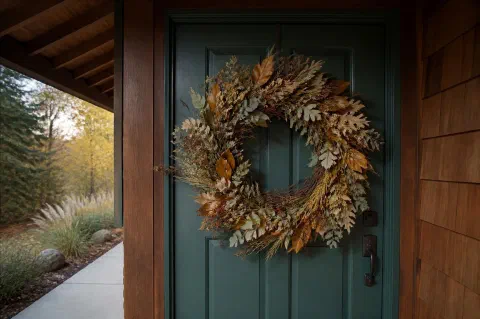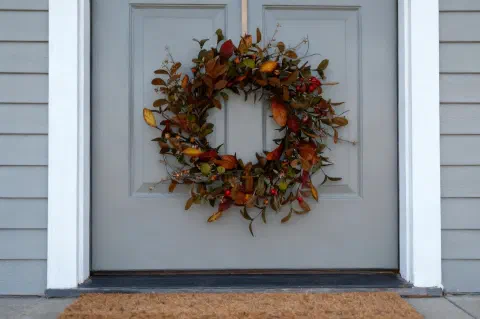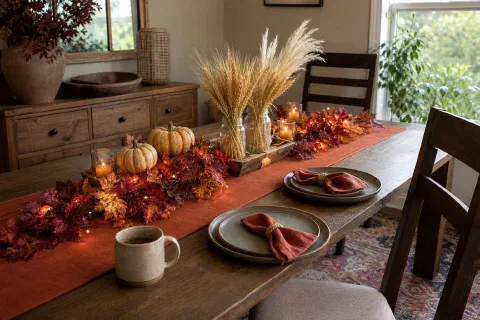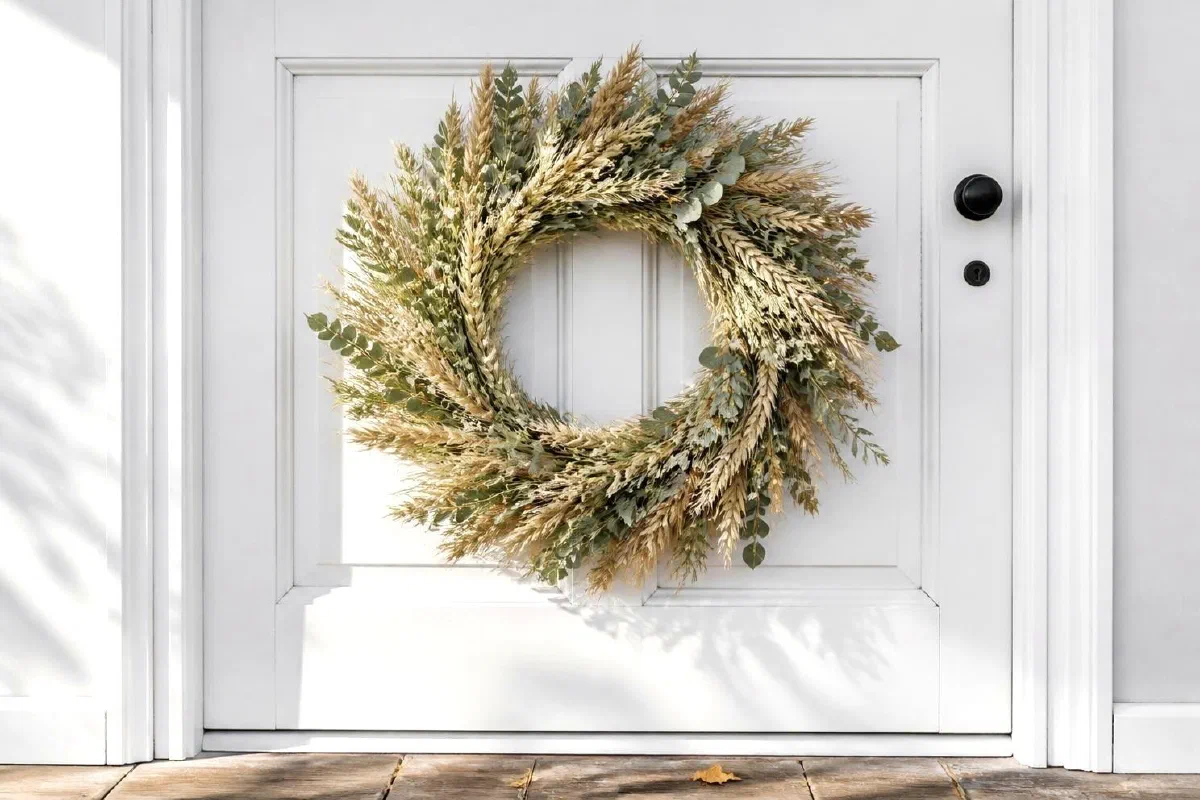
The base you want for a standard front door is 14 inches across. The finished wreath is 22. Mississippi State University Extension builds its 22-inch magnolia design on a 14-inch frame, using stems pruned to about 14 inches and roughly 1.5 pounds of material per wreath.
That eight-inch gap is the number most people miss, and it works both ways. It is why a DIY fall wreath built on a base that looked right in the craft aisle comes out too small on the door, and why the base that looked comically large is usually the correct one.
Get the size and the attachment right and the rest is an evening at the kitchen table. Get either one wrong and you have a small wreath that sheds by October. If you want the neutral version to hold through Thanksgiving instead, a dried fall wreath that lasts past October covers the material choices and the door spots that keep it intact.
DIY fall wreath size guide: 14-inch base vs. 22-inch finish
A wreath should cover roughly two-thirds of the door width. The check that keeps you honest is arithmetic rather than judgment: subtract the wreath diameter from the door width, divide by two, and you want 4 to 6 inches of bare door on each side. On a 36-inch door, a 24-inch wreath leaves exactly 6 inches per side.
Most US entry doors built after 2000 are 36 inches wide by 80 inches tall . Measure anyway. Older houses and side doors run narrower.
| Door width | Finished wreath | Base to buy |
|---|---|---|
| 28 to 30 in (side or storm door) | 18 to 20 in | 10 to 12 in |
| 32 in | 20 to 22 in | 12 to 14 in |
| 36 in (most common entry door) | 22 to 24 in | 14 to 16 in |
| 42 in | 26 to 28 in | 18 to 20 in |
| Double doors, 36 in per leaf | 20 to 22 in each | 12 to 14 in each |
The base column assumes stems reaching about 4 inches past the ring, which is what a 7-inch stem wired at its base gives you. If the wreath overshoots, cut the stems shorter rather than buying a smaller ring.
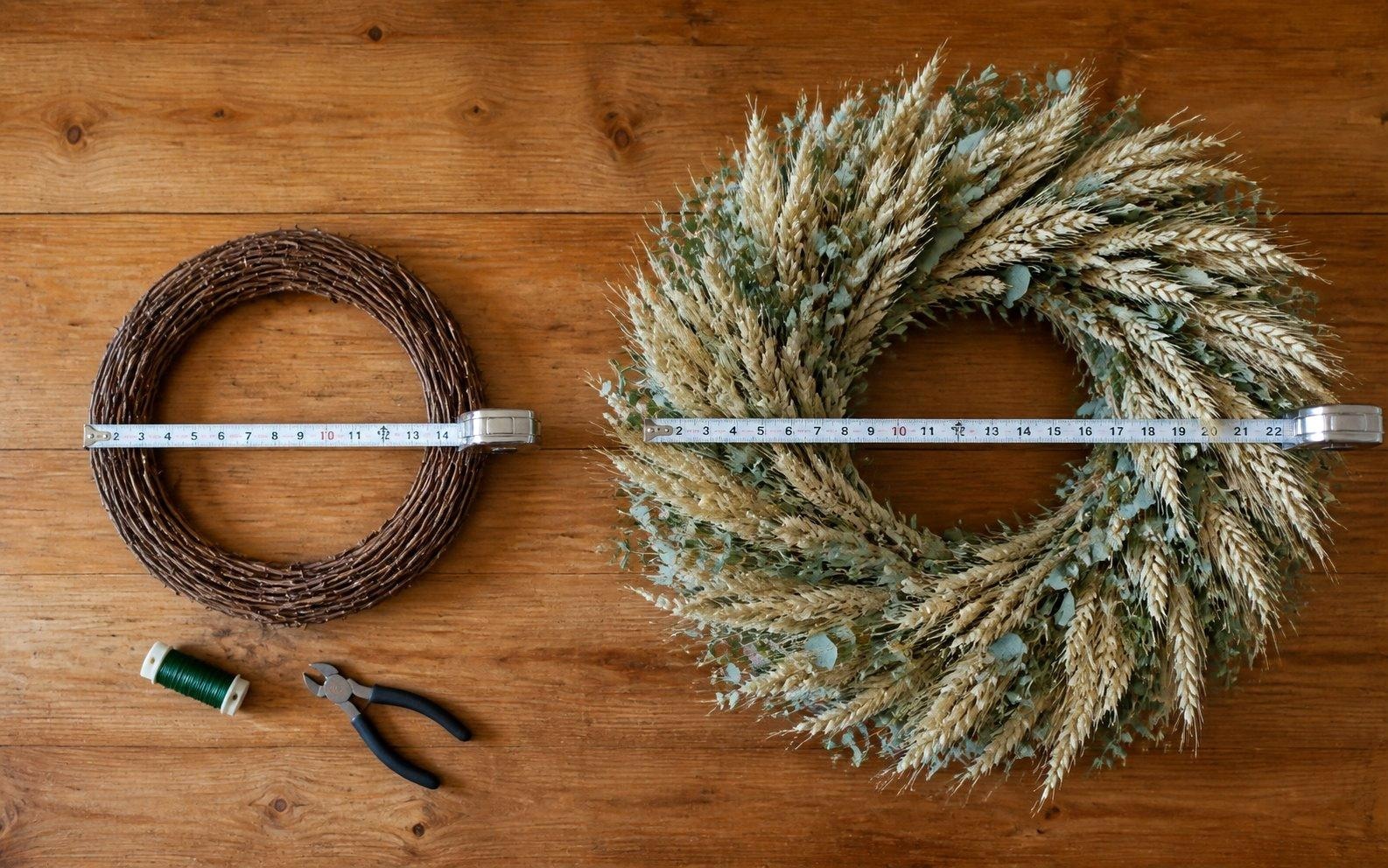
Where it goes vertically. Hang it so the center sits 26 to 30 inches down from the top of a standard 80-inch door. On a 24-inch wreath that puts the bottom edge around 40 inches off the floor, clearing a handle at the usual 36 inches. Centering a wreath in the middle of the door reads low and crowds the handle every time.
Should you make or buy a fall wreath?
Building is not automatically better. It wins in specific situations.
Build when you want a palette the stores do not sell, which usually means anything without orange in it. Building is also the only sane route to 26 or 28 inches, since retail sizing thins out fast above 24. And it gets cheaper every year: a grapevine ring and a paddle of wire carry over, so the second wreath costs a fraction of the first.
Buy when the door faces full afternoon sun with no overhang. A faux wreath with UV protection is the only version that survives that spot unattended for a season, and no amount of care makes dried wheat waterproof. Buying is also the low-risk route if a first homemade wreath sounds like a gamble. For the bought route, a fall berry wreath that reads from the street is the style that carries color at a distance without going full orange.
The honest split: build the dried one for a covered or partly shaded door, buy the faux one for an exposed door in full sun.
This article contains affiliate links. If you buy through them, Etheric Echoes may earn a commission at no extra cost to you. As an Amazon Associate I earn from qualifying purchases. Read the full disclosure.
Fall wreath supplies: choose the base before the stems
| Base | How material attaches | Best for | The catch |
|---|---|---|---|
| Grapevine ring | Stems tuck in, wire for anything heavy | The forgiving default, and the one to learn on | Twiggy edges show, which most people want |
| Wire ring or box frame | Everything gets wired or clamped on | Light, cheap, and capable of a very full wreath | Nothing hides the frame, so coverage must be complete |
| Foam or straw ring | Picks and pins push straight in | Faux stems and picked florals | Holds water outdoors and can mildew, and it is heavy |
| Wooden embroidery hoop | Stems wire to one arc of the hoop | A spare, partial arrangement | Very light, so wind swings it, and the wood swells in rain |
For a first dried wreath, a 14-inch grapevine base (opens Amazon in a new tab) is the right call. It hides mistakes, holds a stem before you even wire it, and its own texture counts as part of the design. A 14-inch wire wreath frame (opens Amazon in a new tab) costs and weighs less, but forgives nothing: any thin patch shows metal.
How to make an easy fall wreath in one evening
A neutral wheat and eucalyptus wreath on a 14-inch grapevine base, finishing around 22 inches. It suits a 36-inch door and takes about 45 minutes, 15 of which is sorting.
What you need
- One 14-inch grapevine base
- 22-gauge floral paddle wire (opens Amazon in a new tab)
- 55 to 70 dried wheat stems (opens Amazon in a new tab) , cut to 7 inches
- 20 to 24 eucalyptus sprigs cut to 5 inches, which is 6 to 8 full 17-inch preserved eucalyptus stems (opens Amazon in a new tab) broken down
- Optional: 10 to 12 bunny tails or small dried grass plumes
- Wire cutters, or scissors you do not mind dulling
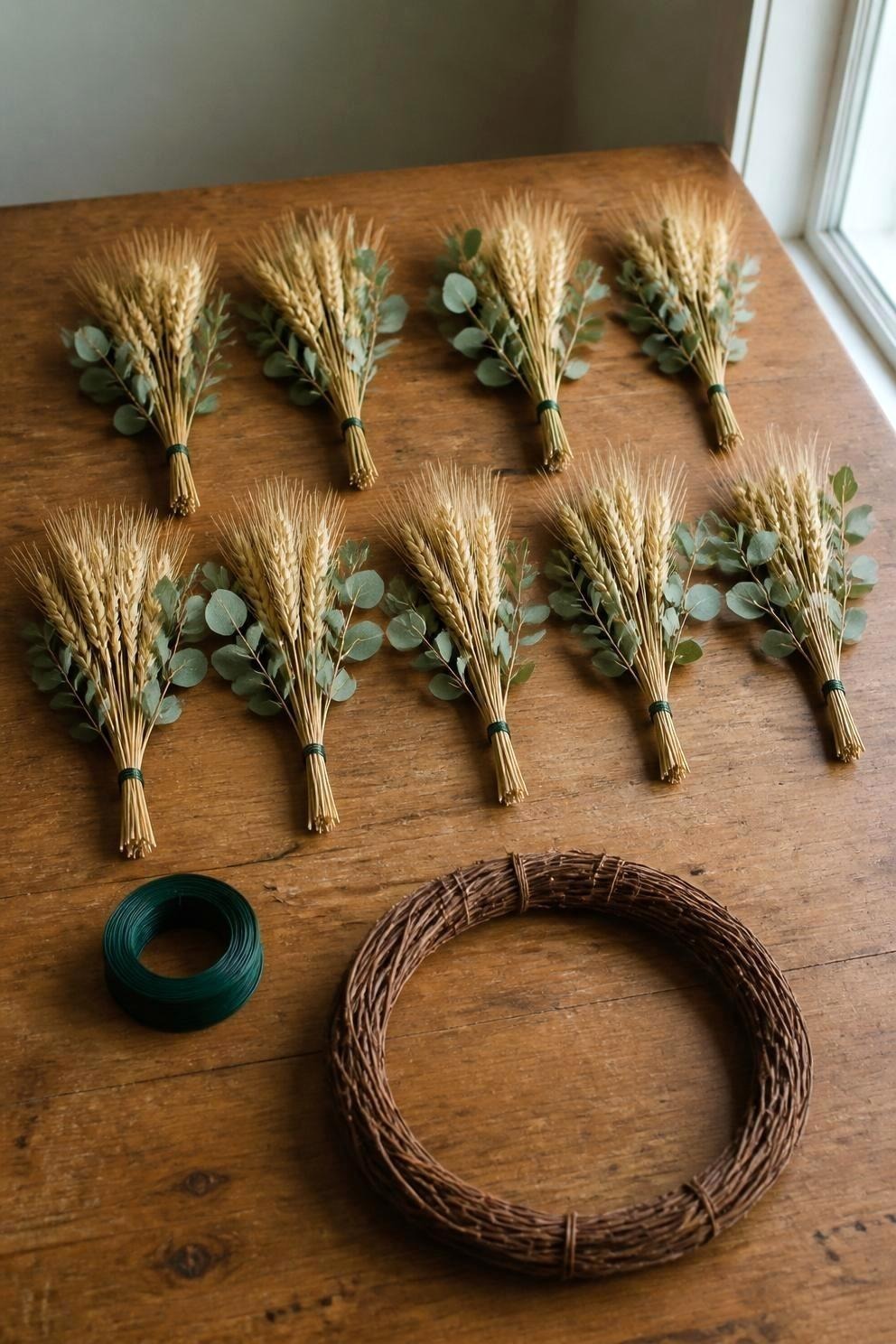
A 14-inch ring has a circumference of about 44 inches. Bunches covering roughly 4 inches of that arc, overlapping, means 10 to 12 bunches around the ring. That is where the stem counts come from, and it scales to any base size with a tape measure.
The steps
- Cut everything first. Wheat to 7 inches, eucalyptus to 5. Cut as you go and your lengths drift, which shows up as a lopsided outline.
- Build the bunches on the table before you touch the base. Ten to twelve piles, each 5 or 6 wheat stems with 2 eucalyptus sprigs laid on top and one grass plume if you are using them. Mississippi State bunches four to six stems per clamp and the same logic applies by hand. This step is what makes a wreath look consistent instead of homemade.
- Anchor the wire. Wrap the paddle wire three or four times around the point that will be the bottom, then twist the tail back on itself. Leave the paddle attached. You want one continuous length, not cut pieces.
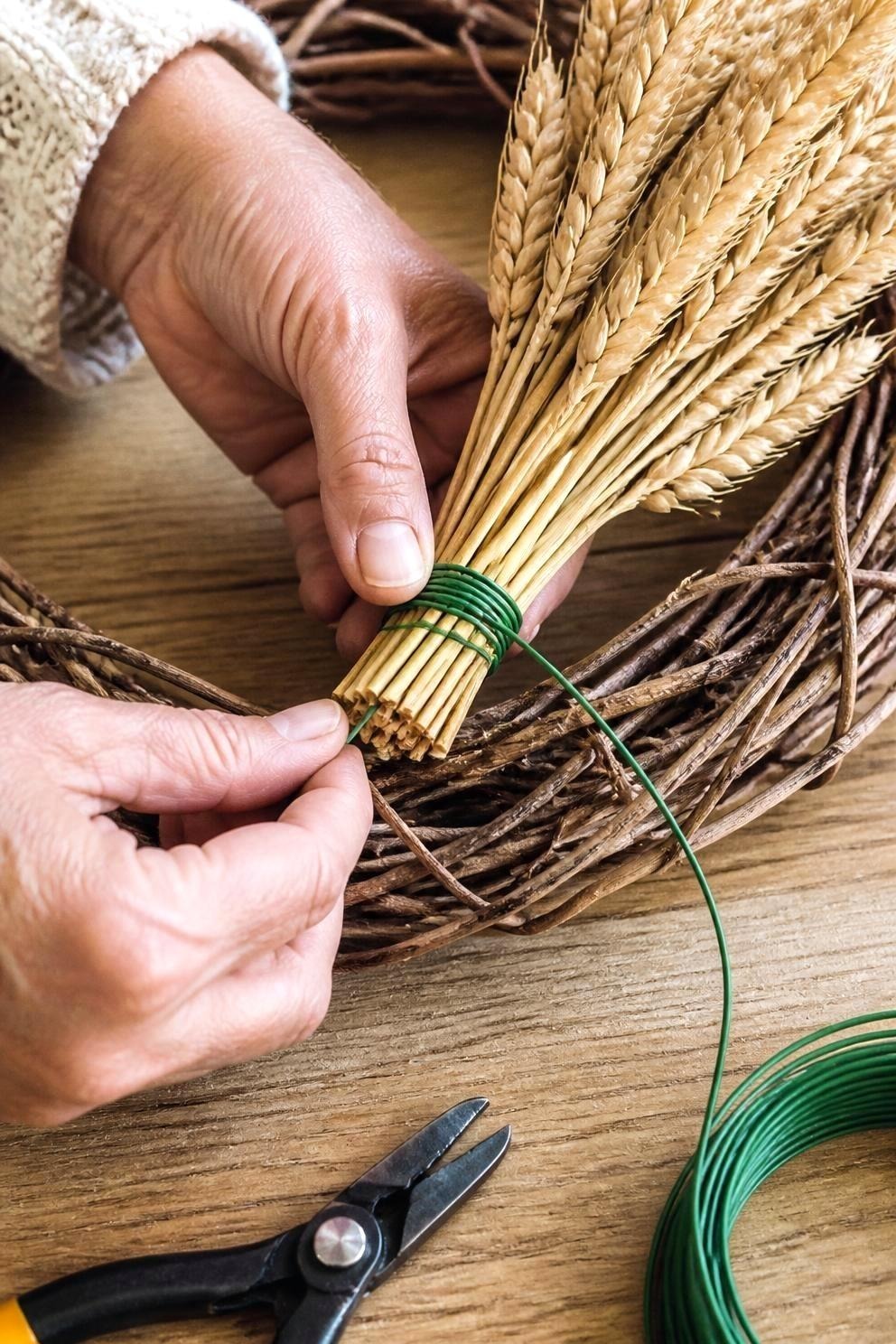
- Lay the first bunch flat against the ring, stems pointing clockwise. Wrap two or three tight turns across the stem ends only, never across the wheat heads. Pull it tighter than feels polite, because dried stems shrink slightly and a loose wrap loosens further.
- Add each bunch so its stem ends sit under the heads of the last one. Every bunch hides the wire and cut ends of the one before it. Keep the angle identical the whole way around.
- On the last bunch, lift the heads of the very first one and tuck the stems underneath. Wrap, cut the wire, and twist the end into the vine where it cannot scratch the door.
- Wire a hanging loop to the back at the top, using a doubled length of the same wire. Do not hang the wreath off the vine itself, which splits.
- Take it outside and look from the sidewalk. Thin spots are obvious at 30 feet and invisible at arm’s length. Fill them with a few loose stems tucked into the vine.
Floral wire vs. hot glue for an outdoor fall wreath
Hot glue is thermoplastic. It went on liquid because it was hot, and it goes soft again when it gets hot. A front door in September afternoon sun is one of the hotter flat surfaces on the house. For scale, 3M rates its outdoor adhesive strips to hold up to 125 degrees Fahrenheit , which is the range a manufacturer expects a sunlit outdoor surface to reach.
The second reason matters more. Glue bonds one contact point. Wire captures the whole bundle mechanically, which is why a wired wreath sheds a stem or two and a glued wreath drops a cluster.
Glue does have a job. Acorns, pods, berries, and anything with no stem to wrap around are fine to glue, on a door with a roof over it. Use it as a supplement, never as the structure.
Real, faux, dried, or preserved
| Material | Life on a front door | Wins at | Fails at |
|---|---|---|---|
| Fresh cut greenery | Days in heat, a couple of weeks once nights cool | Scent, and free if you have the shrubs | Needs replacing constantly |
| Air-dried (wheat, grasses, pods) | One outdoor season | The neutral fall look, easy to wire, cheap by volume | Shatters once rained on, brittle in wind |
| Glycerin-preserved (magnolia, eucalyptus) | Years, but see below | Stays supple instead of shattering | Weeps oily solution in humidity |
| Faux with UV protection | Several seasons | Full sun and weather, unattended | Cheap ones read as plastic from three feet |
The preserved caveat is worth spelling out because nobody mentions it. Mississippi State warns that glycerin-preserved foliage “will weep solution from the leaves when displayed under humid conditions,” and that those droplets can stain doors, walls, and floors. Their guidance is to keep preserved products indoors and out of humid locations. On a covered porch in a dry climate that is a small risk. On a South Carolina front door in September it is not.
To preserve your own, the same publication gives a half-and-half glycerin and water solution, with timing by species: about a week for nandina and Carolina cherrylaurel, two weeks for ‘Little Gem’ magnolia, four or more weeks for full-size magnolia and camellia. Expect the color to shift to brown, which is the process working.
How an outdoor fall wreath handles sun and weather
A south or west-facing door in September still gets hours of hot, direct light. That light fades color long before it damages structure.
University of Missouri Extension is direct about it: hang drying material in a warm, dry, dark place, avoid damp rooms and direct sun, and expect faded material to need retinting for durable color. The same physics applies once the wreath is on the door.
- Dyed anything fades fastest. Bright orange and red preserved leaves, dyed grasses, and colored berries lose saturation in weeks on a sunny door.
- Undyed material barely shows it. Wheat, oats, cotton, pods, pinecones, and natural eucalyptus are already close to the color they fade toward.
- Faux stems need to say UV somewhere on the listing. Untreated polyester leaves go chalky in one season of direct exposure.
- An overhang changes everything. A recessed door lets you use the fragile, pretty material. A door flush to the wall in full sun does not.
A dried fall wreath with no orange
Plenty of people want the season without the pumpkin palette. This is the easiest wreath to build and the one that reads most expensive, partly because the material sits in one value range.
Work from wheat, oat, cream, sage, and bone white. Dried wheat carries the volume. Bunny tails and small pampas plumes (opens Amazon in a new tab) add the soft texture. Undyed eucalyptus supplies the only real color, a muted grey-green. White statice or a few cotton stems give the pale note that keeps the whole thing from going flat brown.
The ratio that works: one material for about three quarters of the volume, two accents sharing the rest. Three materials at equal weight looks undecided.
If you would rather grow and cut your own, Missouri Extension’s list of reliable air-dryers is where to start: baby’s breath, bachelor’s button, globe amaranth, larkspur, statice, strawflower, and yarrow, plus fountain grass, pampas grass, and quaking grass. Hang bunches upside down in a warm, dry, dark spot with good air movement for two to three weeks. Clemson’s drying guide gives the same instruction and the reason the room has to be dark: darkness is what preserves the flower color.
How to hang a fall wreath without damaging the door
This is where most of the actual damage happens, and where renters get stuck.
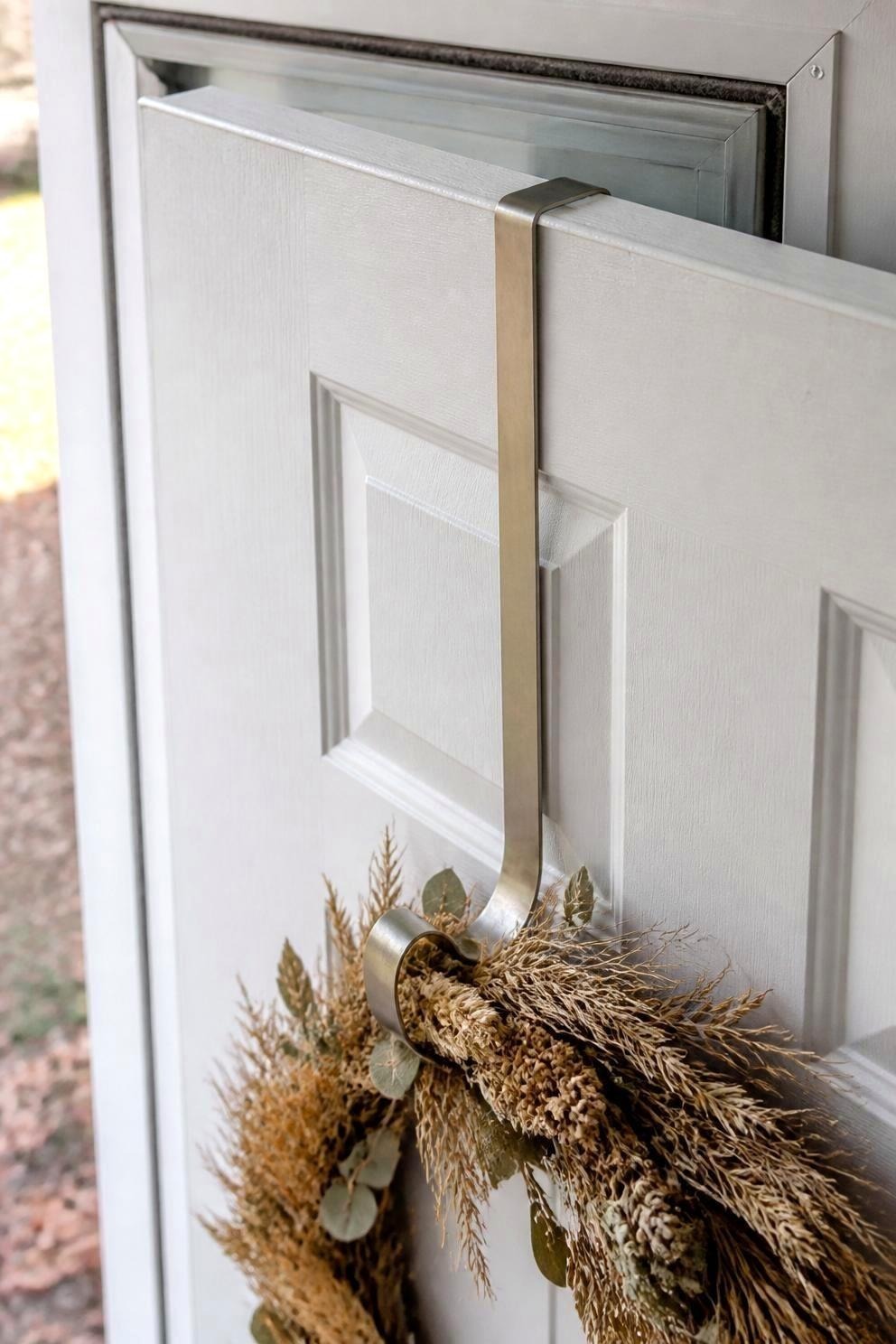
Over-the-door hanger. The default, and the right answer on a plain entry door with no storm door. A 15-inch over-door wreath hook (opens Amazon in a new tab) drops the wreath near the height the size table calls for and needs no holes. For a taller door, or a wreath hanging too low, an adjustable 15 to 25 inch hanger (opens Amazon in a new tab) rated to 20 pounds covers more positions.
Ribbon over the top. The magazine look. Run wide ribbon over the top edge and secure the inside tail with a thumbtack into the top edge or a small hook on the inside face. Two warnings: thick ribbon compresses the weatherstripping at the top of an exterior door, which you notice as a draft, and grosgrain soaks up rain and stays wet against the paint.
Adhesive hooks. 3M’s outdoor line is rated for smooth, sealed, finished surfaces including doors, windows, vinyl siding, and trim, and is explicitly not recommended for rough surfaces like brick, cement board, or rough-sawn wood. Apply above 15 degrees Fahrenheit. Respect the weight number on the package, because a soaked dried wreath weighs considerably more than the dry one you hung.
Magnets. Only if there is steel in the door. Test with a refrigerator magnet before buying anything. Steel doors hold, wood does not, and fiberglass depends entirely on whether that particular door has steel reinforcement behind the skin. There is no way to know but the magnet.
The storm door, which is the hard case. The gap between a storm door and the entry door behind it is narrow, so two things go wrong: a wreath on the inner door hits the storm door glass, and a standard over-door hook adds enough thickness at the top edge that the storm door will not latch. Two ways out. Hang on the storm door itself with a slim clear over-door hanger (opens Amazon in a new tab) , whose listing specifies doors up to 1.8 inches thick and about a tenth of an inch of clearance above the door. Or, on a single-pane storm door, use a pair of magnets, one on each side of the glass, which needs no clearance at all. Either way, build the wreath flatter than you otherwise would. Depth is what hits the glass.
Seven DIY fall wreath mistakes to avoid
- Buying a base the size you want the wreath to be. Add about 8 inches. A 22-inch wreath comes off a 14-inch ring.
- Cutting stems as you go. Lengths drift and the outline goes uneven.
- Wrapping the wire over the wheat heads instead of the stem ends, which crushes the part you are trying to show.
- Hot glue as the structure on a door that gets sun. It softens and lets go of whole clusters.
- A glycerin-preserved wreath on an exposed door in humid weather. It can weep and mark the paint.
- Dyed material on a west-facing door. Two weeks of afternoon light and the color is gone.
- A standard over-door hook with a storm door. The outer door stops latching, which is a security problem and not just an annoyance.
What I’d Actually Buy
The bases and the wire are the purchases that pay off twice, because they carry over to next year and to a Christmas wreath.
- 14-inch natural grapevine wreath base, 2 pack (opens Amazon in a new tab) (4.4 stars, 123 ratings). The right size for a standard 36-inch door once stems go on, and two means you can ruin one and continue.
- 14-inch wire wreath frame, 2 pack (opens Amazon in a new tab) (4.6 stars, 1,200+ ratings). Lighter and cheaper, best once you can reliably get full coverage.
- BEADNOVA 22-gauge floral paddle wire, 38 yards (opens Amazon in a new tab) (4.8 stars, 1,300+ ratings). One paddle builds several wreaths. Twenty-two gauge is the useful compromise, strong enough to hold a bunch and soft enough to wrap without pliers.
- Sukh dried wheat stalks, 100 stems (opens Amazon in a new tab) (4.4 stars, 800+ ratings). One bundle covers a 22-inch wreath with stems left over for a vase.
- Oning preserved eucalyptus stems, 30 pieces at 17 inches (opens Amazon in a new tab) (4.2 stars, 2,200+ ratings). Each full stem breaks into three or four sprigs. Sold for shower hanging, which is the same material.
- Dried pampas grass with bunny tails, 100 stems (opens Amazon in a new tab) (4.5 stars, 13,000+ ratings). The texture accent for the no-orange version, and the best-reviewed dried material in the category.
- Sattiyrch 15-inch over-the-door wreath hanger (opens Amazon in a new tab) (4.7 stars, 30,000+ ratings). No holes, and the drop lands the wreath near where the size table wants it.
- 12-inch clear slim over-door wreath hangers, 2 pack (opens Amazon in a new tab) (4.4 stars, 3,300+ ratings). The storm door answer, with a stated fit up to 1.8 inches of door thickness.
- GP Life adjustable wreath hanger, 15 to 25 inches, 20 lb (opens Amazon in a new tab) (4.6 stars, 3,200+ ratings). For a taller door, or to raise a wreath hanging too low on a fixed hook.
Check each product page for current sizes and options before ordering.
What to Read Next
- Fall front porch decor for a small porch for what goes around the door once the wreath is on it, when the porch is narrow.
- Fall flowers for pots that get better in the cold for the container half of the same doorway, with planting windows by zone.
- Front porch planter ideas that look full all season if the pots beside the door look thin next to a full wreath.
- Fall table centerpiece ideas uses the same dried wheat and eucalyptus indoors, where nothing fades.
- Halloween entryway decor ideas for carrying the same door through the end of October.