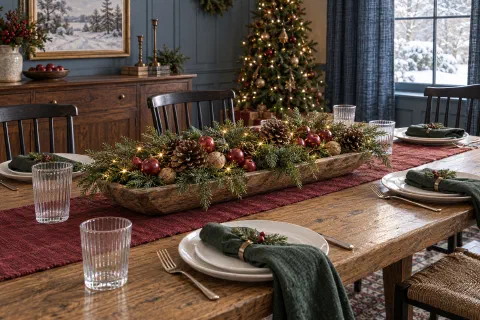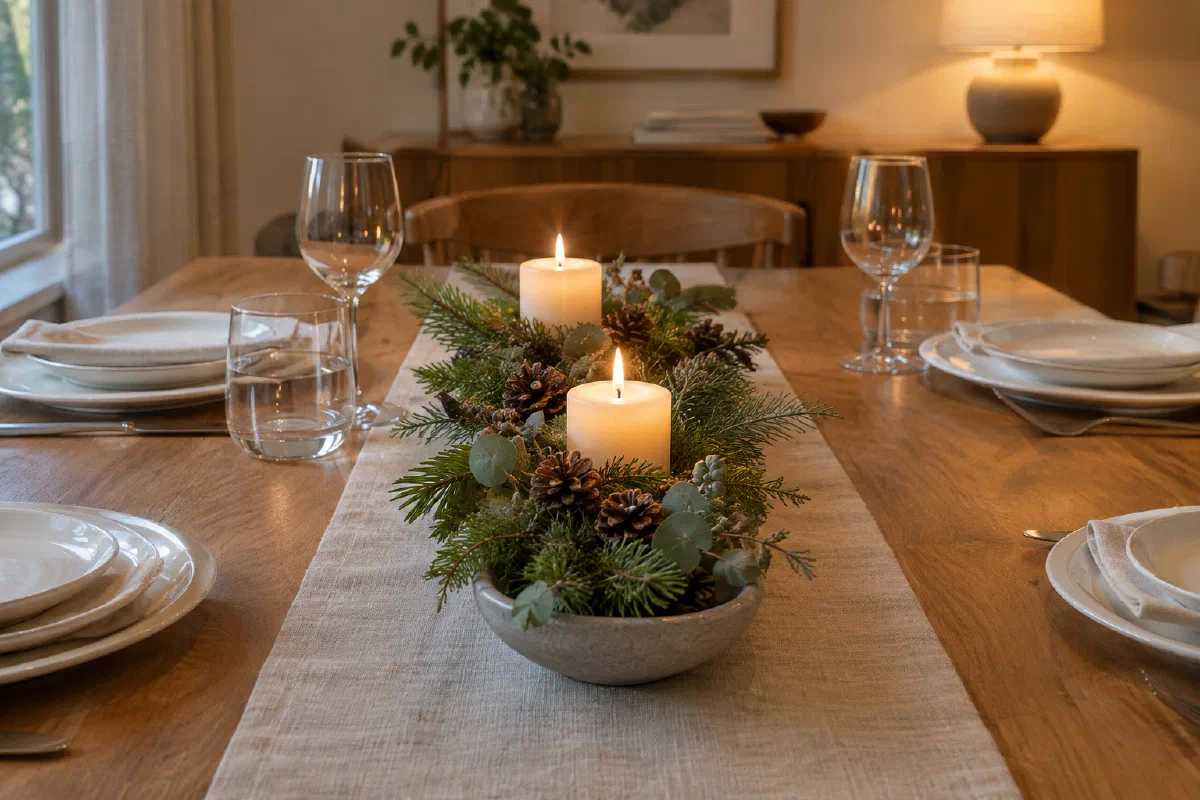
A centerpiece fails at Christmas dinner for one of two reasons. It’s too tall, or it’s too wide. Everything else is styling.
Keep the tallest part of a Christmas dining table centerpiece under about 8 inches if it sits on the center line, and keep the footprint narrow enough that two place settings and one platter can share the table. Then decide whether the thing is greenery, fruit, or candles.
Most guides give you one number, 12 inches, and stop there. That number came from round wedding tables, where the arrangement sits in the middle of a 60-inch circle. On a 38-inch family table, the person across from you spends dinner talking to the back of your fir tips.
The Sightline Test: How to Set the Height Rule
Standard dining tables sit 28 to 30 inches off the floor and chairs put the seat at 17 to 19 inches, which lands seated eye level for most adults about 15 to 17 inches above the tabletop. Two lines of sight cross that table. Only one of them is a problem.
- Eye to eye. This line is close to level, so it takes real height to break it. A 12-inch arrangement rarely blocks a face.
- Eye to the far plate. This line drops from your eyes to the plate rim opposite. Near the middle of the table it passes about 8 inches above the surface.
The second line fails first, and it fails quietly. You keep leaning sideways for the salt, or the person opposite stops reaching for anything.
The height rule has two parts:
- Anything on the center line stays under about 8 inches, measured to the top of the greenery.
- Anything taller goes narrow, off the center line, or onto a sideboard. A 12-inch candlestick near the end of a table is fine. The same one in the middle is a fence post.
The test takes thirty seconds. Sit in the chair you’ll use. Put the tallest piece in the middle. Look at the far plate rim and the eyes of the person who’ll sit there. If either disappears, take the top third off.
Advice elsewhere disagrees. Event florists and bridal guides usually say 12 inches, table-setting guides say 8 to 10, and a few say 14. No extension service or standards body publishes a number, and I went looking, so those are convention rather than code. The differences track the table: 12 inches is fine on a wide round table and too tall on the rectangle most people eat on.
The Serving Space Rule: Footprint Beats Symmetry
One place setting eats about 15 inches of table depth once you count the plate, the glass above it, and room for a pulled-in chair. Two settings leave 8 inches of open strip down the middle of a 38-inch table. That strip is your entire footprint.
| Table width | Open center strip with both sides set | What fits on the center line |
|---|---|---|
| 36 inches | about 6 inches | A laid-flat runner, or nothing at all |
| 38 to 40 inches | 8 to 10 inches | One narrow bowl, no wider than 8 inches |
| 42 inches | 12 inches | Two small dishes with a real gap between them |
| 48 inches and up | 18 inches or more | A low bowl plus two candle sleeves |
Serving space is more than footprint. A platter is hot and needs landing room. A 15-inch turkey platter wants 15 inches of clear table plus a few inches of approach, so leave 12 to 14 inches of bare table at each end. Three things quietly steal that room:
- A dough bowl wider than 8 inches, because its longest side runs across the strip.
- Charger plates under dinner plates, which push every setting two inches toward the middle.
- A symmetrical mound, which puts the widest point exactly where the sightline dips lowest.
Plate in the kitchen instead and you can spend that strip on something wider. That’s the trade. A wider centerpiece costs you the platter.
What to Use Instead of a Floral Arrangement
You don’t need flowers, and on this table you’re better off without them. Tall arrangements are the default in floral design for one reason: they photograph well from a standing position, which is not how anyone at your table sees them.
What works at dinner height:
- Laid-flat greenery: fir or cedar tips in a line no more than 3 inches tall, cut ends tucked under.
- A shallow bowl of whole fruit: pomegranates, red apples, or crabapples inside the rim.
- Unshelled walnuts or hazelnuts in one layer. Guests eat them, so the bowl empties itself.
- Three small dishes instead of one big one, spaced so the table shows between them.
- Battery candles in glass sleeves at two heights, both below eye level, so the glow sits near dry needles with no open flame.
The trick is dimension, not height. Flat arrangements cost almost none of the sightline, so a 40-inch runner can be generous. Round arrangements cost the most, because their widest point sits where the sightline dips lowest.
Which Greens to Use, and Which Offcuts Stay Outside
Fresh greenery is where this gets cheap, and where it gets risky, in that order.
Species matter. University of Minnesota Extension puts Fraser fir and balsam at the top for staying fresh indoors and near heat, and lists pine and cedar as good tabletop choices if they stay away from vents. Evergreens seal their cuts with sap after harvest, which is why a fresh cut at the base matters once stems sit in water (University of Minnesota Extension ).
For evergreen offcuts from your own yard, Oregon State University Extension keeps it simple: harvest after a hard frost, cut 3 to 4 feet back from the branch tip and above a node so the tree can regrow, and never take more than 25 percent of the live crown from a tree you’re leaving standing. Store the pieces cool, mist them, and don’t soak them, because excess water grows mold (OSU Extension ).
Here’s the part most centerpiece posts skip. Yew is the common hedge people clip for winter arrangements, and the NC State Extension Gardener Plant Toolbox rates Taxus cuspidata as high severity poison. The alkaloid taxine in the leaves, bark, and seeds can cause vomiting, weakness, convulsions, and in serious cases death, and the plant is flagged as a problem for cats, dogs, and horses. Holly berries and mistletoe belong in the same conversation. If you can’t name the shrub, don’t put it next to the butter (NC State Extension Plant Toolbox ).
Two choices worth making on purpose:
- Floral foam. Most tabletop greens guides assume a water source or foam. Foam holds stems upright and holds a shape, and a shape is what makes an arrangement tall. Skip it here, use a waterproof liner, and keep wet material off the tablecloth.
- Battery candles over real ones. CPSC says burning candles belong on a stable, heat-resistant surface and away from trees, evergreens, decorations, curtains, and furniture. On a table of dry needles, that settles it (CPSC holiday decoration safety ).
Build One From Evergreen Offcuts in Twenty Minutes
- Cut more than you need. Short tips, 6 to 10 inches, stay low more easily than long branches.
- Re-cut every stem at an angle and stand the tips in cool water for an hour or two.
- Line a shallow bowl, tray, or board so sap never reaches the linen.
- Lay the flattest pieces first with the cut ends turned inward, so nobody is looking at a stump.
- Build one fuller cluster off-center rather than a mound, and put the tallest point there.
- Add the second dimension last: fruit, nuts, dried orange, three candle sleeves at two heights.
- Run the sightline test, then check length. Stop 12 to 14 inches short of each end.
Before You Build: Mistakes That Cost You the Table
- Building three days ahead with no water source. Fresh greens go brittle faster than people expect, and brittle tips drop needles into the gravy.
- Setting the arrangement straight on the tablecloth with nothing underneath. Sap and damp moss both leave marks.
- Clipping a shrub you can’t identify.
Care and Cleanup After Dinner
Fresh cut greens want cool air and water, and a dining table offers neither. Keep the arrangement clear of heat vents, radiators, and hot lights, the same advice University of Minnesota Extension gives for indoor cedar and pine. Mist it once a day, and top up the water when the stems sit in a liner.
Check under the vessel each morning. A shallow bowl of wet greenery sweats, and a ring on wood is permanent.
After dinner, lift the arrangement off in one piece and shake it outside rather than rinsing needles into the sink. Compost the greenery, keep clippings away from pets, and store the bowl, tray, and candle sleeves together so next year takes ten minutes.
The meal is the point. A centerpiece that lets you watch your aunt laugh at the far end of the table did its job, and it will do it again the next day.
What to Read Next
- Christmas Centerpiece Ideas for Tables You Actually Use covers eight arrangements by room once you know your height and width numbers.
- Christmas Garland Ideas for a Small Home is where the rest of the branch goes after the centerpiece is built.
- Christmas Mantel Decor applies the same keep-it-low thinking where greenery sits closest to heat.
- Fall Table Centerpiece Ideas lets you test the serving-space math in November, before December gets busy.