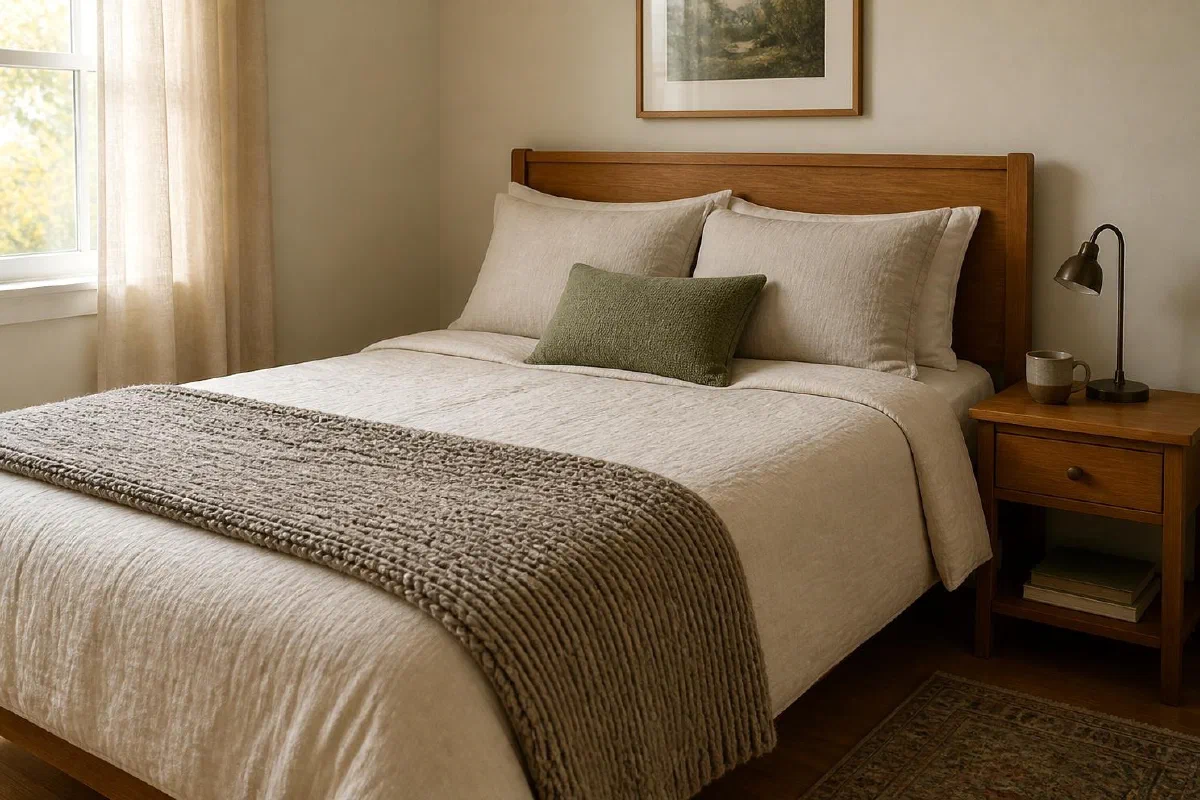
A small bedroom gets cold before the rest of the house does. Less air to hold heat, usually one exterior wall, often a single window with a draft under it. The fix is not a space heater and it is definitely not new furniture. It is seven swaps you can make in a weekend, most of them things you already half own.
Everything here works in a rental. Nothing needs a drill.
This article contains affiliate links. If you buy through them, Etheric Echoes may earn a commission at no extra cost to you. As an Amazon Associate I earn from qualifying purchases. Read the full disclosure.
Start With the Sheets, Not the Duvet
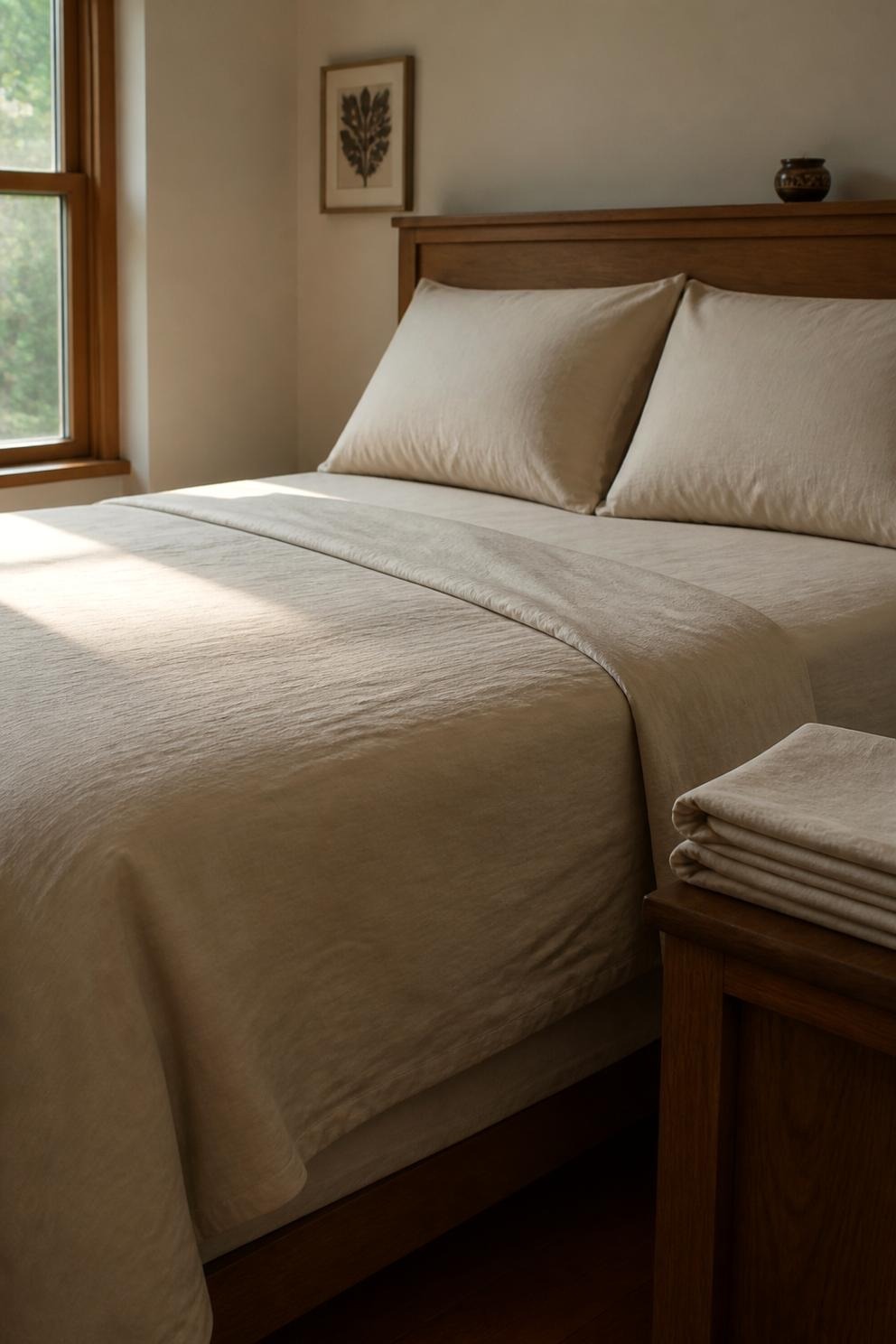
The layer touching you matters more than the one on top. A percale sheet feels crisp and slightly cool, which is exactly right in July and exactly wrong in October.
Swap to brushed cotton or jersey (opens Amazon in a new tab) for early fall. Both feel warm on contact without the weight that makes you kick everything off at 2am. Flannel is the next step up, and worth it if your room genuinely runs cold, though most people find it too warm before November.
Look for a listed weight. Flannel sold by weight, around 170 GSM, is a light flannel. Around 190 GSM and up is the heavy kind people either love or overheat in. If the listing does not say, the reviews usually will.
One set is enough. You are swapping seasonally, not building a collection.
Drop the Light to 2700K
Bulb color changes a room faster than paint, and it costs the price of a bulb.
Most bedrooms are lit at 4000K or higher, which is a bluish daylight tone that reads as an office. Fall bedrooms want 2700K, sometimes labeled soft white or warm white. The number is printed on the box.
| Kelvin on the box | What it looks like | Where it works |
|---|---|---|
| 2700K, sold as soft white or warm white | yellowish warm white | bedside lamp and evening light |
| 4000K and up, sold as cool white or daylight | bluish white | offices and task areas, not a fall bedroom |
DOE’s lighting guidance makes the same split in plainer words: light color runs from a yellowish warm white to a bluish cool white, and that color changes how a room feels. Warm white is the end of the scale you want here.
Change the bedside bulb (opens Amazon in a new tab) first. If the room has one ceiling fixture doing all the work, change that too, and then stop using it after sunset.
The second half of this swap costs nothing: stop lighting the room from above. A single lamp at mattress height throws light across the bed instead of down onto it, and the corners of the room stay dim. Small rooms feel larger when the corners disappear.
A plug-in dimmer (opens Amazon in a new tab) between the lamp and the outlet takes ten seconds to install and lets you drop the level further as the night goes on.
One Rug, on the Side You Actually Get Out On
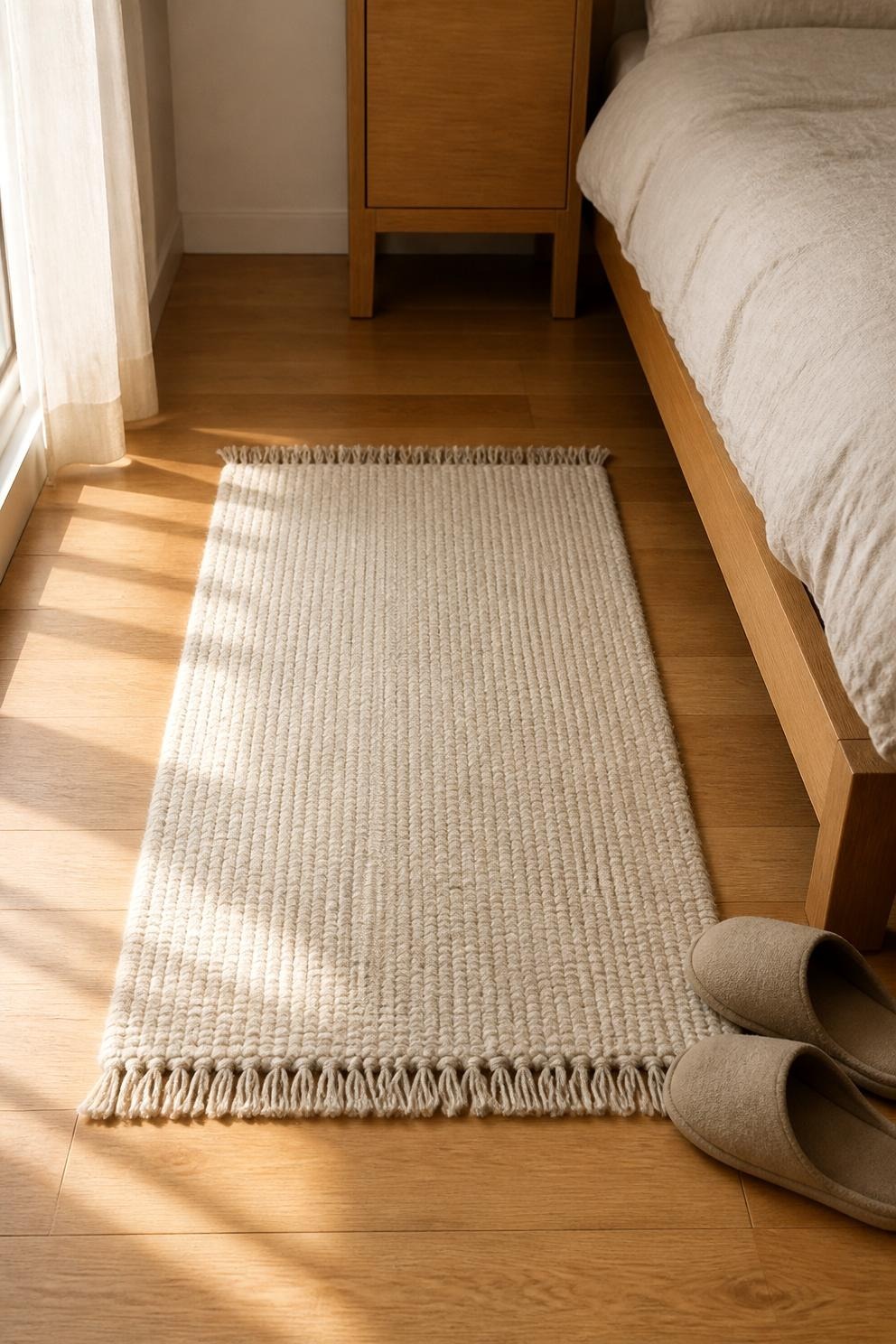
Cold floors are most of what people mean when they say a room feels cold. Your feet hit the floor once a day at the worst possible moment, and that one contact colors how the whole room feels.
You do not need a rug under the bed. In a small room, a large rug mostly disappears under furniture and eats a third of your budget doing it.
Buy a 2 by 3 (opens Amazon in a new tab) , or a 2 by 6 runner, and put it on the side you get out on. Machine-washable is worth prioritizing over material in a bedroom, because a bedside rug gets more traffic than any other soft surface in the room.
If the floor is tile or laminate, add a rug pad. Without one it slides, and a sliding rug beside a bed is a genuine hazard in the dark.
Layer the Foot of the Bed, Not the Whole Bed
A folded throw across the bottom third of the bed does two things. It reads as warmth from the doorway, and it is right there at 3am when you want one more layer without getting up.
Chunky knit looks the part but sheds and snags. A washable chenille knit (opens Amazon in a new tab) or a heavyweight cotton waffle holds up better through a season of actual use.
Skip the pile of decorative pillows. In a small room they have nowhere to go at night except the floor, and a stack of pillows on the floor is the opposite of calm. The spare throws need a home too, and blanket storage that holds its shape beats a stack on a closet shelf that flattens by January.
Fix the Window Before You Blame the Room
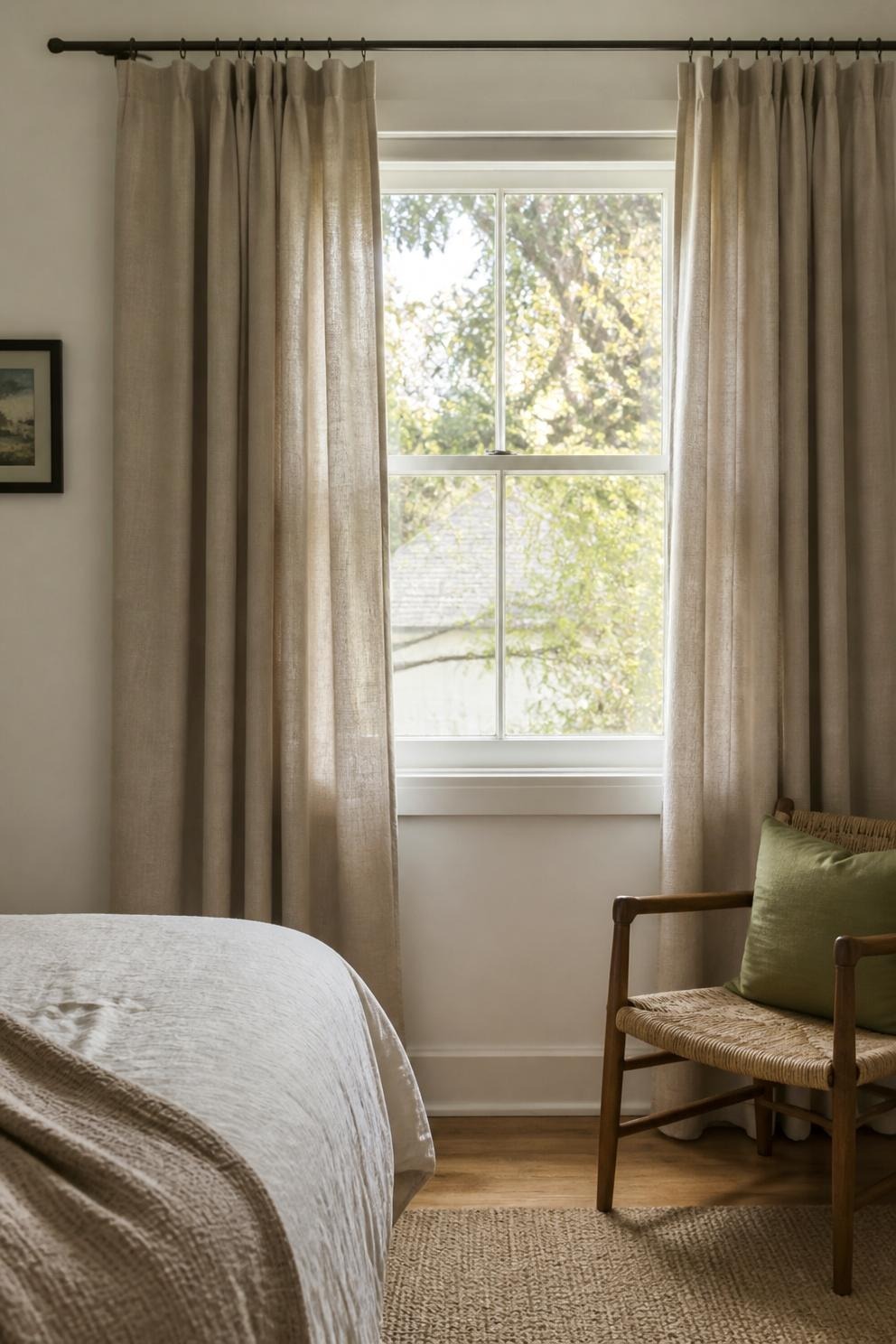
A single-pane window loses heat all night, and most bedroom curtains are decorative sheers that do nothing about it.
DOE’s Energy Saver guide is blunt about the scale of it: air leaks are among the greatest sources of energy loss in a home, and sealing cracks and openings to the outside can save 10 to 20 percent on heating and cooling bills. Two habits come free with curtains you already own. Close them at night to block the chill coming off the glass, and open them during the day to let the sun do some of the warming.
Lined or thermal-backed curtains (opens Amazon in a new tab) make a measurable difference. Hang the rod four to six inches above the frame and eight to twelve inches wider on each side. That way the panels stack against the wall when open, so you keep your daylight, and they fully cover the glass when closed.
Renters: tension rods work inside most frames, and command-style hooks handle light panels. Neither leaves a mark.
If you can feel air moving at the sill, a window sealing strip (opens Amazon in a new tab) along the bottom sash costs almost nothing and stops the specific cold draft that wakes you up.
Move the Bed Off the Cold Wall, if You Can
This one is free and most people never try it.
An exterior wall stays several degrees cooler than an interior one all night. If the layout allows it, put the headboard against an interior wall instead. In a small room this often means giving up the symmetrical arrangement, which is fine. Nobody has ever slept better because a bed was centered.
If the bed cannot move, pull it two or three inches off the wall and put something soft between, even a folded quilt behind the headboard. You are breaking the direct contact with the cold surface.
Add One Warm Thing That Is Not Decor
A hot water bottle under the covers twenty minutes before bed. A candle warmer instead of an open flame if you rent. A mug of something on the nightstand.
The point is a ritual attached to the room, not another object in it. Small rooms punish accumulation. What makes them feel good is the thing you actually do in them.
That is also the line between a farmhouse bedroom that looks lived in and one that looks styled for a photo. Five ways to keep a farmhouse bedroom warm rather than staged covers the same trap in a different palette.
The Weekend Order
If you only get to some of this, do it in this order. Each step buys the most comfort for the least effort and money.
- Change the bedside bulb to 2700K. Ten minutes.
- Swap to brushed cotton or flannel sheets. One load of laundry.
- Put a small washable rug where your feet land.
- Fold a throw across the foot of the bed.
- Hang lined curtains wider and higher than the frame.
- Draft-strip the window sash if you feel air.
- Move the bed off the exterior wall if the layout allows.
Steps one through four can be done in an afternoon and account for most of the difference.
What Not to Buy
Skip the seasonal throw pillow set. Skip the artificial garland for the headboard. Skip anything described as a bedroom refresh bundle.
A small bedroom has a fixed amount of visual room, and every decorative object spends some of it. The seven swaps above all do a job. That is why they work, and it is why the room still feels calm in February when the pumpkins are long gone.
What I’d Actually Buy
Everything below is a current Amazon best seller in its category, chosen to match the seven swaps above rather than to fill a list.
- Sheets: Amazon Basics cotton jersey set , 4.5 stars across 33,000 ratings. Jersey is the early-fall answer; save flannel for deep winter.
- Bulb: TJOY A19 2700K six pack (opens Amazon in a new tab) . The colour temperature is stated in the listing, so there is no variant to get wrong.
- Dimmer: Leviton plug-in lamp dimmer (opens Amazon in a new tab) . Pair it with a dimmable bulb or it will buzz.
- Bedside rug: OLANLY 2 by 3 machine washable (opens Amazon in a new tab) , 11,000 ratings. Add a rug pad on hard floors.
- Throw: chenille chunky knit (opens Amazon in a new tab) , 4.7 stars. Chenille sheds less than acrylic chunky yarn.
- Curtains: NICETOWN thermal insulated panels (opens Amazon in a new tab) , 132,000 ratings. Hang the rod wide and high.
- Draft: XFasten window sealing tape (opens Amazon in a new tab) for the sash gap you can feel.
Common Questions
Is flannel too warm for early fall? Often, yes. Brushed cotton or jersey is the better early-season choice. Save flannel for when nights are consistently below 50°F.
What if my room only has an overhead light? Add one plug-in lamp on the nightstand and stop using the ceiling fixture after dark. A clamp lamp on a headboard works if there is no table.
Does a rug pad really matter under a small rug? On hard floors, yes. A 2 by 3 rug beside a bed will slide, and it slides at the exact moment you are half awake.
Can I do any of this in a rental? All of it. Tension rods, plug-in dimmers, adhesive hooks, and a foam draft strip all come off cleanly.
What to Read Next
- Blanket Storage Ideas That Hold Their Shape solves the problem the throw creates once you own two of them.
- Farmhouse Bedroom, Warm Not Staged covers the same line between lived-in and styled in a different palette.
- Make Your Bedroom Feel Like a Spa Without Buying All New Stuff is the calmer, less seasonal version of this same room.
- Warm Color Palettes for a Cozy Living Room is worth reading before you pick the bedding color, since the two rooms usually have to agree.
- Small Apartment Living Room Ideas for Renters applies the same rental rules to the room next door.