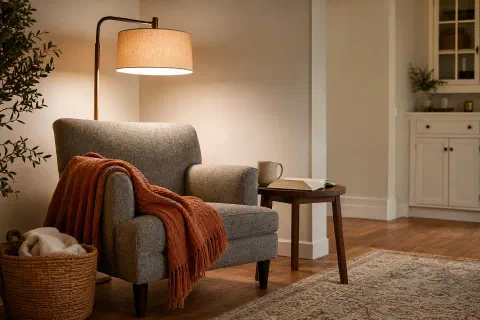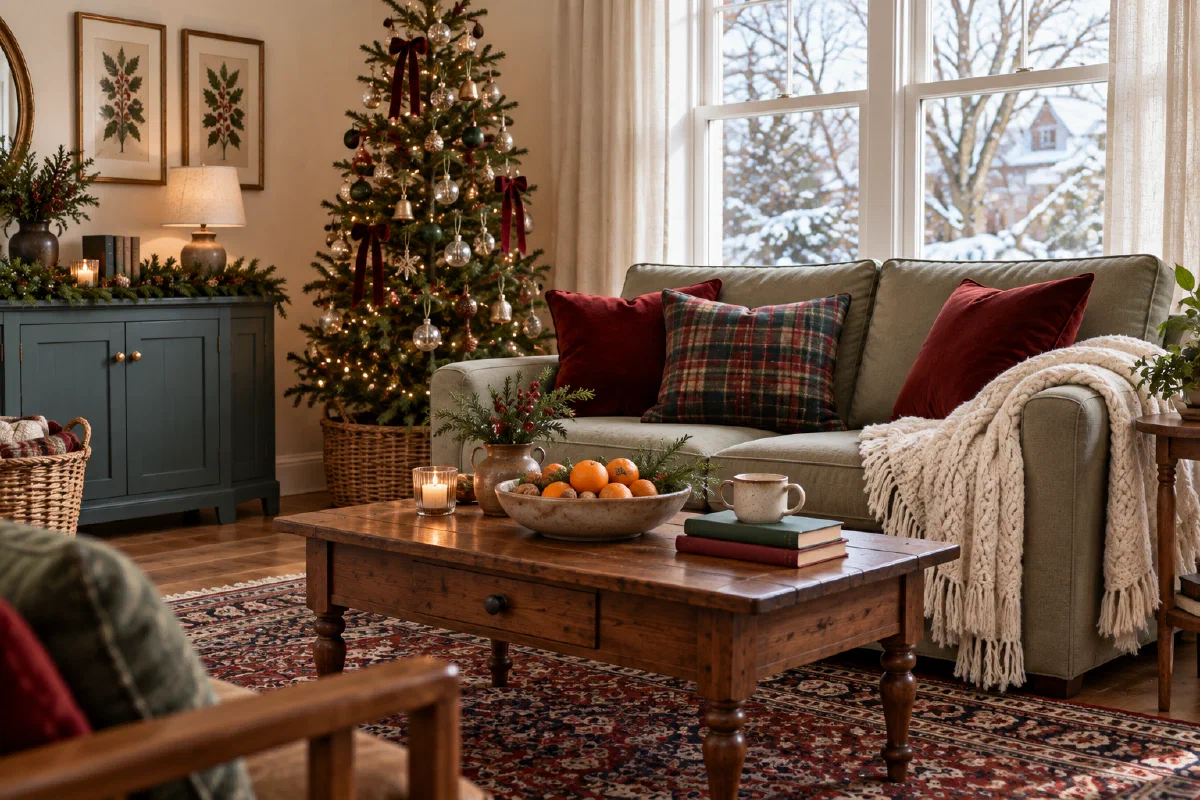
A slim tree beside the sofa, a green throw you can reach, and a tray of greenery can make a small living room feel ready for Christmas while leaving somewhere to put a cup. Start with the view from your favorite seat. Choose one main display, repeat a color in the textiles, and use the lamps you already own before buying more decorations.
These 10 ideas for Christmas living room decor on a budget work for apartments and small homes. Pick the ones that solve your room’s problem; you don’t need all 10. If you arrived from an older Pin promising 28 decorating moves, those options are still here, grouped under the 10 room ideas and labeled Move 1 through Move 28. They include free rearrangements, small additions, and larger swaps worth considering only if you need them.
1. Put a small Christmas tree where you can enjoy it from the sofa
Let the tree be the room’s main Christmas display. Before moving furniture, sit down and choose the corner you can see easily. A tree tucked behind the television may fit but give you little to look at. Use its actual branch spread and stand footprint when checking space; the height on the box doesn’t tell you whether the room can still function.
Try the position with a chair or taped outline first. Open the nearby cupboard and walk through carrying a laundry basket. The renter friendly Christmas decor guide covers setups when the floor is already full.
- Move 1: Turn the tree toward the seating area rather than choosing an unused corner automatically.
- Move 2: Shift the sofa a little if that improves the view and preserves the walkway. There is no required gap behind it.
- Move 3: Choose a pencil tree if its measured spread fits the available floor.
- Move 4: Use a tabletop tree on a stable console when a floor tree won’t fit.
For a live tree, the U.S. Fire Administration recommends daily watering, at least 3 feet from heat sources, and clear exits. If the attractive corner fails those checks, choose another spot.
2. Dress the sofa with a throw and covers you can use all winter
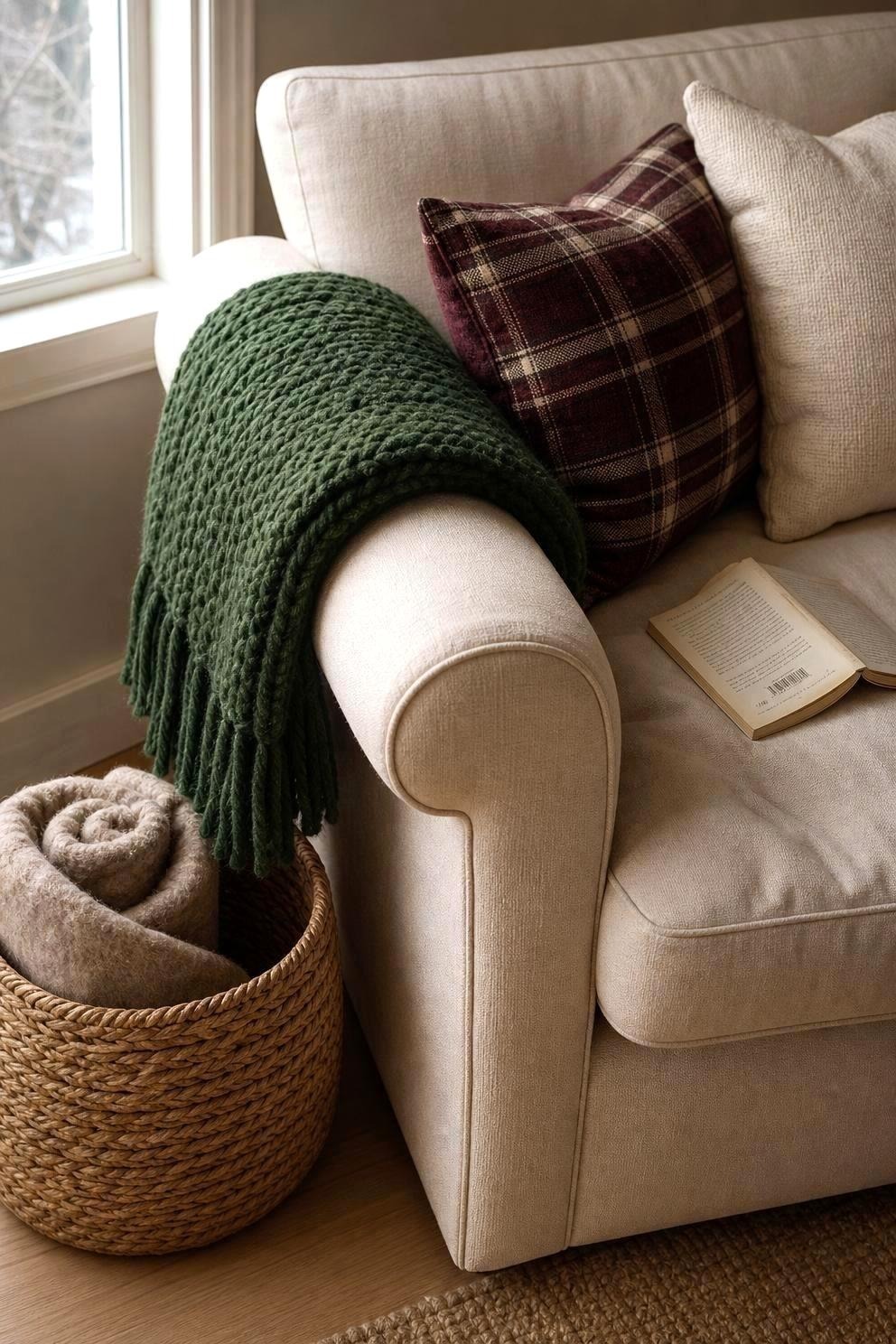
Deep green knit against a cream sofa, burgundy velvet against oatmeal, or plaid against plain upholstery gives the seating area a visible Christmas change. Start with a blanket already in the house. Put it over the arm nearest your usual seat, where you can pull it over your knees without standing up.
Change pillow covers using the inserts you own. Check the insert size and closure before ordering. Keep enough unoccupied cushion space for everyone who normally sits there; a loveseat might need only one pillow at each end. The warm living room color palettes can help you choose colors that work after December.
- Move 5: Move an existing throw from the back cushions to the arm you reach from.
- Move 6: Swap covers while keeping your existing inserts.
- Move 7: If you need a new throw, choose a washable fabric you want to use beyond Christmas.
- Move 8: Put spare blankets in a basket that fits beside the sofa. Check that its opening is easy to reach; the blanket storage guide explains storage without crushing them.
3. Make a Christmas coffee table arrangement that clears in one lift
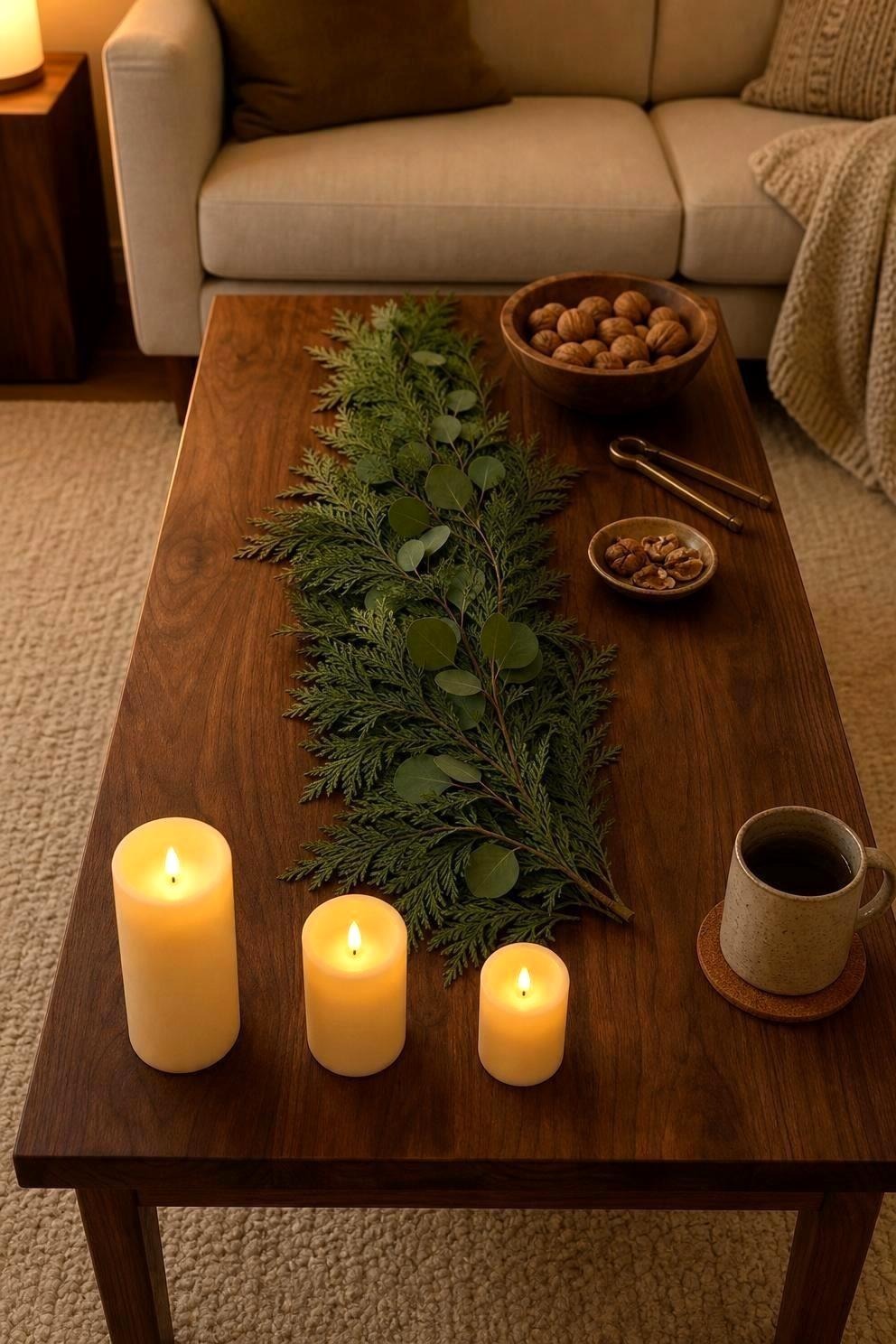
A wood tray, a small bowl, and a short piece of greenery give the coffee table a focal point while leaving its edges useful. Gather the remote and coasters first, then choose decor that fits around their daily use. Avoid covering the entire table with a runner or garland if this is also where you eat or play games.
Build the arrangement on a tray you can lift comfortably with everything on it. Test that lift before adding anything fragile. Put a heat-protective coaster under mugs and keep the tray light enough to move to a shelf when guests need the surface.
- Move 9: Clear the table, then return only everyday essentials and one seasonal grouping.
- Move 10: Corral remotes, chargers and coasters on a tray you already own.
- Move 11: Lay a short garland along the back of the display instead of hanging it. Trim the plan to the table’s usable space.
4. Bring in greenery and a small December scent
A few branches in a heavy jug add a different shape from the tree. Put the jug on a sideboard or console where it won’t tip into the main route. Use cuttings you can identify and have permission to take; consider pets before bringing plants indoors. Keep stems in water when the vessel allows and protect the furniture underneath.
A pot of paperwhites or rosemary can replace another ornament if you have suitable light and want a plant to care for. A cut garland needs different care from a living plant: keep it away from heat and remove it when it dries. The room’s temperature and the material affect how long it lasts, so don’t plan around a guaranteed number of weeks. Clemson Cooperative Extension’s greenery guide covers choosing fresh material for holiday displays.
- Move 12: Use a stable stack of books as a riser for a small, cool decoration. Keep real flames away from books.
- Move 13: Arrange permitted evergreen cuttings in a heavy jug with water.
- Move 14: Choose a living plant for a bright, protected spot, allowing room for its growth.
- Move 15: For scent while you’re in the kitchen, simmer orange peel and spices in water. Stay nearby, top up the water, and switch the burner off before leaving. This is optional; don’t leave a pot heating to scent the living room.
5. Light the seat, the corner and the tree separately
A table lamp beside the sofa makes reading possible; a floor lamp can brighten a dark corner; the tree supplies the seasonal sparkle. Use fixtures at the heights that fit the furniture you have. Three prescribed heights aren’t a requirement, and a small room may need only two lamps.
Place shades so bare bulbs don’t shine into your eyes from the sofa. Keep plugs accessible and route cords along a wall. Then compare the room with the overhead light on and off. Keep whichever combination gives enough light for walking, reading and seeing faces. Turn the ceiling fixture back on whenever the task needs it.
- Move 16: Use the overhead light as needed, then switch to lamps for a quieter evening setting.
- Move 17: Try a flameless lantern on a stable low surface, outside the walkway.
- Move 18: Move an existing floor lamp beside the chair or use a suitable plug-in light when its mounting and cord route work.
6. Check warm bulbs before replacing the lamps
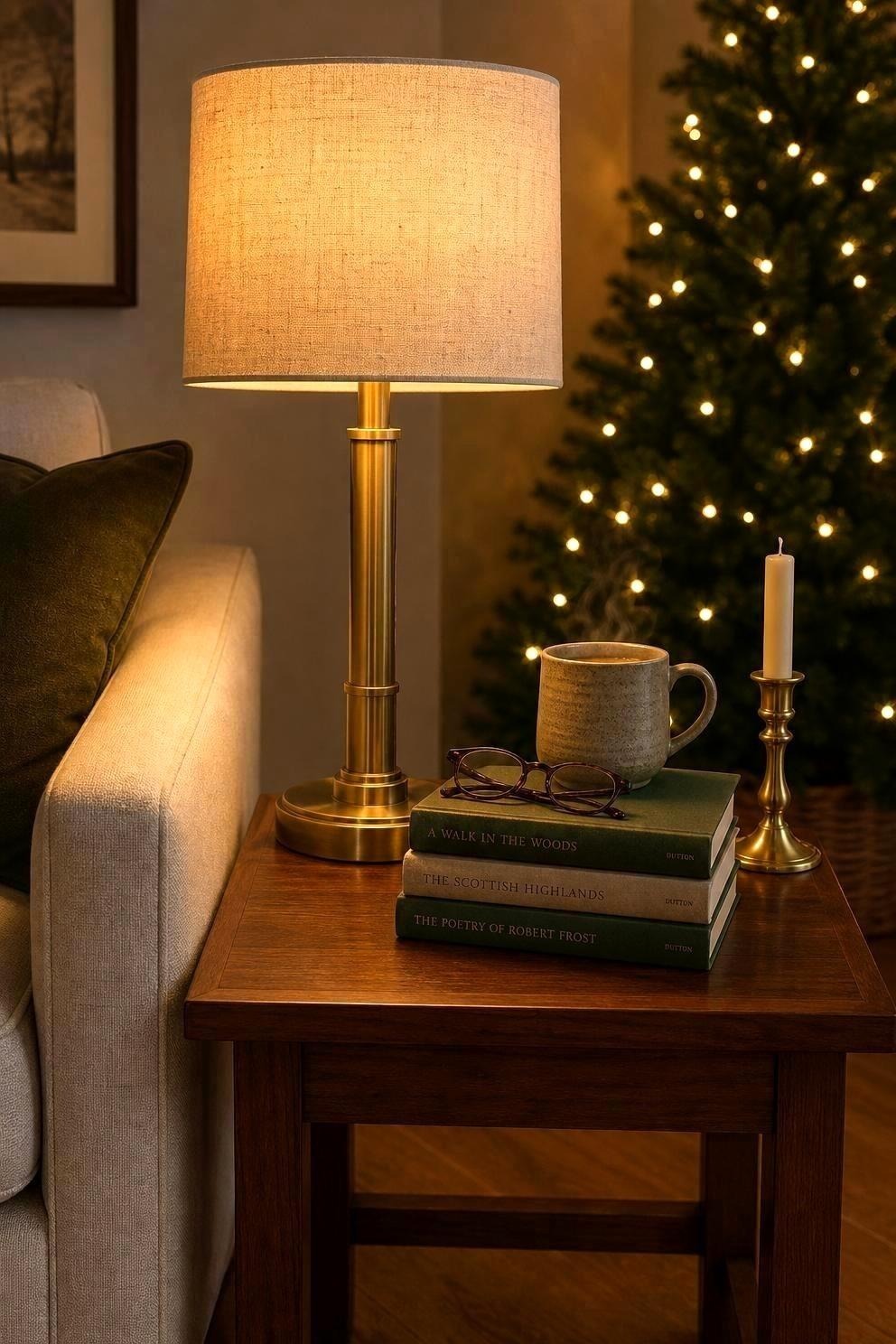
If a lamp throws very white light over a cream sofa, changing the bulb may be enough. Around 2700K is a useful warm-white starting point, rather than a rule for every person or task. The Department of Energy’s color-tunable lighting guide explains how dim-to-warm bulbs become warmer as their output drops.
Compare labels before buying. Kelvin describes color appearance; lumens describe light output. ENERGY STAR’s brightness guide helps compare output, but your reading needs and lamp shade determine how much light is comfortable. Check the fitting, fixture rating and dimmer compatibility too. The warm-white bulb guide goes into that decision.
- Move 19: Try a compatible warm bulb in the lamp nearest your seat.
- Move 20: Use a rated outlet timer if reaching the plug is awkward. Set an off time too.
- Move 21: Consider dim-to-warm or adjustable lighting if the same lamp handles reading and evening relaxation.
7. Give one shelf or window a light display
Tiny lights can make a plain shelf look festive without taking any floor space. Choose one line of light along a bookcase or one short strand within a decorative grouping. In a very small room, that may be enough alongside the tree. More strands also mean more cords, switches and batteries to manage.
For window lights, check the product’s installation instructions before putting lights near fabric. Use a separate approved support and leave the curtain free to open. A window needed for escape must still work. Avoid wrapping electrical lights in material or relying on a curtain to hide an unsafe cable route.
- Move 22: Thread suitable small lights through a display, keeping the battery box accessible.
- Move 23: Use curtain-style lights at a window only when the product allows the placement and the curtain can move freely.
- Move 24: Run a suitable strand along one bookcase, secured without damaging the cable.
Inspect cords and connectors, follow the manufacturer’s connection limits, and switch decorative lights off before leaving or sleeping.
8. Use flameless candles for a shelf with greenery
A few pillar-shaped flameless candles give a shelf or table the candlelit look without putting a flame beside pine needles and fabric. Vary their heights if that helps the grouping fit, but keep them stable and leave room to reach the switch. Protect battery compartments from children and pets, and follow the product instructions.
Move 25: Use flameless candles in a greenery display, a lantern, or beside a window. You can repeat the same small group each winter instead of buying new ornaments.
If you choose a real candle elsewhere, the U.S. Fire Administration’s candle guidance calls for stable holders, at least 12 inches from anything that burns, and extinguishing it when leaving or going to bed. A crowded Christmas shelf usually makes flameless candles the easier fit.
9. Use the mirror and curtains already in the room
A mirror that reflects the tree can bring the Christmas display into another view of the room. Check the reflection from the sofa before moving it: a reflection of the bare bulb or television may be distracting. Secure the mirror according to its mounting instructions; leaning a heavy one against a wall isn’t automatically safe.
Close existing curtains after dark and see whether the fabric works with your chosen throw or cushions. If new curtains are needed for privacy anyway, compare their full dimensions and the rod’s capacity. Keep them clear of heaters. Holiday decorating alone doesn’t require a new curtain purchase.
- Move 26: Reposition an existing mirror only if it can be installed securely and reflects the display you want to see.
- Move 27: Use the curtains you own, or choose suitable lined panels when privacy and warmth are already on your room’s shopping list.
10. Keep a comfortable rug under the seating area
A rug can connect the sofa, chair and Christmas tree visually, especially when the living area shares a room with the kitchen. Start with the rug already in place. Straighten it and move the seating so the grouping feels connected without hiding a walkway beneath furniture. Look at the edges as well as the center; curled corners will get more traffic during holiday visits.
Move 28: If you already need a rug, measure the complete seating arrangement and choose one that reaches beneath the front legs where practical. Use a suitable pad on hard floors and check that the edges don’t trip anyone. A larger purchase needs a year-round reason; it shouldn’t consume the Christmas budget just to match a photograph.
Choose your first change before shopping
Use this order to keep the budget manageable:
- Arrange the tree and existing furniture, then walk through the room.
- Try the lamps and textiles already in the house.
- Make one movable table or shelf display.
- Write down the one missing thing that would improve daily use, and compare its total cost before buying.
Keep the decor within the storage you can give it in January. The small-home Christmas storage plan helps with that check. “Free” here means rearranging something you own; no universal price or savings total is promised.
Existing links for a missing blanket or light strand
If a blanket or decorative light is the missing piece, use these retailer links to compare options. Check current sizing, power requirements, care and price on the listing, then choose only what the room needs.
- Bedsure fleece throw blanket (opens Amazon in a new tab)As an Amazon Associate, we earn from qualifying purchases. Full disclosure.
- Exclusivo Mezcla forest green throw (opens Amazon in a new tab)As an Amazon Associate, we earn from qualifying purchases. Full disclosure.
- TASTHROW flannel fleece throw (opens Amazon in a new tab)As an Amazon Associate, we earn from qualifying purchases. Full disclosure.
- Brightown battery fairy lights (opens Amazon in a new tab)As an Amazon Associate, we earn from qualifying purchases. Full disclosure.
- Brightown larger fairy-light pack (opens Amazon in a new tab)As an Amazon Associate, we earn from qualifying purchases. Full disclosure.
- JMEXSUSS globe string lights (opens Amazon in a new tab)As an Amazon Associate, we earn from qualifying purchases. Full disclosure.
- Brightown fairy curtain lights (opens Amazon in a new tab)As an Amazon Associate, we earn from qualifying purchases. Full disclosure.
Related reading for the next season
- Winter home decor after the tree comes down helps decide which textiles and lighting to keep through January.
- Cozy up the living room for fall, no new sofa offers another seasonal use for the furniture you have.
- Warm white light bulbs for a living room explains the bulb choices behind a comfortable evening setup.
- Renter friendly Christmas decor with no nails covers Christmas displays when every corner already has a purpose.
- A small home Christmas decor storage plan helps you choose what will fit back in the cupboard.