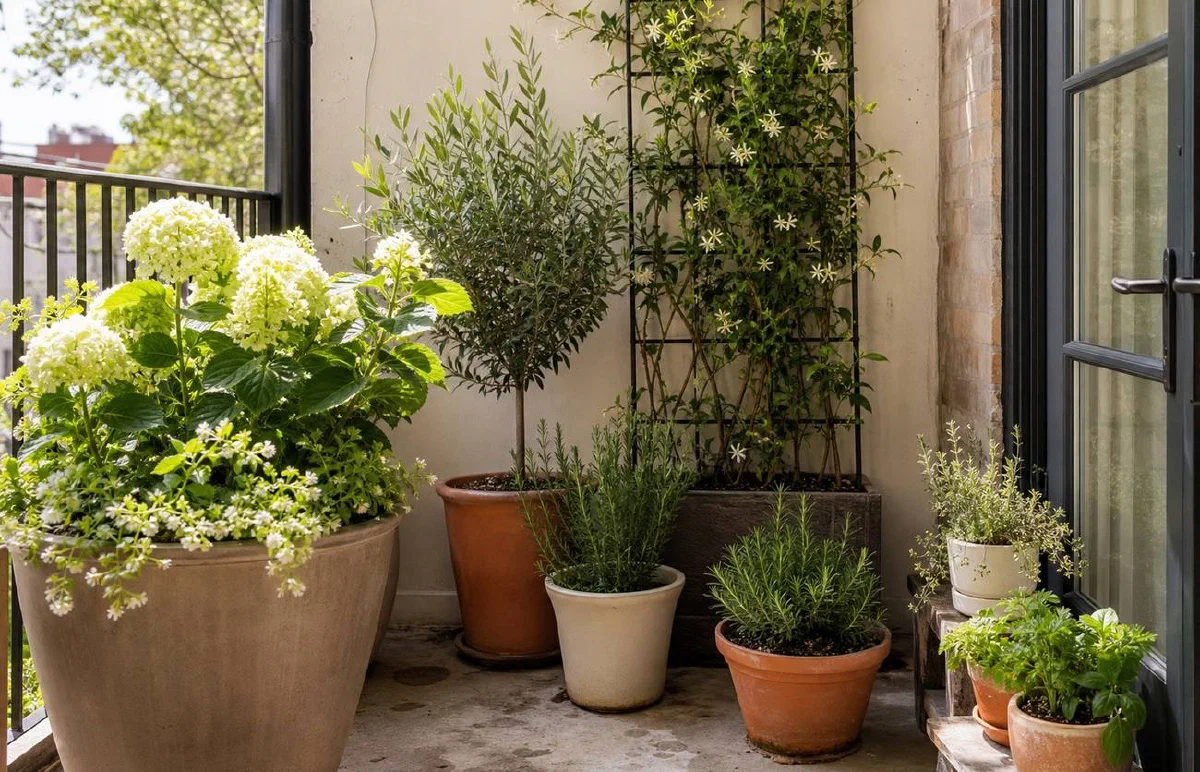
Container gardens are easy to overthink because the garden center makes every plant look necessary.
Then you get home with six tiny pots, three colors that fight each other, and nowhere to sit. A small patio cannot absorb that much visual noise. It needs fewer things doing more work.
The good news is that containers are perfect for a small patio when you treat them like a layout, not a plant collection. You do not need a flower bed. You need a few strong anchors, one repeating color, and enough room to move through the space without turning sideways.
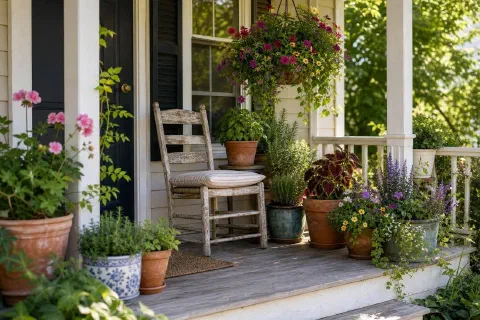
A small patio container garden feels full when you cluster pots by height and job: one tall anchor, two medium color pots, and one trailing pot near the edge. Keep the walking path clear and repeat colors so the space feels intentional.
What Fits When the Patio Does Not
| The constraint | Containers to use | What to skip |
|---|---|---|
| No floor space left at all | A hanging basket or railing planter | A floor pot you have to step around |
| One chair and one clear corner | A single 16 to 20 inch anchor pot | Three small pots spread along the edge |
| Room for a group but not a planting bed | One large pot, one medium pot, one low bowl | A fourth and fifth pot that break the group |
| A path that is already tight | A narrow plant stand held against the wall | Tall plants placed in front of the chair |
| Watering already feels like a chore | Two bigger pots instead of five small ones | Anything under 10 inches wide |
Start With One Anchor Pot
Every small patio needs one container that is clearly in charge.
Use the biggest pot you can comfortably water and move if you have to. For most patios, that means 16 to 20 inches wide. It can be terracotta, resin, glazed ceramic, or a plain nursery pot dropped inside a basket. The plant matters more than the price tag.
This anchor pot should sit where the eye naturally lands: beside the chair, at the corner of the step, next to the door, or at the edge of the seating area. Do not hide it in the back.
Good anchor plants:
- compact hydrangea in part sun
- tall coleus in shade
- rosemary in full sun
- dwarf ornamental grass
- geranium with trailing bacopa
- lavender in a sunny, dry spot
The anchor pot gives the patio shape. Everything else can be simpler.
Use Three Pots, Not Seven
Three containers usually look better than seven small ones.
Try one large pot, one medium pot, and one low bowl. Group them close enough to read as one planted corner. The large pot gives height. The medium pot adds color. The low bowl softens the edge with thyme, sedum, alyssum, or trailing lobelia.
Leave a little negative space around the group. The floor still needs to show. When every inch is filled, the patio starts feeling like storage.
If you already own too many little pots, tuck some inside the larger grouping instead of spreading them across the patio. A few can sit on an old crate or low stool to create levels.
Repeat One Color
Small patios look calmer when one color repeats.
White is the easiest. White bacopa, white begonias, white alyssum, or white calibrachoa show up in shade and look good against almost any house color.
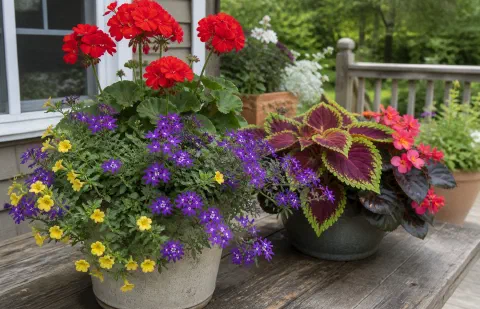
If white feels too plain, use one warm color: coral, soft pink, butter yellow, or deep red. The trick is not to use all of them at once.
You can mix pot styles if the flower color repeats. You can mix plants if the pots repeat. If both the pots and plants are random, the patio starts to look like a holding area behind a nursery.
Add Height Without Blocking the Chair
A small patio needs height, but not a wall.
Use a narrow plant stand, a shepherd’s hook, a railing planter, or one tall grass in a pot. Keep the height near an edge so the sitting area still feels open.
Good vertical choices:
- upright rosemary
- purple fountain grass
- tall coleus
- mandevilla on a small trellis
- a hanging basket near the corner
- a narrow shelf with two herb pots
Avoid putting tall plants directly in front of the view from the chair. The best patio containers make the seat feel tucked in, not trapped.
Put Useful Pots Near the Door
Herbs belong where you will touch them.
A pot of basil on the far side of the patio is decoration. A pot of basil beside the door becomes dinner. Rosemary, thyme, parsley, mint, chives, and basil all work in containers, but they do not all want the same care.
Mint needs its own pot. It spreads aggressively enough that Clemson HGIC suggests growing mints in a container to keep them from taking over a garden bed, and it does not behave any better in a shared pot. Rosemary likes to dry out. Basil wants warmth and steady water. Thyme wants sun and drainage.
If you only have room for three useful pots, I would pick basil, rosemary, and mint. Put mint alone. It has no manners.
Make Watering Easy Before You Buy More Plants
The best small patio container garden is the one you can keep alive in July.
Before adding another pot, ask where the water comes from. If the hose is awkward, keep the number of containers low. If you use a watering can, make the pots bigger and fewer. Tiny pots dry out fast and turn watering into a daily apology.
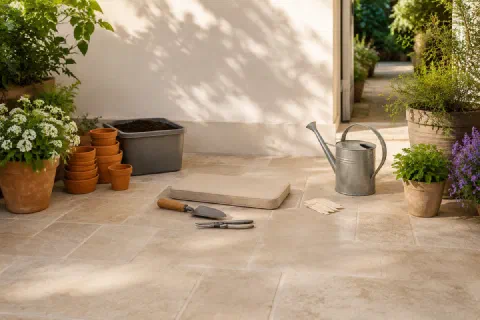
Most of what makes container gardening easier is a handful of tools, not more plants. The container garden tools I would buy before more pots is the short list.
Use saucers only where they will not stain the patio. Add fresh potting mix, not garden soil. Mix in slow-release fertilizer when you plant. Then check the soil with your finger instead of guessing from the top. Iowa State Extension’s container care guide puts the test depth at 1 to 2 inches, and it notes that watering swings from once or twice a day for a small pot in hot, windy weather to once or twice a week for a large one in cool weather.
Set the Patio Up in Four Steps
- Measure the walking path first, then decide how many pots will fit beside it without narrowing it.
- Put the anchor pot where your eye already lands when you walk out, not in the back corner.
- Group the medium pot and the low bowl close enough that they read as one planted corner instead of two separate pots.
- Add the vertical element last, once you can see which edge still looks empty.
Can You Grow Vegetables in a 5-Gallon Bucket?
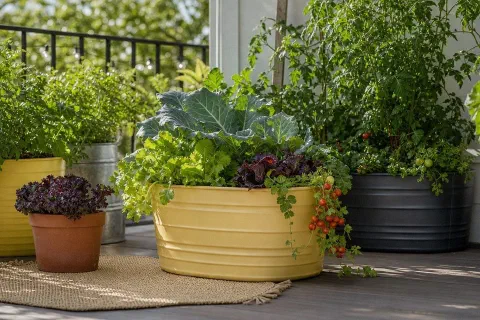
Yes, and it is the cheapest container garden there is. A food-grade bucket, holes in the bottom, and potting mix is a real vegetable bed.
Four decisions decide whether it works, and all four are easy to get wrong.
| Decision | Do this | Skip |
|---|---|---|
| The bucket | Food-grade plastic. A used one from a bakery or restaurant is usually free. | Anything that held paint, oil, or pool chemicals |
| Drainage | Holes every 3 inches across the bottom | A bucket with no holes, which drowns roots the first hard rain |
| Growing medium | One 25-quart bag of potting mix per bucket | Garden soil, which compacts and holds water like a brick |
| The bottom layer | 2 to 3 inches of gravel if the holes clog | Sand as a cheap filler |
Alabama Extension’s five-gallon bucket supply list is the source for the bag count, the hole spacing, and the gravel layer. Clemson HGIC’s container vegetable gardening factsheet agrees that a lightweight potting mix is what containers need and that soil straight from the garden usually cannot be used in one.
Never plant in a bucket that held paint, oil, or pool chemicals, even a rinsed one. Clemson HGIC’s first rule for any container is that it should never have held anything toxic to plants or people.
What actually grows in a bucket
Alabama Extension lists two windows for a bucket garden:
- Cool season: beets, cabbage, carrots, cauliflower, collards, lettuce, mustard greens, radishes, spinach, turnips
- Warm season: cucumber, eggplant, peppers, tomato, zucchini
Add a sturdy tomato cage or twine for anything that climbs or flops over. A 2- to 3-inch layer of gravel under the mix helps if your holes clog, and mulch on top slows evaporation.
Can you put two tomato plants in one 5-gallon bucket?
No. One tomato per bucket.
Two plants share one small root volume, and a single bucket already dries out faster than you expect in July. You end up with two stressed plants instead of one good one. Want two tomatoes? Use two buckets. A compact or determinate variety suits a bucket far better than a big indeterminate that wants to run six feet.
Does a 50-pound bag of sand fill a 5-gallon bucket?
Usually most of it. A 50-pound bag of sand is typically labeled around half a cubic foot.
That is still the wrong thing to put in a bucket. Sand is heavy, it holds almost no nutrients, and roots need the air and moisture balance that potting mix provides. If you are trying to stretch the mix, use the shallow gravel layer at the bottom and fill the rest with potting mix.
Where buckets fit on a patio
A bucket is not pretty. It is not the point.
Put the working garden where it gets sun and keep the decorative pots where you sit. If a bucket has to live on the patio, tuck it behind an anchor pot or in the corner behind the chair. Nobody notices a bucket that is doing its job.
A Small Patio Formula That Works
For a patio that needs to feel full without becoming crowded, start here:
- one large anchor pot beside the chair
- one medium flower pot near the edge
- one low bowl with trailing plants
- one herb pot by the door
- one vertical element, like a hanging basket or plant stand
That is enough.
You can always add more later, but a small patio usually gets better when the containers have room to breathe.
Two things change a small patio more than another pot: light and a reset. String light patio ideas that skip the pergola covers the evening, and a weekend patio refresh you can do with what you already own resets the layout before you buy anything. If budget is the real limit, small backyard patio ideas on a budget starts from the same three-pot plan.
What I’d Buy First
- One large anchor pot instead of four tiny ones.
- A plant stand only if it lifts plants without narrowing the path.
- Self-watering containers for thirsty patio plants.
- Potting mix and mulch before another decorative pot.
What to Read Next
- Small patio ideas when you barely have room is the layout guide for patios smaller than the one in this article.
- Cozy patio ideas for small spaces shows seven calmer arrangements if your pots and chairs are still competing.
- What to do when container soil keeps drying out too fast answers the July problem this layout creates: small pots in full sun.
- A deck box storage fix for small patios gives the empty pots, soil bag, and tools somewhere to live so the patio stays usable.
- Flower container combinations that bloom all season is the planting list once the pots are already in place.