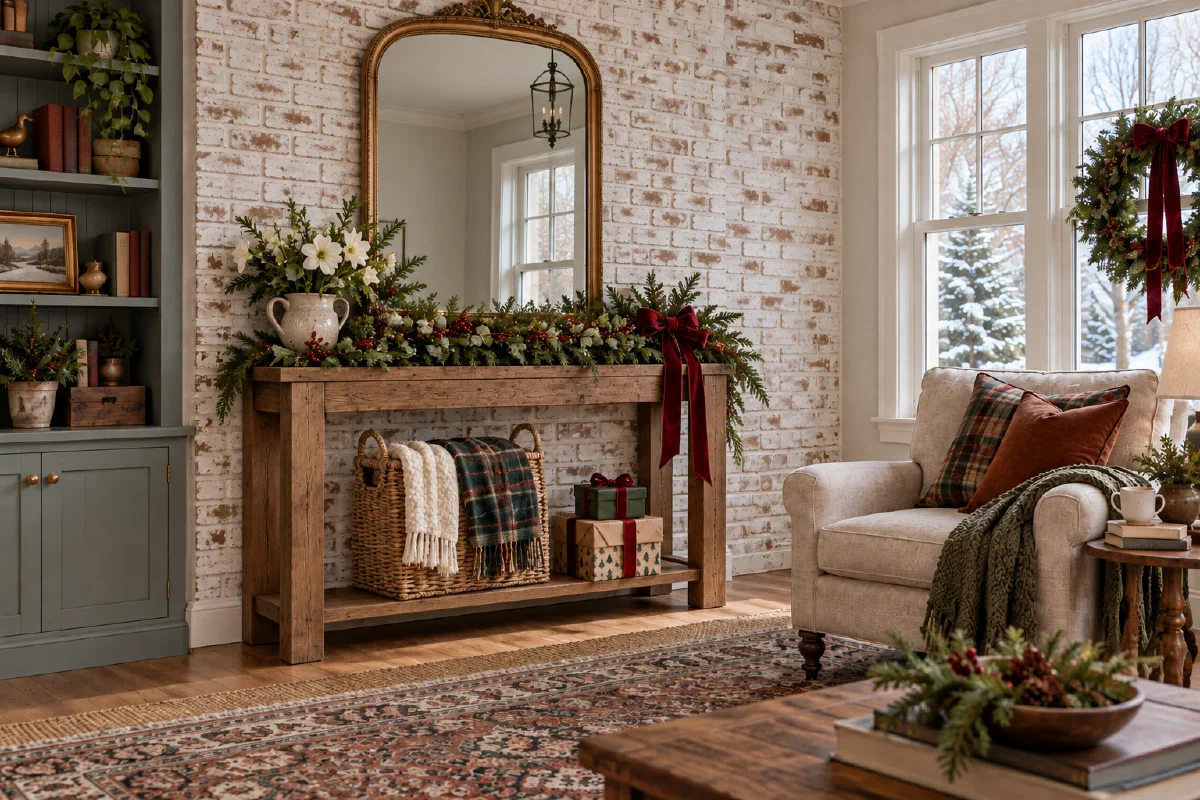
Search christmas mantel no fireplace and you get a hundred photographs of a shelf with greenery on it, and not one of them tells you the two things that decide whether yours works: how high off the floor to put it, and what is holding it to the wall.
That is the actual problem, and it is not really about the mantel. A room with a fireplace has an architectural focal point built in. Yours has four blank walls, and December is the month that makes you notice. So this starts with where the focal point goes, and gets to the greenery after. If the house does have an old firebox and only the fire is gone, an electric insert for an unused firebox is the other project. This page is for the wall that has neither.
| Your room gives you… | Start with | Relative cost when checked | Main catch |
|---|---|---|---|
| A rental wall and very light decor | Command display ledges | Lower-cost | Two pounds per ledge is the ceiling |
| Permission to anchor into the wall | QEEIG floating shelves | Lower-cost | Replace weak included anchors with hardware suited to the wall |
| A console, bookcase, or windowsill already in place | Homemory flameless tea lights | Lower-cost | Tea lights add glow, not the mantel line itself |
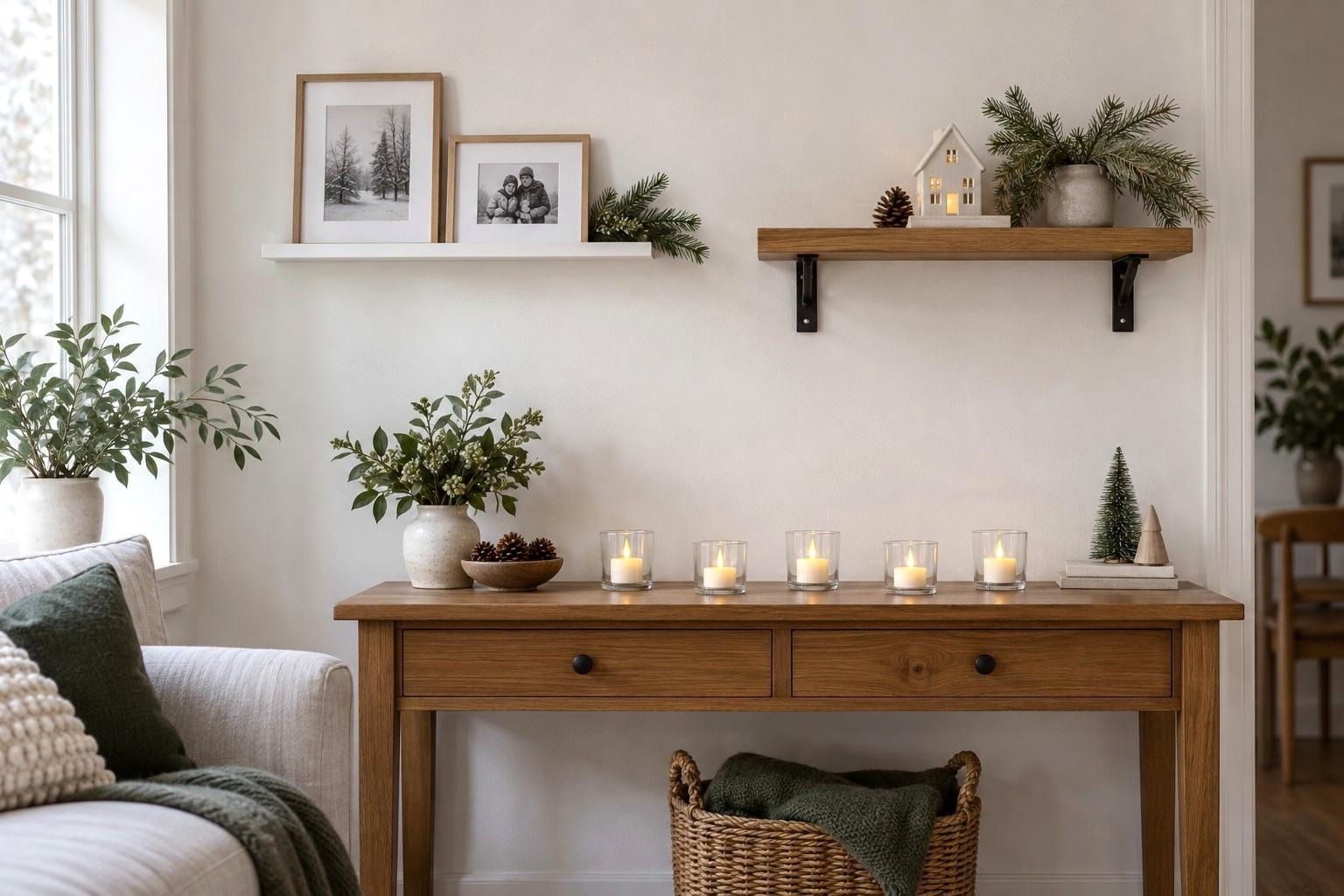
What a Mantel Actually Does for a Room
Strip the fireplace out and a mantel is three things stacked, in this order:
- A heavy horizontal line at a fixed height, wide enough to read as architecture rather than as a shelf that got put up for storage.
- A vertical anchor above it, usually a mirror or a large piece of art, that stops the wall running away into nothing.
- Visual weight below it, which in a real fireplace is the firebox and the hearth stone, and in your room has to be supplied by something else.
Miss the third one and this is the effect you get: a shelf floating on a wall with a bare stretch of paint underneath it, which reads as unfinished no matter how good the greenery is. That is the single most common failure in the no-fireplace version, and the fix is usually a basket, a stack of firewood in a crate, a pair of tall lanterns on the floor, or a rug that runs under the whole zone.
Everything below is a way of producing those three parts without owning a chimney.
The Mantel Height That Reads as a Mantel
This is the number that separates a convincing fake from a shelf.
Mantels Direct puts the common standard at about 54 inches from the finished floor to the top of the mantel shelf, inside a working range of 54 to 60 inches, and notes that rooms with tall ceilings or a full fireplace wall often look better with the mantel a little higher.
So on a standard 8 foot ceiling, 96 inches of wall, put the top of your shelf at 52 to 56 inches. On a 9 foot ceiling, add 2 to 4 inches. That is the whole rule.
Now the mistake, because it is worth understanding rather than just avoiding. Hang the shelf at 40 inches and it will not read as a mantel at all. It reads as a console, and here is why:
| Height above floor | What the eye already knows sits there |
|---|---|
| 30 to 32 in | Dining table, desk, console table |
| 34 to 36 in | Kitchen counter, sideboard, dresser |
| 42 in | Bar counter, kitchen island overhang |
| 52 to 56 in | Fireplace mantel |
| 60 to 66 in | Standing adult eye level, picture rail |
Every height under about 44 inches is already claimed by furniture. Your eye has spent its whole life sorting those, and it will file a 40 inch shelf as a piece of casework with a top on it. At 54 inches the shelf is above the sightline of anyone sitting on the sofa and below the sightline of anyone standing, which is exactly where a real mantel lives, and it leaves roughly 42 inches of wall above it on an 8 foot ceiling. That is enough for a 30 inch round mirror or a 24 inch wreath with air around it. At 40 inches you are left with 56 inches of blank wall overhead and nothing proportionate to fill it.
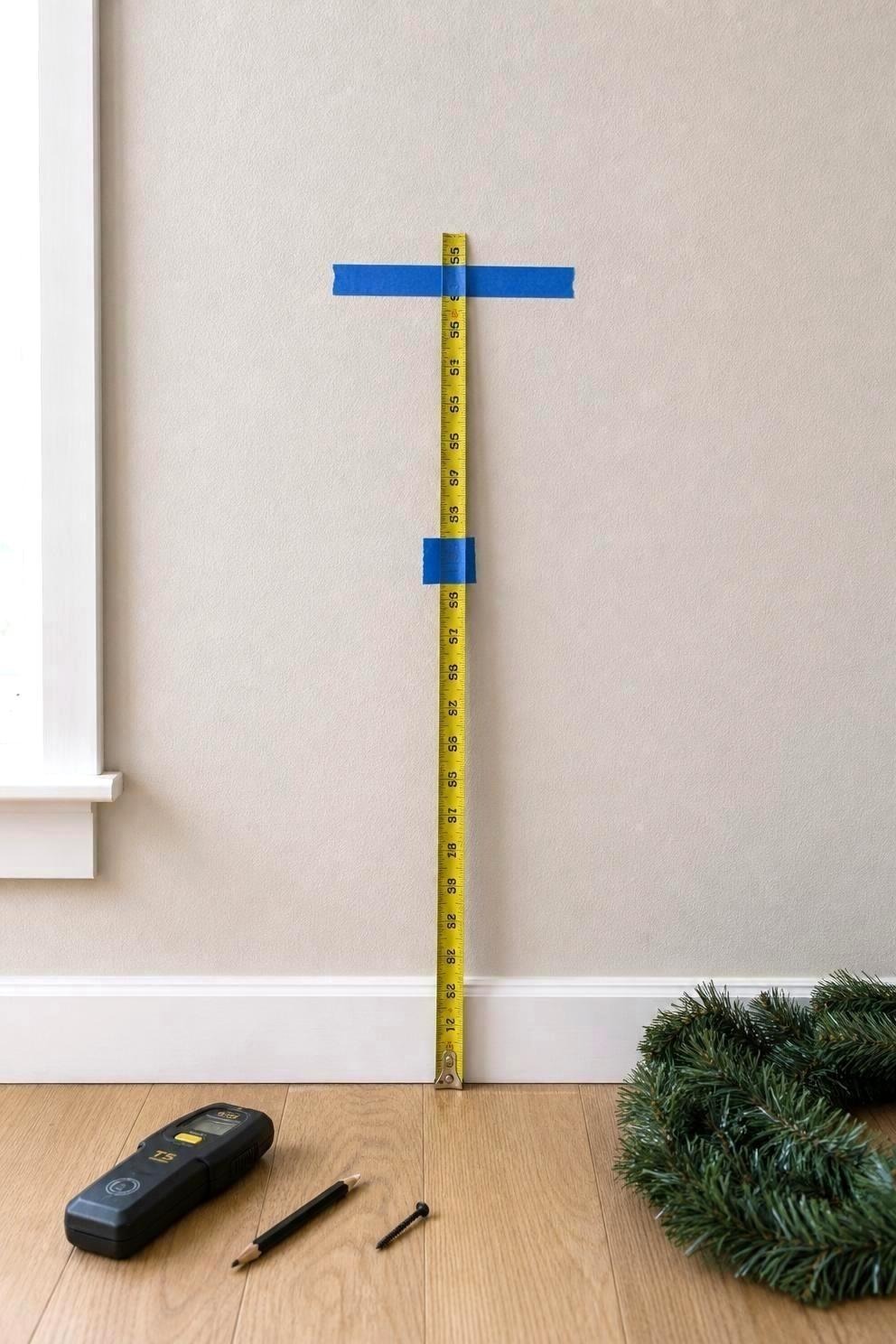
Measure from the finished floor, not from the top of the baseboard, and mark the height with painter’s tape before you drill anything. Live with the tape for a day.
Shelf Depth, and What Will Actually Stand On It
Depth is the second number, and it is the one people find out about after the first candle goes over.
| Shelf depth | What it holds |
|---|---|
| 4 in | Flat-backed things only. Leaning cards, a slim frame against the wall |
| 5 to 6 in | A 3 in diameter pillar candle, with about 1.5 in of clearance in front |
| 7 to 8 in | The honest working minimum. A pillar and a small bottlebrush tree side by side |
| 10 to 12 in | Real mantel territory. Garland can drape over the front edge without pushing things off |
Two things push you deeper than you expect. Garland is the first: a swag hanging over the front edge takes up 2 to 3 inches of depth all by itself, so a 6 inch shelf with garland on it is a 3 inch shelf for everything else. Height is the second. A slim taper about 9.6 inches tall in a narrow base is a lever, and on a 5 inch shelf a knock from the side has real mechanical advantage. On anything under 7 inches deep, keep to low wide candle holders and put the height into what hangs on the wall behind instead.
If your only realistic option is shallow, that is not a dead end. Two of the wall-only ideas further down are built for exactly that.
Which Drywall Anchor Holds the Weight, and Which Does Not
A shelf is not a picture frame. A picture hangs flat against the wall; a shelf sticks out and carries weight at the far end, and that difference is the whole engineering problem.
The anchor manufacturer TOGGLER states it plainly:
Moving objects away from the wall (e.g., the far end of a shelf or using a TV mount that swings away from the wall) significantly increases the effective weight of that object, greatly reducing the allowable load of that anchor.
Two more things from the same manufacturer, and together they explain why anchors fail on people who read the number on the pack:
- The SNAPTOGGLE heavy-duty toggle bolt supports up to 238 lb in half-inch drywall. That is the headline figure.
- “Industry safety standards recommend 1/4 of that ultimate load as a reasonably safe working load for each installed anchor.” Which turns 238 lb into a working load of roughly 60 lb, before the cantilever above takes its cut.
So the number printed on any anchor pack is an ultimate pull-out figure measured in a lab with the load flat against the wall. Divide it by four, then knock it down again for the fact that your load is sitting 8 inches out on a shelf.
Which leaves a short honest hierarchy:
- A wood stud beats everything. Studs in US framing sit 16 inches on center as standard, 24 inches on center in some construction. Two 2.5 inch #8 screws into studs will carry a loaded mantel shelf without an anchor in the picture at all. Find them with a stud finder, then confirm by driving a small finish nail; a stud stops the nail dead, a cavity swallows it.
- A toggle for anything heavy that misses a stud. A metal toggle spreads the load across the back of the board instead of crumbling the face of it.
- Self-drilling threaded anchors for light duty only. They are quick and they hold a mirror fine. They are not a mantel bracket.
- Plastic expansion anchors are the ones that fail. They rely on the drywall face, which is paper and gypsum, and a cantilevered shelf works them loose over weeks rather than seconds.
Two more practical notes. Hit at least one stud if you possibly can, even if the second bracket lands on a toggle. And a bracket that is short front to back on a deep shelf gives the far end more leverage, so match the bracket length to at least two thirds of the shelf depth.
If you rent and none of this is happening, skip to the renter section. Roughly half of the ideas below need no hardware at all.
Twenty-Five Places to Build the Mantel
Grouped by what you are starting with. Nothing here needs a fireplace and most of it needs no construction.
Build the shelf yourself
- A floating shelf at 54 inches. The direct answer. Buy it wider than feels sensible, because a 36 inch shelf on an open wall reads as a small shelf and a 48 inch one reads as architecture. Two 15.7 inch shelves butted end to end give you 31 inches, which is enough over a sofa and thin on a bare wall.
- A salvaged mantel leaned against the wall. No fixings at all if it is heavy enough, and the best-looking option on this whole list. An old pine or oak mantel shelf with corbels leaned at 54 inches, resting on a low console or a pair of stacked crates, gives you the horizontal and the visual weight underneath in one move. Screw one bracket into the top edge and the wall so it cannot tip, and that is the whole install.
- A faux mantel surround. Three sided, no firebox, and it stands on the floor rather than hanging on the wall, which sidesteps the anchor problem entirely. Fill the opening with a stack of birch logs, a basket, or a mirror leaned inside it.
- A scaffold board on iron brackets. A 9 inch wide reclaimed board on two black pipe brackets is the cheapest thing here that still reads as intentional. The depth is right and the weight gives it authority.
- Two picture ledges stacked. A 4 inch ledge at 54 inches with a second at 66 inches turns a shallow shelf into a composition, and the upper ledge does the job the mirror would have done.
Furniture already standing in the room
- A console table against the wall. The most common answer, and the reason it often falls flat is height: a console top sits at 30 to 32 inches, so you must supply the mantel line above it with a leaned mirror or a wide piece of art, not with the tabletop.
- A sideboard or buffet. Better than a console because the mass underneath is already there. Run the garland along the top, put the mirror above, and the whole zone reads as a fireplace wall.
- The top of a low bookcase. A 30 to 36 inch bookcase gives you a deep top surface and solid visual weight below with nothing to install. Style the top as the mantel and leave the shelves alone.
- The top of a tall bookcase. Different rules. Above about 60 inches nobody sees the surface, so this one is for garland draped along the front edge and lights, not for candles and small objects.
- An upright piano. The best mantel in most houses that own one. The top sits close to 50 inches, which is nearly perfect, and the mass underneath is enormous. Keep candles off the lid and use a runner so nothing marks the finish.
- A radiator cover. Usually 30 to 36 inches high, always against a wall, and structurally it is already a mantel with a firebox-shaped void under it. Keep greenery and anything wax off the top when the heat is on.
- A bedroom dresser. The mantel does not have to be in the living room. A dresser at 34 inches with a mirror above it is the same three-part shape.
- The headboard. A wide upholstered or wooden headboard is a horizontal line at roughly the right height already. Garland along the top edge, small lights woven through, done.
Architecture already in the room
- A windowsill. Deep sills in older buildings run 5 to 8 inches and already have a frame around them, which is the vertical anchor built in. Candles on a sill need care, and the flameless section below is aimed straight at this one.
- A bay window ledge. The best surface most apartments have and the most overlooked. It is wide, it is deep, and it has glass behind it that doubles every light you put there after dark.
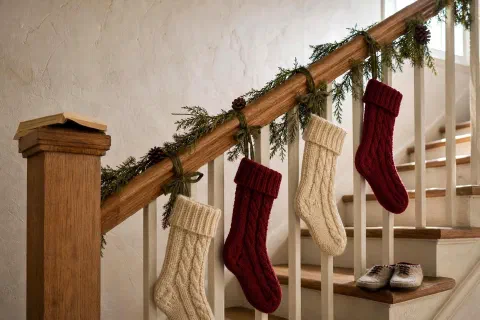
- A stair landing or newel post. A wide newel post cap plus the run of the handrail gives you a horizontal at exactly the right height. This one is also where stockings usually end up, and where to hang stockings with no fireplace covers that whole question properly.
- A TV console with the TV above it. Very common and workable. Do not try to make it symmetrical: the screen is already the focal point, so weight the greenery heavily to one end of the console and leave the other end nearly bare with one tall object. Keep everything clear of the vents.
- A kitchen pass-through or bar counter. A 42 inch counter running into a living space is a horizontal line begging for a garland, and it gets seen from both rooms.
- A doorway header. The trim above a wide doorway sits at 80 to 84 inches. Too high for objects, perfect for a swag with tails down both sides, and it frames the room behind it.
Wall only, with nothing underneath
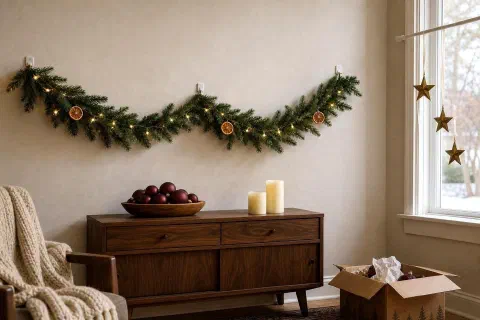
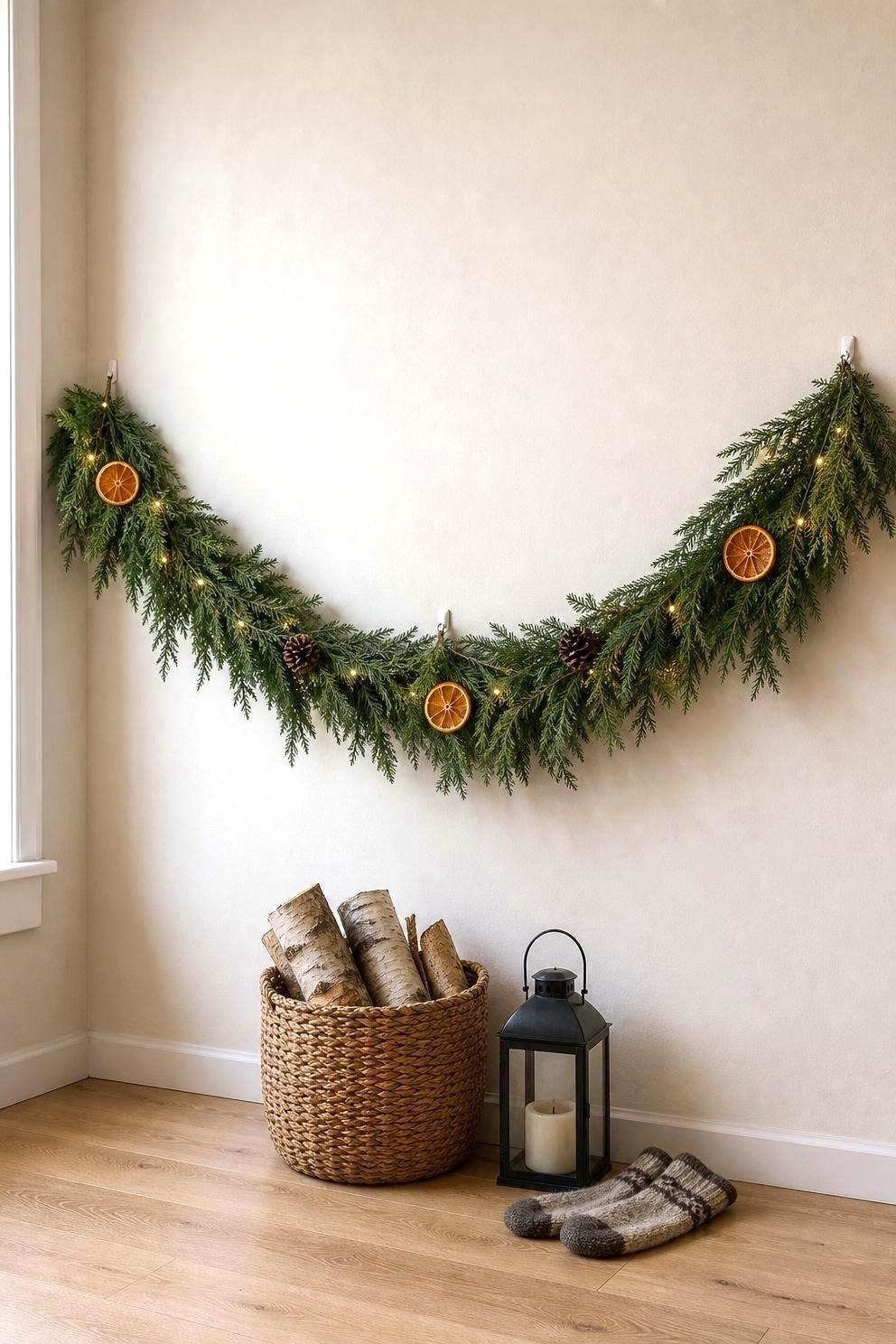
- Garland swagged straight onto the wall. No shelf at all. Hang a 9 foot garland in a shallow U with the low point about 48 inches off the floor and the ends about 60, fixed with three adhesive hooks, and put a basket or two lanterns on the floor beneath to supply the weight.
- A cluster of wreaths. Three wreaths at 24, 18 and 14 inches, hung at staggered heights inside a 40 by 40 inch patch of wall, makes a focal point with no horizontal line at all.
- A painted or peel-and-stick arch. Mark out a mantel-shaped rectangle or arch in a deeper shade behind wherever the garland sits. It costs a sample pot and it fakes the firebox that is supplying your visual weight.
- A leaned ladder. A wooden ladder against the wall gives you three or four horizontals at once. Greenery on the second rung from the top, small things on the rungs below.
- A tension rod as the horizontal. Between two walls of an alcove, at 54 inches, carrying garland with no fixings whatsoever. This is the single most renter-friendly idea here.
- A rectangle of string light. Outline a mantel shape on the wall, roughly 48 inches wide by 40 inches tall, in warm white mini lights on clear adhesive clips. In a dark room after four in the afternoon it does everything a mantel does.
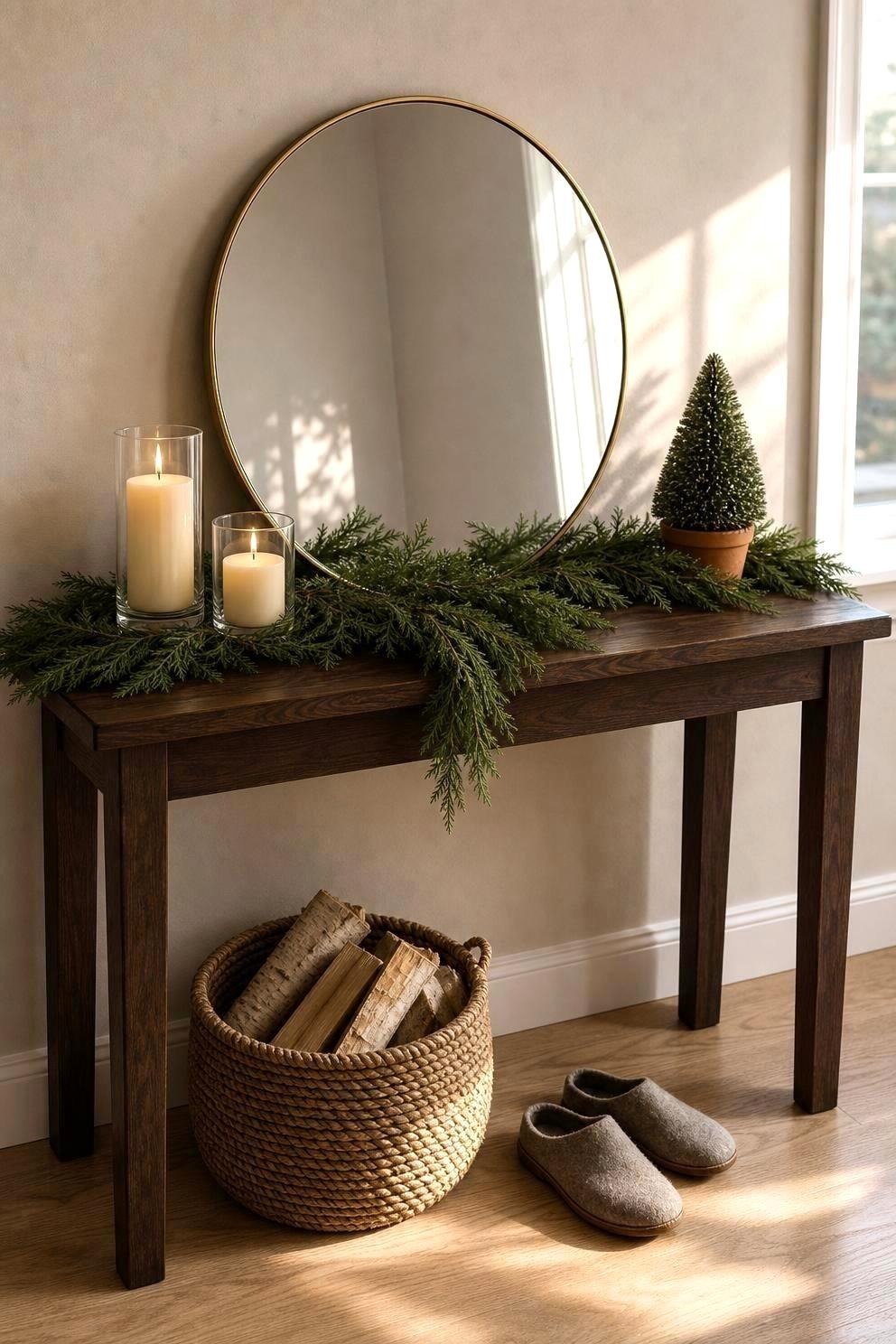
How to Style It Once the Shelf Is Up
Order matters, because every layer changes the one before it.
- Greenery first, and more than one strand. One garland always reads thin. Two layered on top of each other is the honest answer, and the arithmetic behind that is worked through in christmas mantel decor, which covers the mantel you already have rather than the one you are building.
- The vertical anchor next. Mirror, art or a large wreath, sized to roughly two thirds of the shelf width. A 48 inch shelf wants something about 32 inches across. Too small is the usual error and it makes the shelf look wider than it is.
- Height variation third. Tallest object about a third of the way in from one end, never dead center and never at the exact ends. Three heights beats five.
- Group in odd numbers and let the groups touch. Evenly spaced single objects is what makes a shelf look like a shop display.
- Weight underneath last. Basket, logs, lanterns on the floor, or a rug that runs the width of the whole zone. This is the step that finishes it and the one nobody photographs.
- Turn the lights on and look from the doorway. Not from two feet away. Everything reads differently at conversational distance and that is where it is actually seen.
Pull two colors from the room and add one metal. Red and green in a room with no red or green in it fights everything else you own, and a wall-built mantel has less architecture to carry the clash.
Flameless Candles, and Why They Matter More Here
A real mantel has a stone or brick surround and a firebox designed to contain fire. A floating shelf has a painted wall behind it, and often a mirror right above it.
The U.S. Fire Administration is short and specific on this: keep candles at least 12 inches away from anything that burns, and on average 20 home candle fires are reported each day.
Twelve inches is the number to hold against your own shelf. A 6 inch deep floating shelf with garland draped over it does not have 12 inches of clearance in any direction, and neither does a windowsill with a curtain beside it. That is not an argument against candlelight, it is an argument about which kind. Battery tapers and pillars solve it completely, they run on a timer so the whole display comes on at four in the afternoon without anyone thinking about it, and on a shallow shelf they can sit closer to the greenery than a real flame ever could.
If you want real flame somewhere, put it on the surface with the most clearance, which is almost always the floor lantern rather than the shelf.
Renter Fixes, Nothing That Leaves a Mark
Half of the twenty-five need no hardware, and the shelf-based ones have workarounds.
- Furniture is free. Console, sideboard, bookcase, dresser, piano, radiator cover. Zero holes, and the visual weight problem solves itself.
- Leaning beats hanging. A leaned mirror on a console, a leaned mantel shelf, a leaned ladder. All of it comes down in one motion in January.
- Adhesive ledges for the shallow version. Command display ledges are rated to 2 lb, which is printed on the pack and is a real limit rather than a suggestion. That is greenery, a couple of small ornaments and nothing else. Put them up on a clean dry wall at room temperature and let them cure a full hour before loading them.
- A tension rod between two walls carries garland with no fixings at all.
- Removable adhesive hooks for a wall swag, three of them across a 9 foot garland, spread the load so no single hook is doing much.
- Fishing line to an existing picture hook. If there is already a hook in the wall from a previous tenant, use it rather than making a new hole.
The same instinct runs through apartment fall decor with no mantel needed and through small apartment living room ideas for renters: if it does not attach to the building, the deposit is not part of the conversation.
The Mistakes That Give the Fake Mantel Away
- The shelf is too low. Covered at the top, and it is the one that spoils otherwise good work.
- The shelf is too shallow for what is on it. A 4 inch ledge with a pillar candle on it looks precarious because it is.
- Nothing above it. A bare wall over the shelf is the tell. Mirror, art or wreath, every time.
- Nothing below it. The other half of the same mistake, and the more common one.
- One thin strand of garland. Always. Buy two.
- Everything at the same height. Three candlesticks of identical height is a row of sticks.
- Perfect symmetry on an asymmetric wall. If the shelf is off-center in the room, lean into it rather than fighting it.
- Too many small things. Ten ornaments read as clutter, one large and two medium read as a decision.
- Lights with a visible cord run. On a fireplace the cord disappears behind the surround. On a wall shelf it hangs there, so use battery strands or run the cord down the wall behind a curtain.
Taking It Down and Keeping the Shelf Useful
The advantage of building a mantel instead of owning one is that it stays. In January, take off the greenery and the shelf becomes what the wall was missing all along.
Leave the mirror or the art. Swap the candles for two or three of the same objects in a quieter palette. A wide shelf at 54 inches with something anchoring above it is good design in February as well, which is the argument for putting it up properly on studs rather than treating it as seasonal scaffolding.
Coil the garland loosely rather than folding it, and store it in a bin rather than a bag so the branches keep their shape. The small home christmas decor storage plan covers where all of it goes when the apartment has no attic.
Questions People Actually Ask
Can you do a mantel without a fireplace?
Yes, and it is a real design choice rather than a substitute. A mantel is a horizontal line at roughly 54 inches with a vertical anchor above and visual weight below. None of those three requires a firebox. A wide floating shelf, a leaned salvaged mantel, a faux surround standing on the floor, or a sideboard with a large mirror over it all produce the same effect. The only part you have to supply deliberately is the weight underneath, because a real fireplace gets that free from the hearth.
What are some alternatives to a fireplace mantel?
Twenty-five of them are listed above, and they fall into four groups. Build the shelf: floating shelf, salvaged mantel, faux surround, scaffold board, stacked picture ledges. Use furniture you own: console, sideboard, bookcase, piano, radiator cover, dresser, headboard. Use architecture you already have: windowsill, bay ledge, stair landing, TV console, pass-through counter, doorway header. Or use the wall alone: a swagged garland, a wreath cluster, a painted arch, a leaned ladder, a tension rod, or a rectangle of string light. Pick by what the room already gives you rather than by what looks best in a photograph.
How to style a mantel for Christmas?
Greenery first and at least two strands, because one always looks thin. Then the vertical anchor above at about two thirds of the shelf width. Then vary the heights, tallest about a third of the way in from one end. Group in odd numbers and let the groups touch instead of spacing everything evenly. Add weight on the floor beneath. Pull two colors from the room you are standing in and add one metal. Then walk to the doorway and look from there, because that is the distance it is actually seen from.
What are common mantel design mistakes?
Height is the biggest one, and it applies double when there is no fireplace to set it for you. Below about 44 inches the eye files the shelf as furniture. After that: one thin garland, a bare wall above, a bare wall below, everything at a single height, evenly spaced objects, too many small things, and a shelf too shallow for what is standing on it. The specific no-fireplace mistake is forgetting that the firebox was supplying visual weight, so the shelf ends up hovering.
How to make a mantel look good?
Proportion does most of it. Get the height right at 52 to 56 inches, make the shelf wider than feels necessary, size the mirror or art to about two thirds of that width, and give the shelf 7 inches of depth or more if you want anything to stand on it. Then subtract. A shelf with three groups on it looks considered and the same shelf with eight looks anxious. Light is the last lever: a warm strand woven through the greenery changes the whole thing after dark, which in December is most of the time anybody sees it.
What are the rules for a fireplace mantel?
The safety rules are about fire, and with no firebox underneath most of them stop applying. Mantels Direct notes that homeowners commonly start 12 to 24 inches above the firebox opening, but that the real figure comes from the fireplace manual. What carries over to a mantel with no fire under it is the proportion: 54 to 60 inches from the floor, the shelf wider than the thing above it, and clearance kept around anything that produces heat. If you are building over a radiator cover or a TV, treat the heat source the same way you would treat a firebox and keep greenery off it.
What I’d Actually Buy
Product details can change; check the listing before you buy.
Note what is not here: a Christmas garland. That search came back almost entirely fall maple leaves and party banners, so buy your evergreen locally where you can feel the weight of it, and buy two.
For the shelf itself
- BAYKA rustic wood floating shelves, 15.7 inch, set of 3 (opens Amazon in a new tab)As an Amazon Associate, we earn from qualifying purchases. Full disclosure.. The listing states a 22 lb capacity, which is the figure to hold against the cantilever warning above. Two of these butted end to end give you 31 inches of mantel line.
- QEEIG 15.7 inch wood wall shelves, set of 2 (opens Amazon in a new tab)As an Amazon Associate, we earn from qualifying purchases. Full disclosure.. Slim profile, so this is the shallow-shelf lane: greenery and flat-backed pieces rather than candles.
- AMADA white floating shelves with concealed brackets, set of 3 (opens Amazon in a new tab)As an Amazon Associate, we earn from qualifying purchases. Full disclosure.. The hidden bracket is what makes a shelf read as architecture instead of as storage, which is the entire point here.
- Command display ledges, 2 lb rating, 2 ledges with adhesive strips (opens Amazon in a new tab)As an Amazon Associate, we earn from qualifying purchases. Full disclosure.. The renter answer. Two pounds is a genuine ceiling, so this holds greenery and small ornaments and nothing with mass.
For the light, since there is no fire
- Vinkor flameless pillar candles, real wax, 4 to 9 inch, with remote and 24 hour timer (opens Amazon in a new tab)As an Amazon Associate, we earn from qualifying purchases. Full disclosure.. Six graduated heights is the height variation problem solved in one purchase, and the timer is why the display is lit when you walk in.
- GenSwin flameless taper candles, 9.64 inch, set of 6 with remote timer (opens Amazon in a new tab)As an Amazon Associate, we earn from qualifying purchases. Full disclosure.. Tapers are the shape that reads as a mantel, and on a shallow shelf a battery one is the only version that is not a tipping hazard.
- Homemory flickering flameless tea lights, 24 pack, 200+ hours (opens Amazon in a new tab)As an Amazon Associate, we earn from qualifying purchases. Full disclosure.. The most reviewed thing on this list by a distance. These are what go on a windowsill or tucked into greenery where a real flame has nowhere near 12 inches of clearance.
- Minetom clear mini string lights, 100 count, 20 feet (opens Amazon in a new tab)As an Amazon Associate, we earn from qualifying purchases. Full disclosure.. Twenty feet is enough to run through two layered garlands on a 48 inch shelf, or to outline the string-light rectangle described above.
For the wall-only version
- Freyalife artificial ivy vines, 12 strands, 84 feet total (opens Amazon in a new tab)As an Amazon Associate, we earn from qualifying purchases. Full disclosure.. Being straight about what this is: it is ivy, not evergreen, and on its own it reads green rather than Christmassy. Its real use is as filler behind a shorter, better evergreen swag, and as the part you leave up in January.
What to Read Next
- Christmas mantel decor is the version for a mantel you already own, with the garland quantity math and the fixings for brick and painted wood.
- Corner shelf styling that actually gets used goes deeper on the height and grouping rules once the shelf is up year round.
- Renter friendly Christmas decor with no nails is the whole-apartment version for when the mantel is only one of the problems.
- Christmas front door decor handles the other focal point in a small home, and it needs no wall anchors at all.
- Small home Christmas decor storage plan is where all of this lives for the eleven months it is not up.