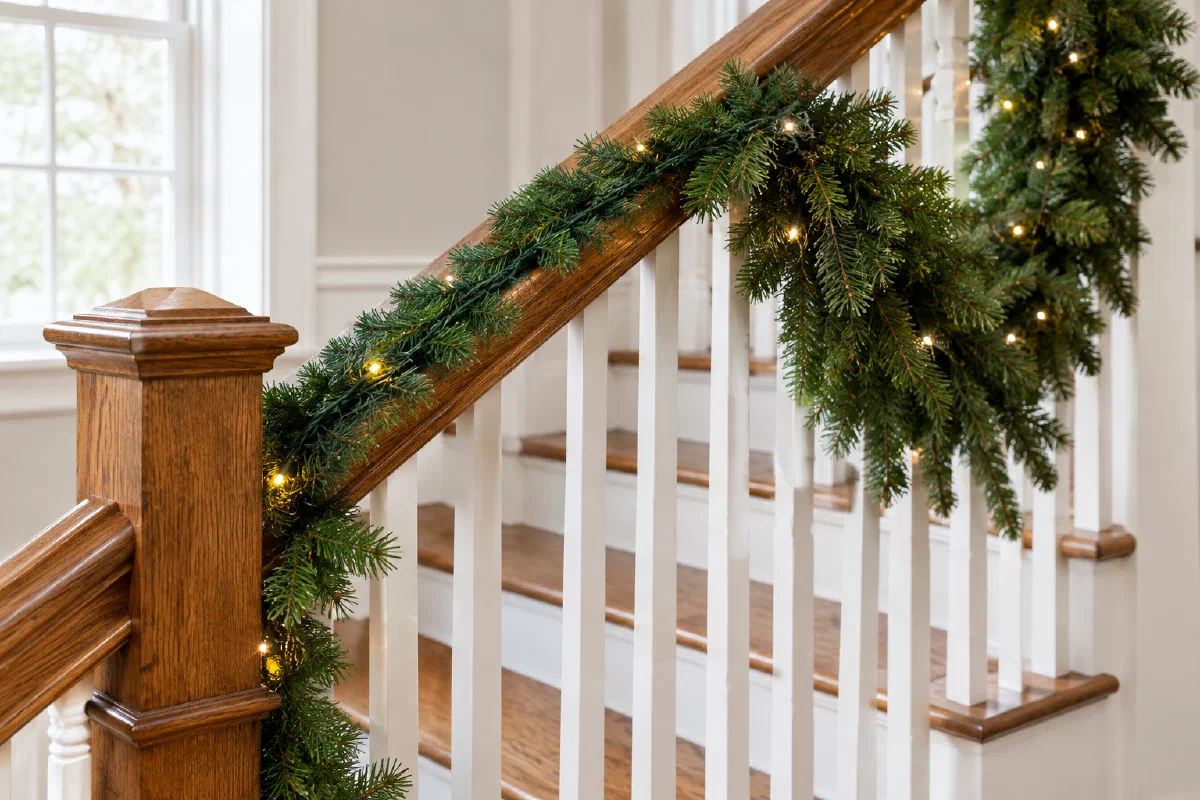
Garland that looks wrong is almost never a buying problem.
By the time someone asks me why theirs reads off, they’ve measured the run, bought the length, and hung it. The strand is fine. What went wrong happened after the box was open: the weight of the strand against the surface under it, how much of the room was left bare, and where the sag lands.
Most garland guides answer a styling question with a shopping fix. More length. A pricier strand. That advice isn’t wrong, it’s aimed at the wrong stage. Here are nine mistakes, in the order they do damage.
Christmas Garland Styling Mistakes, and the Fix for Each
1. The strand is the wrong weight for the mantel or the rail
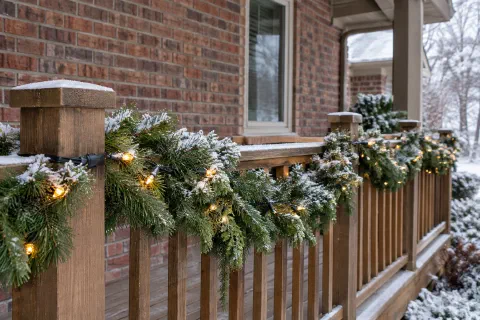
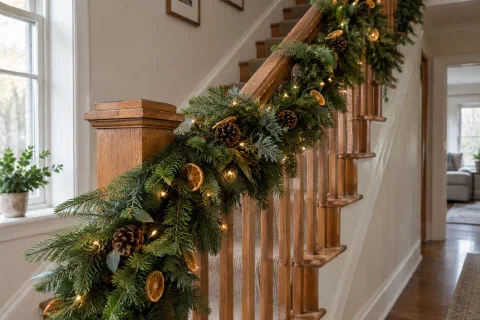
A six inch strand on a two inch banister swallows the rail. A three inch strand on a deep beam reads as a cord. Same mistake both times: the garland was chosen by length and hung without checking the surface under it.
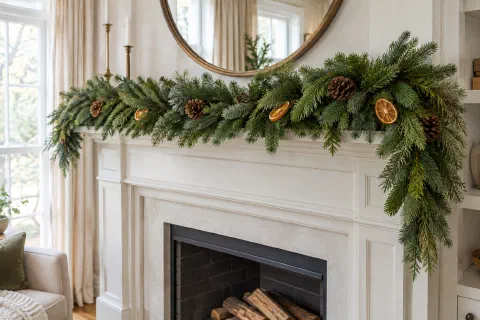
Measure the depth of the ledge first. As a working rule, a run sits right when its width is close to the depth of the surface it rests on, so a shelf about four inches deep wants a strand in the four to six inch range, and a shallow rail wants something slimmer. That ratio is my own read from looking at runs, not a published standard, so adjust by eye.
If you already own the strand, move it rather than replacing it. The thick one belongs on the deep ledge. The thin one belongs on a window head or a chair rail, where a slim line is the right look anyway.
2. The run is pressed flat against the wall
Greenery needs air behind it. Flattened to the wall, a strand loses the shadow that tells your eye it’s a plant and reads as a printed border instead.
Pull the run an inch or two proud of the surface. A small block of wood behind each hook, or a longer hook, is enough.
Stand where you enter the room, not where you hung the garland. The doorway view is the one you’re decorating for.
3. There is no negative space left in the room
Three decorated surfaces in one glance is one too many. Garland on the mantel, the window and the bookcase in one sightline means each run competes with the other two.
The fix costs nothing. Pick one hero run for each view and leave the surfaces between them bare. If you can see two garlands without turning your head, one of them belongs in another room.
4. The evergreen is a pile, not a palette
Color is where a run stops looking like a plant. Blue-green, overlapping, scale-like foliage sits very differently from a warm green fir, and the two together go muddy. Cedar is the usual culprit, because it’s cheap, available, and the bluest thing in the bucket.
It has a seasonal problem too. The NC State Extension plant toolbox notes that eastern redcedar foliage turns bronze to yellow-brown in winter, so a cedar-heavy run drifts away from the deep green you saw in the shop (NC State Extension ).
Pick two greens and stop. Fir with pine, or cedar with a smaller amount of something warmer, is plenty.
5. The greens were chosen by looks, not by staying power indoors
Two garlands can look identical in a bundle and behave nothing alike on a warm wall.
Extension lists are blunt about which is which. Firs tolerate hot, dry indoor conditions and hold their needles. White pine has excellent needle retention but wilts visibly when it dries. Spruce is the one to leave outside, because its needle retention is poorer than other conifer greens. Look for flexible needles, fresh color, and minimal needle drop (Durham County Extension Master Gardeners ).
How long you get is where the sources disagree, so here is both. Iowa State University Extension puts a live wreath at about a week indoors, and months in outdoor winter cold (Iowa State University Extension ). The Durham list, drawing on Clemson’s evergreen guide, allows at least two weeks indoors with soaking and an anti-desiccant. Plan for a week to two weeks and design around the shorter number.
That number should change what you do. Fresh greenery belongs where a photograph matters and you can replace it, not on the longest run in the house.
6. The swag dips into whatever is underneath
The dip is what makes a run look like greenery. The dip is also the part that reaches for whatever is below it.
Set the sag before you admire it. Measure from the lowest point of the strand to the nearest flame, radiator or lamp, and if the gap is tight, move the anchors, not the decorations. The Consumer Product Safety Commission’s holiday guidance is direct: place lit candles away from trees, decorations, curtains and furniture. Its November and December averages run about 1,200 candle fires a year, with ten deaths and more than 42 million dollars in property loss (CPSC ).
None of that means skip candles. It means the swag clears them, and the candle sits at the end of the shelf rather than under the middle of the run.
7. The garland covers the thing you wanted to see
A mirror, a window, a picture or good trim is usually why the wall works. Dragging a run across it buries the best thing in the room and turns a feature into a background.
Frame it instead. Run the garland around the edge and keep the middle clear, or drop the run to one side so the mirror does most of the work.
8. The ribbon is too thin, cut wrong, or tied like a present
Ribbon is the cheapest way to make a garland look considered, and the fastest way to make it look worse.
- Too thin. A one inch ribbon on a fat strand reads as string. Match it to the garland, at roughly half the strand width.
- Cut straight. Square ends look unfinished. Cut the tails on a long diagonal.
- Tied like a gift. One big bow at the exact center looks like wrapping paper. Loop the ribbon at the anchor points, where the eye already stops.
- Matched exactly. A ribbon the same green as the greenery vanishes. Cream, deep red or dark brown reads against needles.
9. The lights were chosen under store lighting
Bulbs look one color under a fluorescent ceiling and another in a living room with warm lamps. A strand that reads soft and golden in the aisle can look orange beside a cool kitchen light.
Plug the strand in at home, at the hour you actually use the room, with the lamps on. Nothing about the bulb changes. Half of that decision is the room, and the room isn’t in the shop.
Which Garland Mistakes Are Worth Fixing First
If you have an hour, work down this list. Each item affects the ones below it.
| Order | Mistake | Fix | Time |
|---|---|---|---|
| 1 | Wrong weight for the surface | Move the thick strand to the deep ledge | 10 minutes |
| 2 | Flat against the wall | Give it an inch of air behind the hooks | 5 minutes |
| 3 | No negative space | Take one run down | 5 minutes |
| 4 | Greens do not match | Rebuild that run with two greens | 20 minutes |
| 5 | Swag dips toward heat | Re-anchor, do not move the candle | 15 minutes |
| 6 | Covers a focal point | Shift the run to one side | 10 minutes |
| 7 | Ribbon wrong | Swap the width and the ends | 10 minutes |
| 8 | Lights judged in the shop | Test at home before redoing anything | 20 minutes |
| 9 | Greens will not last indoors | Note it for next season | Now |
How to Check the Whole Run in Five Minutes
- Stand in the doorway you actually enter by, not beside the garland.
- Squint. If the run disappears into the wall, it needs air behind it.
- Scan for bare surfaces. If there are none near the run, you have a negative space problem.
- Turn the room lights on and look at the bulbs. If they read orange or blue rather than lit, the color is fighting the room.
Keeping the Run Right Through January
A garland that looked right in the first week will move. Hooks settle, the sag deepens, and the strand creeps toward whatever is under it.
- Check the gap to any flame or heat source after the first week, and again after the first cold snap.
- Pull dried sprigs and replace them. One brown patch drags down the whole line.
- Keep the run out of direct sun. Durham’s extension guidance groups direct sunlight with heat sources as things to keep cut greenery away from.
- Re-fluff after the first week. Nothing has gone wrong, the strand has just settled.
What to Read Next
- Christmas Garland Ideas for a Small Home : the measurement math and the doubling trick, covered there in full.
- Faux Christmas Garland That Does Not Look Fake : the fluffing method, for when the strand itself is the problem.
- Pre-Lit Christmas Garland That Looks Real : lights per foot and bulb spacing, once the room’s color is settled.
- Outdoor Christmas Garland That Survives Winter : wind, weather ratings and cord routing for the porch version.
- Lighted Christmas Garland Without a Plug Nearby : battery packs and timers for a run with no outlet.