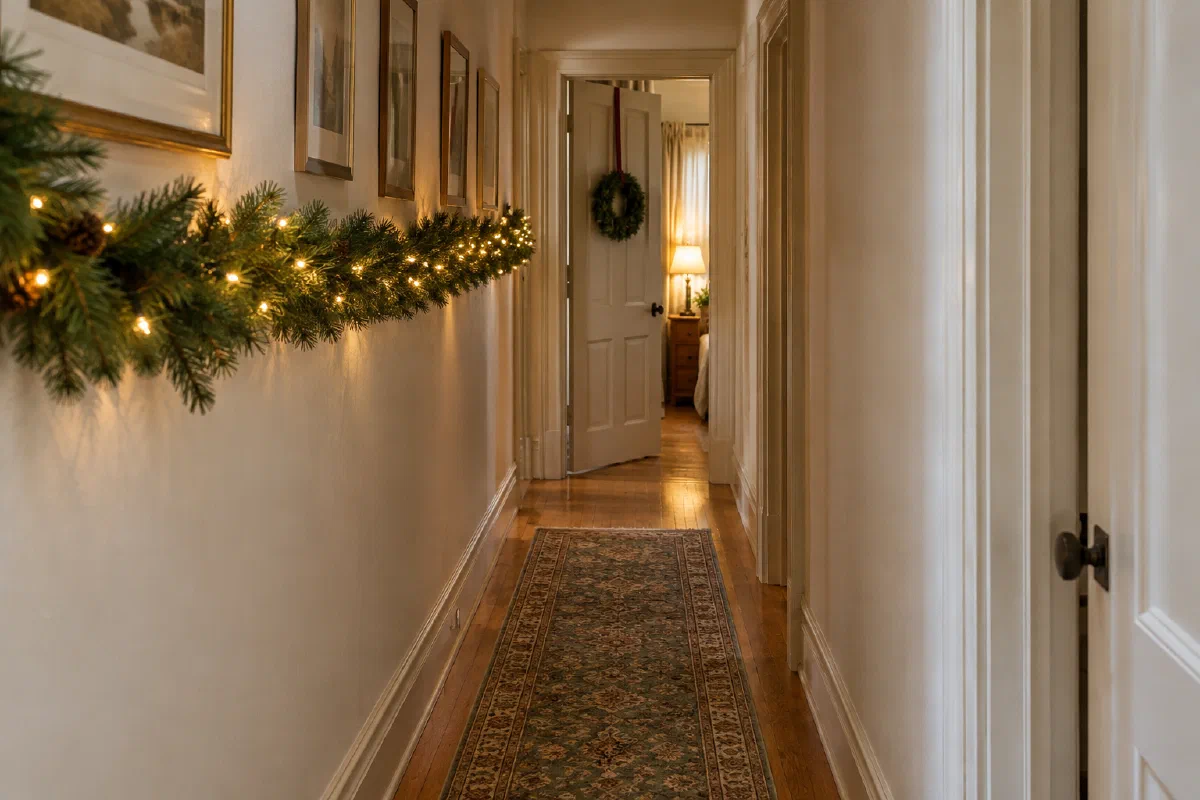
There is a width where entryway advice stops working, and it is around 36 inches. Below that, a console table is not a tight squeeze or a compromise. It is furniture standing in the only path through the house. So stop shopping for a narrower one.
A hall this small is not a small foyer. It is a corridor, and a corridor gets decorated in two bands: below your knees and above your head. Everything between 27 and 80 inches off the floor is capped at about two inches of depth, which is where nearly every tiny entryway decorating ideas photo puts its furniture.
Over 40 inches wall to wall, read christmas entryway decor for a narrow entry instead.
Turning Space Is the Test, Not Square Footage
Square footage tells you nothing here. What decides everything is the clear width at the tightest point, usually the door casing.
The numbers come from the US Access Board, which writes the guide to the ADA standards:
- 30 by 48 inches is the clear floor space a person needs to approach and use something, a closet or a light switch included, per the chapter on clear floor space and turning space .
- 60 inches is the diameter of the area required to reverse direction, and the clearance required at a 180 degree turn around anything less than 48 inches wide.
Read those as a minimum, not a target. They are written for a cane or a wheelchair, not for you in a coat with two bags of groceries. Run the test they imply: coat on, two bags, walk in, turn around at the far end, open the coat closet. Whatever you touched comes out tonight.
Which Surfaces a Tiny Hall Actually Has
| Surface | Depth it can take | What it costs a renter | What it can hold |
|---|---|---|---|
| Wall above 80 inches | Any depth | One adhesive hook or anchor hole | A swag, a hook cluster, a small lit branch |
| Wall between 27 and 80 inches | About 2 inches | A strip or a small nail | Flat garland, a slim frame, a print |
| Ceiling | Any depth | One ceiling hook hole | A hanging star, greenery, a swag |
| Floor strip | Zero on a normal day | Nothing | A low box in the dead corner |
| Inside face of each door | 2 inches while closed | Nothing | A slim wreath, a hook rack, a mirror |
| Inside the coat closet | Any depth | Nothing | The tray, the overflow, the wet coats |
Two generous lines, one stingy line, and the stingy one sits at eye level.
The Protruding Objects Rule Is About Four Inches
The chapter on protruding objects limits anything mounted along a circulation path: with a leading edge between 27 and 80 inches above the floor, it can project four inches and no more. Below 27 inches, an object sits in cane sweep and may project any amount. Above 80 inches, it is above headroom clearance and may also project any amount.
The rule exists for people with vision impairments who read a wall as a guide. Your apartment is not governed by it, but the arithmetic is, and in a hall the number should be smaller, two inches rather than four. A cane sweeps a narrow band close to the wall, and a shoulder with a coat on is 16 to 18 inches wide. A cane finds a wreath. A coat sleeve takes it down.
Two lines of painter’s tape, one at 27 inches and one at 80. Everything above the top line or below the bottom one. Between them, two inches and a hard stop.
How to Work Above 80 Inches Without a Ladder You Cannot Open
Above 80 inches is the best surface a tiny hall owns, because nothing up there is in anyone’s way. Getting there is the problem.
The Consumer Product Safety Commission counted about 14,700 decorating injuries in one season . Falls were 41 percent of them, and three of that season’s injuries were deaths from ladder falls. A three step ladder needs its footprint plus room behind it, which a 33 inch hall cannot give.
- A hook on a pole. Press an adhesive hook onto the end of a broom handle and place it from flat feet. Eight inches of reach is the difference between 78 and 86.
- Two anchors for a swag. A swag pulls sideways at both ends, which drywall will not take for six weeks. Anchor into the casing, or hang from a ceiling hook at each end.
- A rated adhesive ceiling hook, on clean paint and well under its limit. A paper star weighs nothing. A garland with pinecones in it does not.
What the Door Backs Can Take
A hall has more doors than a foyer, so it has more door backs, and a door back is free surface that costs nothing. A door back only exists while the door is open, so decorate the ones that stand open and skip the door that stays shut.
Four checks before you hang anything:
- The top gap. Over the door hardware needs clearance above the door. Hang it, close it, listen for the latch.
- The swing depth. A wreath is two to four inches deep. If the door parks flat against a wall when open, fine. If it stops mid-hall, the wreath stands in the walking strip.
- The close test. A mirror, a hook rack and a wreath are too much weight for a door that still has to latch.
- The steam test. Skip a bathroom door that a hot shower runs against.
The same small wreath in the same ribbon on two doors reads as a plan and costs less than one large wreath. For sticking rather than hanging, renter friendly christmas decor no nails covers what comes off cleanly.
What to Keep Out of the Floor Strip
The floor strip is the point of the hall, and in a small one it holds nothing.
That clear floor space figure points at your coat closet. The 48 inches runs along the hall, the 30 inches runs across it. A twelve inch basket on the floor of a 33 inch hall takes a third of the width.
If one thing lives on the floor, keep it below 27 inches: a shallow lidded box, a low basket in the dead corner, or the boot mat. Nothing tall: a floor lantern, a leaning mirror and a floor tree all sit in the 27 to 80 band and take twelve inches out of a thirty inch path.
The hall runner is either wall to wall or it is not there. A standard runner is about 26 inches wide, which leaves three inches of bare floor on each side of a 33 inch hall. No pad either: a quarter inch is enough for a door to catch the edge.
The boot tray belongs inside the coat closet, not in the hall, because the hall floor is the path. Coir outside against a low pile inside, and the gap under the door, is worked through in christmas entryway decor for a narrow entry .
How to Get Light In Without a Cord Across the Path
A hall has one outlet and no window, so the lit garland goes on the wall and the cord crosses the only floor you have. The CPSC’s guidance is short: check every set for broken sockets, frayed wires and loose connections, throw out damaged sets, and use only lights tested by a nationally recognized laboratory. An older release carries the label detail worth knowing : a red holographic UL label means indoor and outdoor use, a green one means indoor only.
- Battery and USB lights, the only answer that puts no cord on the floor.
- If you must run a cord, run it along the wall rather than across the strip, and unplug it in January.
- One cord, not two. If a plug feels warm, stop using it.
More on that is in lighted christmas garland without a plug nearby .
What to Avoid Buying for a Hall Under About 36 Inches
Each of these stands in the walking strip, or hangs in the 27 to 80 band at more than two inches deep.
- A console table at any depth. Ten inches in a 33 inch hall leaves 23, narrower than most adults’ shoulders with a coat on.
- A floor tree of any size. Small space christmas tree ideas covers where it goes instead.
- A swag hung at 70 inches, which sits at eye level and gets brushed by every shoulder that passes.
- Real candles. The same agency counts about 1,200 candle fires each November and December, with 10 deaths and 130 injuries. In a hall with no surface deeper than two inches, a candle with safe clearance does not exist.
What to Read Next
- Christmas entryway decor for a narrow entry is for an entry 40 inches or wider, where the ten inch console does work.
- Lighted christmas garland without a plug nearby goes deeper into the outlet problem.
- Renter friendly christmas decor no nails has the adhesive weight ratings for the wall and ceiling hooks.
- Small space christmas tree ideas is where the tree goes when the hall cannot hold one.
- Christmas window decorating ideas renters is for the room at the end of the hall, where the light has to come from.