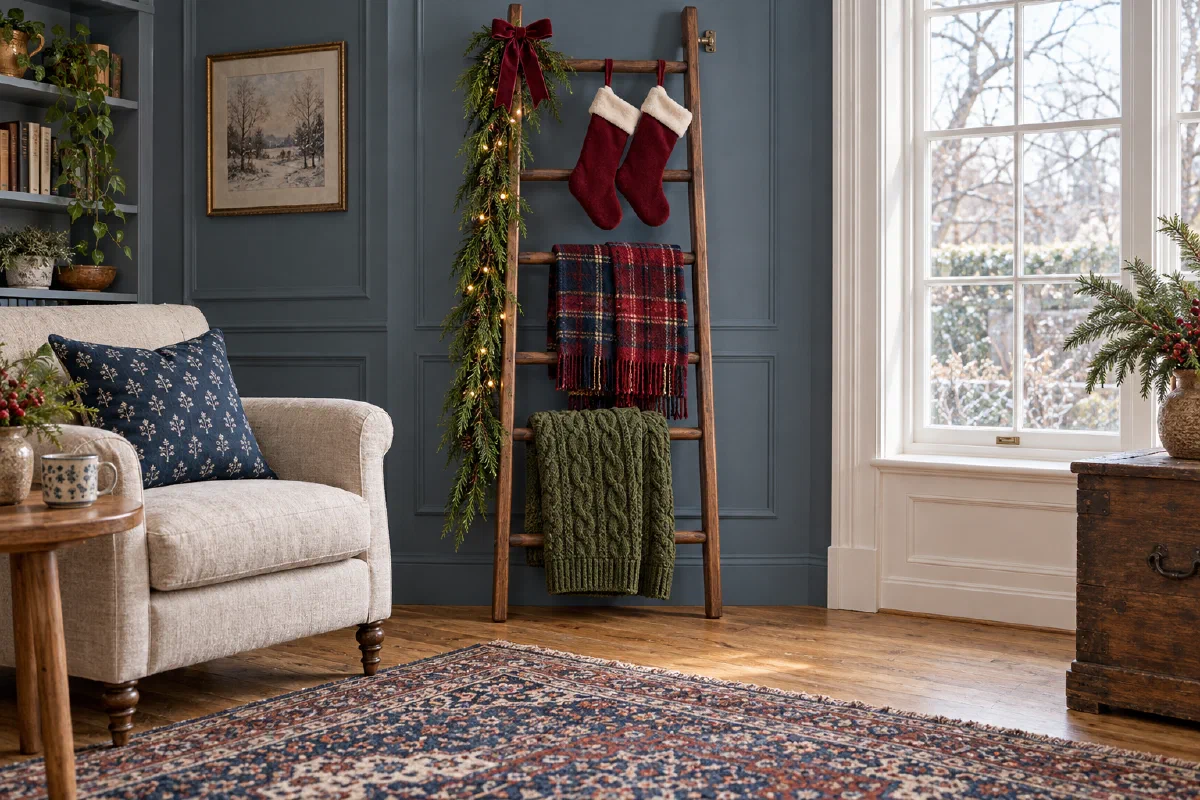
A leaning ladder is the cheapest way to buy the one thing a room without a fireplace is missing, which is a vertical anchor. A mantel gives a room a place for the eye to stop. So does a ladder, and a ladder costs less, needs no drill, folds flat in January, and holds five times as much.
It is also the only piece of Christmas decor in the house that is simultaneously a display and a lever. Everything you hang on it hangs on the front, which pushes the centre of mass out and away from the wall, and by the time there is a chunky throw, three stockings and a garland on it, that is real weight sitting well forward of the feet.
So this starts with the numbers, then gets to the styling. The numbers are short and they are the part that decides whether you like it in February or find it face down on the rug in December.
Are Blanket Ladders Out of Style?
Worth answering honestly, because it is the first thing people search and the answer changes what you buy.
The 2018 version is dated: the raw grey barnwood ladder, distressed to look reclaimed, with a folded buffalo check throw and nothing else. That is a specific farmhouse moment and it reads as that moment.
The object is not dated at all. A ladder is a vertical rail in a room that needs one, and that is a furniture problem, not a trend. What changed is the finish and the load. Warm mid-tone or dark wood instead of grey, a natural oil finish instead of heavy distressing, matte black metal for a more modern room, and fewer things on it.
If you are buying one to use for six weeks a year, it is a bad purchase. If you are buying one because you have blankets and nowhere to put them for the other forty six weeks, the Christmas version is a bonus. That is the honest framing, and it is the same argument that runs through blanket storage that holds its shape.
Blanket Ladder Anatomy and Rung Spacing
Decorative ladders are not standardised, and the differences matter more than the finish does.
- Height. Most sit between four and six feet. Five feet is the useful middle: tall enough to read as a vertical anchor, short enough that the top does not fight a low ceiling or a piece of art. Six feet needs a wall with nothing above it.
- Rung spacing. Usually ten to fourteen inches (opens Amazon in a new tab)As an Amazon Associate, we earn from qualifying purchases. Full disclosure.. Wider spacing is better for Christmas, because a folded throw is bulky and rungs at ten inches means the blankets touch. Fourteen inches gives each item its own air.
- Rung count. Four to six on a five foot ladder. You want more rungs than you plan to fill.
- Width. Seventeen to twenty inches between rails is typical. Under seventeen and a standard throw hangs past both sides and looks like laundry.
- Rung profile. Round dowel rungs are kinder to knits than square edged ones, which press a crease into a heavy blanket over six weeks.
- The feet. Look for flat cut feet that sit fully on the floor rather than the pointed ends of the rails. Pointed rail ends on a hard floor are the main reason these slide.
One thing to say once and then leave alone: a decorative blanket ladder is not a step ladder. There is no load rating on the rungs for a person, the joinery is usually glued dowel, and the lean angle is nowhere near safe for climbing. Do not stand on it, and if you have children, expect that somebody will try.
The Lean, Which Is the Only Number That Really Matters
A leaning ladder stays up because gravity pulls it into the wall rather than away from it. That only holds while the top of the ladder is behind the feet by enough margin, and the margin is set by how far out you pull the base.
For a five foot ladder, put the feet eight to fourteen inches out from the wall. That gives you roughly an eight to thirteen degree lean, which is the range where the ladder is clearly resting on the wall and is not yet sticking into the room.
Scale it with height. A rough rule that works: base out about one fifth of the ladder height. A four foot ladder wants about ten inches, a six foot ladder about fourteen.
What goes wrong at each end:
- Too upright, under about six inches out. The ladder is barely leaning, so there is very little of it pressing into the wall. A knock from the side, a dog, or a blanket being pulled off takes it over.
- Too far out, past about eighteen inches. Now the whole thing is a trip hazard sticking into a walking path, and the feet are carrying more of the load, which is when they start to slide on hard floors.
Two more placement rules. Put it against a flat wall section, not a corner and not over skirting board that is thicker than the rails, because a ladder resting on skirting only touches at the bottom of the rails and pivots. And leave the top rail touching bare wall, not art, not a shelf edge, not a curtain. The top rail will mark a wall it rests on over six weeks, which is worth knowing before you lean it on fresh paint.
Stop It Tipping Before You Load It
Loaded up, a Christmas ladder can carry twenty to thirty pounds, and most of it hangs in front. That is not a lot of weight, but it is weight in the wrong place.
Three fixes, in order of how much they help:
- Grip the feet. A strip of rug pad, two felt-and-rubber furniture pads (opens Amazon in a new tab)As an Amazon Associate, we earn from qualifying purchases. Full disclosure., or a couple of cabinet door bumpers stuck to the bottom of each rail. On tile, laminate or hardwood this is the single highest value thing you can do, because sliding feet are how nearly all of these fail. On carpet the ladder mostly grips already.
- Tether the top. One furniture anchor strap (opens Amazon in a new tab)As an Amazon Associate, we earn from qualifying purchases. Full disclosure. or a heavy picture hanging strip from the top rail to the wall stops it walking sideways. It does not need to hold weight, only to stop travel.
- Load low. Put the heaviest thing, usually the chunkiest blanket, on the second rung from the bottom rather than the top. Weight up high is what turns a lean into a fall.
If there are toddlers or a large dog in the house, treat this like any other tall furniture and anchor it properly. The CPSC’s Anchor It guidance is about dressers and televisions, and the physics is the same: anything tall, light and climbable near a child gets strapped to a wall.
What a Rung Actually Holds
Nobody publishes a rung rating, so here is the practical version from what actually goes on one.
| Item | Rough weight |
|---|---|
| Chunky knit throw | 4 to 8 lb |
| Standard fleece or cotton throw | 2 to 3 lb |
| Quilt, throw size | 4 to 6 lb |
| Filled stocking | 2 to 4 lb |
| Nine foot faux garland | 2 to 4 lb |
| Battery string lights, 50 count | under 1 lb |
A glued dowel rung on a decent ladder handles a heavy blanket without complaint. The failure mode is not a snapped rung, it is the whole ladder moving. So the useful budget is not per rung, it is total, and the answer is to keep the load under about thirty pounds and keep the heavy end low.
One exception. If the ladder has flat board rungs joined with staples or brad nails, which is common at the cheapest end, check them by hand before you hang anything. Flex means it is a display for a light throw and a garland, not for stockings.
Build It in This Order
Order matters, because each layer sits behind the next and you cannot get the garland behind a blanket you already hung.
- Garland first, woven through the rungs. A nine foot faux cedar garland (opens Amazon in a new tab)As an Amazon Associate, we earn from qualifying purchases. Full disclosure. is right for a five foot ladder. Weave it diagonally, going behind one rung and in front of the next, starting at the top on one rail and finishing at the bottom on the other. The diagonal is what makes it look deliberate rather than draped.
- Lights next, following the garland. Same path, so the wire hides in the needles. Do this before anything soft goes on, or you will be feeding wire past a blanket.
- Blankets. One or two, never on adjacent rungs.
- Stockings. Tied to a rung, not hooked over it.
- Ornaments. A handful of shatterproof ones (opens Amazon in a new tab)As an Amazon Associate, we earn from qualifying purchases. Full disclosure., hung on short ribbon from the rungs, at different drops.
- One thing at the top. A small wreath leaned against the top rung, or a single sprig, is what finishes it. Optional, and skip it if the ladder is already busy.

Leave Rungs Empty. This Is the Whole Difference
The mistake is filling every rung. A five rung ladder with something on all five rungs is a drying rack. The same ladder with three rungs used and two left bare is a display.
The working ratio is about half to two thirds of the rungs occupied, with the empty ones distributed rather than stacked at the bottom. On a five rung ladder that means three items. On a six rung ladder, three or four.
The other half of the same rule is that each rung gets one thing. A blanket and a stocking and two ornaments on the same rung is where it starts to look like a jumble sale, and it is exactly the drift that happens when you keep adding one more nice item.
If it looks wrong and you cannot say why, take something off before you add anything.
How to Fold a Blanket So It Hangs Right
This is the difference between a styled ladder and a pile.
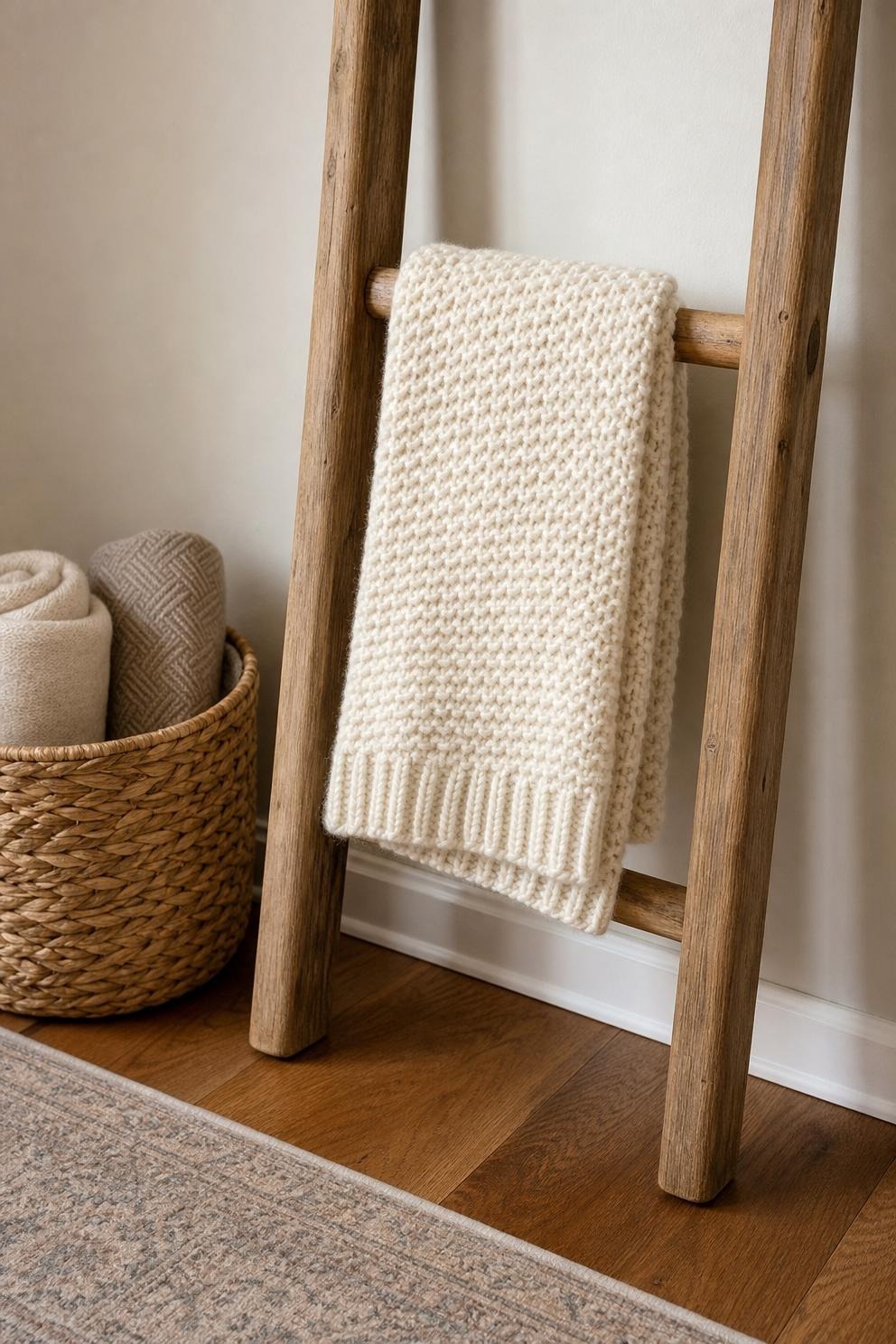
Fold the throw lengthwise in thirds first, so you get a long strip roughly twelve to sixteen inches wide. That strip should be narrower than the distance between the rails, so nothing hangs past the sides.
Then drape it over the rung with uneven lengths, roughly a two thirds to one third split, rather than dead centre. Even lengths read as folded laundry. Uneven reads as a blanket someone uses.
For a chunky knit, skip the crisp fold and go looser, because a heavy knit creased over a rung for six weeks holds that crease. Drape it, then pull the top edge slightly forward so it falls open rather than flat.
Two textures beat two colours. A chunky ivory knit and a flat woven plaid on different rungs do more for the ladder than two knits in different colours.
Stockings on a Ladder
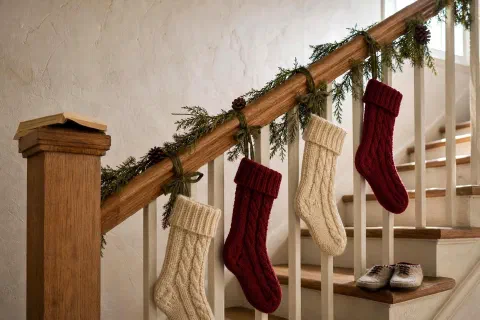
A blanket ladder is a genuinely good stocking spot, and it is one of the entries in our full list of places to hang stockings with no fireplace. Two things make it work.
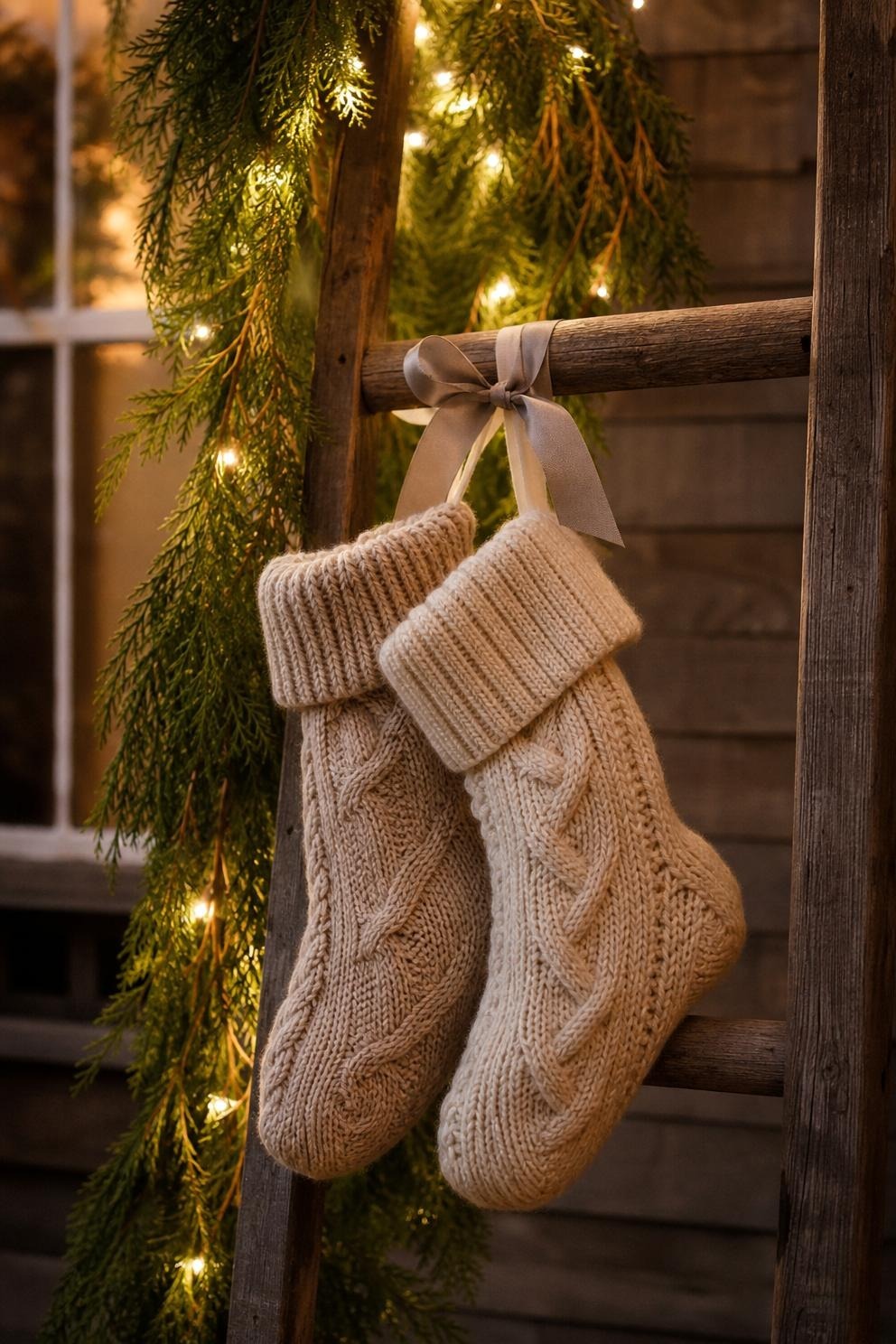
Tie, do not hook. A ribbon or a wired twist tie around the rung holds a filled stocking (opens Amazon in a new tab)As an Amazon Associate, we earn from qualifying purchases. Full disclosure. without sliding along it. A hook slides, and three stockings that have slid together look like a mistake. Ribbon in the same colour as the ladder disappears; ribbon in a contrast colour becomes part of the design.
Keep them off the bottom two rungs. Filled stockings at ankle height are within reach of a dog and a toddler, and chocolate is the usual cargo. Second rung from the top is the natural spot, and it also puts the weight where it is least likely to help the ladder fall over.
Three stockings is about the limit on a standard width ladder. Four crowd, and the cuffs stop sitting level.
Lights, and Where the Battery Pack Goes
Battery lights are the right call here, because a leaning ladder in the middle of a wall is rarely near an outlet and a cord running across the floor undoes the whole look.
Look for a set with a timer function (opens Amazon in a new tab)As an Amazon Associate, we earn from qualifying purchases. Full disclosure., which usually runs six hours on and eighteen off, so it lights itself in the evening and you never think about it. Warm white, not cool white, and copper or green wire rather than white, because white wire is visible against dark greenery from across the room.
The battery pack is the ugly part. Three places to put it:
- Taped to the back of the top rail, where the ladder body hides it
- Tucked into a basket or a folded blanket at the base
- Cable tied behind the second rung, up against the wall side
Whichever you pick, keep the switch reachable. A perfectly hidden pack you have to dismantle the display to reach gets switched off in week two and stays off.
Where to Put It in the Room
The ladder wants a narrow wall, not a wide one. It is a tall thin object, so it reads as deliberate in a gap between a window and a corner, beside a sofa arm, at the end of a hallway, or in the awkward strip next to a doorway. On a wide empty wall it looks stranded.
Two feet of clear wall is enough. Keep it out of door swings and off walking paths, and if it is going beside a sofa, sit down first and check the top rail is not in your eyeline.
It also does not belong beside a working fireplace, a radiator or a heater. It is a stack of dry textiles on a wooden frame, and the U.S. Fire Administration’s home heating guidance puts three feet between anything that can burn and any heat source.
What to Use Instead of a Blanket Ladder
If a ladder is not right for the room, the shape you are actually after is a vertical rail with horizontal lines on it. Several things do that:
- A wall mounted peg rail. Permanent, holds more, and takes stockings and a garland just as well. The right answer if you own the place.
- A leaning bookcase or ladder shelf. Same footprint, more usable the rest of the year, and it gives you flat surfaces for candles that a ladder cannot.
- A coat rack or hall tree. Already in a lot of hallways, already at the right height.
- A wooden quilt rack. Lower and wider, better under a window or at the end of a bed.
- A dowel hung from two brackets. The cheapest version of all, and the one that disappears into the wall when it is empty.
If the goal is specifically a mantel replacement rather than blanket storage, the shelf route is the stronger one, and the heights and anchors are in Christmas mantel ideas when there is no fireplace.
The DIY Version
Two eight foot 2x2s and five one and a quarter inch dowels make a five foot ladder for less than a takeaway, and it is a genuinely easy first build.
- Cut the rails to five feet. Cut five dowels to eighteen inches.
- Mark rung positions at twelve inch centres, starting twelve inches from the bottom.
- Drill one and a quarter inch holes three quarters of the way through each rail, not all the way, so the end grain of the dowel never shows.
- Glue and clamp. No screws needed if the holes are snug.
- Sand the rails hard at the top and bottom edges so nothing catches a blanket.
- Cut the bottom of each rail at a slight angle, roughly ten degrees, so the feet sit flat when it leans. This is the step most plans skip and it is what stops the rocking.
Finish with oil or a wax rather than a heavy stain, because a matte finish is what separates the current look from the 2018 one.
Taking It Down, and the Other Two Seasons
Everything comes off in about five minutes, which is one of the quiet arguments for a ladder over a shelf. The garland gets coiled loosely rather than folded, ornaments go back in their box, and the ladder stays exactly where it is with blankets on it.
That is the real value. The same ladder does autumn with a rust throw and a few berry stems woven through the rungs, Halloween with a different set of rungs, and then Christmas, and the only thing that changes is what hangs on it. One object, three seasons, and a job for the other nine months.
Questions People Actually Ask
What is a good height for a blanket ladder?
Five feet suits most rooms. It is tall enough to work as a vertical anchor beside a sofa or in a narrow wall gap, and short enough to sit under art, a wall clock or a sloped ceiling without a fight. Go to six feet only if the wall above it is completely clear, because a six foot ladder against a wall with a picture on it reads as crowded. Four feet is the right pick for a small bedroom or the end of a hallway, and it is easier to keep stable because there is less of it leaning. Whatever the height, set the feet out about one fifth of it from the wall.
Are blanket ladders still a thing?
Yes, though the version that dates is the finish rather than the object. Raw grey distressed barnwood is a 2018 look. Warm mid tone wood, dark walnut, natural oiled pine and matte black metal all read as current. The other shift is how much goes on them: the older look loaded every rung, and the version that looks right now uses about half the rungs and leaves the rest bare. As furniture, a rail that holds blankets in a room with no linen closet was never a trend in the first place.
How do you fold blankets for a blanket ladder?
Fold lengthwise in thirds so the strip is roughly twelve to sixteen inches wide, which should be narrower than the gap between the ladder rails, then drape it over the rung with uneven lengths hanging on each side, about two thirds to one third. Even lengths look like laundry. For a chunky knit, drape rather than fold sharply, because a heavy knit will hold a crease from six weeks over a rung. One blanket per rung, and never on two rungs next to each other.
What to use instead of a blanket ladder?
A wall mounted peg rail if you can drill, a leaning ladder shelf if you want surfaces as well as rails, a quilt rack if you want something lower and wider, a coat rack or hall tree if one is already in the hallway, or a wooden dowel on two brackets, which is the cheapest and the least visible when empty. All of them give you the same thing a blanket ladder gives you, which is a horizontal line at a useful height that stockings, garland and blankets can hang from.
How do you keep a blanket ladder from sliding?
Grip the feet and tether the top. Rug pad offcuts, rubber furniture pads or cabinet bumpers stuck to the bottom of each rail solve most of it, because sliding feet on hard floors cause nearly all of these falls. Then run one furniture anchor strap or a heavy adhesive picture strip from the top rail to the wall so it cannot travel sideways. Finally, load the heaviest blanket low rather than high, and keep the base eight to fourteen inches out from the wall so gravity is pulling it into the wall rather than away from it.
Can you hang stockings on a blanket ladder?
Yes, and it is one of the better answers when there is no mantel. Tie them to a rung with ribbon or a wired twist tie rather than hooking them over it, because a hook slides along a smooth dowel and three stockings end up bunched together. Use the second rung from the top so the filled weight sits high on the rail but out of reach of a dog or a toddler, and stop at three on a standard width ladder or the cuffs stop sitting level with each other.
What I’d Actually Buy
Product details can change; check the listing before you buy.
One note before the list. Almost every decorative ladder is sold on looks, and the two measurements that decide whether it works are usually buried in the description: the rung spacing and the rail width. Read those two numbers before anything else.
- HOOBRO 5-tier blanket ladder with removable hooks (opens Amazon in a new tab)As an Amazon Associate, we earn from qualifying purchases. Full disclosure.. Five rungs is the right count for the half-full rule, and the removable hooks give you somewhere to hang a wreath or a small stocking that is not the rung itself.
- 6-tier blanket ladder, 5 ft 8 in, white (opens Amazon in a new tab)As an Amazon Associate, we earn from qualifying purchases. Full disclosure.. Taller and more rungs, so this is the one for a room with a clear wall and high ceilings. Not the pick for a wall with art above it.
- Farmhouse neutral cable knit stockings, 18 inch, 4 pack (opens Amazon in a new tab)As an Amazon Associate, we earn from qualifying purchases. Full disclosure.. This is the neutral cream and oatmeal palette that suits a wood ladder better than red and green does.
- XIMISHOP cable knit stockings, 18 inch, 6 pack (opens Amazon in a new tab)As an Amazon Associate, we earn from qualifying purchases. Full disclosure.. The pick if you have four or more stockings, for the reason in the stockings section: a matched set of six beats two mismatched sets of four.
- 9 ft artificial cedar garland (opens Amazon in a new tab)As an Amazon Associate, we earn from qualifying purchases. Full disclosure.. Nine feet is the right length for a five foot ladder woven diagonally, with enough spare to tuck the ends.
- Battery fairy lights, 16 ft, 50 LED, warm white, 6 hr on and 18 hr off timer, 4 pack (opens Amazon in a new tab)As an Amazon Associate, we earn from qualifying purchases. Full disclosure.. The timer is the whole reason to buy this rather than a plain set. Four packs means one for the ladder and three for everywhere else you were going to run an extension lead.
- XmasExp burgundy shatterproof ball ornaments, 24 count (opens Amazon in a new tab)As an Amazon Associate, we earn from qualifying purchases. Full disclosure.. Shatterproof matters here specifically, because anything hanging from a rung at knee height on a hard floor is going to get knocked eventually.
- X-PROTECTOR non slip furniture grippers, 2 inch, 16 pack (opens Amazon in a new tab)As an Amazon Associate, we earn from qualifying purchases. Full disclosure.. Two of these under the ladder feet is the single cheapest thing on this page and it prevents the failure that actually happens.
- Anti-tip furniture anchor straps, 10 pack (opens Amazon in a new tab)As an Amazon Associate, we earn from qualifying purchases. Full disclosure.. Only if there are toddlers or a large dog. One strap from the top rail to the wall, and the other nine go on the furniture that actually needs them.
No link for a felt or rubber pad cut to size, because a scrap of the rug pad you already own does the same job for nothing.
What to Read Next
- Where to hang Christmas stockings with no fireplace lists twenty six spots, including this one, and explains the weight a filled stocking puts on a fixing.
- Christmas mantel ideas when there is no fireplace is the build-a-shelf route, with anchor and height numbers.
- Halloween ladder decor uses the same ladder in October, so the purchase earns more than six weeks of use.
- Renter friendly Christmas decor with no nails covers what adhesive strips can hold across the rest of the apartment.
- Blanket storage ideas that hold their shape puts the ladder to work during the other forty six weeks of the year.