A ghost made of gauze costs less than almost anything else you can hang outside in October, and it beats most of what costs more. Two yards of cloth, something round underneath, a branch to hang it from.
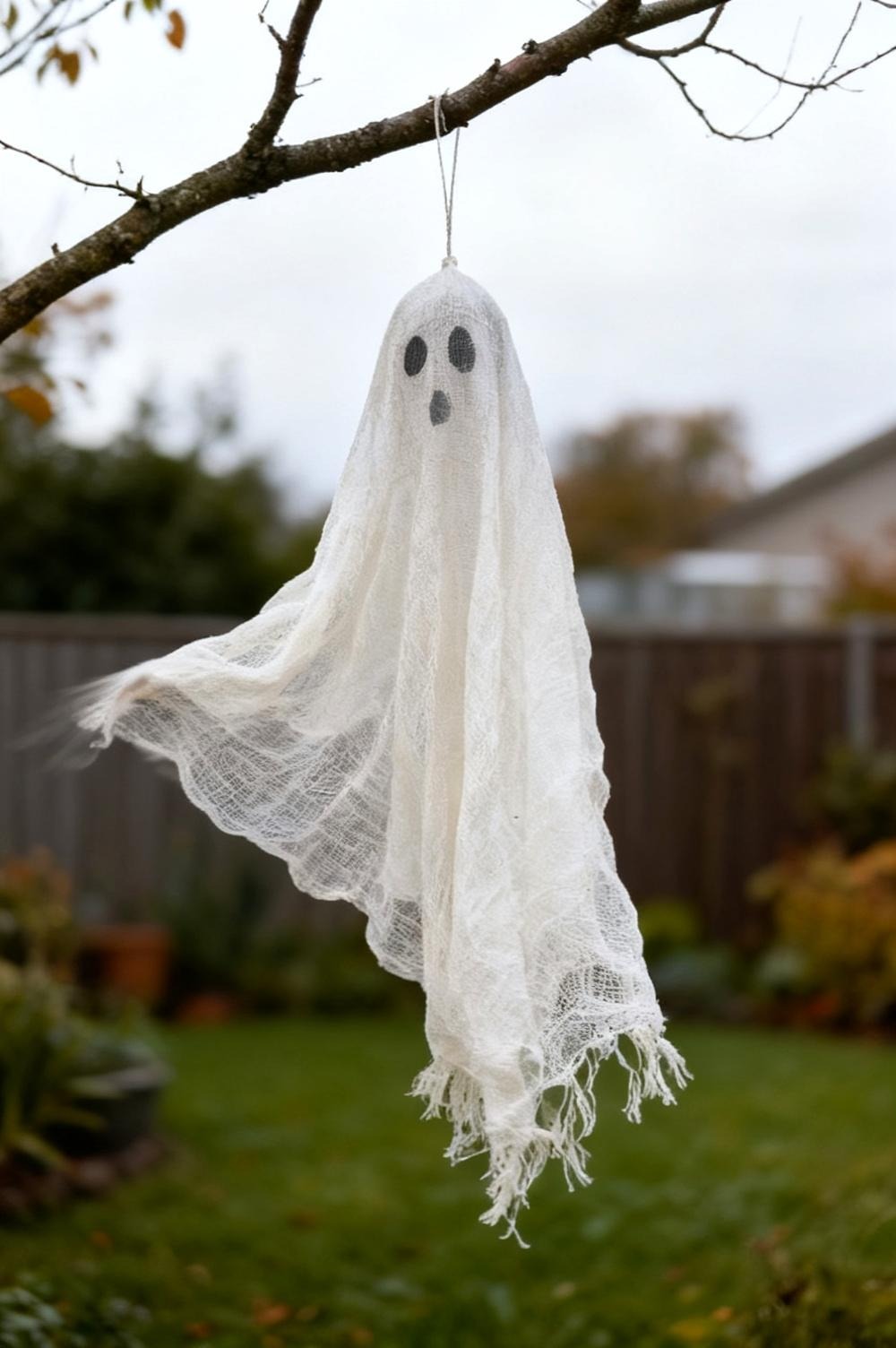
It is also the piece people get wrong most often, and almost never in the making. It goes wrong at the hanging. Pinned flat to the siding or tucked into a corner where nothing moves, it reads as a bedsheet with two dark spots on it. Move that same ghost out to the end of a branch and it drifts on its own. The drift is the entire effect.
Cheesecloth ghosts come down to three decisions, and none of them is difficult.
| The decision | What it controls | The short answer |
|---|---|---|
| What you drape it over | The head shape and silhouette | A balloon, a foam ball, a tomato cage. Anything round |
| How you stiffen it | Whether the folds hold | Cornstarch or diluted glue indoors, nothing outdoors |
| Where you hang it | Whether it moves | Open air on every side, from a single point |
This is the practical half of an argument I made in Cheap Halloween Decor That Doesn’t Look Cheap : inexpensive decorating gives itself away through molded plastic, cold colored light, and pieces set out one at a time. Cloth answers the first of those. No mold seam, no glossy highlight, and it moves, which plastic cannot do at any price.
This article contains affiliate links. If you buy through them, Etheric Echoes may earn a commission at no extra cost to you. As an Amazon Associate I earn from qualifying purchases. Read the full disclosure.
What cheesecloth actually is, and why the grade matters
Cheesecloth is plain woven cotton sold by grade, and the grade is a thread count. Grade 10 is gauze you can see straight through. Grade 90 is dense enough to strain stock. That number decides how a ghost behaves before any other choice you make.
- Loose, open weave. Light passes through, so a lit ghost glows instead of blocking, and it moves on less wind. The outdoor default, and what most bagged Halloween creepy cloth is.
- Tight, fine weave. Holds a shape better and drapes with real weight, reading as cloth rather than netting. Better for a small ghost on a table or a covered porch.
Grade 90 cheesecloth in unbleached cotton (opens Amazon in a new tab) is the tight end of that range, 4.7 stars across roughly 12,700 reviews, and it is sold for cooking rather than decorating. That is a point in its favor: it is reusable, it washes, and unbleached cotton is a soft cream instead of optical white. Thirty-six square feet makes a few small ghosts, not a yard full.
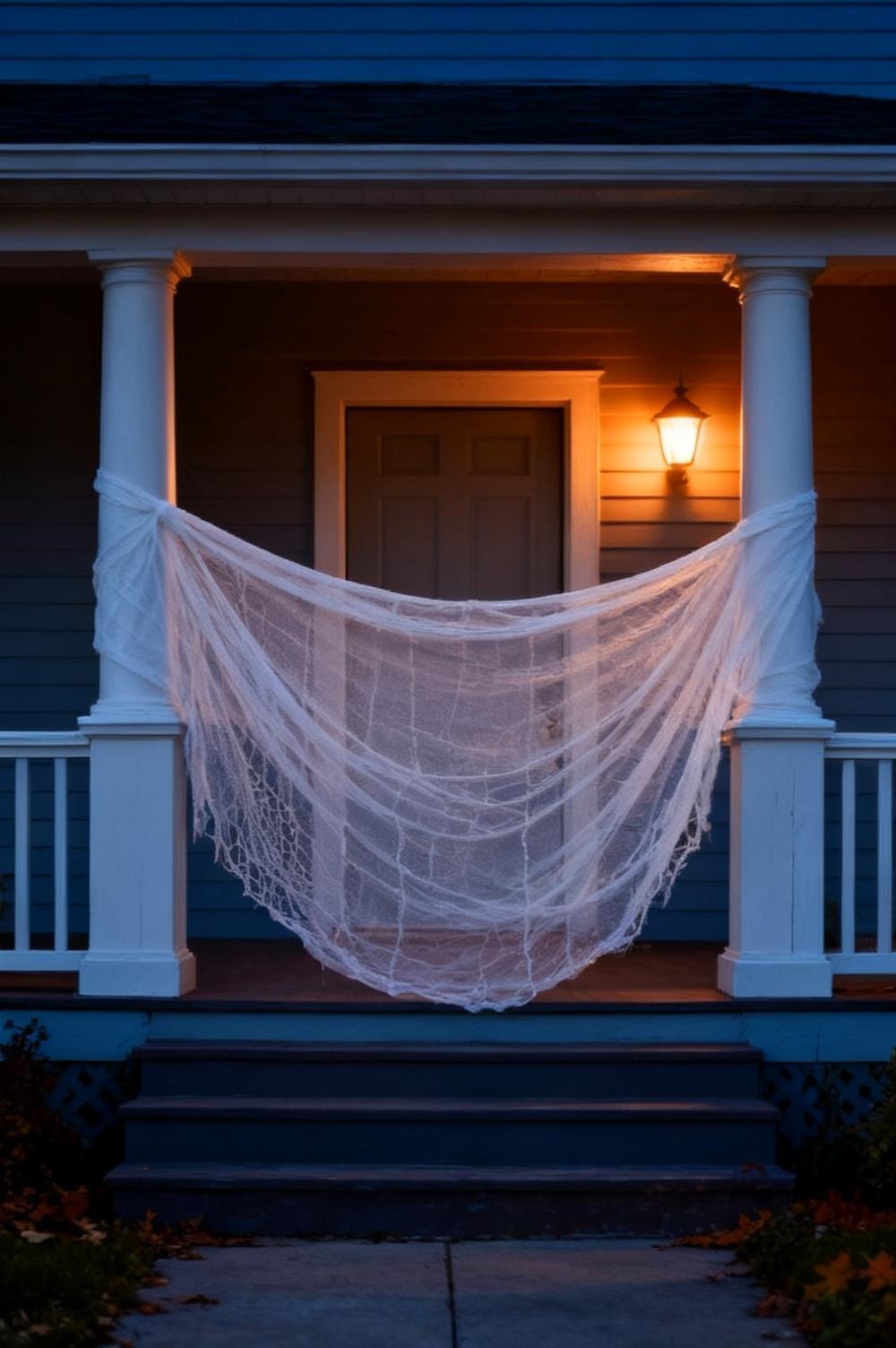
The Halloween-aisle version is the same fabric in a looser weave and a much bigger piece. Boao’s white cheesecloth roll (opens Amazon in a new tab) runs 85 by 197 inches at 4.5 stars across about 2,000 reviews, one roll you cut down yourself. This 400 by 85 inch creepy cloth (opens Amazon in a new tab) is Amazon’s Choice at 4.7 stars across roughly 330 reviews, long enough to cover a porch rail and a doorway with cloth left over.
If you would rather not cut anything, Yobbai’s 6-pack of white creepy cloth (opens Amazon in a new tab) ships six cotton pieces at 30 by 72 inches each, 4.4 stars across about 1,300 reviews. Six pieces is six ghosts, already sized, which is what lets you hang a group instead of one lonely ghost by the door.
White is not the only choice. This 5-piece beige gauze set (opens Amazon in a new tab) sits second in Amazon’s best-seller order for beige creepy cloth, at 4.6 stars across roughly 1,000 reviews, 72 by 30 inches per piece. A bright white ghost at two in the afternoon looks like laundry. An aged cream reads as old cloth in full sun.
Choose what you drape it over
The form is the free part of this project. You want something roughly round for the head and something to hold the shoulders out. There is nothing to buy.
| Form | Best for | The catch |
|---|---|---|
| Balloon on a dowel | The classic, and the cheapest | Pops in heat or cold, so pull it out once the cloth dries |
| Foam ball, 4 to 6 inches | A ghost that keeps its head permanently | Stays inside, so it needs a real hanging point |
| Tomato cage, upended | Life-sized yard ghosts that stand alone | Needs a lot of cloth, and catches wind like a sail |
| Wire coat hanger, bent into a loop | Small hanging ghosts, hook built in | Fiddly to get the loop even |
A balloon is where I would start. Inflate it small, tape it to a dowel, stand the dowel in a bottle. Drape, dry, then pop the balloon and pull it out through the bottom.
The tomato cage is the one people underestimate: upended, it gives a free-standing ghost four feet tall for the price of the cloth. Stake it, then read Halloween Yard Decor That Works After Dark before you place it, because a yard piece that only reads in daylight is doing half a job.
How to make a cheesecloth ghost, start to finish
An evening, and most of that is waiting for cloth to dry.
- Cut generously. Measure from the top of the head to the hem, double it, add a foot. Every stubby ghost was cut too short.
- Wet the cloth in your stiffener and squeeze out the excess so it is damp rather than dripping. Wring gently, since twisting hard sets creases you cannot undo.
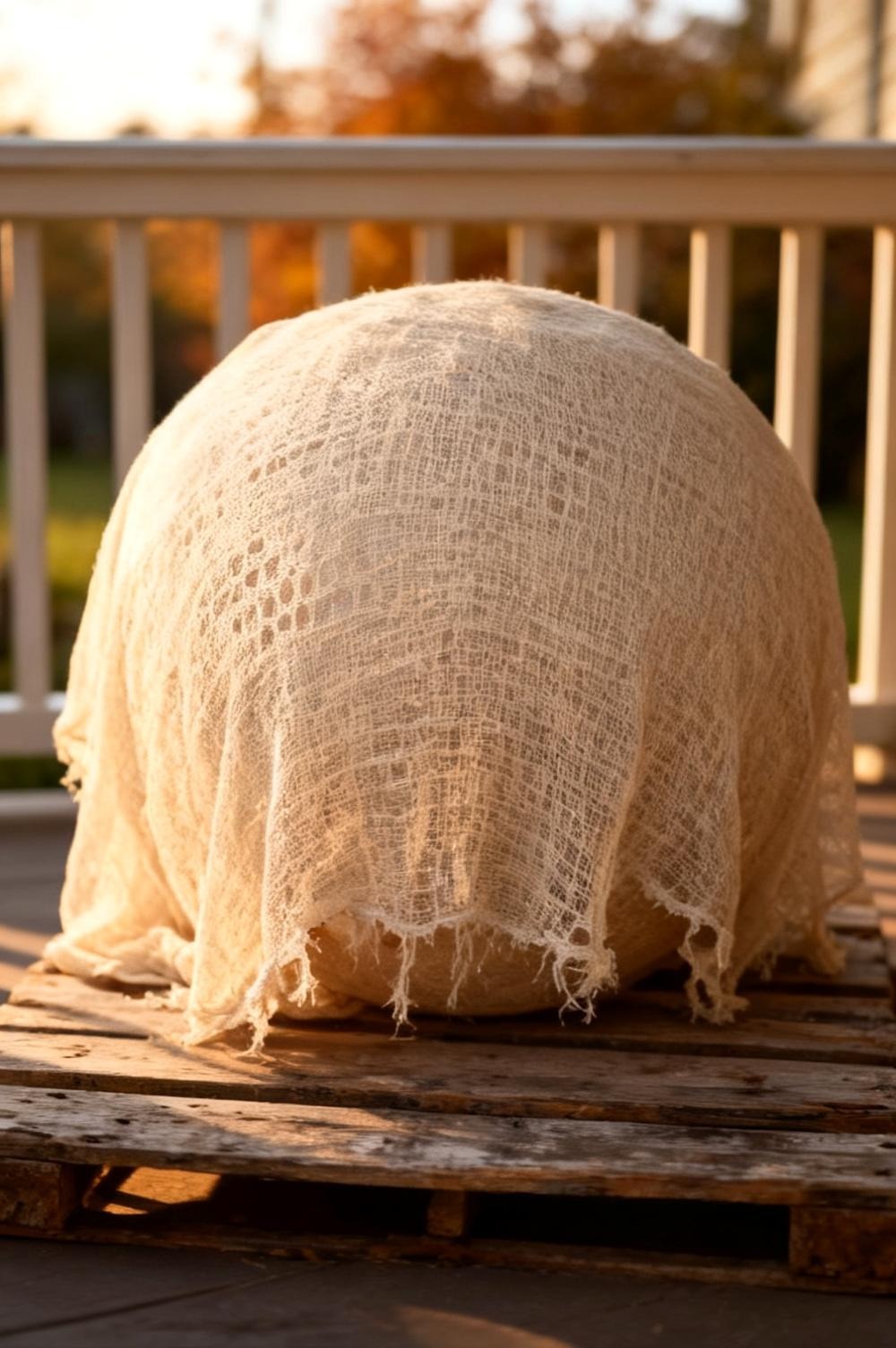
- Drape it over the form, off-center, and arrange the folds while it is wet. This is the only window you get, because a dry fold cracks when you move it. Perfect symmetry makes a shape read as an object instead of a figure.
- Pull a few folds outward so they stand away from the body. Depth is what catches light later.
- Let it dry completely. Overnight indoors covers a small ghost, and a humid day takes longer. The test is not the clock: press the back of your hand to the cloth, and if it feels cool there is still water evaporating out of it.
- Remove the form, then add the face. Two small circles of black felt or marker, set high and closer together than feels right.
Cornstarch, white glue, or fabric stiffener
Three ways to stiffen cloth, and they are more alike than the internet suggests. All three are water-based, dry hard, and soften again when they get wet.
- Cornstarch. Stir it into cold water until smooth, add to simmering water, cook to a thin gravy, cool before dipping. Cheapest, already in the cupboard, dries matte. It is also food, so outdoors it interests insects.
- White school glue, diluted. Roughly equal parts glue and water, stirred until no strings are left. Stiffer and more durable, and what I would use for a fold that has to hold unsupported.
- Commercial fabric stiffener. Ready to use, consistent, and it costs more than the other two combined. Read the label rather than assuming: most are water-based and carry the same weakness.
The outdoor answer is usually none of them. A stiffened ghost is a rigid sculpture, and rigid is the opposite of what makes an outdoor ghost work. It gets rained on, softens, sags, and dries into a shape you did not choose. Untreated cloth moves with every bit of air and dries on its own. Stiffen what goes on a covered porch, a table, or indoors. Leave the rest alone.
Where to hang it so the air can get at it
This is the decision that separates a good ghost from a bedsheet, and it costs nothing.
A ghost needs air on every side. The rule I use is a hand’s width of clear space all the way around and more underneath, since the hem is what catches a breeze and starts the turn. Against a wall, half the air is blocked and the motion dies.
- A bare branch, out toward the end. The best there is. The branch moves, the ghost moves, and there is sky behind it for depth.
- A porch ceiling or an overhang. Sheltered from rain, still open on four sides. Where a stiffened ghost belongs.
- A shepherd’s hook or plant hanger. Movable, already at the right height, usually already in the yard.
- In front of a window rather than against one. Glass backlights the cloth and gives it a glow instead of a shadow.
Hang from a single point, never two. Two points make a hammock and lock the ghost in place, where one lets it rotate and show a different silhouette every few minutes. Use clear fishing line rather than string, since it disappears past a few feet and the ghost appears to float. It is slippery, so tie it twice.
Then hang them at three different heights instead of in a row. Three ghosts level with each other read as bunting. The same three at knee, chest, and above head height read as a group of figures.
The flame rule, since cheesecloth is fabric
Loose open-weave cotton swinging next to an open flame is not a small risk, and it is the one place here with no preference to have.
The U.S. Fire Administration’s candle fire safety guidance says to keep candles at least 12 inches from anything that can burn, notes that an average of 20 home candle fires are reported every day, and recommends battery-operated flameless candles instead. A ghost designed to swing cannot be kept a reliable 12 inches from anything. Run this look flameless and the constraint disappears.
Light them warm, never purple
If you light a ghost, the color of the light does more than the placement of it. The Department of Energy, in its guidance on buying energy-efficient light bulbs , describes correlated color temperature as the color appearance of a lamp’s light, listing 2,700 K as warm and reading as “friendly, personal,” while 4,100 K sits at the cool end and reads as “neat, clean, efficient.”
Cream cloth under warm white light stays cream and keeps every fold visible. The same cloth under a purple or green bulb goes flat gray, because there is nothing in that narrow band for a cream surface to give back. You spent the evening arranging folds, and a cold bulb erases all of them.
One small warm light per ghost, set low and off to one side rather than straight on, is what makes the folds throw shadows. The full lit version is in Halloween Front Porch Decor: The Lit Ghost Look .
The mistakes that make a cheesecloth ghost look like a bedsheet
- Hanging it flat against a wall or a door. The most common one, and the only one better craft cannot fix.
- Two hanging points instead of one. It stops turning, and turning is the effect.
- A straight cut or hemmed edge at the bottom. Tear and fray it with your fingers instead.
- Stiffening a ghost that lives outdoors. Rain softens it, it sags, it dries wrong.
- Wide-set eyes. High and close together. Far apart is a cartoon.
- Optical-white cloth in daylight. Cream or beige holds up in sun where bright white looks like laundry.
- One ghost on its own. Three at three heights, always.
Weather, storage, and keeping them for next year
Cotton gauze outdoors is a seasonal material, and it is worth being straight about that.
Untreated cloth handles rain fine. It gets heavy, hangs lower for a day, then dries and comes back. What it does not handle is staying wet: cloth that never dries between storms will mildew and stain, and the stains do not come out. If a week of rain is coming, bring them in. Wind is the other limit, so untie them before a storm.
Sun weakens cotton over a season. Cloth that spent October outdoors is usually fine for a second year and thin by the third. Fold loosely and store it dry and dark, in a paper bag rather than a plastic tote, since plastic traps whatever moisture is still in the fibers. Store stiffened ghosts upright and unstacked, or plan on re-dipping. The cloth is the cheap part.
What I’d Actually Buy
Buy for weave and quantity rather than for the word Halloween on the bag. It is all plain cotton gauze.
- Grade 90 cheesecloth, 36 square feet, unbleached cotton (opens Amazon in a new tab) (4.7 stars, about 12,700 reviews). The tight-weave, reusable, food-grade one. Cream rather than optical white, and it washes and comes back next year. Small ghosts, table or covered porch.
- Yobbai 6-pack white creepy cloth, 30 by 72 inches each (opens Amazon in a new tab) (4.4 stars, about 1,300 reviews). Six cotton pieces already cut to ghost size, so no measuring and no scissors.
- 5-piece beige gauze creepy cloth, 72 by 30 inches each (opens Amazon in a new tab) (second in Amazon’s beige creepy cloth best sellers, 4.6 stars, about 1,000 reviews). The beige is the reason to pick it, since aged cream reads as old cloth in afternoon sun.
- Boao white cheesecloth roll, 85 by 197 inches (opens Amazon in a new tab) (4.5 stars, about 2,000 reviews). One roll to cut down yourself, the cheapest route to several ghosts plus cloth for a rail.
- 400 by 85 inch white creepy cloth (opens Amazon in a new tab) (Amazon’s Choice, 4.7 stars, about 330 reviews). Yard scale, for a whole front yard rather than a porch.
Check sizes and pack counts before ordering, since gauze listings change constantly. Then buy a spool of clear fishing line, the item everyone forgets and the one that makes the ghosts look like they are floating.
Related
- Cheap Halloween Decor That Doesn’t Look Cheap covers the three tells that give inexpensive decorating away.
- Halloween Yard Decor That Works After Dark lights three distances from the sidewalk so a yard reads at night.
- Halloween Front Porch Decor: The Lit Ghost Look builds a porch around lit ghosts, with the failure that ruins it.