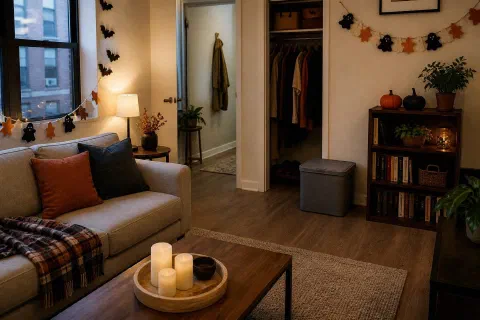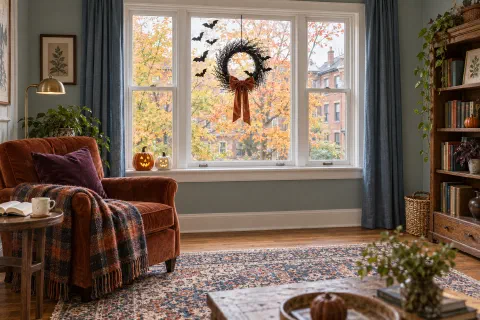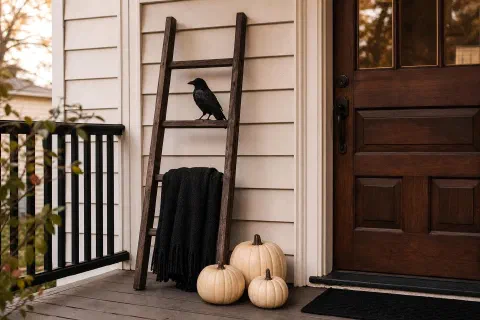
The seasonal aisle in early October is mostly one material. Orange polypropylene, molded, glossy, and lit from behind by a purple bulb.
That is why a porch can take real money and still read as temporary. The budget was never the problem. The finish was.
Cheap halloween decor gives itself away three specific ways, and all three are fixable without spending more than you already planned to spend.
Product ratings, counts, and availability below come from the dated product manifest rather than a live Amazon checkout, so check the current listing before ordering.
| The tell | What your eye is actually reading | The swap |
|---|---|---|
| Molded orange plastic | One flat saturated color, a glossy highlight, and a mold seam | Matte wood, unglazed ceramic, gauze, or a real pumpkin |
| Purple and green bulbs | Narrow-band light with nothing left over to reflect | Warm white, from several small sources set low |
| Pieces set out in ones | Scattered small objects, which the eye files as clutter | Odd-numbered groups at three heights |
Fix the material, fix the light, and group what you already own. Below is each one, with the specific pieces I would use.
This article contains affiliate links. If you buy through them, Etheric Echoes may earn a commission at no extra cost to you. As an Amazon Associate I earn from qualifying purchases. Read the full disclosure.
Tell one: molded orange plastic
Gloss is the giveaway, and it is a material problem rather than a price problem.
Look at what your house is actually made of. Wall paint is matte or eggshell. Wood has grain running through it. Fabric absorbs light instead of bouncing it. Set an injection-molded object into that room and it throws a hard white highlight off its shoulder, and your eye files it as a different class of thing before you have consciously worked out why.
The color finishes the job. Molded orange is one saturated value across the whole surface, so light lands on it and nothing happens. A real pumpkin is never one orange. It has a pale ribbed side, a green shoulder, a dull skin that eats light, and dirt down in the stem. That variation is what you are reading when a real pumpkin looks expensive and a plastic one does not.
The fix costs nothing, because it is a swap and not an upgrade. Buy the same amount of stuff in materials that already behave like the rest of your house: wood, cotton gauze, unglazed ceramic, black metal, heavy paper, dried stems.
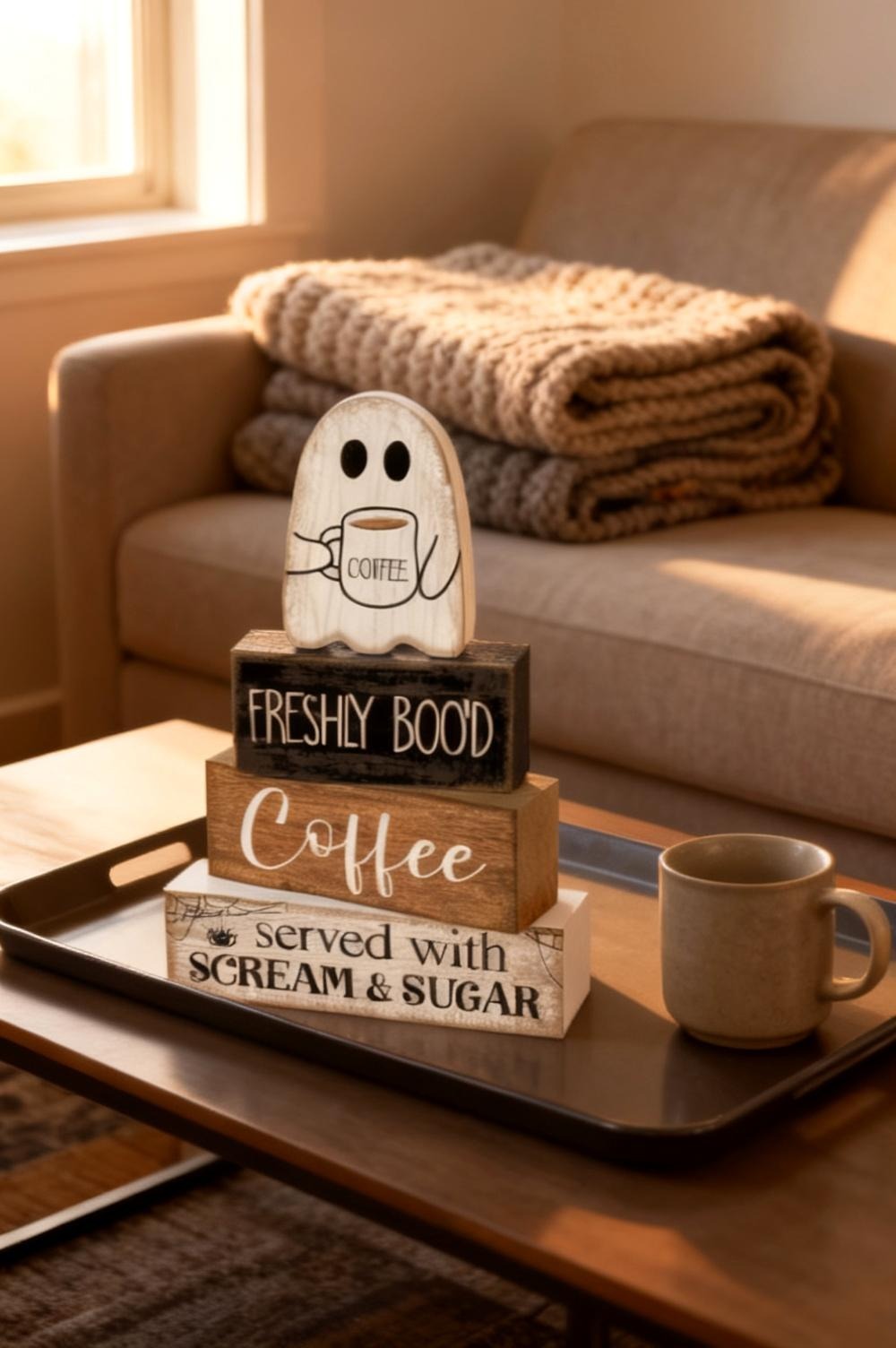
Wood is the easiest swap. Lineshading’s 4-piece wooden ghost set (opens Amazon in a new tab) is a Best Seller at 4.6 stars across roughly 1,300 reviews. These are stackable painted blocks meant for a tiered tray or a shelf rather than free-standing figures, which is why they work: wood grain, a matte face, and a soft edge under a lamp instead of a hot highlight. Four pieces also means you own a group the day it arrives, which matters for the third fix below.
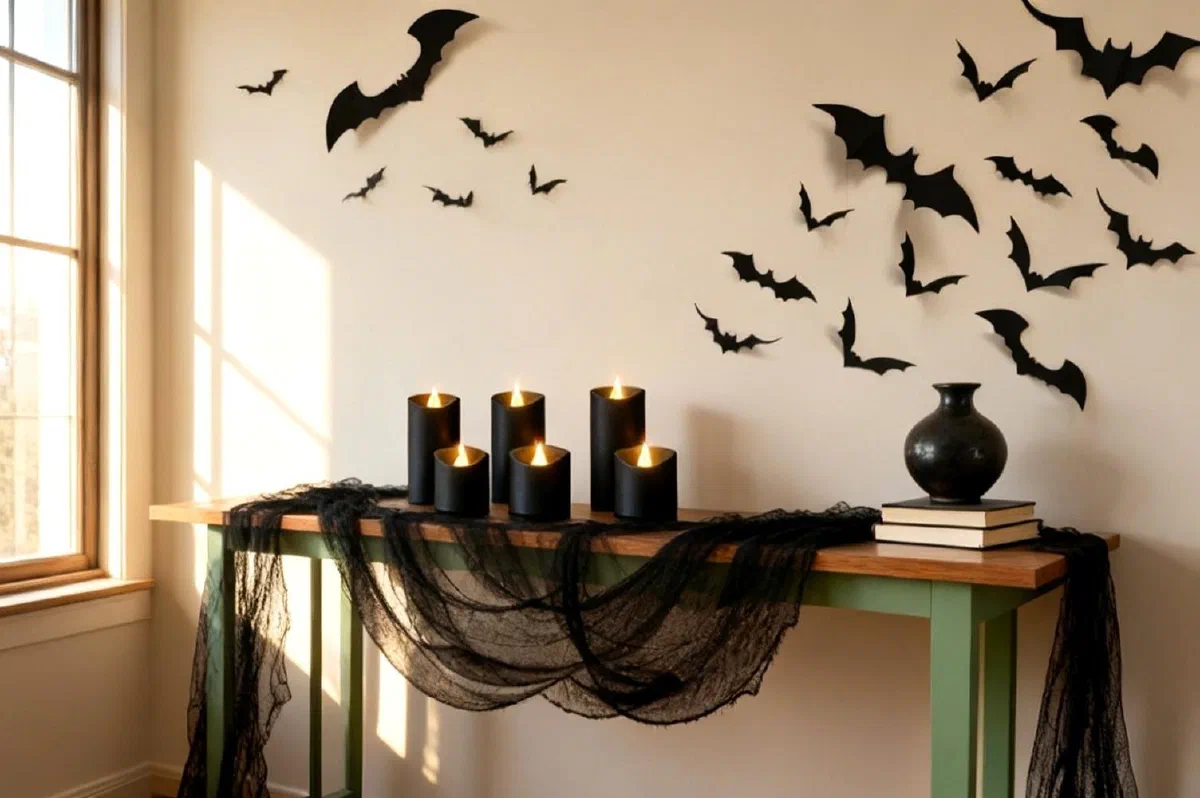
Gauze is the other one. This 5-piece black creepy cloth set (opens Amazon in a new tab) is Amazon’s Choice at 4.6 stars across about 1,000 reviews, and each piece runs 72 by 30 inches. Open-weave fabric filters light instead of blocking it, so a candle behind it glows through rather than stopping dead. Five pieces at that size covers a table runner, a mantel drape, a doorway, a stair rail, and one spare to practice on.
One detail decides whether gauze reads as styled or as a costume, and it is the edge. Pull the weave apart with your fingers so the border is ragged and uneven. A straight scissor cut, and worse a hemmed edge, is the tell.
Keep it to two colors and one wood tone. Black, cream, and warm wood is the combination that survives past October, because none of it has to come down on November 1. It just becomes fall. Orange is welcome as an accent when it is a real pumpkin, since a real one is not uniform enough to read as plastic.
Tell two: cold color instead of warm white
This is the biggest single lever, and the cheapest.
A purple or green bulb puts out a narrow band of light. Anything in the room that does not reflect that particular band has nothing to give back, so it goes gray. Wood loses its grain. Cream goes muddy. Faces look strange in photographs. The scene flattens, and flat is what people usually mean when they say a setup looks cheap at night.
Warm light does the opposite, and the Department of Energy puts numbers on it. In its guidance on buying energy-efficient light bulbs , correlated color temperature is described as the color appearance of a lamp’s light, with 2,700 K listed as warm and reading as “friendly, personal,” while 4,100 K sits at the cool end and reads as “neat, clean, efficient.” The same page defines the color rendering index as a measure of light quality, where a higher value means a better light source. Warm color temperature and good rendering together are why cream stays cream and wood keeps its grain.
Two rules come out of that.
Warm white, everywhere it runs long. If you love the purple, use exactly one colored bulb as an accent, in a single window or inside one lantern. One is a choice. Fifteen is a color cast over the whole porch.
Light low, and from several small sources. One bright fixture overhead is the most obvious tell there is, because it flattens everything under it and throws hard shadows straight down. Four small warm sources at knee and table height do the opposite.
Globe string lights in warm white (opens Amazon in a new tab) run 100 LED bulbs across 33 feet, at 4.5 stars and about 10,700 reviews. That is a bulb roughly every four inches, close enough to read as a line of light along a rail rather than a row of separate dots. Warm white is the part of that description doing the work, and it is worth checking on any string you buy. The same fixture in cool white or a colored bulb undoes everything the low light was doing. The remote and the eight blinking modes are beside the point. Set it to steady and leave it there.
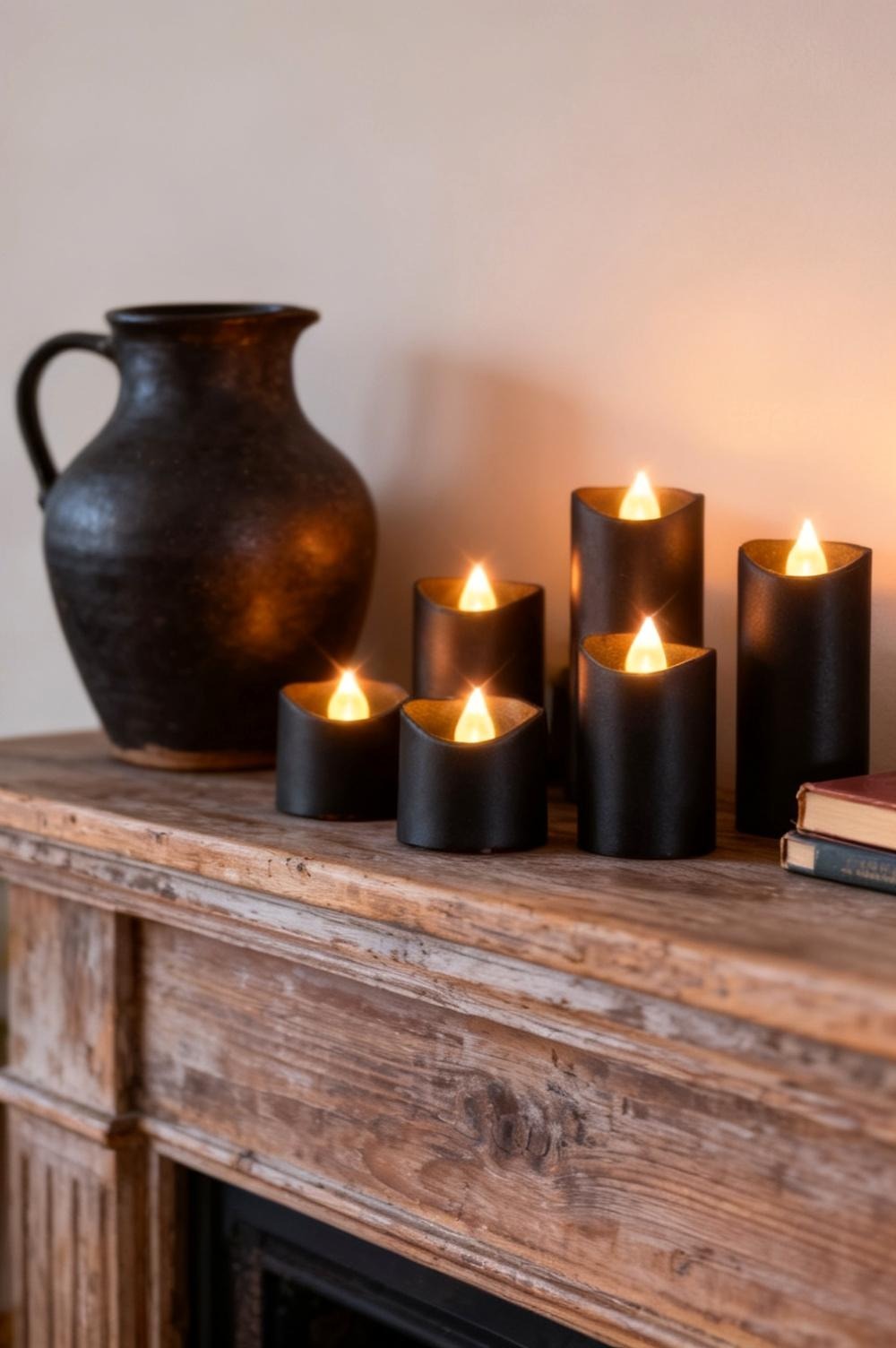
For candles, Homemory’s 24-pack of black flameless tea lights (opens Amazon in a new tab) is a Best Seller at 4.7 stars across roughly 77,000 reviews, by a wide margin the most-reviewed thing on this page, and the listing rates them at 200 or more hours. The black casing is not a style preference. A white plastic tea light shell inside a clear jar is visible in daylight, and it is the same plastic tell as the molded pumpkin. Twenty-four of them covers three in a lantern, three in jars by the door, and a dozen still in the box.
Tapers add the height that tea lights cannot. GenSwin’s flameless taper candles with a remote and timer (opens Amazon in a new tab) hold 4.5 stars across about 15,600 reviews, and ship six to a pack at roughly 9.6 inches tall with real wax shells. The timer is the part that pays off in daily life: they come on at the same time each evening on their own, so the room is already lit when you walk in.
The flame rule, since gauze is involved
Loose open-weave fabric next to an open flame is not a small risk, and this is the one place in the article where the answer is not a preference. The U.S. Fire Administration’s candle fire safety guidance says to keep candles at least 12 inches away from anything that burns, notes that an average of 20 home candle fires are reported every day, and suggests battery-operated flameless candles as an alternative.
Draped gauze, dried stems, and paper bats are all things that burn, and a table runner is nobody’s idea of 12 inches of clearance. Run this look flameless and the constraint disappears.
Outdoors the same open-weave gauze becomes a ghost that hangs from a branch and moves , where a battery puck light is the only sensible light source anyway.
Tell three: pieces set out in ones
One ghost on the console. One pumpkin by the door. One sign on the wall over there. Every piece is fine on its own and the room still looks like a discount bin, because the eye reads scattered small objects as clutter and a group as a decision.
Three rules cover most of it.
- Odd numbers, close together. Three or five, touching or nearly touching. Two matched objects flanking a third is formal and static. Three at different heights, offset, reads as arranged by a person.
- Three heights in every group. Something tall, something mid, something low. A pair of tapers, a wooden ghost block, a folded length of gauze. Three objects of the same height is a row, however nice they are individually.
- Repeat one shape across the room. Repetition is what makes an inexpensive set look deliberate. The same bat silhouette on the wall, in the window, and around the mirror ties three separate areas together out of a single pack.
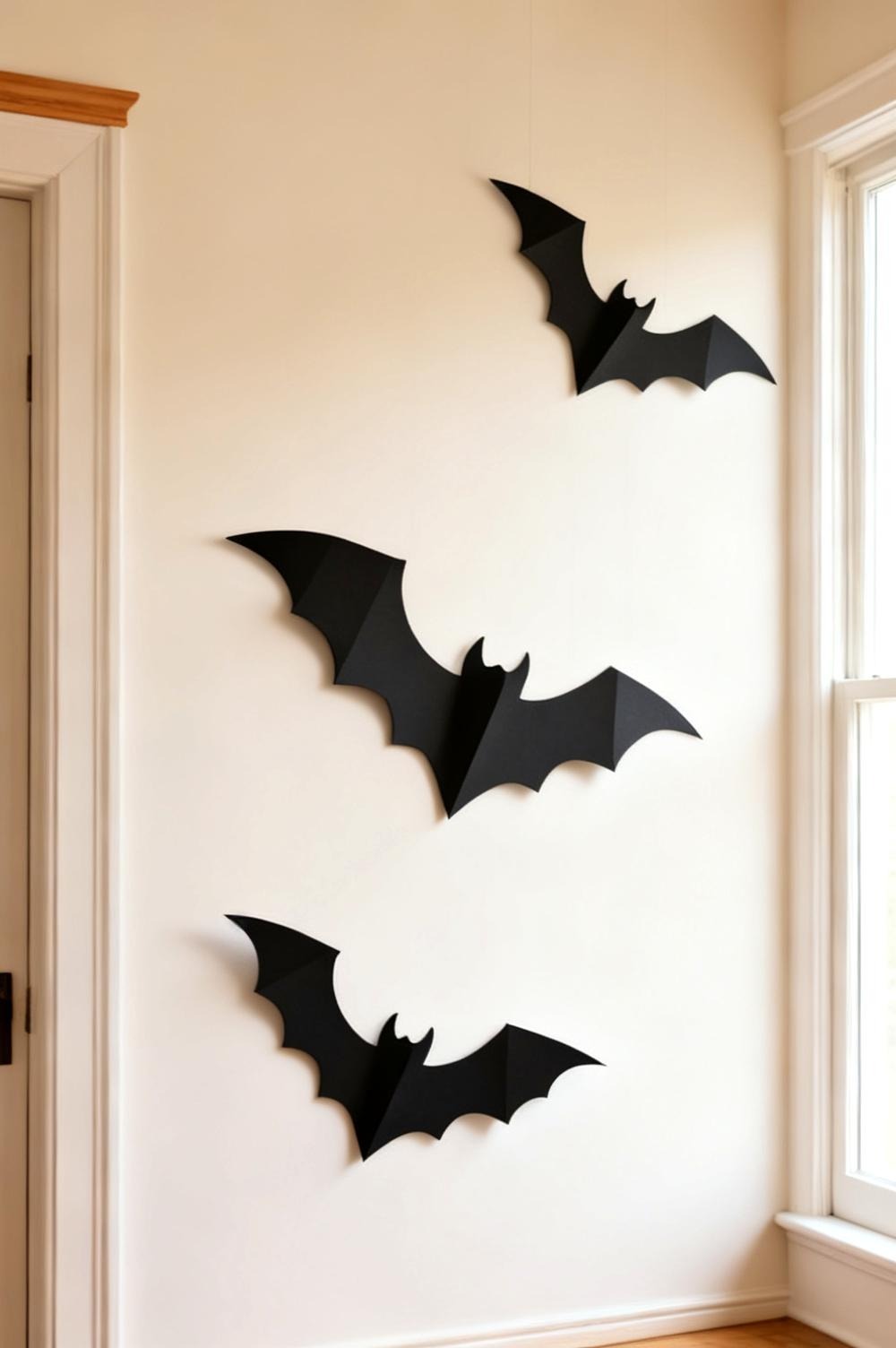
That is the job LUDILO’s 100-piece bat wall stickers (opens Amazon in a new tab) do. The dated listing record shows an Amazon’s Choice badge, a 4.6 rating, roughly 3,400 reviews, PVC construction, and three sizes, which is the part that matters. Graded sizes are what make a flock read as depth instead of a pattern.
Placement, specifically. Pick an origin: a top corner, the head of a doorframe, the space behind a mirror. Cluster the biggest bats there, tightest. Thin them out as they travel away and switch to the smaller sizes at the far end. Evenly spaced bats read as wallpaper. Uneven density reads as movement. You will use 20 to 30 on a wall, not 100, so one pack genuinely covers a wall, a window, and a stair rail.
Scale matters as much as spacing. A dozen small bats floating in the middle of a large blank wall look scattered. The same dozen arranged around a mirror, over a doorway, or climbing into a ceiling corner look placed, because they have an edge to relate to.
Before you stick anything to painted drywall, read the adhesive section in Neutral Halloween Decor: 10 Cozy Amazon Finds . Wall stickers taking paint with them is the most repeated complaint in that whole product category, and if you rent it is the two minutes best spent on this entire project.
Three setups you can finish in one evening
The entry table. Run the gauze down the length and push it into folds instead of pulling it flat. Two tapers at the back left. Three wooden ghost blocks stepped forward and to the right so the group makes a triangle, not a line. Two tea lights tucked low behind the blocks, so light comes from inside the arrangement instead of in front of it. Do not center anything.
The mantel or a long shelf. Same triangle, stretched. Gauze along the back edge with a few inches falling over the front so the line is broken. Tapers about one third in from the left rather than dead middle. Bats leaving the group and climbing toward the ceiling corner. Then leave a full third of the shelf empty, because empty space is what makes the occupied part look chosen.
The front step. One run of warm white string lights along the rail or around the door frame, and nothing purple across the whole porch. Three lanterns or jars on one side of the door with tea lights inside, rather than a matched pair on both sides. Real pumpkins on the treads in odd numbers if you are buying them, since the real ones carry the color variation the plastic ones cannot. If a tree stands near the walk, the branches will hold decor at a height that reads from the sidewalk without buying anything bigger. For the version built around a lit ghost, the layout is in Halloween Front Porch Decor: The Lit Ghost Look .
The mistakes that give cheap halloween decor away
- Buying the whole look in one color. All-orange is what the aisle sells and what everyone else has. Two colors and one wood tone reads as considered.
- Lighting it purple or green. Narrow-band color drains everything it touches, including the pieces you spent the most on.
- One bright light instead of four small ones. A single overhead source flattens the setup and throws hard shadows straight down.
- Spreading pieces evenly around the room. Even distribution is the default and it always reads as clutter. Group them, then leave real gaps between the groups.
- Symmetry everywhere. A matched pair on either side of everything is the most common self-inflicted wound, and it makes an inexpensive set look like a store display.
- Mixing gloss and matte inside one group. The glossy piece next to matte wood and fabric is exactly where the eye lands.
- A straight cut or hemmed edge on the gauze. Tear it and fray it by hand.
- Sticking wall pieces up without testing first. Test one in a hidden spot and leave it a few days before committing to a whole wall.
What I’d Actually Buy
Starting from nothing, I would buy the light before the objects. Warm light fixes more of the problem than any single object does, and it carries into November and December instead of going back in the box.
- Homemory 24-pack black flameless tea lights (opens Amazon in a new tab) (Best Seller, 4.7 stars, about 77,000 reviews). The most-proven item here by review volume, rated at 200 or more hours. Black casings so the shell disappears inside a clear jar, and 24 lights several groups at once.
- Globe string lights, 100 LED across 33 feet, warm white (opens Amazon in a new tab) (4.5 stars, about 10,700 reviews). Roughly a bulb every four inches, which reads as a line of light rather than dots. Warm white is the spec to check. It works indoors or out, and it stays useful long after October.
- 5-piece black creepy cloth gauze, 72 by 30 inches each (opens Amazon in a new tab) (Amazon’s Choice, 4.6 stars, about 1,000 reviews). The cheapest surface change in the house, and enough to cover a table, a mantel, a doorway, and a rail.
- LUDILO 100-piece bat wall stickers in three sizes (opens Amazon in a new tab) (Amazon’s Choice, 4.6 stars, about 3,400 reviews). Three sizes is the reason to pick this one. A single pack does a wall, a window, and a stair rail. Test the adhesive before committing.
- Lineshading 4-piece wooden ghost blocks (opens Amazon in a new tab) (Best Seller, 4.6 stars, about 1,300 reviews). Wood and matte paint instead of molded plastic, and four pieces gives you a group without a second purchase.
- GenSwin flameless taper candles with remote and timer (opens Amazon in a new tab) (4.5 stars, about 15,600 reviews). Six per pack at roughly 9.6 inches, real wax shells, and a timer so the room lights itself at the same time each evening.
Check each listing for current sizes, counts, and bulb or color options before ordering, and put spare batteries for the tea lights somewhere you will actually find them in October.
Related
- Neutral Halloween Decor: 10 Cozy Amazon Finds covers the pieces that stay up into November, plus the wall-adhesive warning worth reading before you stick anything to paint.
- Halloween Entryway Decor Ideas for Inside the Door handles the console, mirror, and stair rail just inside the door, with no-drill picks for renters.
- 6 Moody Halloween Centerpiece Ideas for a Grown-Up Table takes the same black, gauze, and candlelight approach onto the dining table.