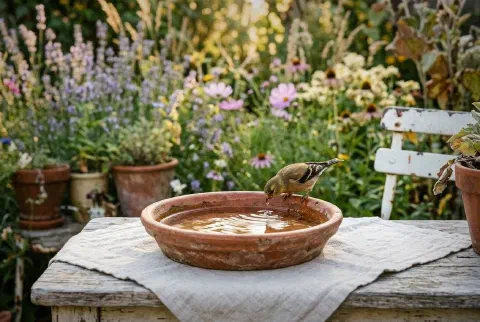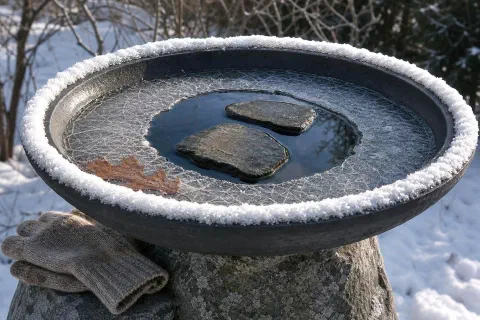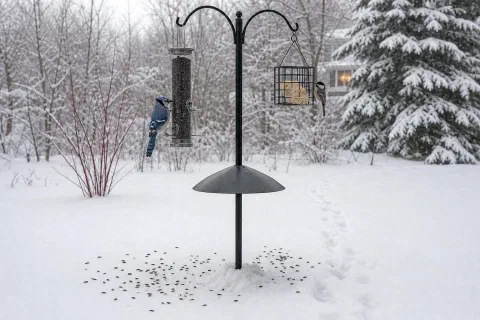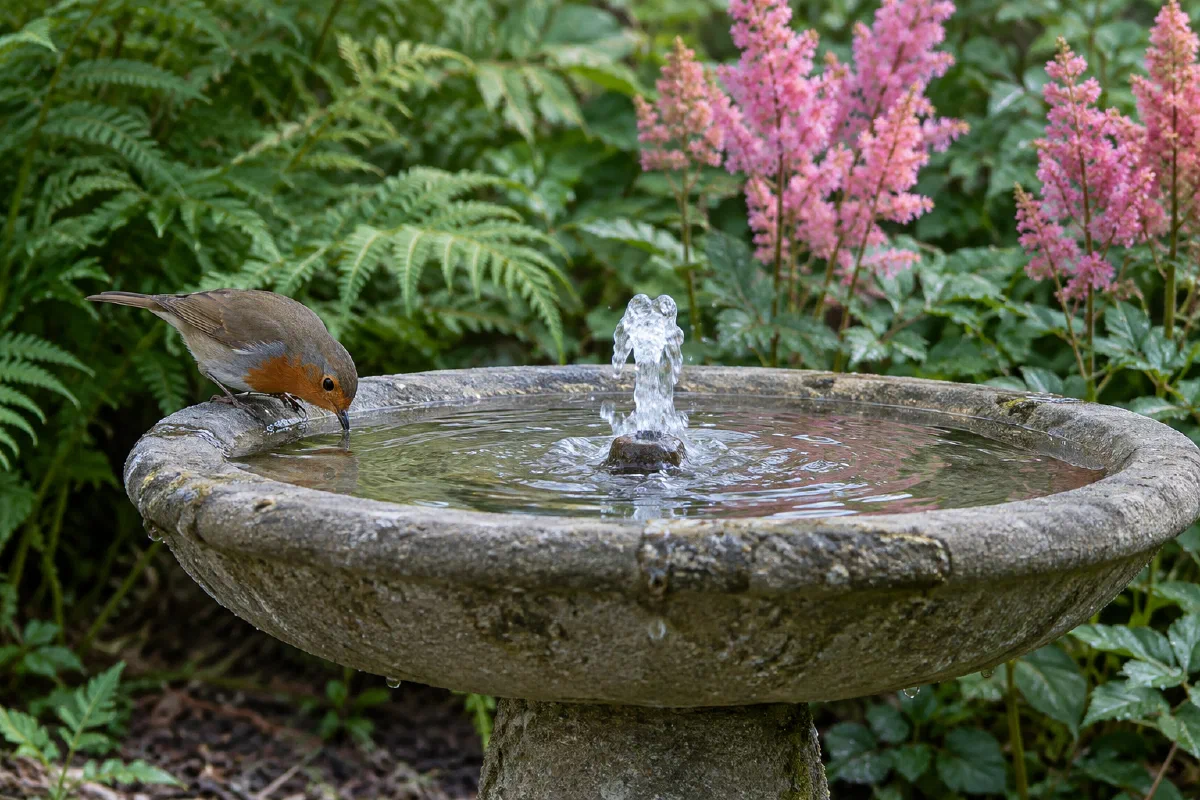
A fountain in a bird bath is sold as an upgrade. Moving water, the listings say, and the birds will come.
That is half true, and the half that is false is the expensive half. Moving water genuinely helps. What the pump changes underneath it usually does not, and that is where most fountain bird baths quietly stop working.
Here is what two agencies that study backyard birds actually tell you to provide, and where a fountain helps or hurts.
Which Is Better: A Bird Bath or a Fountain?
For attracting the widest range of birds, moving water wins, and that is not a marketing claim. The Oklahoma Department of Wildlife Conservation puts it plainly in its birdbath guidance: provide a source of moving water to attract the greatest diversity of birds.
But moving water is the only part of the equation a fountain improves. Everything else in that same guidance is about the basin itself, and a fountain makes some of it harder to hit.
| What matters | Still water bath | Fountain bath |
|---|---|---|
| Water freshness | You refill it | Moving water stays fresher longer |
| Mosquito risk | High if you forget it | Lower, because the surface is not still |
| Depth control | Easy | Easy only if the jet is gentle |
| Rough footing | Easy to add stones | Often blocked by the pump housing |
| Cleaning | Tip and scrub | You have to reach around the pump |
| Power | None | Cord, or sun for a solar unit |
So the honest ranking is not “fountain beats bath.” It is that moving water adds one real advantage, and the basin still has to be a good basin.
Is a Fountain Good for a Bird Bath?
Yes, if the water stays shallow and the birds still have somewhere dry to stand.
That is the whole condition, and it is where most setups fail. Both agencies are specific about depth, and neither of them relaxes the rule for fountains. Cornell Lab’s Celebrate Urban Birds says a good bird bath is closer to a shallow puddle than to a basin, and Oklahoma’s guidance says the bath should slope gradually to a depth of one or two inches in the centre.
A fountain pump does not care about any of that. It will happily push a jet into four inches of water, and a four-inch basin is one most small songbirds will not enter.
There is a second condition, and it is the one people miss. Oklahoma specifies a dry edge around the perimeter and a rough bottom for safe footholds. A fountain that keeps the whole basin wet, or a pump housing that covers the middle of the floor, removes exactly the two features birds need to land and drink. If the fountain leaves no dry rim and no grippable floor, it has made the bath worse, not better.
What the Fountain Must Not Change
Keep these the same whether the water moves or not.
- One to two inches at the deepest point. Two inches is the working number for songbirds. They wade, they do not swim.
- A dry rim. Leave the outer edge bare so a bird can perch without standing in water.
- Rough footing. Sand, a flat stone, or an intentionally rough basin floor. Smooth glazed ceramic is the worst surface for a small bird.
- Shade for part of the day. Oklahoma puts baths in shade, about 10 feet from protective cover, which is also where songbirds want to approach from.
- Distance from the feeders. Oklahoma specifically says to keep the bath away from feeders so seed and droppings do not end up in the drinking water.
Do Birds Use Solar Fountain Pumps?
Some do, but the category has a real quality problem, and the honest answer is that a solar pump is a compromise rather than an upgrade.
A solar floating pump only runs in direct sun. That means it stops in the afternoon shade, stops on cloudy days, and stops entirely in winter, which is also when the bath is most likely to sit still and freeze. The motion you paid for is intermittent by design.
We have watched this category closely because it sells hard. The best-selling solar floating pumps sit around 3.6 to 3.9 stars across tens of thousands of ratings, which is a low ceiling for a product category with that much volume. The recurring complaints are weak output and short life.
If your bath is near an outdoor outlet on a GFCI circuit, a small corded pump gives you motion on demand and is the better buy. If there is no outlet, a hose left on the slowest possible trickle does the same job as a solar pump for free, which is what we recommend in the seven bird bath setups songbirds actually use .
What Colour Bird Bath Do Birds Prefer?
There is no colour requirement in any of the guidance, and that is worth saying plainly because the question gets asked constantly.
Cornell specifies a shallow container that is easy to clean. Oklahoma specifies height, shade, distance from cover, a dry edge, a gradual slope, and a rough bottom. Neither one names a colour, and the same is true of the state extension guidance generally. What the advice turns on is shape and surface, not paint.
So pick for visibility and for your own view of the yard. A bath that reads clearly against its background is easier for a bird to spot from a hedge, and a colour you like is one you will keep filled. Terracotta, glazed stone, and weathered concrete all work.
Bird Bath Problems to Avoid
These are the failures worth knowing before you spend anything on a pump.
- A jet that is too strong. Splashing empties the basin, soaks the rim that was supposed to stay dry, and can discourage smaller birds. A gentle burble beats a spray.
- A pump that blocks the floor. If the housing sits where the footing should be, birds have nowhere to stand.
- A bath under a feeder. Seed hulls and droppings foul the water fast, and Oklahoma advises against the pairing outright.
- A bath next to a window. Reflection strikes are a real risk with any water feature close to glass.
- A bath low enough for cats, with no escape. Cornell notes birds prefer ground-level water but says to raise the bath three or four feet if cats are a danger in your yard.
- A fountain you stop maintaining. A pump that clogs and sits idle leaves you with a still basin and a housing in the way, which is the worst of both versions.
Moving Water and Mosquitoes
This is the one place a fountain genuinely helps, and it still does not replace cleaning.
Mosquitoes need standing water, and moving water is harder for them to use. But a fountain does not make a bath self-cleaning. The CDC’s mosquito prevention guidance names bird baths directly and gives one instruction: once a week, empty and scrub, turn over, cover, or throw out anything that holds water.
In warm weather a mosquito goes from egg to biting adult in roughly a week, so a bath you dump and scrub every seventh day never gets there. Scrub the walls while the water is out, because eggs sit just above the waterline.
This is also why the penny and tennis ball tricks do not do the job. A larvicide tablet is the sensible backup for a week you miss, not a coin.
On regular cleaning, the agencies differ and it is worth knowing the range. Oklahoma says clean daily with a scouring pad and occasionally use a nine-to-one water-to-bleach solution. Cornell says change and clean every couple of days and clean immediately if you see green algae. Ours is a weekly rinse as the floor, with a scrub the moment the walls feel slick or green.
Setting the Fountain Up in Five Steps
- Set the depth first, without the pump in. Fill the basin and confirm one to two inches at the deepest point. Fix this before anything else.
- Check the rim is dry. Run the fountain and watch where the water lands. If the outer edge is wet, reduce the flow or change the nozzle.
- Give the birds a floor. Sand, a flat stone, or a rough surface the pump housing does not cover. This is the step most fountain kits skip.
- Place it in shade, about 10 feet from cover, away from the feeders. That is the Oklahoma placement, and it matches where songbirds approach from.
- Set the cleaning day now and put it in your phone. The rhythm is what keeps the water clean and the mosquitoes out, and the rhythm is the part that slips.
If you are starting from nothing, the bird bath placement mistakes that keep songbirds from landing is worth reading before you buy a pump, because placement decides more than motion does.
Sources
- Cornell Lab of Ornithology, Celebrate Urban Birds: Providing Water for Birds : shallow basins, ground versus raised placement when cats are a risk, sand and stones for footing, cleaning frequency, and algae.
- Oklahoma Department of Wildlife Conservation: Birdbath Tips : height, shade, distance from cover, dry edge, one-to-two-inch depth, rough bottom, daily cleaning, the water-to-bleach ratio, and the moving-water recommendation.
- CDC: Preventing Mosquito Bites : the weekly empty-and-scrub rule, which names bird baths directly.
- Solar floating pump ratings are this site’s own recorded observation from the Amazon best-seller surface, not an agency figure.
What to Read Next
- 7 bird bath setups songbirds actually use if you want the placement, depth, and dripping-water basics before adding a pump.
- keep a bird bath from freezing because a fountain is the first thing to stop working when the temperature drops.
- mosquito fixes for small patios and standing water if the pump is part of a wider standing-water problem on a balcony or patio.
- a small water feature for a rental balcony when a full bird bath is more than the space allows.