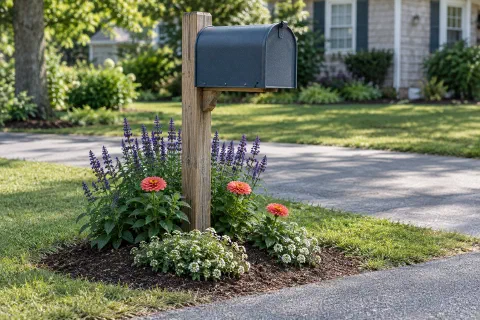
For a full-sun mailbox flower bed, choose heat-tolerant plants suited to your zone and drainage, repeat a few varieties, and keep the carrier’s approach clear. Salvia, coreopsis, blanket flower, sedum, zinnias and moss rose are useful starting points. Road salt and reflected heat need separate checks; drought tolerance does not establish salt tolerance.
Mailbox Flower Bed Ideas for Full Sun: 15 Plants
Last updated:
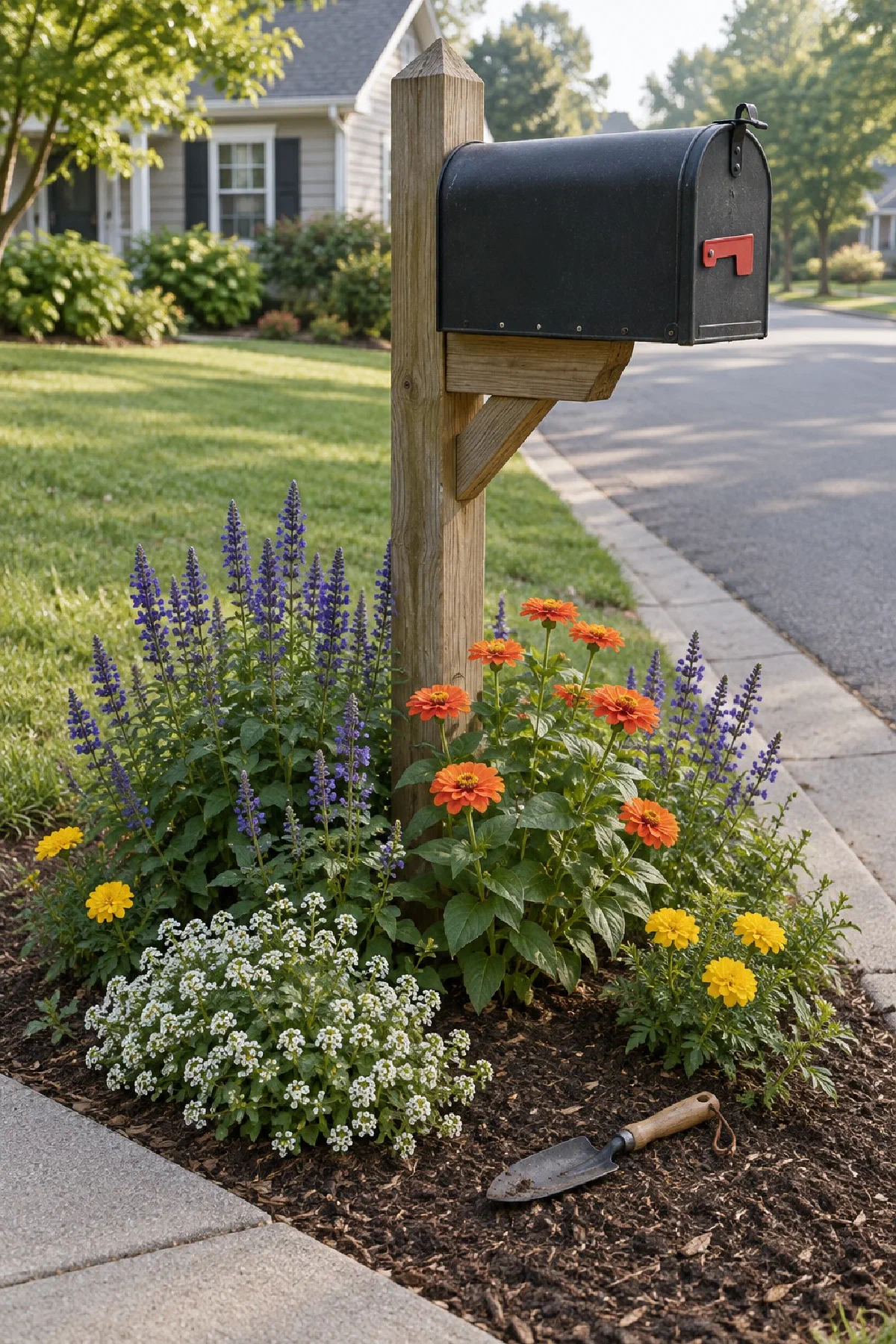
Illustrative scene, not a photograph of the linked products.
Keep taller growth behind or beside the post and the road-facing edge low. Leave the mailbox door, flag, house number and delivery approach unobstructed at the plants’ mature size.
Check the spot before choosing flowers
Penn State Extension’s roadside planting guide describes full sun as six or more hours of direct sun. Observe the mailbox area through the day instead of assuming an open roadside gets the same light as the rest of the yard.
Check whether pavement reflects heat, rain collects around the post, or salted runoff enters the bed. Note how far you must carry water. A drought-tolerant perennial still needs care while its roots establish.
Check local roadside planting and utility requirements before digging. Keep the delivery approach usable. Do not treat a landscape height suggestion as a replacement for the requirements at your mailbox.
Compare fifteen plants by mature size
The ranges below are planning values from the existing plant comparison. Cultivars differ, so use the nursery label for the plant you are actually buying. Annuals do not become frost-hardy because they are grown in a particular USDA zone.
| Plant | Mature height | Spread | Bloom window | USDA zones |
|---|---|---|---|---|
| Lantana (Lantana camara) | 1 to 3 ft grown as an annual | 2 to 3 ft | Late spring to frost | 9 to 11, annual elsewhere |
| Zinnia (Zinnia elegans) | 1 to 3 ft | 12 to 18 in | Early summer to frost | Annual in all zones |
| Perennial salvia (Salvia nemorosa) | 18 to 24 in | 18 to 24 in | Late spring, reblooms if cut back | 4 to 8 |
| French marigold (Tagetes patula) | 6 to 12 in | 6 to 12 in | Late spring to frost | Annual in all zones |
| Purple coneflower (Echinacea purpurea) | 2 to 4 ft | 18 to 24 in | Midsummer to early fall | 3 to 8 |
| Black-eyed Susan (Rudbeckia fulgida) | 2 to 3 ft | 18 to 30 in | Midsummer to early fall | 3 to 9 |
| Threadleaf coreopsis (Coreopsis verticillata) | 12 to 24 in | 18 to 24 in | Early summer to early fall | 3 to 9 |
| Blanket flower (Gaillardia x grandiflora) | 12 to 24 in | 12 to 24 in | Early summer to frost | 3 to 9 |
| Autumn sedum (Hylotelephium telephium) | 18 to 24 in | 18 to 24 in | Late summer into fall | 3 to 9 |
| Verbena (Verbena x hybrida) | 6 to 12 in, trailing | 12 to 36 in | Spring to frost | 9 to 11, annual elsewhere |
| Daylily (Hemerocallis) | 12 to 36 in | 18 to 36 in | Early to midsummer, longer on rebloomers | 3 to 9 |
| English lavender (Lavandula angustifolia) | 18 to 24 in | 24 to 36 in | Early to midsummer | 5 to 8 |
| Moss rose (Portulaca grandiflora) | 4 to 8 in | 12 to 18 in | Summer to frost | Annual in all zones |
| Creeping thyme (Thymus serpyllum) | 2 to 4 in | 12 to 18 in | Late spring to early summer | 4 to 9 |
| Sweet alyssum (Lobularia maritima) | 4 to 8 in | 6 to 12 in | Spring to frost, pauses in peak heat | Annual in most zones |
Choose lavender only where drainage suits it. Alyssum can pause in peak heat, so do not count on it to carry the hottest pavement edge all summer. Plant spread matters as much as height: a compact nursery pot may eventually fill a large part of a small bed.
Build a small bed in layers
| Part of the bed | A starting choice | What to allow for |
|---|---|---|
| Behind or beside the post | Compact perennial salvia | Mature spread and room to reach the mailbox |
| Open side | Zinnias or French marigolds | Cultivar height, annual replacement and access for watering |
| Low edge | Moss rose in a dry sunny spot, or alyssum where summer heat allows it | Growth must stay clear of the pavement and delivery route |
| Perennial alternative | Coreopsis and an appropriate sedum cultivar | Drainage, mature spacing and winter appearance |
Repeat one flowering plant on each side rather than filling every gap with a different variety. Mark the eventual spread on the ground before digging. A three-foot bed cannot hold every plant from the table at full size.
For a perennial bed, start with fewer plants at their recommended mature spacing. Add annuals only where there is actual room, and reduce them as the perennials grow. Skip a rigid calendar for watering or dividing: check soil moisture, growth and the needs of the selected species.
Keep a working space beside the post
The mailbox is a delivery point first. Leave room to open it, raise the flag and read the address without reaching through stems. Keep thorny plants and vigorous vines away from that approach.
Look at the planting from the road as well as from the house. Check sight lines and where a mower, trimmer or snowplow operates. Review the mature layout each season; a bed that was clear when planted can become obstructed later.
The broader mailbox-flower guide gives simpler starting combinations. Cottage-garden edges can help define a planted patch without expanding it.
Prepare for the soil you have
Inspect compaction and drainage before adding amendments. Use a soil test and local extension advice when the bed has persistent problems. More compost, fertilizer or water is not automatically the answer for a wet pocket or salt injury.
Use mulch appropriate to the plants and site, keeping it away from stems and crowns. Leave the border accessible for weeding. A small repeated planting is easier to maintain than a crowded ring of many varieties.
Treat winter road salt as its own problem
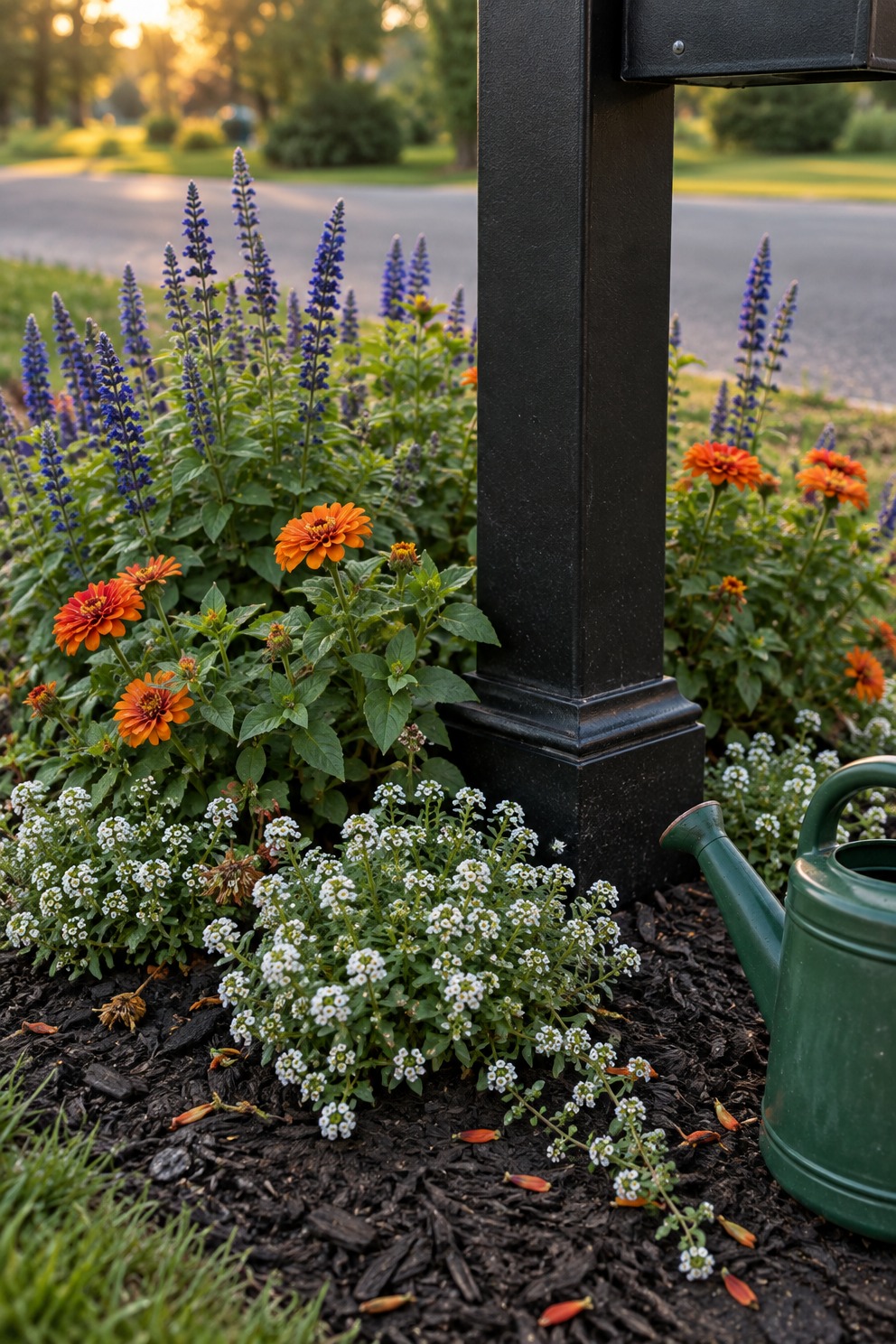
Penn State’s salt-tolerant planting guidance is a starting reference, but check the exact species and cultivar for your region. Plants that tolerate dry summer soil may still be damaged by deicer spray or runoff.
Look at where meltwater enters the bed. If damage is concentrated along the road, seek local advice before fertilizing or trying to flush the soil. Flushing is unsuitable where the water cannot drain, and a fixed amount of irrigation is not a solution for every site.
Where exposure is severe, a smaller planting farther from the runoff may be more practical than replacing the same flowers each year. Containers also need a safe location and winter care; they do not remove every roadside problem.
Three container supplies to compare
Use containers only where they leave the approach clear and can be maintained safely. These are alternatives for a specific container job, not required extras for an in-ground bed.
| Product | When to consider it | Check first |
|---|---|---|
| SnugNiture 22-inch round planters, black pair (opens Amazon in a new tab)As an Amazon Associate, we earn from qualifying purchases. Full disclosure. | A taller decorative container fits beside the planting | Interior volume, drainage, filled stability and room for mature plants |
| Worth 9-gallon tall round planters, beige pair (opens Amazon in a new tab)As an Amazon Associate, we earn from qualifying purchases. Full disclosure. | A larger container is needed for the selected plants | The listing gives 14-inch diameter and 21-inch height. Confirm drainage and filled weight |
| Miracle-Gro Moisture Control potting mix, 8-quart two-pack (opens Amazon in a new tab)As an Amazon Associate, we earn from qualifying purchases. Full disclosure. | A container needs a potting mix suited to its plants | Follow the label and plant requirements. It does not replace watering, and it is not a universal amendment for an in-ground bed |
All three were in stock on Amazon on October 11, 2026. The planter options have different sizes; choose by the planting and site rather than a price tier. Do not assume an empty lightweight planter will withstand roadside wind.
Questions to settle before planting
Are annuals or perennials better here?
Annuals can provide seasonal color where you can water and replace them. A perennial base can reduce replanting, but it still needs establishment care, suitable spacing and a plan for winter. Use the site and your available time to choose.
Can hydrangeas or hostas work beside a mailbox?
Check the exact plant’s light, moisture and mature size. They are poor default choices for a hot, dry full-sun edge, but a different site can change that decision. Do not choose solely from a shaded porch photograph.
What makes the bed low maintenance?
A manageable size, a short plant list suited to the site, access to water and room to weed. Check for obstruction as stems grow. If the bed repeatedly needs rescue, reconsider the plant or location instead of adding more varieties.