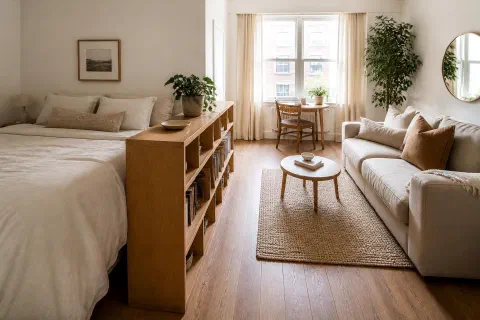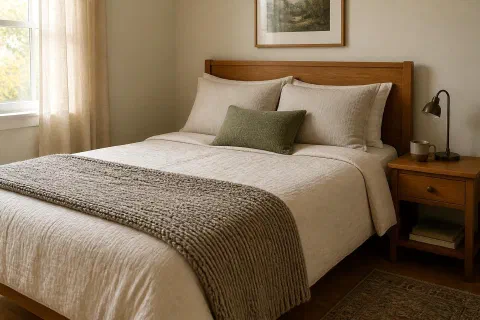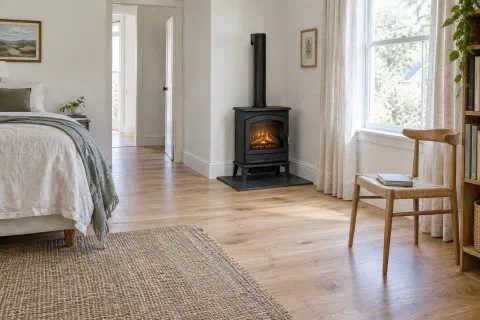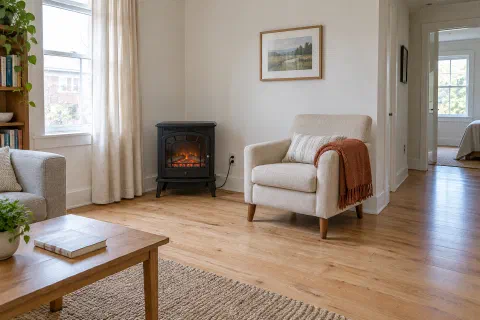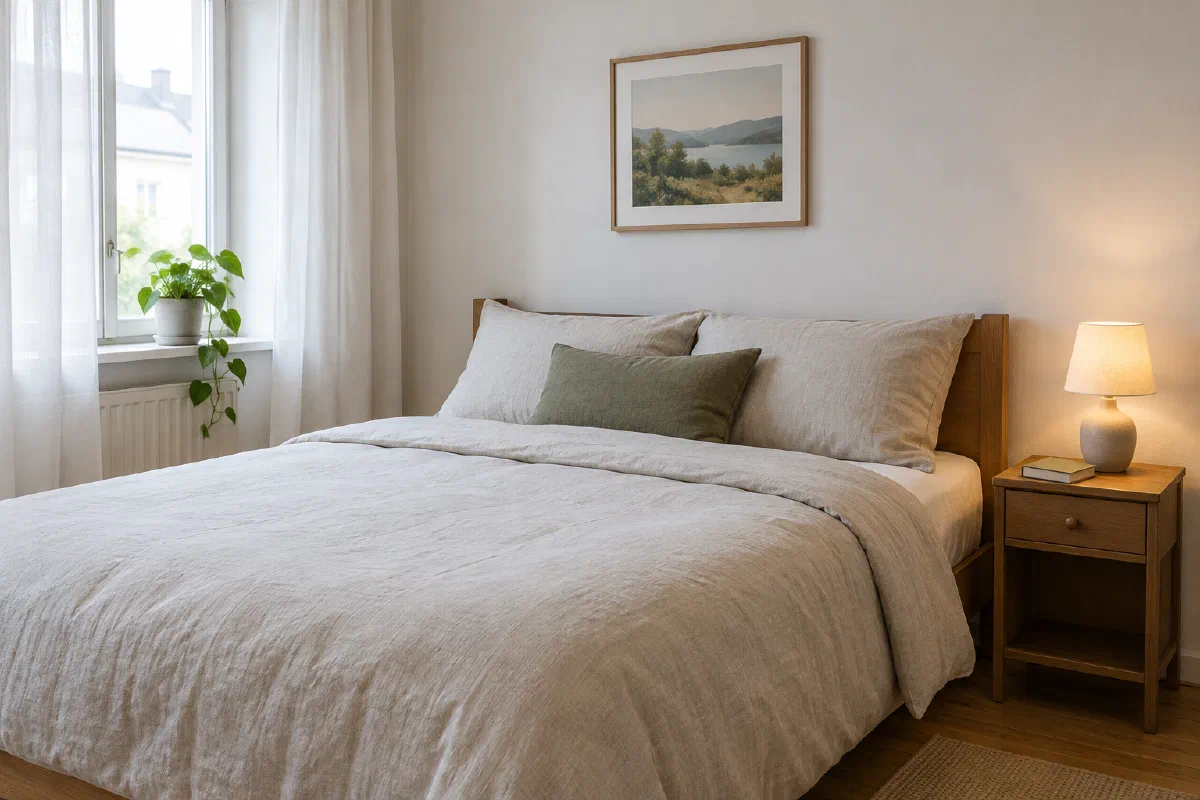
A small bedroom feels cramped for a reason that has nothing to do with its size. The furniture sits in front of the only light and across the only walking path. Most decor lists skip that part.
Search bedroom decor ideas for small rooms and you get baskets, throws, and a gallery wall. Those are fine. But if the bed blocks the window and the dresser blocks the door, no amount of texture fixes how the room feels at 7am.
So this is layout first, in the order that fits a room you cannot knock walls out of.
How to Measure a Small Bedroom Before You Move Anything
Three things decide the room: the window, the door swing, and the path between them. Everything else is negotiable.
Walk the room and write down what you cannot change: which way the door swings, how high the window sill sits, where the outlets are, and where the radiator or floor vent lands.
Then measure the path. Block out the width with painter’s tape, or a broom laid down. A useful target is about 24 inches of clear floor between two pieces of furniture, and 30 to 36 inches where you carry things through.
Two honest caveats. Building codes set clear widths for stairs, hallways, and accessible routes. They do not set a minimum gap between your bed and your dresser. That number is design guidance, not law. And the guidance disagrees with itself: stylists push for equal space on both sides of the bed, in a room with none to spare. A bed with 30 inches on one side and 6 inches on the other walks better than a centered bed you turn sideways to pass.
Which Wall, Which Side, and the Nightstand Question
The headboard belongs against a solid wall, not under the window.
| Position | What it costs you | Call |
|---|---|---|
| Headboard under the window | Curtains hang behind your head, cold glass near your pillow, sill blocked | Avoid when the room has one window |
| Headboard opposite the window | The first thing you see is a dark wall | Workable if the window is large |
| Bed along the wall beside the window | Uses a wall that was doing nothing | Best fit for one-window rooms |
| Bed centered on the long wall | Eats both side paths in a narrow room | Only if two real paths fit |
The arrangement that repairs a one-window bedroom is almost always the same. Push the head of the bed along the wall beside the window, headboard perpendicular to the glass, so the window sits to one side of you rather than above you.
This is where competing room makeovers go soft. They put the bed under the window because it is the only open wall, and never mention that you just gave up the light.
Then the nightstand, often missing entirely. Decide what you need within arm’s reach at night: a lamp, a book, water, your phone, medication. That is the list. A wall shelf, a stool, two stacked crates, or a sill at least 4 inches deep will do it, and each one frees floor space.
Keep the Path Clear, Then Everything Else Fits
The clear floor in a small bedroom is not spare room. It is the route your body takes in the dark, and the route out if the smoke alarm sounds.
The U.S. Fire Administration advises finding two ways out of every room and making sure doors and windows are not blocked, and notes residents may have less than 2 minutes to escape a home fire once the alarm sounds. A laundry basket in front of the only door is a real cost, not a styling choice.
That is the only hard rule here. Keep the route from the bed to the door clear, the window operable, and the closet able to open. Everything below is preference.
Clutter collects in the one clear path. Watch where it lands. If it is always in front of the closet or under the window, the room is telling you where to put a hook or a basket.
Which Window Treatments to Choose for One Window
A room with one window is a light problem before a privacy problem. Heavy drapes over the only window solve privacy and spend the daylight doing it.
The cheapest real improvement is thin curtains that filter rather than block, hung close to the ceiling and wider than the frame. You get soft light and keep some of the borrowed daylight. For darkness to sleep, add a lined curtain or a roller shade on the same window rather than swapping to heavy fabric.
Renters can do most of this with a tension rod or adhesive bracket, no drilling. A removable window film kit is a common winter fix, and know that film and heavy drapes both trap condensation against the glass. Check the sill on cold mornings and dry it.
How to Fix the Four Things That Make a Small Bedroom Feel Cramped
Get the light off the ceiling
One fixture in the middle of a small room flattens everything and throws your own shadow across the bed. Use the ceiling light for cleaning and stop using it after dark. Bedside bulbs around 2700K read warm, and the number is printed on the box.
You want two low sources, not one bright one: a lamp within reach of the bed, and a second across the room so the lit side is not also the side your eyes point at. The CDC lists a quiet, relaxing, cool bedroom among the habits that support good sleep, and a hard overhead light fights two of those three.
Stop paying for cozy with texture
The usual small bedroom advice is to layer: more blankets, more pillows, more rugs. In a one-window room that works against you.
A small bedroom is often the hottest room in the house. Fewer square feet, often one exterior wall, and one window that cannot flush heat on its own. Pile layers on the bed, close the door, and you sleep hot, then badly.
Keep two setups instead of one big pile: a warm set for winter, a lighter set for the rest of the year, with the off-season one in a zippered underbed bag. Thread count is the number people shop by and the least useful one. Weave and weight tell you more about how sheets feel.
Use a mirror as borrowed light, not a wall of glass
One mirror, placed to catch window light and bounce it across the room, does more than a second lamp. Aim it at a wall or the ceiling, not the bed. A mirror facing the mattress reflects the window straight back into your eyes while you are falling asleep.
Give the air a second opening
A single window does not make a draft. Air needs an opening in and an opening out. The EPA’s indoor air quality guidance is blunt that ventilation is one of the three basic ways to improve indoor air, and its most useful line here is that source control beats filtration. Deal with moisture and smell at the source instead of buying an air cleaner later.
So open the window and the bedroom door when you can. A box fan in the doorway moves more air than the same fan against a wall. Keep the plant count sensible, too. That same EPA page states plainly that there is currently no evidence a reasonable number of houseplants removes significant quantities of pollutants in homes. Plants here are for how the room looks. If it smells musty, the fix is airflow, not more greenery.
Before You Buy a Single Thing
Do none of the shopping until the layout is settled.
- Sort out the walking path and where the bed goes before ordering one item. Tape and your feet are free.
- Move the bed off the window if that window is your only light.
- Replace the overhead bulb with a warm one before you buy a second lamp.
- Clear what blocks the window and the door, and decide what the nightstand must hold.
- Only then spend. One lamp, one set of thin curtains, one mirror, and one throw blanket you actually use beat a cart of accessories.
Work in that order and the room is calmer after the second step, before any money moves.
How to Keep the Room Feeling Calm
Calm in a small bedroom is a habit, not a purchase, and it takes about two minutes at bedtime.
- Reset the path before bed. Whatever lands in the clear floor goes in its basket, the closet, or another room.
- Keep the nightstand at three items. It is the last surface you see at night.
- Wash what you touch most: pillowcases weekly, sheets with the next load. If the room runs damp, check under the bed for moisture.
- Look at the ceiling fan before summer. Dust on the blades lands on the bed. A pillowcase pulled over each blade cleans it without a ladder.
- Check window film and heavy curtains for condensation on cold mornings, and dry the sill.
None of that is decorating. It is the reason the decorating stays visible.
What to Read Next
- Cozy Reading Nook in a Small Space: 7 Layouts That Fit for the same measuring routine applied to a chair.
- Window Seat Ideas if your one window has a deep sill that can carry storage and seating.
- Cozy Fall Bedroom Ideas for a Small Room for the seasonal swap: bedding weight, bulb color, one rug for a cold floor.
- Small Apartment Living Room Ideas for Renters for the same one-window problem in the next room.
- Hygge Home Checklist: 12 Small Changes when you want the warmth without buying anything.