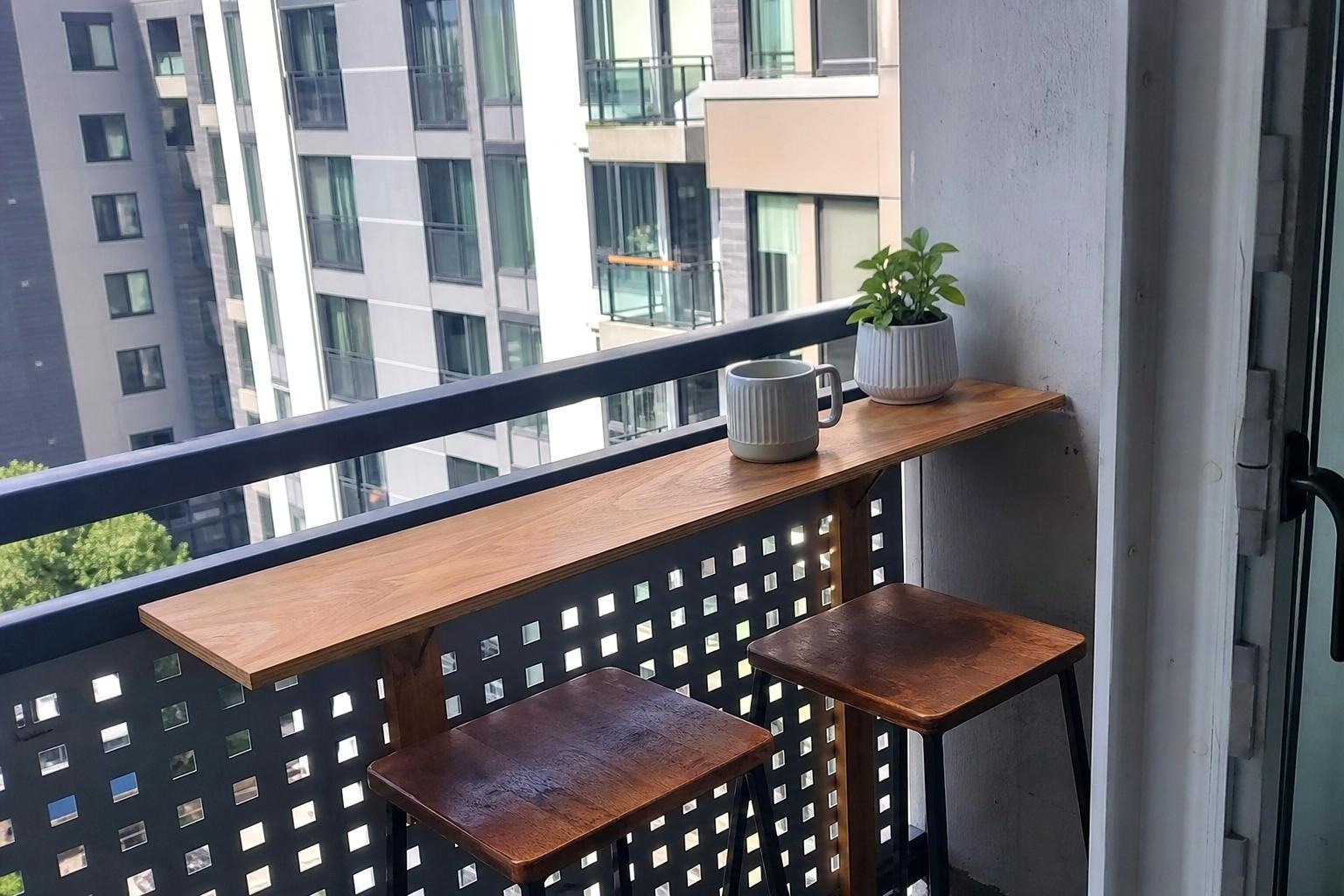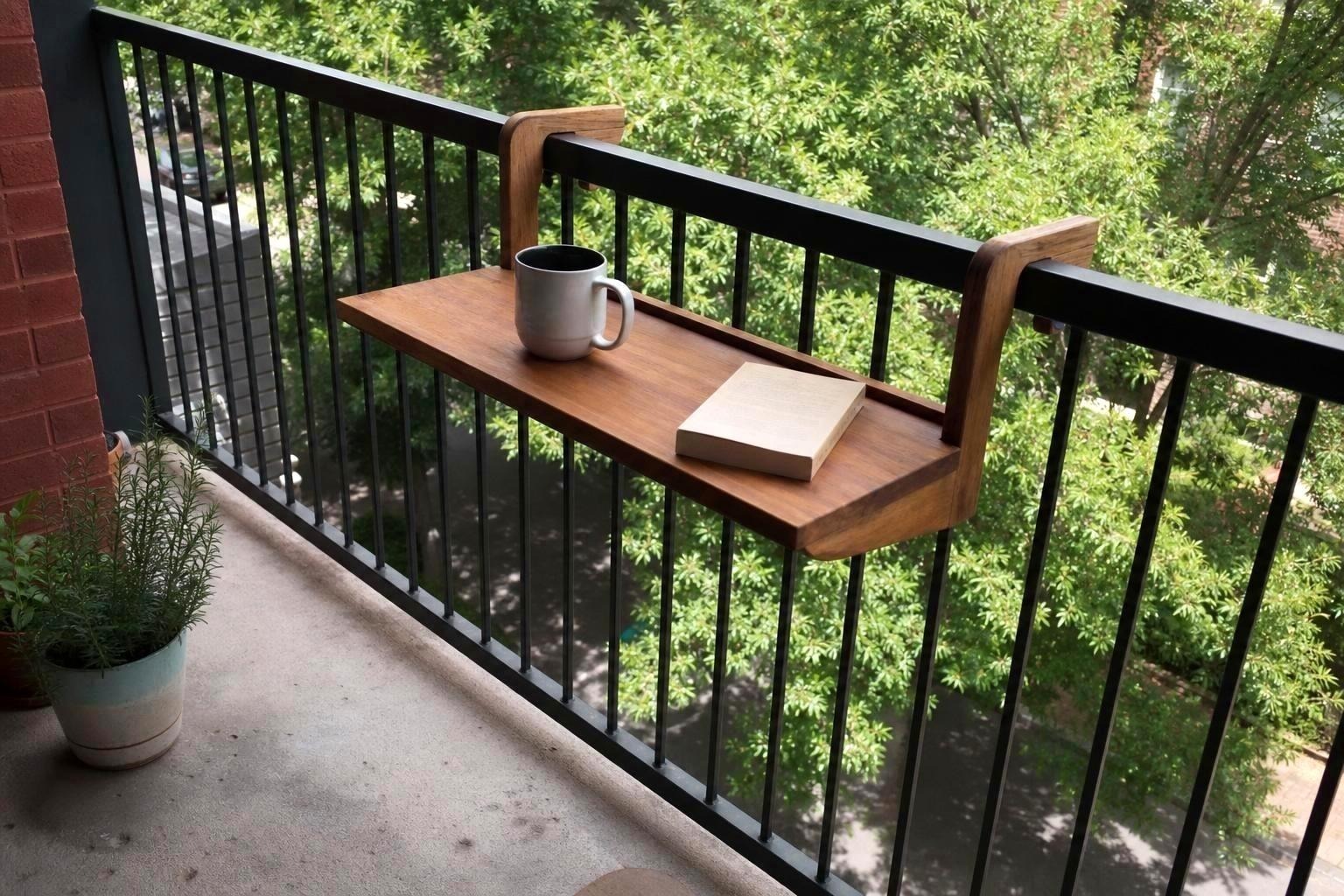
A narrow balcony rarely has floor space for a full-size table. The railing does. A balcony railing table turns that unused edge into a spot for a coffee cup, a small plant, or a plate, without eating the few square feet you actually stand in. The part that trips people up is not style. It is picking the right mount for the actual rail on the actual building, because the four common types are not interchangeable.
If you are building out a full narrow balcony bar with stools and a rail shelf, the table is the one piece worth choosing first since it sets the height and depth for everything else; see small balcony bar ideas with stools and a rail shelf for the complete setup.
The Four Balcony Railing Table Mounts, and Which One Fits Your Rail
Every balcony railing table on the market uses one of four mounts. Each one solves a different rail, budget, and renter situation.
| Mount type | Holes needed | Fits which rail | Load guidance | Best for |
|---|---|---|---|---|
| Hook-on rail table | None | Only the rail shape and thickness listed by the maker | Use the maker’s stated limit; keep the load light | Renters, quick setup |
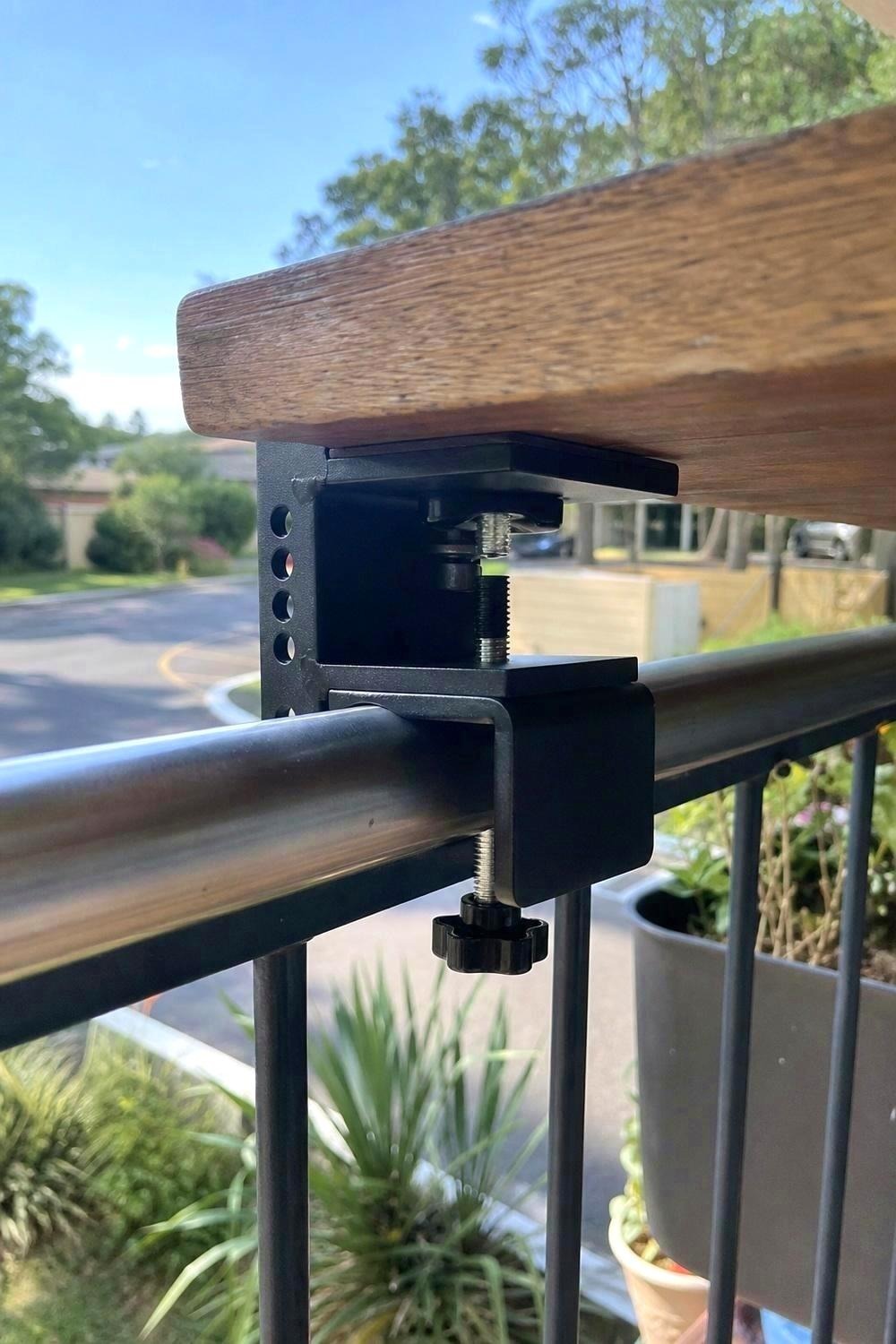
| Adjustable clamp bracket | None | Only the rail shapes and range listed by the maker | Use the maker’s stated limit; never guess from clamp size | Round tube rails, thicker caps |
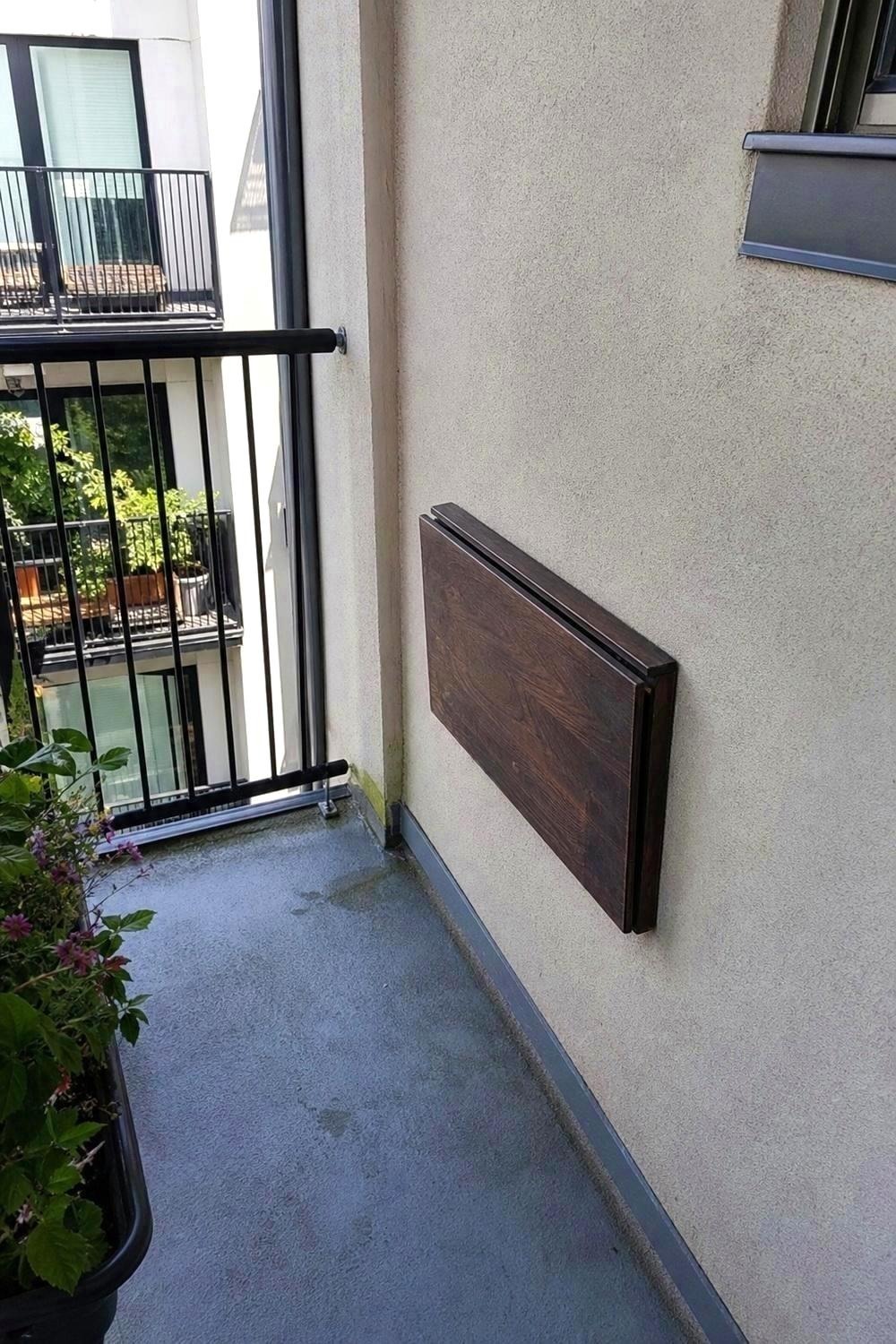
| Drop-leaf wall mount | Yes, into the wall or door frame | A structure where the owner or manager permits anchoring | Follow the hardware and anchor instructions | Owners, permanent use |
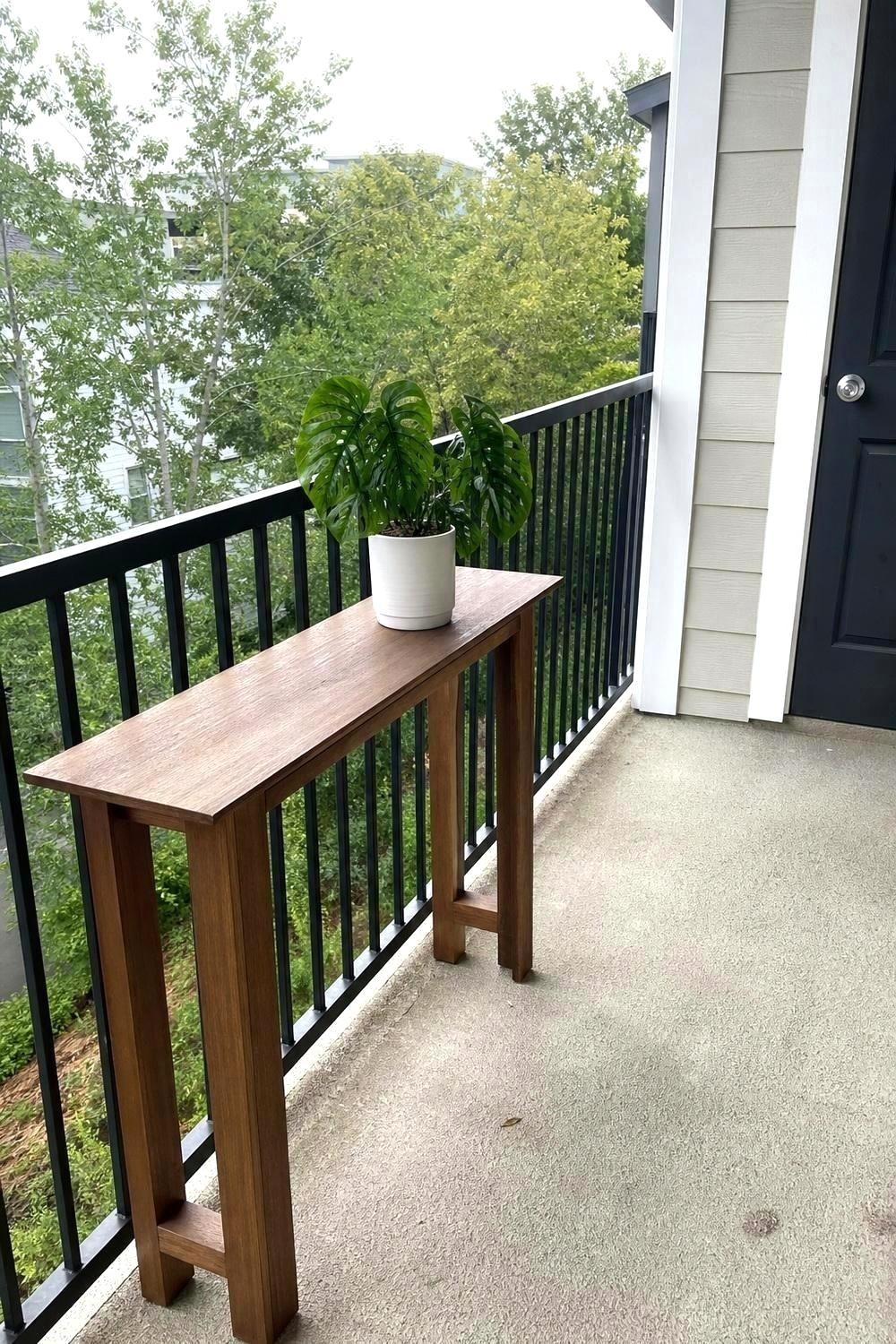
| Freestanding narrow console | None, sits on the floor | A balcony with enough floor depth and a clear path | Use the maker’s stated floor-load limit | Balconies with a sliver of floor space |
A hook-on rail table is the fastest option and the one most renters reach for first. An adjustable clamp bracket earns its place when the rail is round tubing or too thick for a hook-on lip to grip. A drop-leaf wall mount skips the rail entirely and answers to the wall instead, which matters once you understand what the rail can and cannot hold. A freestanding narrow console is worth a look if you have even a little floor depth to spare, because it carries more weight than any rail-mounted option.
How to Measure Your Rail Before You Buy a Balcony Railing Table
Rail width decides whether a hook-on table fits at all, and most buyers skip this step and return the table instead.
- Measure the top rail’s flat width, from the inner edge to the outer edge, and compare it with the exact fit range in the table’s instructions.
- Measure the rail’s thickness where a clamp screw would grip, then confirm the product’s published range before you order.
- Check whether the rail is a flat cap rail or a round tube rail. A flat cap is a wide, level surface built for a hook-on table’s lip. A round tube rail defeats most hook-on designs and needs a clamp bracket built for curved surfaces instead.
- Note your railing’s height and condition. A loose, rusted, or visibly damaged rail is not a candidate for a mounted table. If the building’s requirement is unclear, ask the manager or a qualified inspector rather than applying a generic internet dimension.
Skip any of these four checks and you end up with a table that rocks, will not close its clamp, or simply will not sit flat on the cap.
Load Rating and Weight Limits for a Balcony Railing Table
Every mount type has a load rating, the maximum weight it is built to hold without failing. A hook-on rail table is designed for a mug, a phone, and maybe a paperback, not a potted plant, a laptop, or a stack of books. The lip that hooks over the rail relies on gravity and a small locking screw, and once you add real weight, that leverage works against you instead of for you.
An adjustable clamp bracket holds more because the clamp bites into the rail material itself rather than resting on top of it, but it still has a printed limit, usually on the box or the product page. A drop-leaf wall mount, anchored into a stud or masonry, carries the most weight of the three rail- or wall-based options because the load runs into the building structure instead of a lightweight metal bracket.
Before you mount anything, look at the rail itself. Many cities require periodic structural checks on exterior balconies, railings, and stairs, and a building’s deck and balcony safety requirements page is a reasonable model for what an older rail should be able to pass. A rail with loose bolts, rust at the base, or visible wobble is not a candidate for any hook-on or clamp table, no matter how light the load rating says it can hold.
The building rule is still the first check. For the container and drip side of the same decision, University of Maryland Extension’s balcony container guidance explains why moist containers can weigh much more than empty pots and why saucers or self-watering designs can protect the surface below. That is useful context, not permission to place a planter on a rail table.
When a Hook-On Rail Table Fits a Narrow Balcony
A hook-on rail table sits directly on top of the rail, with a lip that hooks over the inner and outer edges and locks down with either its own weight or a small thumbscrew. It needs no tools beyond what ships in the box, no landlord approval for holes, and it comes off in seconds if you move. It is the right call when the rail is a flat cap rail within the fit range, the load is genuinely light, and you want the table gone by the end of the season without a trace.
It is the wrong call on a round tube rail, a rail thinner than an inch, or a rail you plan to rest a heavy planter or a laptop on for hours at a time.
A Drop-Leaf Wall Mount Table Needs Anchors, Not a Rail
A drop-leaf wall mount table folds flat against the exterior wall on a folding hinge and swings up on brackets when you need the surface. Because it anchors into the wall instead of the rail, it sidesteps every rail-width and load-rating problem above and can hold something closer to a real dinner plate and two mugs. The tradeoff is the anchors: this is the one mount type in this comparison that requires drilling into the building, which makes it an owner-or-approved-renter option, not a no-questions-asked one.
If you rent and cannot drill, a clamp bracket or hook-on rail table gets you almost the same usable surface without asking permission. The same renter-first thinking that shapes good balcony privacy ideas that do not look cheap applies here: solve the problem without altering the building, and take it with you when you move.
Wind and Folding Down a Balcony Railing Table
A narrow balcony sits higher off the ground than a backyard patio, and wind moves faster up there. Any rail table with a folding hinge should fold down when you are not using it, both to keep it from acting like a small sail and to keep a light hook-on table from working itself loose over hours of vibration. A freestanding console is the most wind-stable option since its weight sits on the floor rather than hanging off the rail, but even a console benefits from being pulled back from the open edge on a windy day.
Check a hook-on table’s locking screw or clamp bracket’s tension monthly if the balcony gets regular wind. A mount that felt snug in spring can loosen after a summer of heat cycling the metal.
Materials That Survive Weather, and Ones That Do Not
Powder-coated steel frames are the toughest material in this category. The coating seals the metal against rust and holds its color through direct sun and rain, and it needs nothing more than an occasional wipe-down. Acacia slat top surfaces look like real wood furniture because they are, and they hold up outdoors if you oil them once or twice a season to keep the grain from graying and drying out. HDPE, the dense recycled plastic used on higher-end outdoor furniture, shrugs off rain and sun without any care at all, though it costs more upfront than painted metal.
Untreated pine and any particle-core or fiberboard tabletop are the two materials to avoid outright. Both swell, warp, or delaminate the first time they take real rain, usually within a season. If a listing does not name the wood species or the core material, assume it is one of these two and skip it for balcony use.
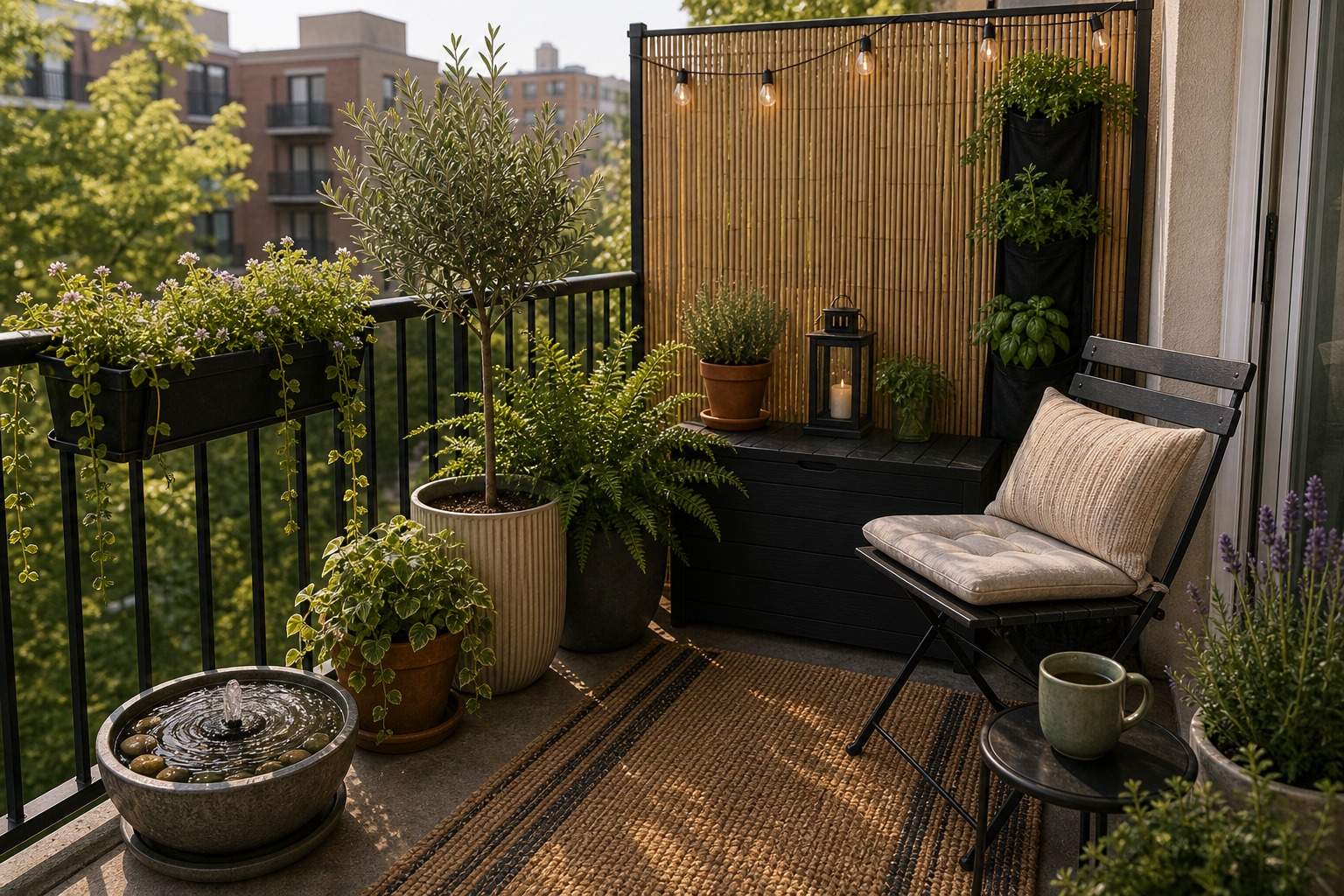
Once the table is up, one small plant does more for the space than a full collage of pots. A small tabletop bowl of moving water does the same job through your ears instead; small water features for an apartment balcony covers the sizes that suit a narrow ledge. If the corner still feels empty, ideas for a bare apartment balcony covers what to add without crowding a mount that is already carrying its limit.
Care and Maintenance for a Balcony Railing Table
- Wipe powder-coated steel down after rain so water does not sit in the seams around the mount.
- Oil an acacia slat top once at the start of the season and again mid-summer if it sees full sun.
- Check the hook-on lip, clamp bracket screw, or wall-mount anchors for looseness monthly during windy months.
- Fold the tabletop down on its folding hinge when you leave for more than a few days, especially before storms.
- Bring hook-on and clamp tables inside, or at minimum unhook them, before the first hard freeze if the mount is a lightweight alloy.
- Store a freestanding console against the building wall in winter rather than leaving it in the open on the floor.
Buy This One If
- Buy a hook-on rail table if your cap rail is flat, 1 to 2.5 inches wide, and you rent and want zero holes.
- Buy an adjustable clamp bracket if your rail is round tubing or thicker than a hook-on lip can grip.
- Buy a drop-leaf wall mount if you own the unit, or have written approval to drill, and want the highest load rating of the wall- or rail-based options.
- Buy a freestanding narrow console if you have 10 to 14 inches of floor depth to spare and want the sturdiest surface without touching the rail or wall at all.