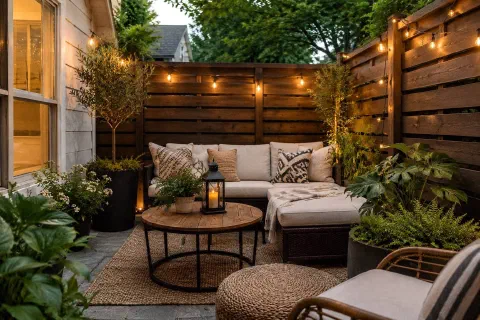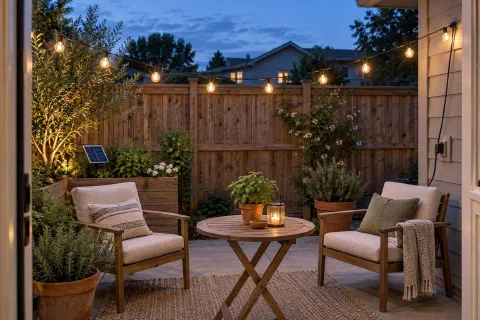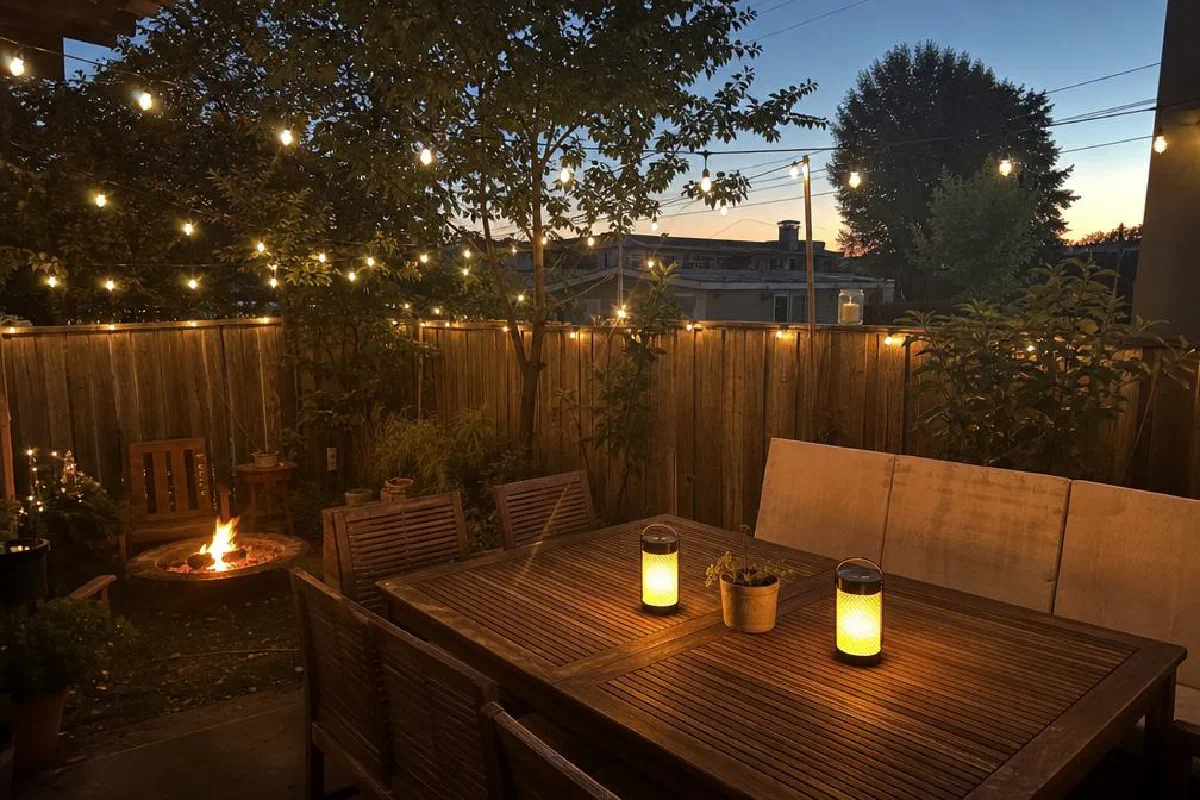
The single biggest mistake in backyard lighting is one bright overhead floodlight.
A backyard lit by one harsh overhead reads like a parking lot. The same backyard lit by 8-12 small warm light sources layered at different heights reads like a sanctuary. The trick isn’t more wattage, it’s more sources, lower, warmer, and aimed thoughtfully.
These eleven lighting layers work in any size yard. Most yards don’t need all eleven; even three or four chosen carefully transform the space. Warm white (2700K-3000K color temperature) is the single technical detail that matters more than any other.
Here is the whole plan on one screen before the detail. Find the rows your yard actually needs, then read those sections.
| Layer | Where it goes | Best for | Renter version |
|---|---|---|---|
| String lights overhead | House to a post, tree, or fence, above the seating | The main layer over the chairs | Posts set in heavy planters |
| Solar path lights | Along a walkway, 4-6 feet apart | The route back to the door | The same fixture, no wiring |
| Uplight under a tree | 18-24 inches from the trunk, aimed up | Canopy glow and depth | Solar spotlights |
| Table lanterns | On the dining or coffee table | Light at face height | Battery or rechargeable |
| Tiki torches | Around the seating perimeter, 8-10 feet apart | A flickering border | Stake-mounted, nothing fixed |
| Candles in mason jars | Fence rail, table edge, porch step | The cheapest layer on the list | Nothing to install |
| Edison sconces | The porch wall, front and back | How the house reads from the street | Swap the bulb, keep the fixture |
| Fence or wall uplights | Ground level, aimed at the back fence | Making the yard feel deeper | Solar spike lights |
| Hanging lanterns | Pergola or arbor crossbeams | The photographed look | Battery LED candles |
| Step lights | The side of each stair riser | Safety on steps and level changes | Solar step lights |
| One fire feature | 8-12 feet from the seating | The gathering point | A portable fire bowl |
1. String Lights Overhead
Warm white café-style string lights crossing the patio or hanging over a seating area are the single most-recommended backyard lighting upgrade.
Look for 2700K (warm white) bulb temperature, not multicolor, not cool white, not “daylight.” LED versions cost more upfront but last 10+ years; incandescent versions look slightly warmer but burn out within 2-3 seasons.
For a 10x12 patio: two 25-foot strands crossed diagonally cover it. For a 20x20 patio: four strands in a square. Anchor from the house to a sturdy post, tree, or fence. Use guide wire underneath the strand to prevent sagging in heat or wind.
2. Solar Path Lighting
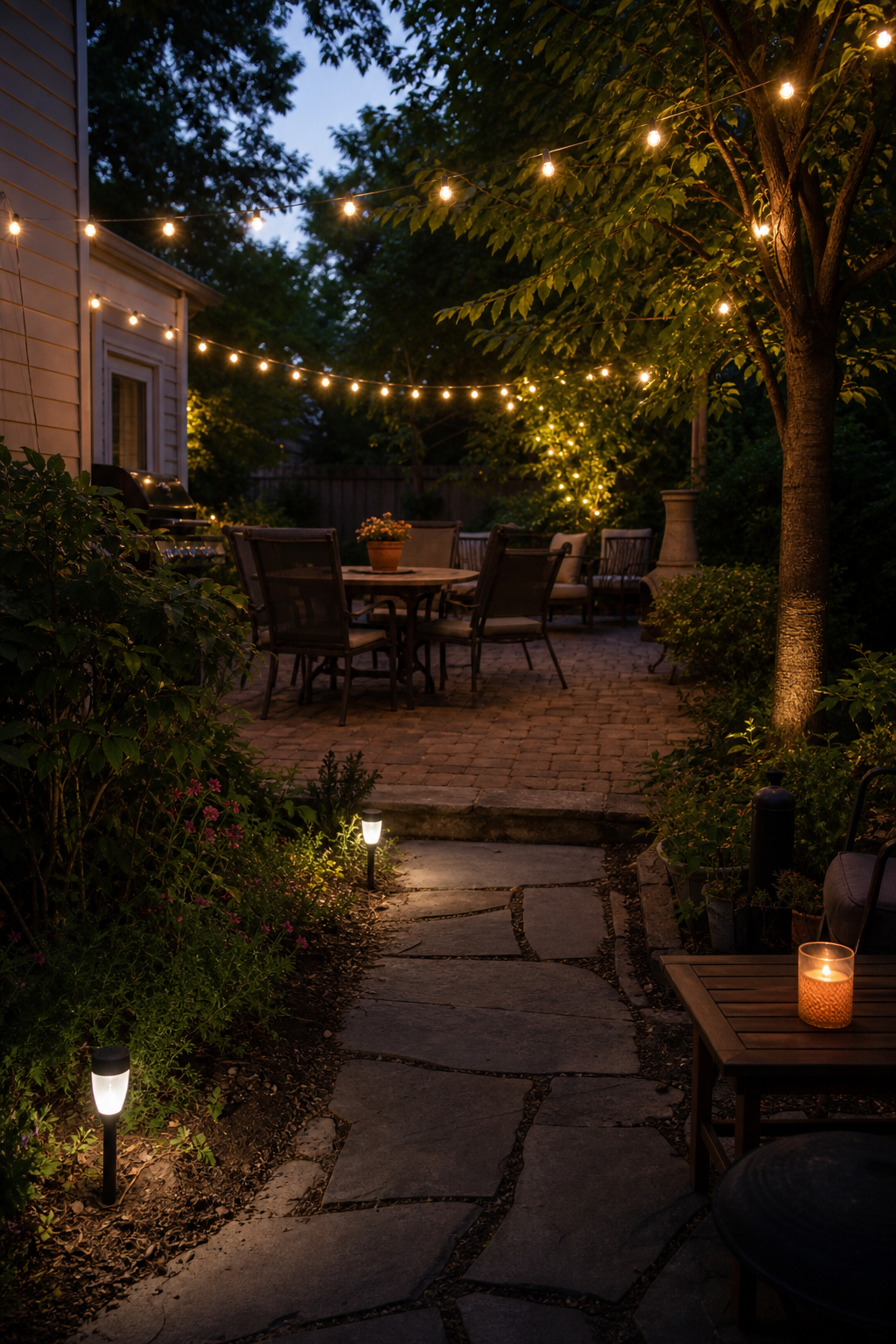
Solar stake lights along a path or walkway are the lowest-effort permanent outdoor lighting.
The good versions (look for “warm white,” not “cool white”) provide subtle ground-level glow without crossing into landing-strip territory. Space stakes 4-6 feet apart along the path. Six lights cover a typical 24-foot path.
Avoid the cheapest solar path lights, the batteries die within a season. Look for solar lights with replaceable AA NiMH batteries; those last 3-5 years.
3. Uplighting Under a Tree
A small ground-level spotlight aimed up into a mature tree from below creates dramatic ambient light without putting any direct light at eye level.
LED outdoor spotlights with warm white bulbs at around 5-10 watts work well. Place 18-24 inches from the trunk, aimed upward through the canopy. The light bounces off the leaves and creates a soft halo effect.
One uplight per major tree. Two or three uplights across a backyard with mature trees creates more atmosphere than any other single upgrade.
4. Lanterns on the Table
Solar or battery-powered table lanterns in warm-glowing styles (rather than bright direct LED) anchor the dining or coffee table.
Real candles in a hurricane lantern or a beeswax pillar candle on a glass plate work too. For households with kids or pets where open flame is a concern, battery-powered flickering LED candles in a glass lantern give a similar effect.
One or two lanterns per table is enough. Three or more starts to read cluttered.
5. Tiki Torches at the Perimeter
Tiki torches with citronella oil double as ambient lighting and mosquito repellent.
Standard bamboo tiki torches at 5-6 feet tall, spaced 8-10 feet apart along the perimeter of the seating area, create a warm flickering border. Citronella oil keeps the mosquito count down within their burn zone, about a 6-foot radius per torch.
Use the longer-burning oil refills (some last 8 hours per fill) for evening parties. Always extinguish before going inside.
6. Candles in Mason Jars
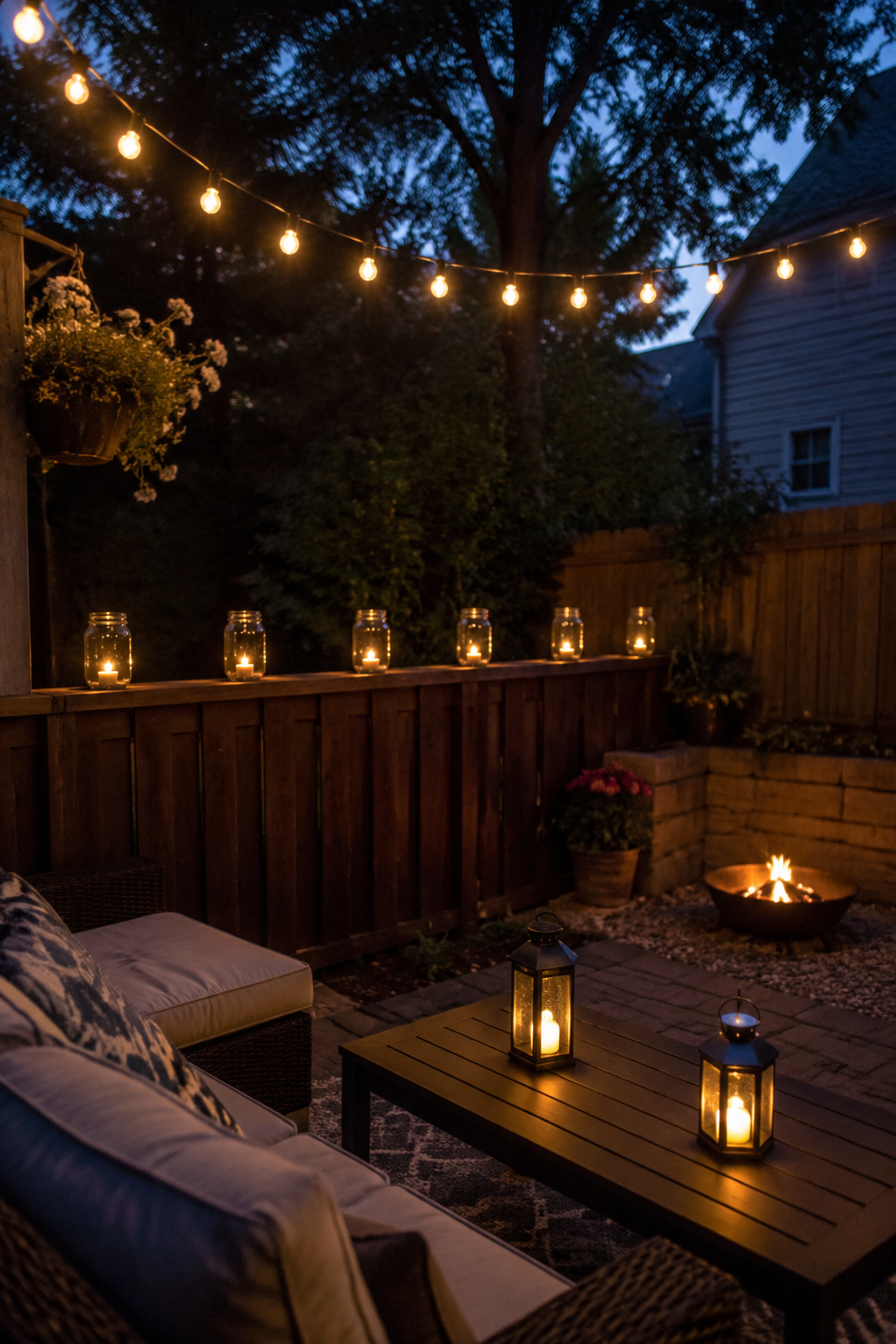
The cheapest and most beautiful evening lighting layer is a candle in a glass jar.
Tea lights or small votives in clean mason jars, lined along a fence rail, a table edge, or a porch step, give a warm flickering effect that no LED can replicate. The jars protect the flame from light wind. Five to seven jars along a porch railing transforms an entry.
For longer evenings, use beeswax tealights, they burn 6-8 hours each, double the standard paraffin.
7. Edison Bulb Sconces on the Porch
Replace the standard porch light fixture with a real Edison-bulb sconce.
Edison bulbs (vintage filament style) give a warm amber glow that matches the rest of the layered lighting in a way that white-globe porch lights don’t. Wall sconces in oil-rubbed bronze or matte black with a single exposed Edison bulb are widely stocked and easy to swap. Replace both, front and back, so the house reads consistent from the street.
This is the single biggest improvement for the look of a porch at night. The default porch fixture is almost always wrong.
8. Uplighting on a Fence or Wall
Small LED spike lights aimed at a fence, a wall, or a hedge create a soft wash of light that pulls the eye outward and visually enlarges the yard.
LED uplights at 3-5 watts mounted in the ground, aimed at the back of a privacy fence or the side of the house, do this work. Warm white only. Two or three lights per fence section.
For renters or for non-permanent installs, solar versions of the same fixtures work, though the brightness is lower.
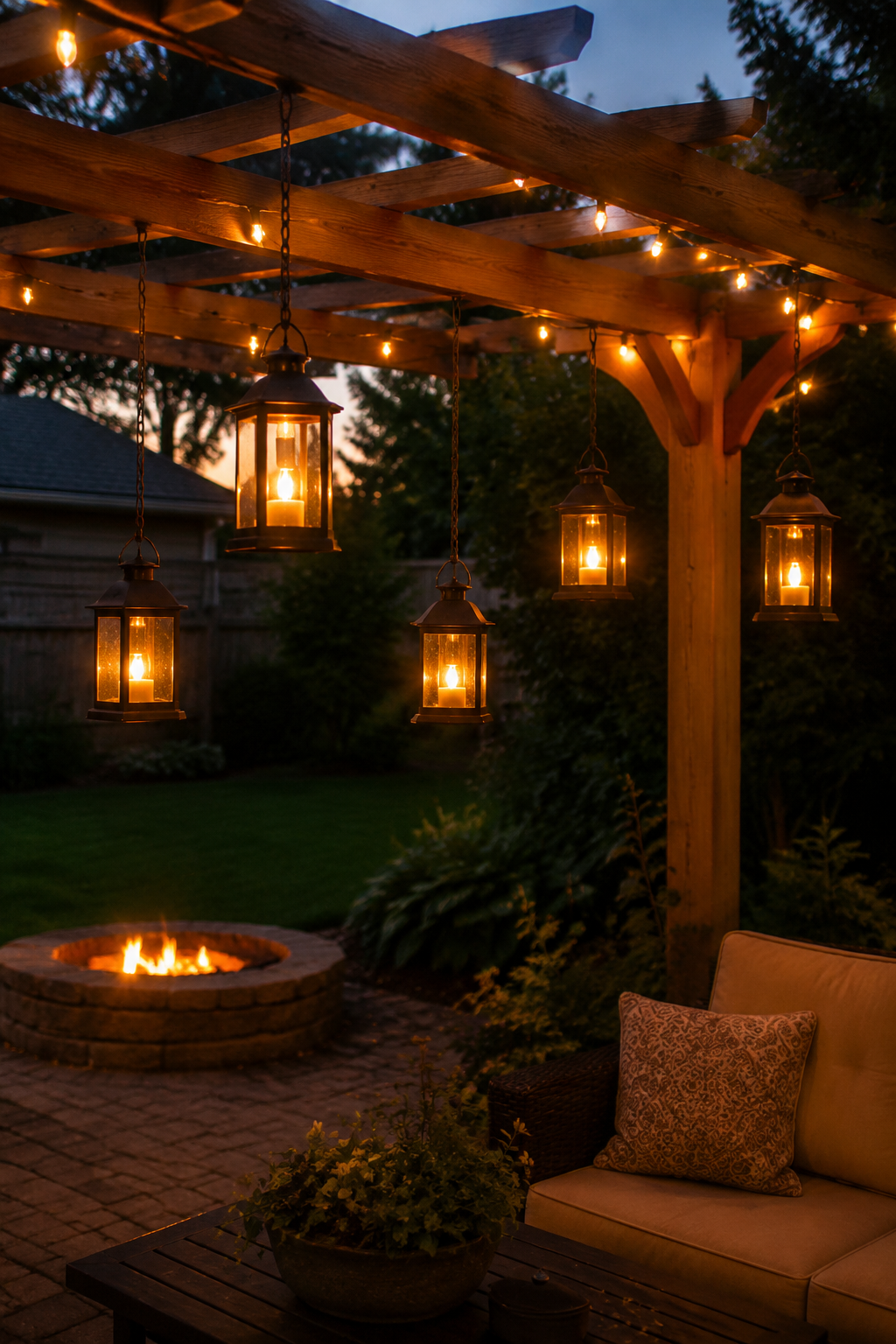
9. Hanging Lanterns from a Pergola
A pergola or arbor with hanging lanterns (real or LED) creates the most photographed backyard look on Pinterest, and for good reason.
Use lightweight metal or glass lanterns with battery-powered LED candles inside, hung from the pergola crossbeams with shepherd’s hooks or chain. Five to seven lanterns at varied heights creates the cascade effect.
For pergolas without proper electrical access, solar or battery lanterns do almost as well as wired versions, with the convenience of no wiring runs.
10. Step Lights
Small recessed lights along outdoor steps or stairs prevent missteps and add a subtle ground-level layer.
LED step lights wired into the side of a stair riser are the permanent solution. Solar step lights stuck to the side of an existing step are the renter-friendly version. Either way, one light per step for shallow runs, every-other-step for longer staircases.
Warm white only. Cool white step lights read like a strip mall.
11. A Single Fire Feature
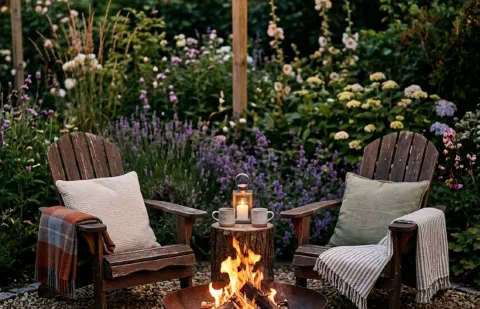
A fire pit, a fire bowl, or even a small propane fire tabletop element gives the backyard a natural gathering point and contributes the warmest light of any source.
The fire feature doesn’t need to be elaborate. A simple steel ring fire pit burning wood, or a propane fire bowl for an instant-on version, both anchor the evening. Place 8-12 feet from seating for warmth without overwhelming heat. Wherever it ends up, NFPA’s fire pit guidance keeps a pit at least 10 feet from anything that can burn and at least 3 feet from children and pets, so check both distances before you settle on the spot.
Add the fire feature last in any lighting plan. It pulls focus and changes how the rest of the lighting needs to work.
Light is one layer of an evening outside. Sound is the other, and patio speakers built to live outdoors handle it better than carrying an indoor speaker onto the table and back.
Which Color Temperature to Choose
All outdoor evening lighting should be 2700K or warmer.
The usable band runs from about 2200K to 2700K. The low end is the amber of an old filament bulb, and it is the warmest light that still lets you see what you are doing. 3000K is acceptable. 4000K, the “natural white” most hardware stores stock by default, is too cool and reads as utility lighting. 5000K and above are wrong for any residential outdoor setting. The U.S. Department of Energy’s color temperature table lists 2,700K as warm and 4,100K as cool, and the applications it gives for each one are homes on the warm end and offices and showrooms on the cool end.
If a fixture’s bulb is too cool, the fix is usually a bulb swap, not a fixture replacement. Buy warm-white LED replacements for any cool-white outdoor fixture currently in the yard.
What Not to Do
A few specific things to avoid:
- One overhead floodlight as the sole lighting source. Reads like a parking lot. Even two layered lower sources beat one bright overhead.
- Multicolor string lights. Reads Christmas. Save them for December.
- Cool white bulbs (4000K+) anywhere outdoors at night. Reads commercial.
- Motion-sensor floodlights pointed at the seating area. Useful for security at side and back walls. Not for the patio itself.
- Solar lights that promise to be as bright as wired. They aren’t, and the disappointment makes the yard feel under-lit.
Weather Ratings, and How to Keep Fixtures Alive
The rating on the box tells you where a fixture is allowed to live, and it is the difference between a strand that lasts five summers and one that fails in October.
- Damp rated covers a porch ceiling, a covered patio, or anywhere under a solid roof. Splashes are fine, direct rain is not.
- Wet rated, usually IP65 or better, is what an open patio, a fence run, or anything in the lawn needs. Rain lands on it directly.
- In-ground and submersible, IP67 and up, is for uplights sitting in a bed that gets watered and path lights that end up in a puddle.
The connectors matter more than the bulbs. A strand sold as “indoor/outdoor” with no rating printed anywhere is an indoor strand, and the point it fails is the socket, not the glass. Solar fixtures are worth checking twice, since the battery compartment is the part that fills with water.
Give plug-in fixtures a drip loop as well: let the cord hang below the connection point so water runs off the low spot instead of into the plug.
Where to Start When the Yard Is Completely Dark
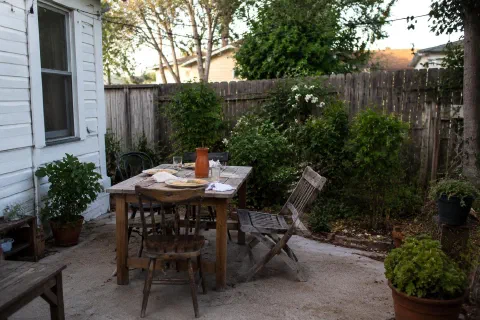
An unlit backyard is not a shopping problem, it is an order-of-operations problem. Work outward from where people sit.
- Light the seating zone first. One overhead layer, string lights or a pergola run, directly over the chairs. This is the layer that decides whether the yard feels finished, and on most patios it is the only one that has to be plug-in.
- Then light the walk to the door. Path or step lights, low, aimed down. This is safety, and it is what stops people from carrying a phone flashlight across the lawn.
- Then put one light on the table. A lantern, a candle, a rechargeable lamp. Light at table height is what people actually read faces by.
- Then push light to the edges. An uplight into a tree, or a wash on the back fence. Lit edges pull the eye outward and make the yard feel deeper than a lit middle ever will.
- Add the fire feature last. It changes the balance of everything else, so it should land on a yard that already works.
Height is what separates a layered yard from a lit one. Aim for something at ground level, something around table height, and something overhead. Three sources at three heights beat six sources all hung at the same line.
Keep the light beside and behind seating rather than in front of it, and keep bulbs out of the sightline of anyone sitting down. A fixture you can see the filament of from your chair is a glare source, however warm the bulb is.
If the space in question is a small patio rather than a full yard, the same layers apply at a smaller scale. Ten patio-sized versions of these ideas are worked out separately, including the lumen ranges each job needs.
Renting, or Working Around No Outlet
Most of the eleven layers above have a version that needs no wiring and leaves no holes.
Overhead string lights hang from posts set in heavy planters instead of anything screwed to the house, which is the approach in the string light guide . Path and step lights come in solar versions that press into soil. Uplights do too, though they run dimmer than wired ones and want a panel in real sun rather than in the pretty shady spot you would rather hide them in.
For the table, a rechargeable lamp or a battery lantern beats hunting for an outlet. For the fence line, adhesive hooks rated for outdoor use hold a strand without a single screw, and they come off when the lease does.
The one layer that genuinely needs an electrician is a wired low-voltage system with a transformer. Everything else on this list has a renter-friendly substitute.
FAQ
What color temperature should backyard string lights be?
2700K (warm white). It matches indoor incandescent lighting and reads warm against landscaping. Cool white (4000K+) feels harsh outdoors at night.
Are solar outdoor lights bright enough?
For ambient layering, yes, solar path lights and solar lanterns provide enough soft glow to function. For task lighting (reading on the patio, cooking on the grill), wired LED is necessary because solar can’t sustain high lumens.
How many string lights do I need for a patio?
Roughly 1 linear foot of string lights per 1 square foot of patio. A 10x12 patio (120 sq ft) needs about 100-150 linear feet of string lights, or two 50-foot strands crossed diagonally.
What to Read Next
- The 4th of July backyard setup you can do in one afternoon is the daytime version of the same yard, and it plans the evening lighting in with the rest of the setup.
- Backyard BBQ zones for a crowd is where these layers matter most, since the cook, drink, and eating zones all need their own light after dark.
- Summer porch decor, six light and relaxed layouts carries the same warm-bulb thinking onto the porch, where the front of the house is what the street sees.
- A backyard Belmont Stakes party runs into the evening, so the viewing and seating plan is worth reading alongside this one.