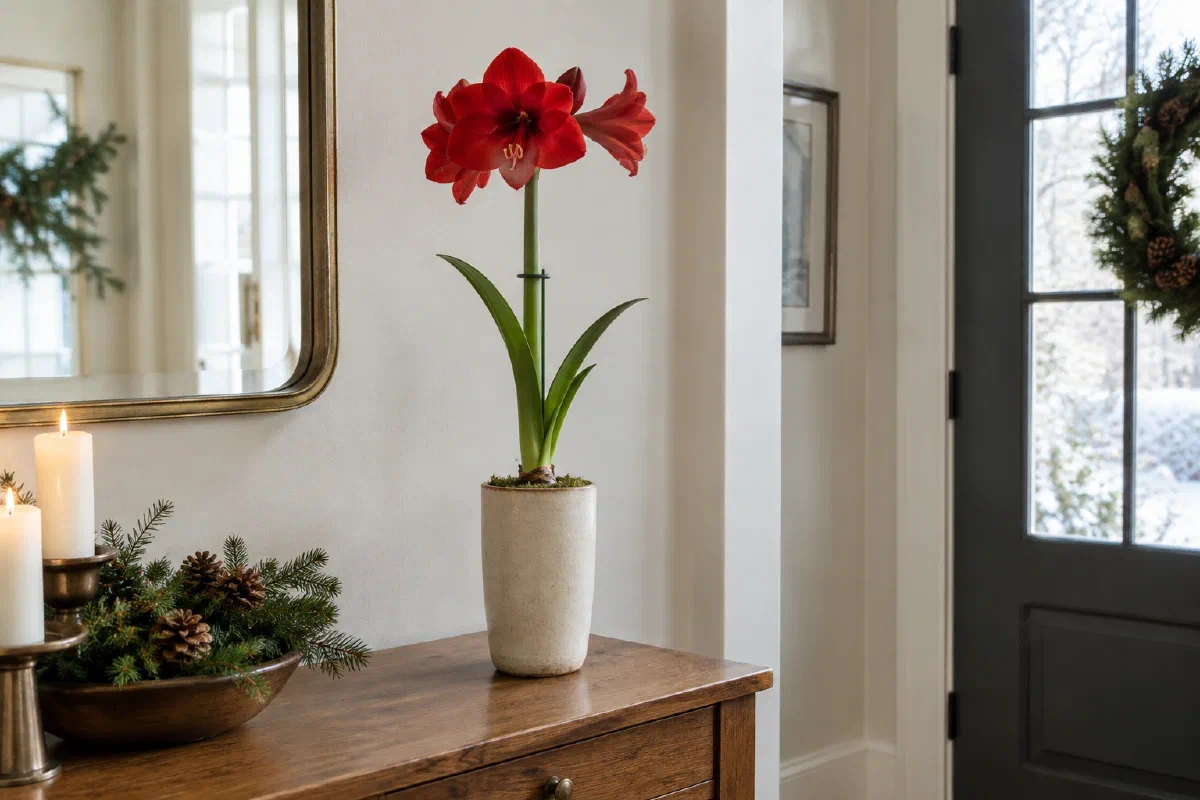
The easiest amaryllis arrangement is one bulb in a heavy pot you like, set where you will see it from your chair. For a fuller look at Christmas dinner, cut a few stems and stand them in a tall glass vase with eucalyptus or cedar. Both work, and the choice mostly comes down to timing: a bulb potted in early to mid-November flowers around Christmas, while cut stems from a florist are ready the day you bring them home. Here are eight ways to do each, and the care that keeps them looking good into January.
1. One red amaryllis in a heavy stoneware pot
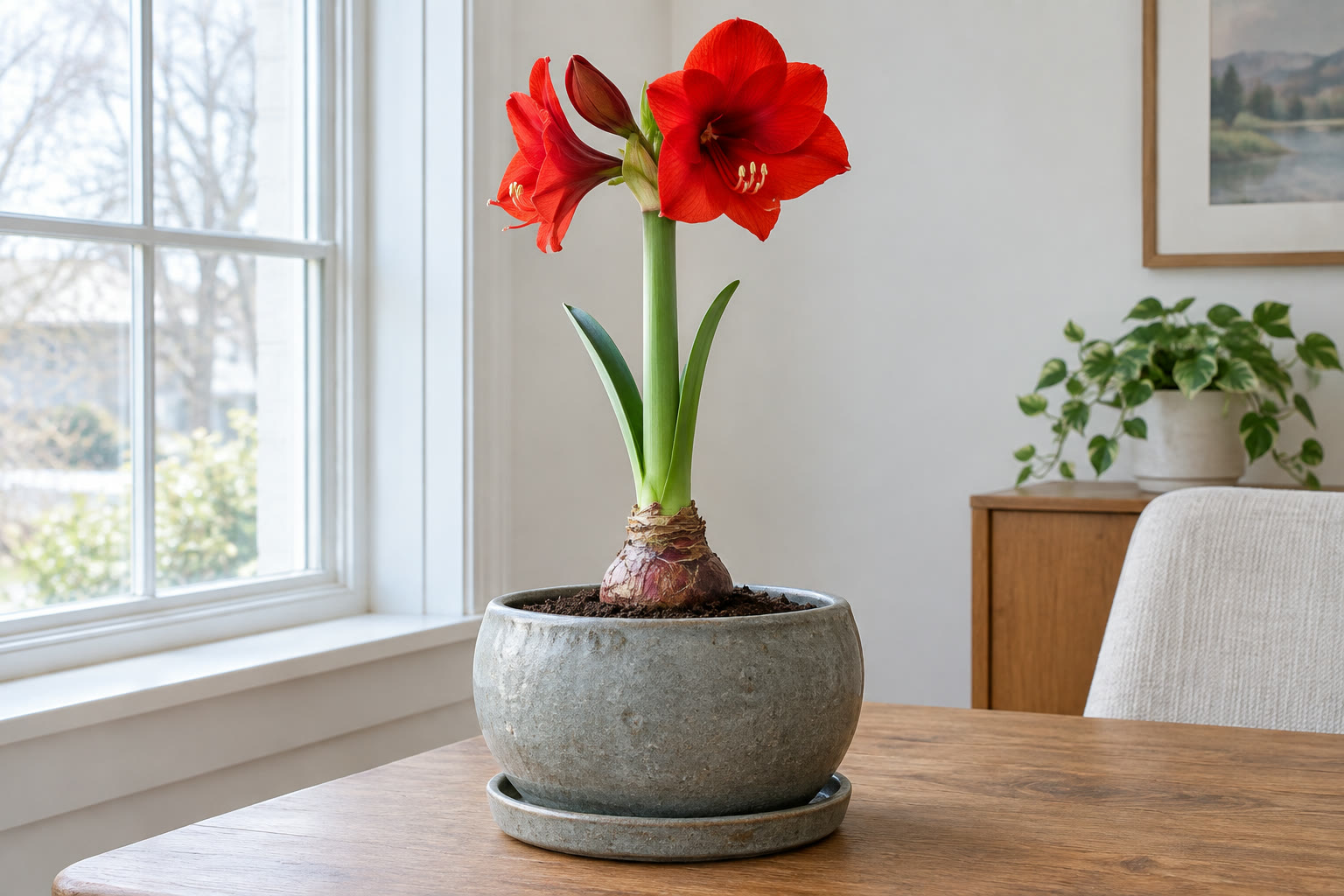
This is the classic. One bulb, one heavy pot, and a spot on a hall table, a console or a windowsill where the red can be seen from across the room. Set a candle beside it, and a bowl of pinecones or any conifer cones from the yard, and you are done.
If you are starting from a bulb, a kit with the pot, saucer and soil makes it simple. We earn a small commission if you buy through the Amazon links on this page, at no extra cost to you. The Red Lion amaryllis growing kit (opens Amazon in a new tab)As an Amazon Associate, we earn from qualifying purchases. Full disclosure. has a big red bulb, a plastic pot and soil, and you can slip it into a prettier pot you already own as long as it has a drainage hole.
Pick a pot about 1 to 2 inches wider than the bulb, and let the top half of the bulb sit above the soil. A heavy pot helps because the flowers are top-heavy. Turn the pot a little each day while the stalk grows so it climbs straight, and slide a thin stake in beside it if it starts to lean.
2. A red-and-white trio in mismatched pots
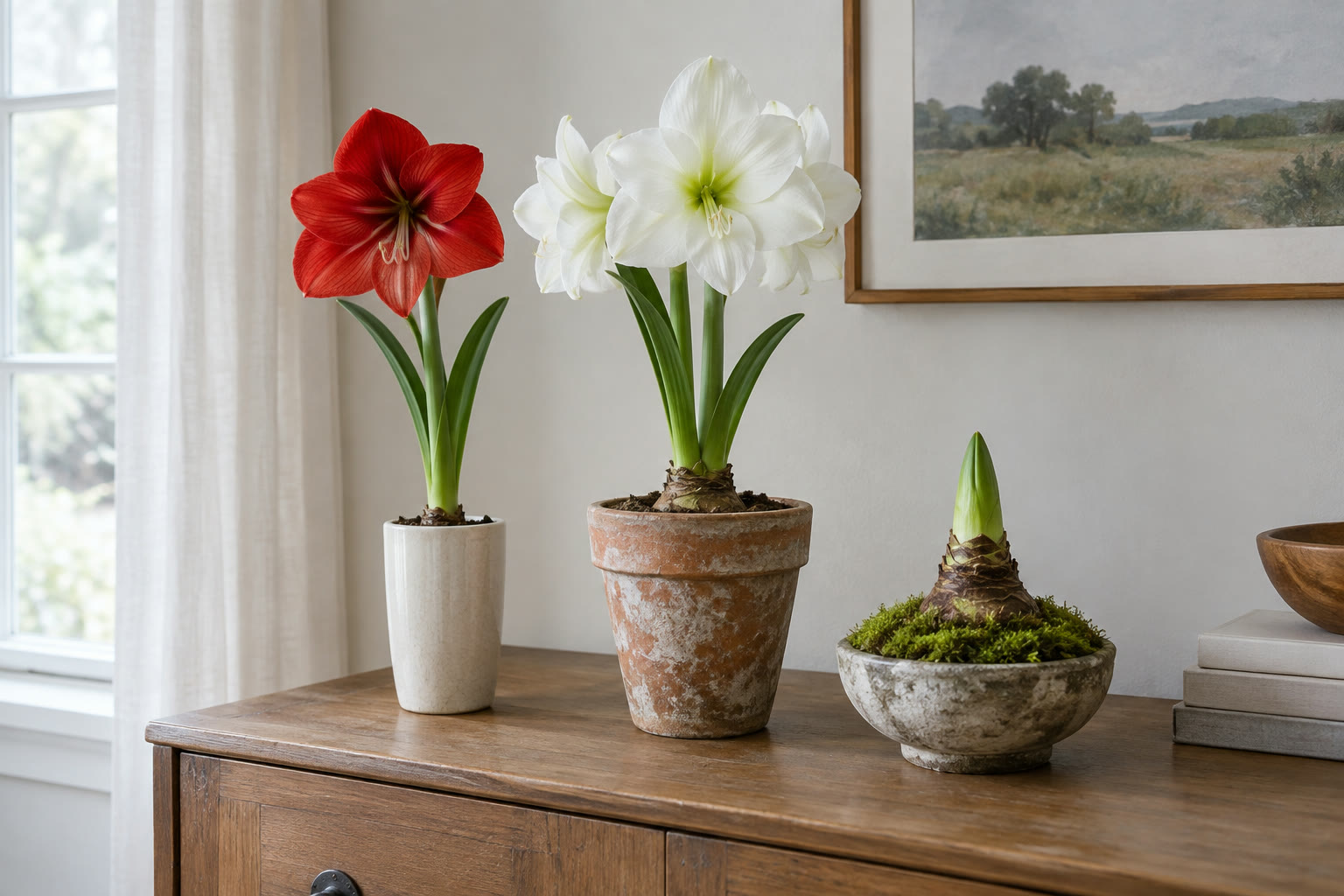
Put a red bulb, a white bulb and one that has only just sprouted in three different pots and line them up on a sideboard. Bulbs open on their own schedule, so a group gives you a little something new every week and covers for the one that is slow. Red and white are the classics, though salmon and pink are lovely too. Keep the pots in the same family of colors, such as terracotta, cream and stone, so the group looks chosen and not random.
Don’t count on all three flowering on Christmas Day. If the date matters, buy one that is already in bud. More on that below.
3. White amaryllis in a cream bowl
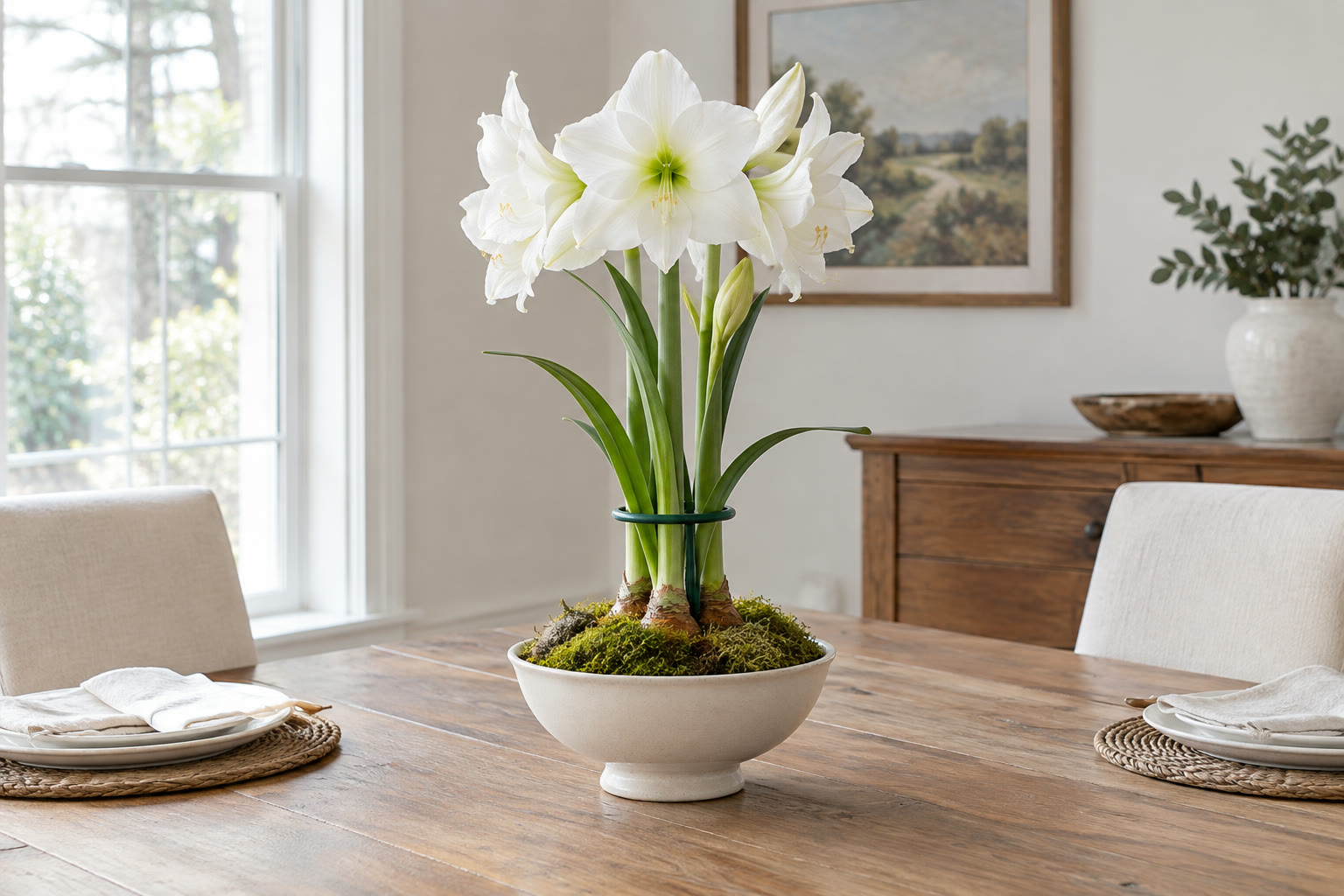
Three white bulbs in a wide cream bowl, with moss tucked over the soil, make a quiet centerpiece for a light room. Pot the bulbs in a nursery pot with drainage and set that inside the bowl, so water has somewhere to go and you can lift it out at the sink.
Check the height before dinner. A low bowl does not make the stalks any shorter, so if the flowers block the view across the table, move the bowl to the sideboard while you eat.
4. Waxed bulbs on a tray with fairy lights
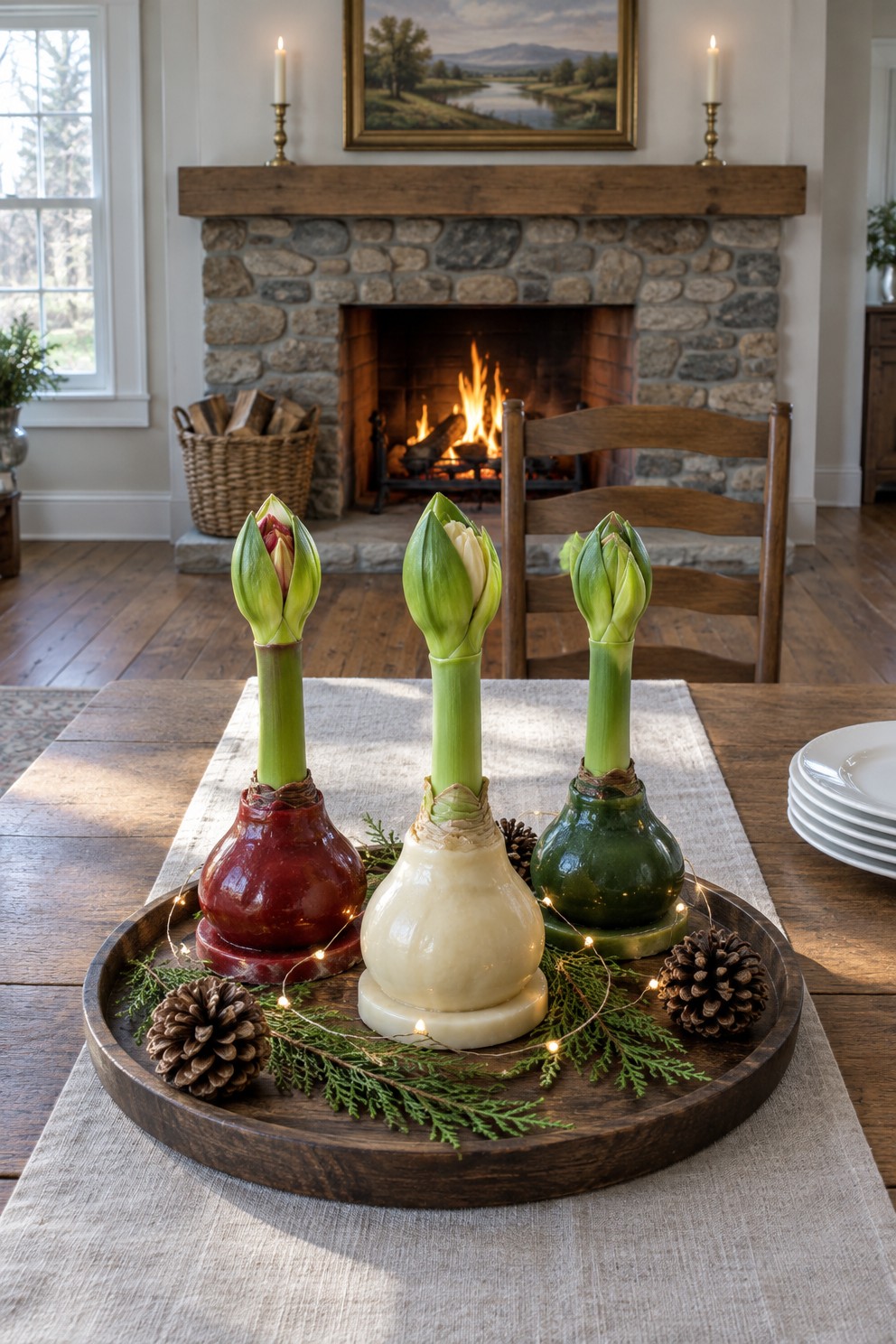
Waxed bulbs need no pot, soil or water, which makes them the easy pick for a tray centerpiece. Stand three of them together, wind a strand of battery fairy lights through, and add a few cedar sprigs and pinecones. A waxed red amaryllis with a stand (opens Amazon in a new tab)As an Amazon Associate, we earn from qualifying purchases. Full disclosure. arrives ready to set out on a table.
Waxed bulbs bloom once, then you toss them. More on how they differ from loose bulbs is in the waxed section below.
5. A potted amaryllis in a woven basket
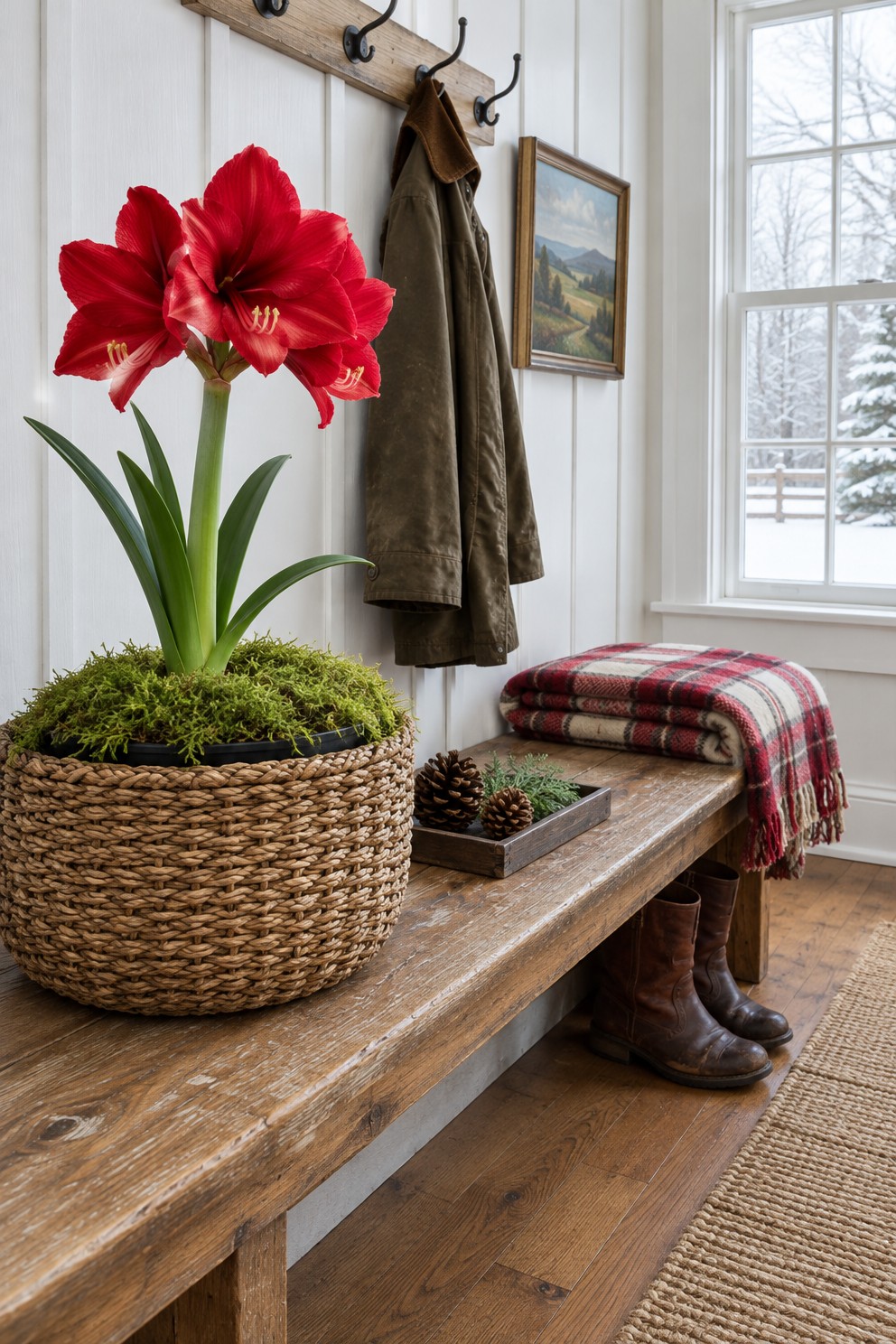
A low woven basket warms up a plain plastic nursery pot and suits a bench, a hearth or a kitchen counter. Leave the plant in its own pot with a drainage hole and set the pot inside the basket with a saucer under it. Tuck moss around the rim, and put the pinecones and a sprig of cedar on a tray beside it so you can still see the soil.
Lift the pot out to water at the sink, let it drain, then set it back.
6. Cut amaryllis in a tall clear vase with eucalyptus
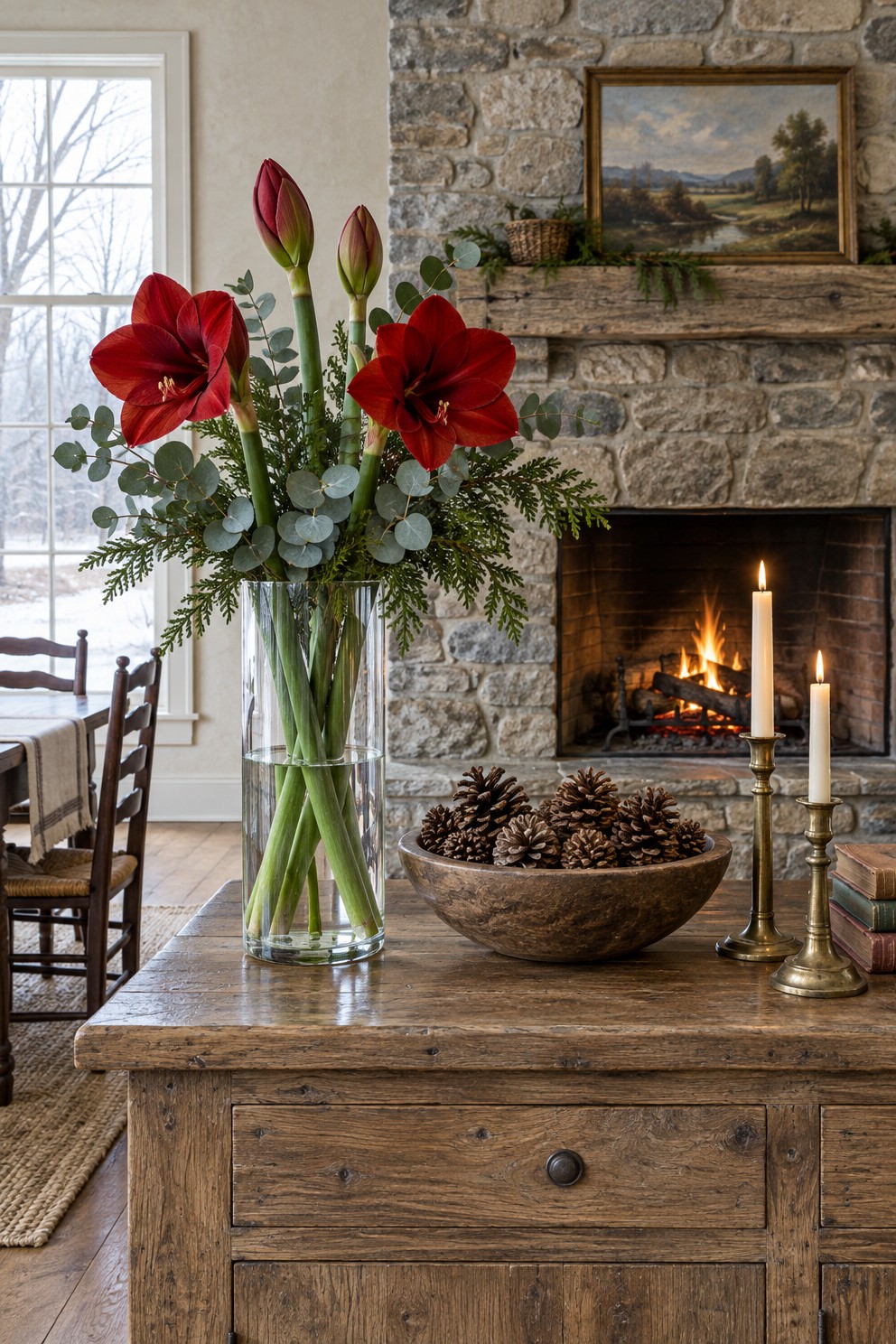
Three to five stems at different heights in a tall glass cylinder look like a florist’s window and take very little time. Add silver dollar eucalyptus or a few cedar tips low in the vase so the green stems are covered and the red flowers stand above them. Clear glass shows off the long stems, and a thick, heavy vase keeps the tall stems from tipping it over.
A heavy 12-inch glass cylinder like the WGV thick glass vase (opens Amazon in a new tab)As an Amazon Associate, we earn from qualifying purchases. Full disclosure. (about 12 inches tall and 5 inches across, per the listing) holds a small armful. Follow the steps below for cutting and supporting the stems.
7. Short cut stems in a low bowl with evergreens and berries
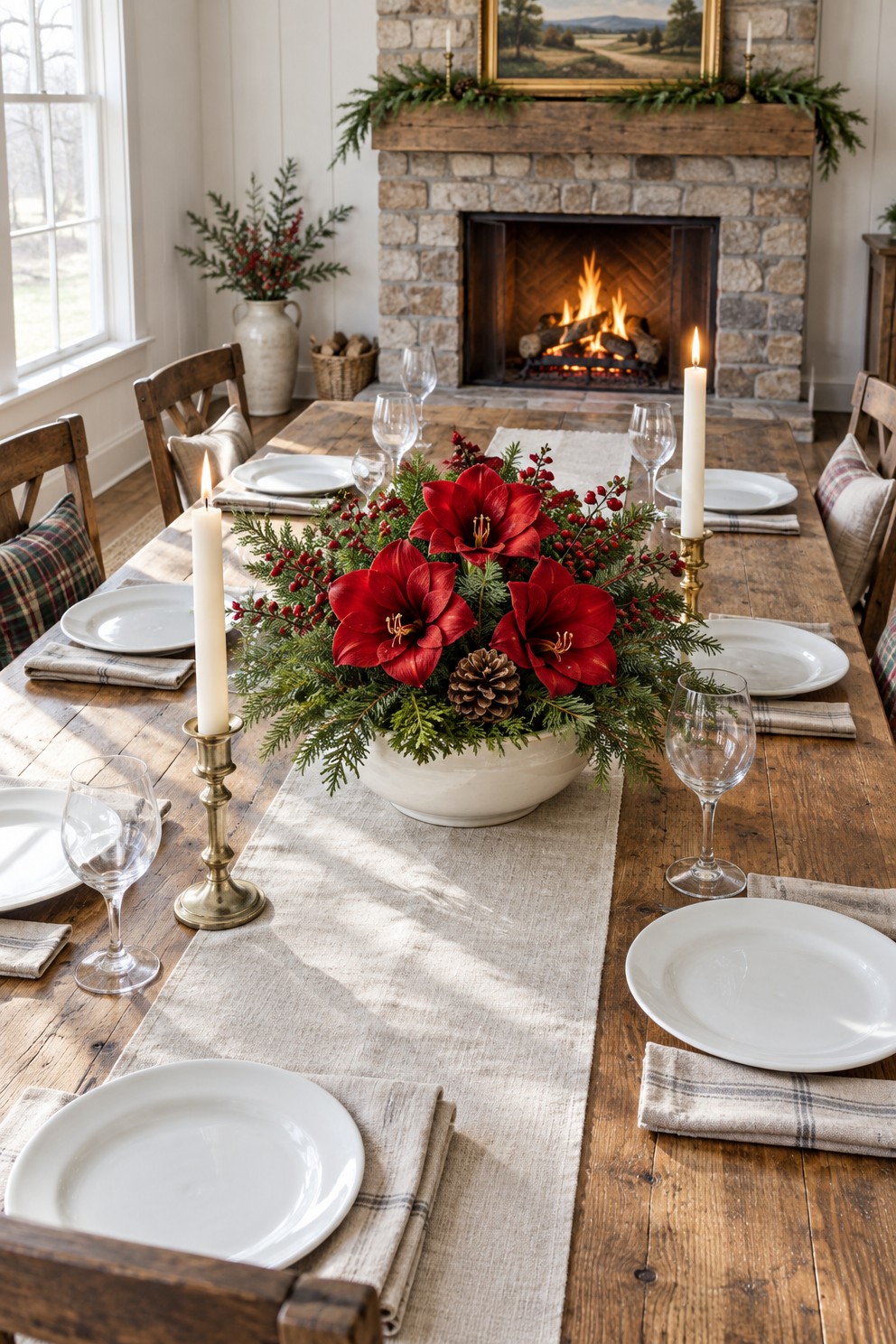
For the dinner table, cut the stems short and tuck the flowers low among evergreens. Build a nest of cedar, fir and holly or winterberry in a wide bowl first, then press the amaryllis in so the open flowers sit just above the greens. A pinecone or two finishes it.
This is the one to pick if people need to see each other across the table. For a fuller bouquet-style flower arrangement, mix in white roses, tulips or hydrangea. Magnolia leaves or a little fern make good greenery, and a few orchid stems or garland ends tucked in at the base look nice too. Designers often pair the big petals with berries and pinecones, which is why this one reads as Christmas without any ornaments.
8. A potted amaryllis as a host gift
A planted bulb in a sturdy pot with one ribbon around the outside arrives ready to enjoy and keeps flowering for weeks. Choose the color for the person, tuck in a note that says to water when the top of the soil feels dry, and add a saucer. A waxed bulb in a gift box is even easier for someone who forgets to water. The Christmas hostess gift guide helps decide when a plant is welcome.
Potted bulb or cut stems: which one should you pick?
Cut stems are instant. You buy them, put them in water and the flowers open within days. A potted bulb takes weeks, starts with green shoots, and gives you a plant you can keep and flower again next year.
Pick cut stems when you need flowers on a set date, such as dinner on the 25th, or for a low centerpiece. Pick a potted bulb for a windowsill, a gift or a display that should last a few weeks. Many people do both: a pot on the sideboard and a vase on the table.
When to pot amaryllis so it blooms for Christmas
Pot the bulb in early to mid-November for Christmas flowers. The timing depends on where the bulb was grown. South African bulbs usually bloom 3 to 5 weeks after potting, and Dutch bulbs 6 to 8 weeks, so counting back from December 25 puts Dutch bulbs at the end of October through mid-November and South African bulbs in late November.
Bulbs now come from both hemispheres, and amaryllis itself is native to South America. Bulbs grown in the Northern Hemisphere often flower later, between January and March. A January amaryllis is still lovely, and the same arrangements work then too. Keep the pot somewhere warm, about 70 to 75 degrees, until the stalk grows. When the buds begin to open, move it to a slightly cooler spot out of direct sun, about 65 to 70 degrees, and the flowers last longer.
If you want flowers on a particular date, buy a plant that already has buds. Bulbs vary, and no one can promise the day.
Waxed bulbs or loose bulbs?
Loose bulbs go in soil and take a little care, but you can keep them and bring them back year after year. Waxed bulbs need no water or soil. They flower from the energy stored in the bulb, with stalks showing in about 4 to 6 weeks, and set in bright, indirect light, turned every few days so the stalk grows straight.
The catch is that waxed bulbs are meant to be used once. They bloom for up to three weeks, then you throw them away. Skip any that have already sprouted or have a spent stalk, since they may not bloom for you. Remove the wax before composting.
How to arrange cut amaryllis in a vase
- Start with stems whose buds are puffy and soft but not yet open. They last the longest.
- Cut the stems at an angle with a sharp knife, supporting the hollow stem as you cut. Put them in water right away.
- Use a clean, tall, heavy vase and room-temperature water with a little flower food. Let the stems rest somewhere cool for a few hours before arranging.
- The stems are hollow and the flowers heavy, so slide a thin bamboo cane or dowel up inside the hollow plant stem to hold it straight. Measure it first. A pack of 12-inch bamboo plant stakes with ties (opens Amazon in a new tab)As an Amazon Associate, we earn from qualifying purchases. Full disclosure. works for this and for supporting a leaning potted stalk.
- If the ends split and curl, wrap floral tape or a rubber band around the base of the stem, then give it a fresh cut just below.
- Pull out the stamens when the flowers open. The pollen stains linens and clothing, so pull it off the way you would from a lily, and the flowers last a little longer without it.
- Keep the vase cool and out of direct sun and away from heaters.
How long do cut amaryllis last in a vase?
About two weeks, and sometimes up to three, if you change the water twice a week and recut the stems each time. Snip off each flower as it fades so the buds still to come get their moment.
What do you do with amaryllis after it has bloomed?
Cut the faded flower stalk off 1 to 2 inches above the bulb, but leave the leaves. Each long, strap-like leaf feeds the bulb for next year, much like any garden plant. Put the plant in a sunny window, water when the soil surface is nearly dry, and feed it every 2 to 4 weeks with a balanced plant food at half strength. In late spring, once nights are warm, you can set the pot outside in part shade for the summer.
Amaryllis is poisonous to cats and dogs, so keep the pot out of reach of pets.
How many times a year will amaryllis bloom?
Once a year, if you look after it. A bulb that blooms at Christmas can flower again the next winter when you give it a summer of leaves and a rest.
What triggers amaryllis to bloom?
A bulb that has stored enough food in its leaves, and then a cool rest. It needs about 8 to 10 weeks at 50 to 55 degrees, either by letting the plant go dormant and storing the dry bulb or by keeping the green plant in a cool, bright spot. Then bring it back to a warm room and water it.
Why does my amaryllis have leaves but no flowers?
Usually the bulb did not store enough food, which is a common gardening snag, so give it more light and feed it more often in spring and summer. Sometimes it missed the cool rest.
What do amaryllis flowers symbolize?
In the language of flowers, amaryllis stands for pride, determination and radiant beauty.
What to buy
We earn a small commission if you buy through these Amazon links, at no extra cost to you.
- Red Lion amaryllis growing kit (opens Amazon in a new tab)As an Amazon Associate, we earn from qualifying purchases. Full disclosure. ($$): a bulb, pot, saucer and soil in one box.
- Waxed red amaryllis with a stand (opens Amazon in a new tab)As an Amazon Associate, we earn from qualifying purchases. Full disclosure. ($$): no water, one bloom season.
- Thick 12-inch glass cylinder vase (opens Amazon in a new tab)As an Amazon Associate, we earn from qualifying purchases. Full disclosure. ($): for cut stems.
- 12-inch bamboo plant stakes with ties (opens Amazon in a new tab)As an Amazon Associate, we earn from qualifying purchases. Full disclosure. ($): for hollow stems and leaning stalks.
Related reading for the Christmas table
- Christmas planter ideas for indoors and outside connects the bulb display with other holiday pots.
- Paperwhites for Christmas: when to plant them and keep them upright covers another bulb display.
- Christmas centerpiece ideas compares flower arrangements with other ways to dress the table.
- Christmas hostess gift ideas for every kind of invite helps match a planted gift to the person.
- Winter home decor after the tree comes down offers places for a flowering plant after the holiday.
- Indoor Christmas plants covers 10 plants and how to care for them.