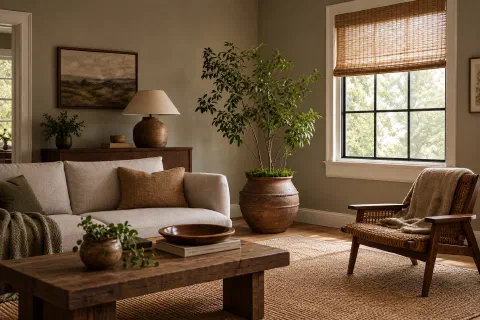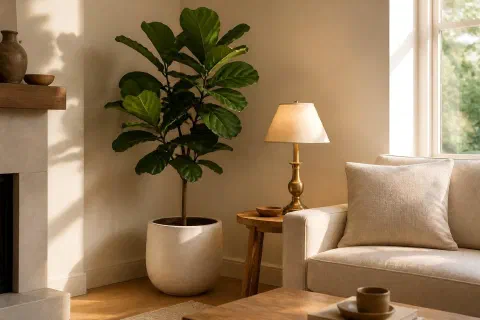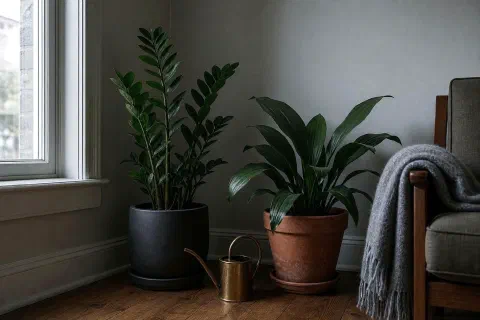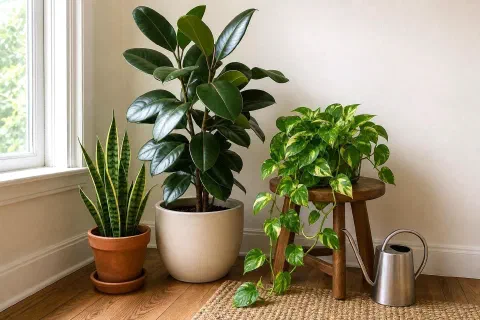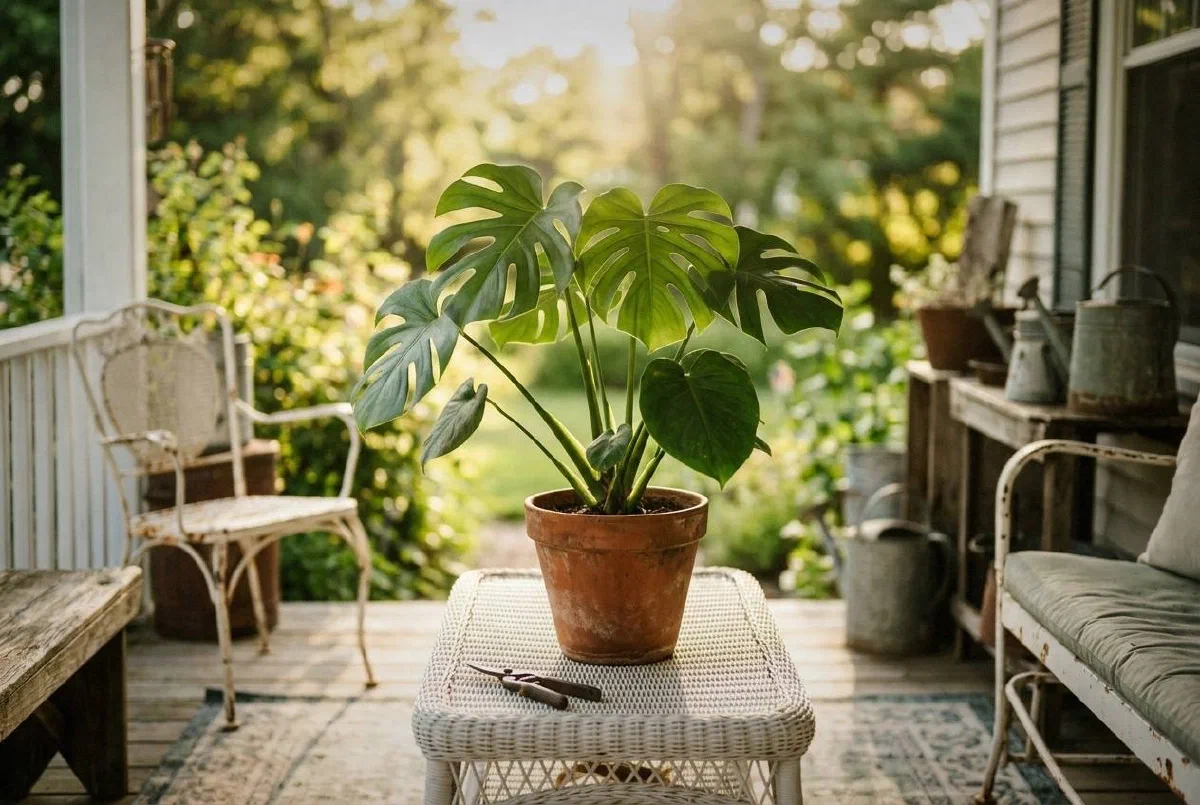
A living room with a few plants reads calmer than a living room without them.
The reason is simple. Plants soften hard edges, absorb sound at the leaf level, and give the eye somewhere to land that is not a screen. Done well, two or three plants can change the temperature of a whole room.
Done badly, plants become another chore. Yellow leaves, dropped leaves, soil bugs, watering schedules. The list below is built for living rooms that get average light, average humidity, and average attention. Each plant survives one missed watering and one wrong pot. None demand a grow light.
Here are all seven side by side, so you can match a plant to the corner you actually have before reading the care notes.
| Plant | Light it tolerates | Water | Rough size indoors | The one thing to know |
|---|---|---|---|---|
| Snake Plant | Low to bright indirect | Every 3-4 weeks | 2-4 feet upright | Rots in wet soil faster than it dies of drought |
| Pothos | Low to bright indirect | Every 7-10 days | Trails 4-8 feet | Roots from a cutting in a glass of water |
| Peace Lily | Low to medium indirect | When the leaves droop | 2-3 feet | Toxic to cats and dogs if chewed |
| ZZ Plant | Low to bright indirect | Every 3 weeks | 2-3 feet | Grows so slowly it stays put for years |
| Rubber Plant | Bright indirect | Every 7-10 days | 4-8 feet on a windowsill | Glossy leaves only stay glossy if you dust them |
| Spider Plant | Low to bright indirect | Every 7-10 days | 1-2 feet, trails | Brown tips usually trace back to tap water |
| Boston fern | Medium indirect | 2-3 times a week | 2-3 feet, trails | Wants 50% humidity or higher |
What Counts as Average Light in a Living Room?
Less than most people assume. Clemson’s Home and Garden Information Center puts the interior of a well-lighted home at often under 100 foot-candles, and sets 100 foot-candles as the minimum for low-light plants, with 75 to 200 preferred for good growth.
That number is worth having because your eye adjusts and a light meter does not. A corner that reads bright at noon can still measure in the low band, which is the band most of the plants below are chosen for. In the low band, expect slower growth and soil that stays wet longer, so water on the soil rather than on a calendar.
Treat every watering number below as a starting point rather than a schedule. Pot size, drainage, season, light, and the humidity in the room all change how fast the soil dries. Check the top inch or two with a finger before you water, and expect a plant in a dim corner to dry out more slowly than the same plant by a window.
Which Plant for Which Corner
Match the plant to the light you have, not the light you wish you had. This takes about a minute per room.
- A north-facing room or an interior corner with no window. Snake plant, ZZ plant, or pothos. These three are the only ones on the list that genuinely tolerate the low band.
- An east window with a few hours of morning sun. Peace lily, spider plant, or pothos. Morning light is gentler than afternoon light and these three handle it well.
- A bright room with a large window and no direct sun. Rubber plant or Boston fern. Both want more light than the first group and neither wants to be baked.
- A corner that catches hot afternoon sun. None of these. Direct afternoon sun scorches snake plant, bleaches ZZ, and crisps a fern within days. Put a sheer curtain there or choose a different corner.
- A shelf above a radiator or a heat vent. Skip it. Forced-air heat is what browns peace lily tips and dries a fern out between waterings.
1. Snake Plant (Sansevieria)
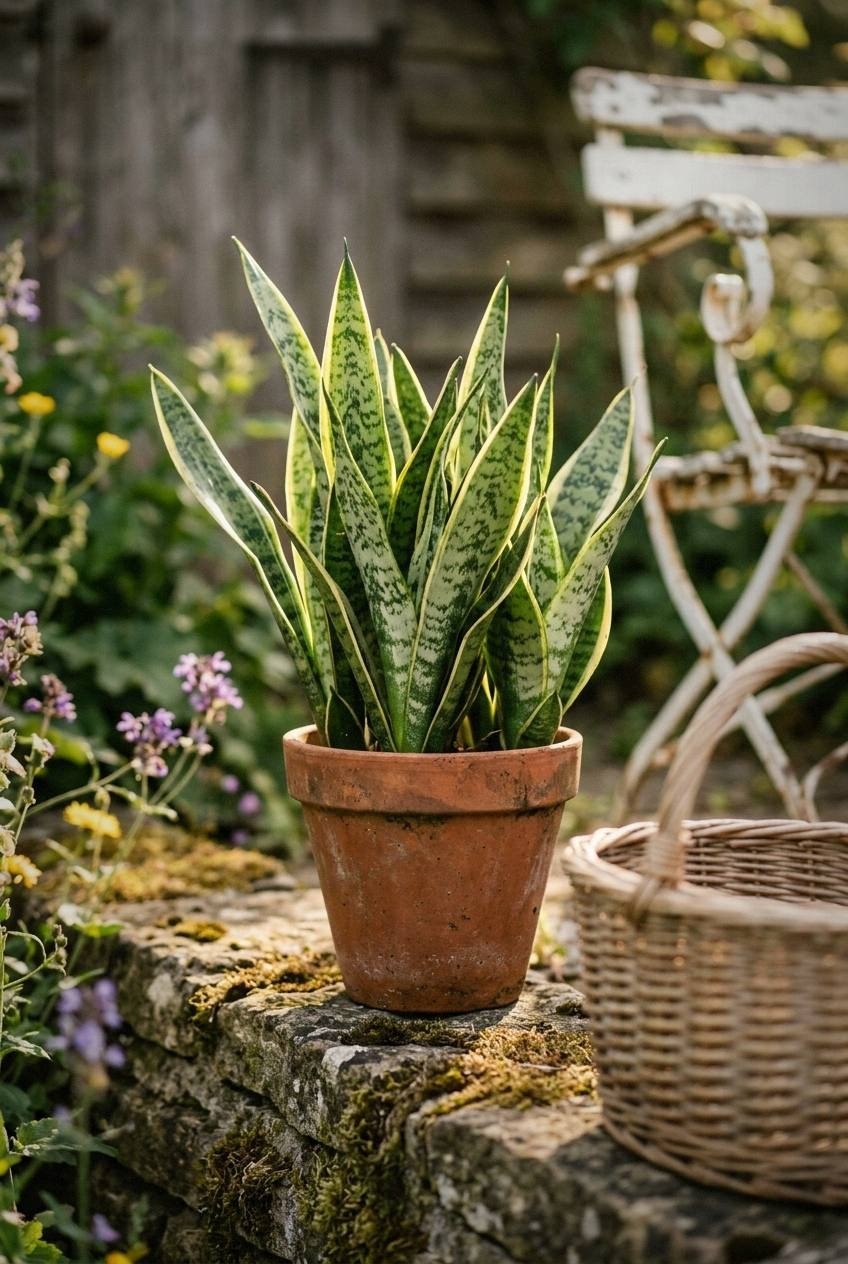
Snake plant is the plant that survives the conditions that kill other plants.
It tolerates low light, missed waterings, dry indoor air, and inconsistent temperatures. The upright leaves give a vertical line that breaks up the visual horizon of a couch and a coffee table.
Water once every 3 to 4 weeks, and only when the top two inches of soil are completely dry. Pick a pot with drainage. Snake plant rots in waterlogged soil faster than it dies of drought.
Place it in a corner that gets indirect light. A north-facing or east-facing room works fine. Direct afternoon sun in summer can scorch the leaves if it lands hot for hours.
Snake plant turns up on every air-purifying list because of a 1989 NASA chamber study. Those chambers were sealed and small, and later research found that ordinary air exchange in a building does far more than a reasonable number of pots. Grow it for the tolerance and the shape, not the filtration. The full story on what houseplants do and do not do for indoor air is worth ten minutes.
2. Pothos (Devil’s Ivy)
Pothos is the plant that grows in conditions where nothing else will.
The trailing stems hold up under low light, irregular watering, and dry rooms. Variegated golden pothos and marble queen pothos both produce green-and-cream leaves that brighten a dim corner without needing direct sun.
Water when the top inch of soil is dry. In a typical living room, that ends up being once every 7 to 10 days. The leaves droop slightly when the plant is thirsty, which is a useful reminder rather than a sign of distress.
Hang from a shelf, drape across a bookcase, or train along a wall. A pothos cutting roots in a glass of water within two weeks, which gives you a backup plant for free.
3. Peace Lily (Spathiphyllum)
Peace lily is the plant that flowers indoors when nothing else will.
The white spathe flowers appear in spring and again in late summer, lasting about a month each cycle. The dark green leaves stay glossy in low light, making it a good fit for a corner that gets two hours of indirect morning sun.
Water when the leaves start to droop slightly. The peace lily tells you exactly when it needs water by lowering its leaves, then perking up within a few hours of a thorough watering. Use room-temperature water, since cold tap water can shock the roots.
Avoid placing it near heat vents in winter. Dry forced-air heat causes leaf-tip browning. A pebble tray under the pot or weekly misting solves it.
Note: peace lily is toxic to cats and dogs if chewed. The ASPCA plant list names insoluble calcium oxalates as the cause, with mouth irritation, drooling, and vomiting as the usual signs. If pets nibble plants, keep this one out of reach.
4. ZZ Plant (Zamioculcas Zamiifolia)
ZZ plant is what to buy if you forget to water for two weeks at a time.
The waxy dark green leaves hold water in thick stems, so the plant thrives on neglect. It tolerates low light, dry air, and irregular care better than almost any other living room plant.
Water once every 3 weeks, and only when the soil is fully dry. Yellow leaves usually mean too much water, not too little. The ZZ wants to be left alone.
Place in indirect light, near a window or several feet from one. Direct sun bleaches the leaves. North-facing rooms and interior corners both work.
ZZ grows slowly. A 12-inch plant stays roughly that size for years, which makes it easy to keep in the same spot without it taking over.
5. Rubber Plant (Ficus Elastica)
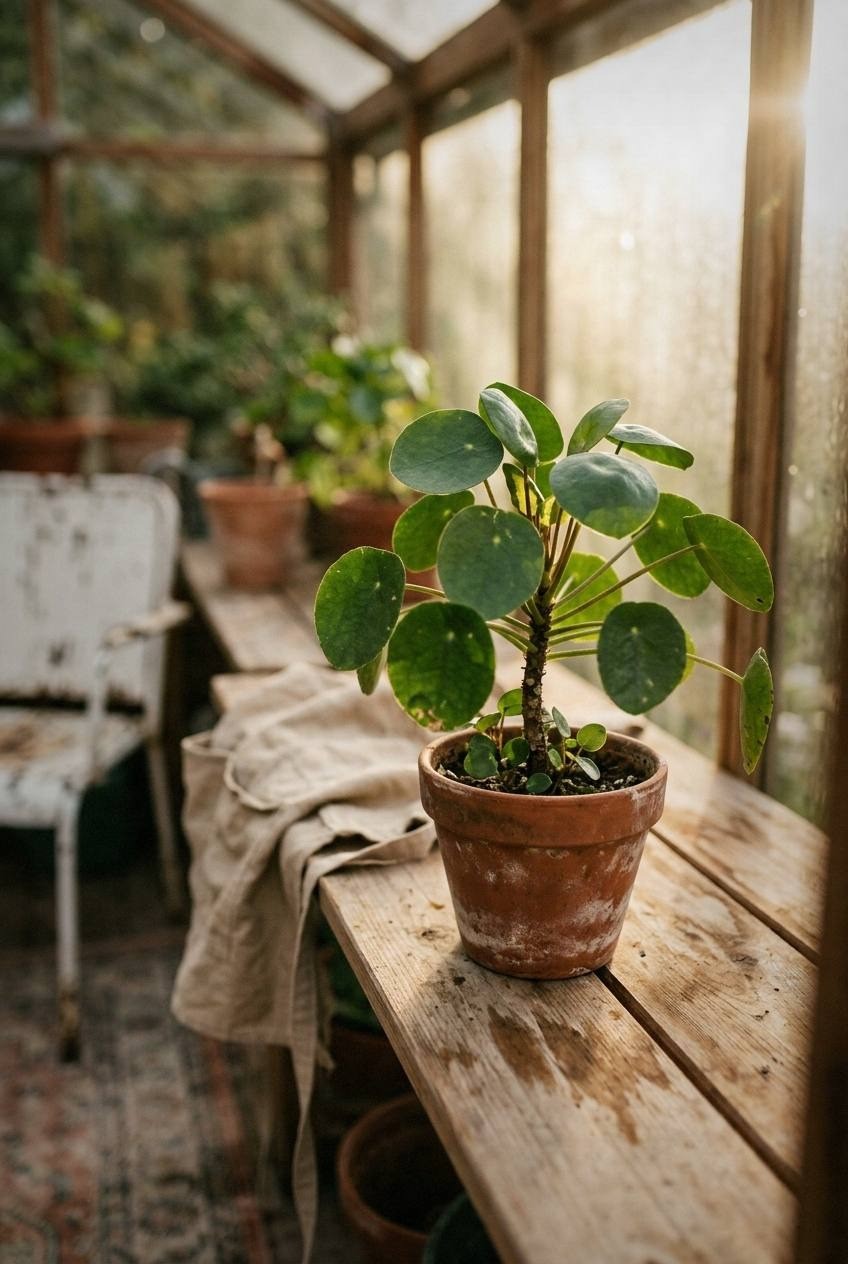
Rubber plant adds visual weight to a corner the way a piece of furniture does.
The large glossy leaves come in deep green, burgundy, or variegated cream. A 4-foot rubber plant in a 12-inch pot becomes a focal point in a living room corner, taking the place of a side table or floor lamp.
Water when the top 2 inches of soil are dry, usually every 7 to 10 days in summer and every 14 days in winter. The plant tells you it is thirsty by drooping the lower leaves first.
Wipe the leaves with a damp cloth once a month to remove dust. Glossy leaves stay glossy only if dust does not coat them. The wipe-down also lets the plant photosynthesize better, which keeps growth steady.
Bright indirect light is ideal. Direct afternoon sun causes leaf burn. East-facing windows work best in most homes.
6. Spider Plant (Chlorophytum Comosum)
Spider plant is the plant that makes baby plants for free.
The arching striped leaves trail over the edge of a hanging pot or a high shelf. By summer, mature plants send out long stems with small plantlets at the ends, which can be cut off and rooted in water to make new spider plants.
Water when the top inch of soil is dry. Spider plants tolerate inconsistent watering well. Brown leaf tips often mean too much fluoride or chlorine in tap water, which can be fixed by watering with rainwater or filtered water for a few weeks.
Place in indirect bright light. The plant tolerates lower light but produces fewer plantlets without enough sun.
Spider plant sits on the same NASA list, with the same caveat: sealed chamber, small scale. Its real strength is that it keeps going in ordinary room light and forgives a missed watering.
7. Boston Fern (Nephrolepis Exaltata)
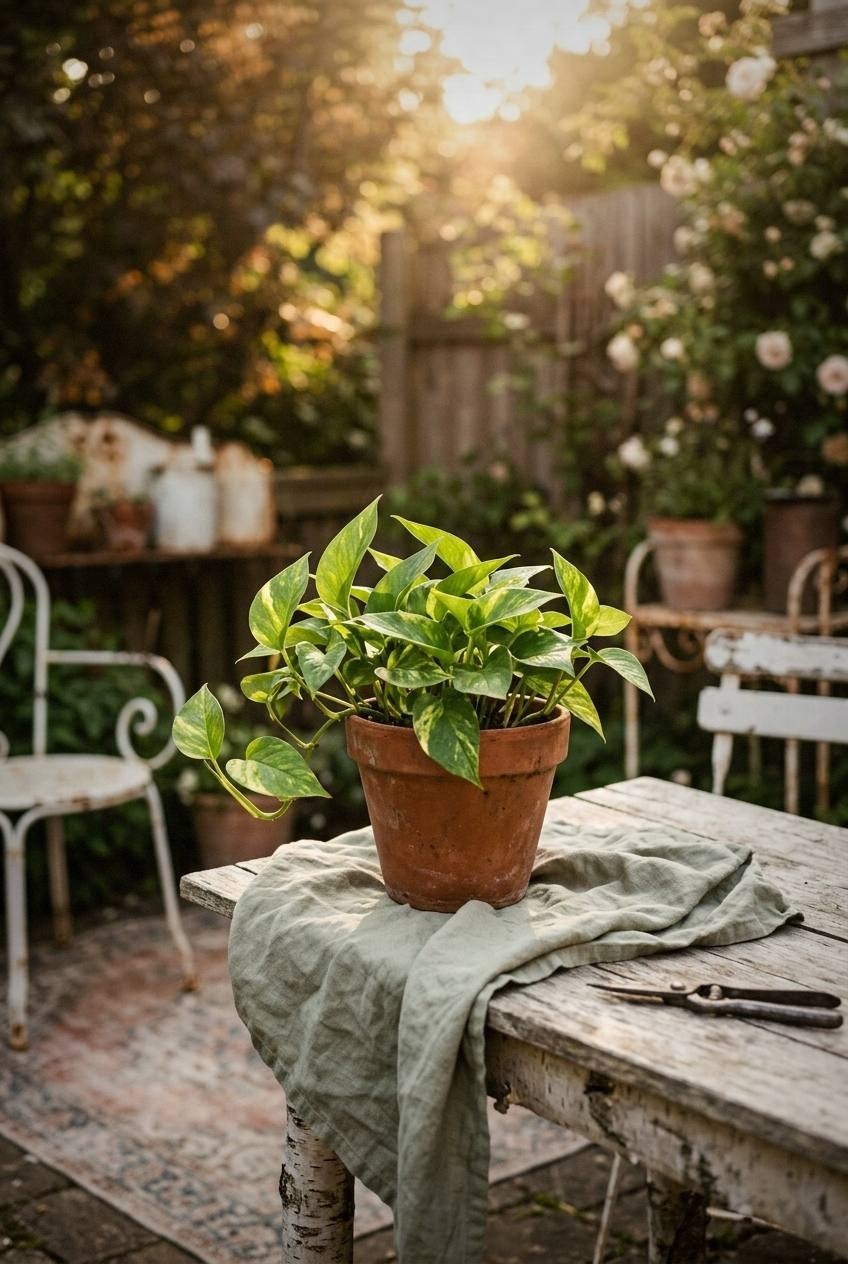
Boston fern is the most demanding plant on this list. It earns the spot because nothing else gives the same cascading texture.
The arching fronds drape from a hanging pot or stand, softening any room they live in. A healthy fern reads as lived-in and slightly wild in a way that no upright plant matches.
Water 2 to 3 times a week. The soil should stay consistently moist but never soggy. Boston fern drops fronds quickly when it dries out, then takes weeks to recover. A self-watering pot or a saucer with pebbles helps maintain consistency.
Mist the fronds twice a week, especially in winter when forced-air heat dries the air. Boston fern wants 50% humidity or higher, which is rare in most homes without help.
Place in indirect light, near a north or east-facing window. Direct sun crisps the fronds within days.
How to Water Without a Schedule
The plant does not know what day it is. These six steps replace the calendar.
- Push a finger into the soil to the second knuckle. Water only if it comes out dry at that depth.
- Lift the pot before you water. Get used to how heavy it feels when wet. A light pot is a thirsty pot, and the lift test works even on a big rubber plant.
- Water slowly until it runs into the saucer. One fast pour down the middle of the pot runs around the root ball instead of through it.
- Empty the saucer within the hour. Every plant on this list would rather dry out briefly than sit in water.
- Water less from November through February. Low winter light means slow growth and slow water use, even in a warm room.
- Write nothing down. Check the soil instead. A calendar cannot know that the heat came on this week.
Care That Keeps Them Going for Years
- Dust the leaves monthly. A dry microfiber cloth or a damp one both work. Dust blocks the light the plant is already short on.
- Rotate a quarter turn each time you water. Growth leans toward the window, and a quarterly turn keeps a tall plant from developing a permanent list.
- Keep leaves off cold glass in winter. A leaf pressed against a freezing pane can mark overnight.
- Repot only when roots show at the drainage hole. Moving a plant up too early leaves wet soil around roots that cannot use it.
- Feed sparingly, if at all, in winter. Slow growth cannot use the fertilizer, and the excess sits in the soil.
- Wipe up spilled water the same day. Water under a pot damages a wood floor and breeds fungus gnats in the saucer.
Mistakes That Kill a Living Room Plant
- Watering on a fixed weekly schedule. It is the single most common cause of a dead houseplant, and it kills by drowning rather than thirst.
- Leaving a pot without drainage in a decorative cachepot. The water has nowhere to go. Lift the inner pot out to water, then put it back once it has drained.
- Moving a low-light plant into direct summer sun to “perk it up.” It scorches. Move it closer to the window gradually instead.
- Repotting into a much larger pot. The extra soil stays wet, and the roots rot in the part they never reach.
- Ignoring a dropping leaf for a month. A droop is a signal. A crispy edge is a result.
What These Plants Have in Common
Each one tolerates typical living room conditions: indirect light, dry indoor air, and the watering rhythm of a household that has other things to do.
A calm living room is not the room with the most plants. It is the room with the right plants quietly doing their work.
Once there are more than a few, placement starts to matter more than the plant list. Grouping and siting them so the room still reads calm is the next thing to get right.
What to Read Next
- Simple living room plants that clean air year round because the air-purifying claim deserves a straight answer before you buy.
- Cozy reading nook ideas for small spaces if the plant corner is competing with the chair you actually read in.
- Brown living room decor in 8 layers for a palette that makes green leaves look deliberate rather than accidental.
- Warm color palettes for a cozy living room when the room feels cold and the plants alone are not fixing it.
- How to style tall indoor plants in a living room for the one corner where height matters more than another small pot.